The global conveyor system market hit $10.4 billion in 2024 and is projected to reach $14.8 billion by 2030, according to MarketsandMarkets. That growth isn't happening by accident.
Automated conveyors solve real problems: labor shortages, safety risks, slow throughput, and inconsistent handling that costs money every day it continues. This article breaks down what these systems actually are, how they work, the main types available, their biggest benefits, and where they show up across industries, including textile and apparel finishing lines.
Key Takeaways
- Automated conveyors move goods using motors, sensors, and controls
- Belt, roller, and chain conveyors serve different load types
- Conveyor automation boosts throughput and lowers long-term labor costs
- E-commerce and textile finishing rely on conveyors for production
What Is an Automated Conveyor System?
At its most basic, a conveyor system is a mechanical device that moves materials or goods along a fixed path within a facility. Think belts, rollers, or chains, all doing the physical work of transport so people don't have to.
What makes a conveyor "automated" is the addition of three things:
- Motors that power continuous or programmed movement
- Sensors that detect items, positions, and speeds
- Control systems (often programmable logic controllers, or PLCs) that run the whole operation without someone standing there flipping switches
That's the core difference between manual and automated setups. A manual conveyor still needs an employee pushing, lifting, or guiding items along. An automated one runs on programmed logic, executing the same sequence hundreds or thousands of times a shift without fatigue or inconsistency.
Automation Isn't Just Transport Anymore
Modern automated conveyors do more than move boxes from point A to point B. They can:
- Sort items by size, weight, or destination
- Weigh products in motion
- Route goods to different lines based on real-time criteria
- Trigger packaging steps automatically
Automation also exists on a spectrum. On one end, you've got a simple motorized roller section. On the other, fully integrated smart conveyor networks tied directly into a Warehouse Management System (WMS), making routing decisions based on live inventory data.
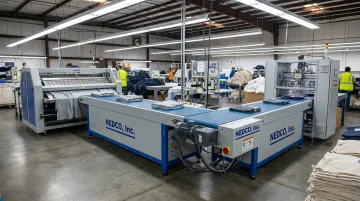
So can any conveyor type be automated? Pretty much, yes. With the right combination of motors, sensors, and controls, belt, roller, chain, and even specialty conveyors can all be automated. NEDCO's Automatic Conveyor System line is a good example on a smaller scale, engineered specifically to connect folding, labeling, and bagging equipment into one continuous, hands-free workflow.
How Do Automated Conveyor Systems Work?
Every automated conveyor, including the systems NEDCO engineers for textile and apparel lines, relies on the same four building blocks working together.
The transport surface carries the actual load. This is the belt, roller bed, or chain that physically moves items. Belts flex to handle irregular shapes; rollers support heavier or palletized loads; chains take on the heaviest industrial jobs.
Motors and drives provide the power. Variable frequency drives (VFDs) let operators fine-tune speed and torque by adjusting the electrical frequency feeding the motor. Rockwell Automation notes that matching motor speed to actual demand improves both energy efficiency and process control. That's a big reason VFDs show up on nearly every modern conveyor line.
Sensors and Controls Do the Thinking
Sensors are the system's eyes. Photoelectric sensors detect an item's presence, absence, or surface change, useful for catching jams or tracking product on the line. Inductive proximity sensors detect metal objects without any physical contact, common on lines handling machined parts.
The PLC ties it all together. Schneider Electric describes a PLC as an industrial computer that reads inputs, applies programmed logic, and controls outputs in a continuous scan cycle. In plain terms: it's the brain deciding when to start, stop, speed up, or redirect.
A simple sequence looks like this:
- A sensor detects an item entering the conveyor zone
- The control system logs the position and decides the next action
- The motor adjusts speed or triggers a routing gate
- The item moves to the next station, and the cycle repeats
Safety components run in parallel throughout: emergency stop buttons, physical guards, and interlocks that shut the line down the moment something's wrong.
Types of Automated Conveyor Systems
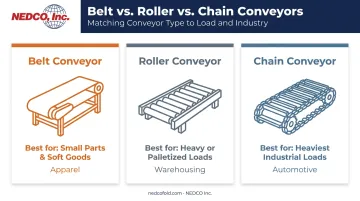
Three conveyor types cover the vast majority of material handling needs across industries. Each excels at a different job.
- Belt conveyors use a continuous belt looped over pulleys, making them the most versatile option for small parts and soft goods. NEDCO's own line runs on a variable speed belt drive built for apparel like t-shirts and sweatshirts.
- Roller conveyors move items across gravity-fed or powered rollers, making them the top choice for heavier or palletized loads. MHI identifies live roller conveyors as the most common conveyor style found in warehouses.
- Chain conveyors use driven chains to move heavy unit loads like pallets and containers. Automotive plants rely on them for body panels weighing several tons.
Specialty Conveyors Worth Knowing
A handful of niche types serve specific materials or spaces:
- Screw conveyors move bulk powders or granules through an enclosed helical tube, common in food and pharma
- Pneumatic conveyors push materials like plastics or pellets through piping using air or vacuum pressure
- Overhead conveyors suspend loads above the floor, freeing up ground space in busy assembly plants
- Bucket conveyors lift bulk materials vertically, often seen in cement and mining operations
Choosing between them comes down to product weight, shape, throughput demands, and how much floor or overhead space you actually have to work with.
Key Benefits of Automated Conveyor Systems
The case for automating a conveyor line rests on four pillars: speed, safety, cost, and scale.
Efficiency and throughput. Automated lines simply move more product with less friction. Hytrol's Monoprice case study cited a target jump from roughly 300 to 1,000 orders processed per hour after installing automated material handling equipment.
Broader warehouse-automation retrofits have delivered similarly dramatic results, including a McKinsey-documented case where a grocery distributor saw 4x productivity gains after upgrading its systems.
Workplace safety. Removing repetitive lifting, bending, and carrying from a worker's day reduces the wear and tear that leads to injury. An MHI EASE Council case study on portable conveyors reported fewer injuries and less fatigue after cutting manual handling steps, even without a precise injury-reduction percentage attached.
Cost savings and accuracy. Fewer manual touches mean fewer errors and less product damage. Combined with reduced dependence on manual labor, this adds up to a stronger long-term return on investment.
Scalability. Modular conveyor sections can be added, removed, or reconfigured as a facility grows.
NEDCO's CV-100 model, for instance, is built for small operations just starting to automate, while the CV-500 scales up to high-volume, continuous production. Both use the same modular philosophy, letting a business start small and expand without replacing the whole system.
Industries & Real-World Applications
Automated conveyors show up almost everywhere goods need to move quickly and consistently.
E-commerce and warehousing. Global parcel volume hit 161 billion parcels in 2022, with Pitney Bowes forecasting 225 billion by 2028. That kind of volume simply isn't manageable without high-speed automated sorting and fulfillment lines.
Food, beverage, and pharma. These industries need sanitary, temperature-controlled transport that meets strict regulatory standards, including FDA rules requiring food-contact conveyor surfaces to stay cleanable and corrosion-resistant.
Manufacturing and automotive. Powered roller and chain conveyors move parts, sheet metal, and full vehicle bodies between production stages, some carrying loads up to four tons per cycle in body-panel operations.
Textile and Apparel Finishing
This is where NEDCO's equipment plays a direct role. Automated conveyors in textile finishing don't just move garments from one end of a facility to the other. They connect entire production stages into a single automated line.
NEDCO's Automatic Conveyor System is engineered to work directly with its E-Z Fold folding systems, labeling equipment, and bagger/sealer units. A few things make this pairing work:
- Speed synchronization on the CV-500 model keeps belt speed matched with connected folding and packaging stations, so nothing bottlenecks
- Plug-and-play integration cuts down setup time when building a full production line
- Variable belt width adjusts for t-shirts, polos, sweatshirts, and similar garments
- Horizontal and inclined configurations (models ranging from 6-H to 10-L) fit different facility layouts
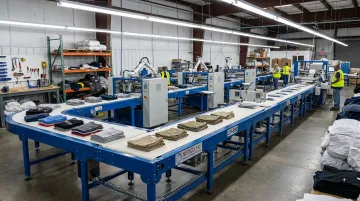
The result is a hands-free flow from folding straight through to sealed, labeled product, cutting out manual transfers that slow lines down and wear out operators over a long shift.
Frequently Asked Questions
Can conveyor systems be automated?
Yes. Most conveyor types, including belt, roller, and chain, can be automated by adding motors, sensors, and a control system, with the automation level depending on the sensors and software used.
What is a motorized conveyor?
A motorized conveyor uses an electric motor to power movement, rather than relying on gravity or manual pushing. This allows for consistent, adjustable speed control across the entire line.
What are the main types of conveyors?
Belt, roller, and chain conveyors are the three primary types used across industries. Belt handles varied shapes, roller manages heavier or palletized loads, and chain takes on the heaviest industrial applications.
How much does it cost to install an automated conveyor system?
Costs vary widely based on conveyor type, length, and complexity, ranging from a few thousand dollars for compact systems to hundreds of thousands for large, multi-station lines. Most manufacturers, including NEDCO, price custom quotes based on configuration.
Are automated conveyor systems safe?
With proper safety features like emergency stops, guards, and interlocks in place, automated conveyors are designed to reduce injury risks compared to manual handling. OSHA's conveyor standard, 29 CFR 1926.555, outlines specific requirements for these protections.
What industries use automated conveyor systems the most?
Warehousing, e-commerce, food and beverage, pharmaceuticals, manufacturing, and textile/apparel finishing are among the leading adopters. Each relies on conveyors to keep products moving safely and consistently at scale.