Introduction
A twenty-dollar bushing fails at 6 a.m. The folding line stops. Forty employees stand around a machine that can't run, and every minute costs money nobody planned to spend.
That scene is why spare parts strategy now sits with production and cash flow—not just the storeroom. One missing part can idle a line; the right part on hand keeps output steady and costs predictable.
This article covers what spare parts management really means, the gains when you get it right, and the cost when you don't. It also lays out practical steps textile and apparel manufacturers can use to turn parts into a real advantage.
TL;DR
- Spare parts act as an insurance policy; one missing critical part can stop an entire line
- Classify parts by criticality, value, and predictability—not by stockpiling more inventory
- Strong spare parts strategy protects uptime, frees cash flow, and steadies maintenance costs
- Skipping spare parts strategy leads to firefighting, dead capital, and rising costs
- A responsive OEM partner—like NEDCO’s E-Z Fold service team—cuts downtime risk without overstocking
What Is Spare Parts Management
Spare parts management is the process of stocking, classifying, and replenishing the components that keep production equipment running. It's a balancing act: enough parts on hand to avoid stoppages, without tying up capital that could be used elsewhere.
Deloitte describes it as a strategic process covering cataloging, stock-level setting, criticality classification, and supplier coordination, tied directly into maintenance and procurement operations.
It applies broadly:
- Heavy industry and process manufacturing, where a single valve or bearing failure halts a plant
- Discrete production lines, such as textile finishing and packaging equipment
- Simple machines that still depend on a handful of critical wear parts, like heat seal bars or drive belts
The goal is uninterrupted production and healthy cash flow. A warehouse full of parts nobody needs only ties up capital.
Key Advantages of Effective Spare Parts Management
The advantages below aren't theoretical. They tie directly to metrics most manufacturers already track: uptime, cost, and capital efficiency. Research and real-world examples, from process industries to discrete manufacturing, consistently link disciplined parts management to these results.
Minimized Downtime and Protected Production Continuity
Having the right critical part on hand, or guaranteed fast access to it, stops small failures from becoming full production stoppages. This is where classification earns its keep.
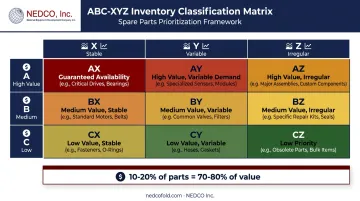
ABC/XYZ analysis sorts parts two ways:
- ABC ranks by value and volume. A-items are typically 10-20% of parts but 70-80% of value, according to Verdantis's classification framework
- XYZ ranks by demand predictability, from stable (X) to irregular (Z)
Combining both tells you which parts deserve guaranteed availability and which don't need to sit on a shelf at all.
Avoiding unplanned stoppages protects scheduled output and delivery commitments. Digitalized inventory records with standardized descriptions and barcodes make parts easier to locate during a crisis, cutting the time spent hunting through disorganized bins, per Plant Engineering's maintenance guidance.
KPIs that move with this work:
- Equipment uptime and OEE
- Part availability rate for critical items
- Mean time to repair
Single-line or bottleneck operations feel this most—one machine failure can halt everything downstream. Textile finishing equipment feeding into packaging is a clear example, which is why fast OEM parts and service support matter so much for keeping those lines from turning a small failure into a full production loss.
Protected Cash Flow and Capital Efficiency
Every dollar of inventory sitting on a shelf is a dollar not funding payroll, upgrades, or growth. Spare parts management directly affects that balance.
The Spare Parts Investment Ratio (SPIR) measures spare parts inventory value against asset reproduction value. It's a benchmark for whether a company is over- or under-invested.
- Overstocking ties up working capital in parts that may never get used
- Understocking risks costly emergency purchases and downtime
- Top-quartile facilities with strong maintenance systems target MRO inventory at 1.5% of replacement asset value or less, according to UpKeep's inventory benchmarking research
A one to two percentage point difference in SPIR can free—or trap—hundreds of thousands of dollars for a mid-sized manufacturer with several million in equipment value.
KPIs that move with this work:
- Inventory turnover
- Dead stock percentage
- Working capital tied to inventory
- SPIR benchmark position
Capital-intensive plants with expensive machinery feel this pressure first. Growing businesses do too—they need cash flexibility, not money locked in a parts room they rarely visit.
Predictable Costs and Extended Equipment Life
Planned, criticality-based part replacement avoids the price premiums and rush shipping fees that come with emergency ordering. It also extends equipment life.
NIST's maintenance research draws a clear line: reactive maintenance carries high labor and parts costs and isn't cost-effective, while predictive and preventive approaches carry lower risk and better returns, per NIST's maintenance cost analysis.
Proactive replacement pays off in measurable ways:
- Fewer secondary failures — a worn part left too long often damages the components around it
- Better budget accuracy — planned maintenance spending replaces unpredictable emergency costs
- Lower counterfeit risk — rushed purchases under time pressure increase the odds of buying an ill-fitting or forged substitute, a risk flagged by EU Automation's counterfeit parts guide
KPIs that move with this work:
- Maintenance cost per unit of output
- Average part lead time
- Equipment lifespan and mean time between failures
Older equipment fleets, shops without in-house engineering staff, and operations with strict quality or safety rules gain the most—here, "any part that fits" is an unacceptable substitute.
What Happens When Spare Parts Management Is Missing or Ignored
Skip the discipline, and the consequences show up fast, then keep compounding.
- Inconsistent output. Unplanned stoppages recur unpredictably, making delivery promises unreliable.
- Lower-quality repairs. Without the right part, teams grab substitutes that don't fit properly.
- Firefighting culture. Maintenance and procurement blame each other instead of fixing root causes.
- Rising costs over time. Emergency shipping, premium pricing, and secondary equipment damage add up.
- Scaling problems. Institutional knowledge of "what's needed" lives in one person's head, not a system.
ABB's 2023 survey of over 3,200 plant maintenance decision-makers found that more than two-thirds report unplanned outages at least monthly, with average downtime costs approaching $125,000 per hour.
That number explains why 60% of respondents in the same survey planned to increase reliability investment over the following three years. Waiting for a crisis to justify spare parts discipline is an expensive way to learn the lesson.
How to Get the Most Value from Spare Parts Management
Spare parts management only pays off when it's a routine practice, not a one-time cleanup project done after a bad quarter.
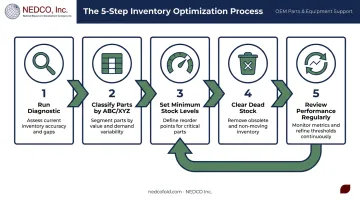
A practical roadmap looks like this:
- Run a quick diagnostic of current stock levels and data quality
- Classify parts by criticality and value using ABC/XYZ logic
- Set minimum stock levels for the parts that actually matter
- Clear dead stock that's been sitting untouched for years
- Review performance regularly through a small KPI set: availability, turnover, lead time
Skip the temptation to build an elaborate system on day one. Start with the parts that would actually stop production if missing, then expand from there.
Supplier relationships close the remaining gap. OEM service agreements or guaranteed parts availability arrangements let companies cut in-house inventory risk without giving up fast access.
For E-Z Fold equipment owners, NEDCO provides nationwide access to genuine replacement parts through a dedicated service contact. A reliable OEM relationship shifts the stockpiling burden to the manufacturer instead of every shop holding every possible part.
Conclusion
Spare parts management comes down to control, clarity, and consistency. Done well, it protects production and cash flow together—not just metal sitting on a shelf.
Uptime, capital efficiency, and predictable costs compound when classification and review become routine rather than an annual scramble.
Treat spare parts strategy as an ongoing operational discipline, not a project with an end date. Manufacturers who pair internal process discipline with responsive OEM support, like NEDCO's parts and service team, put themselves in the strongest position to protect both production and profitability.
Frequently Asked Questions
What is the future of the spare parts industry?
The industry is moving toward digitalization, predictive analytics, and vendor-managed inventory. Refurbishment and on-demand 3D-printed parts are also growing as plants cut lead times and dead stock.
What are spare parts in manufacturing?
Spare parts are interchangeable components kept in inventory to repair or maintain production equipment. They fall into two types: repairable spares, which get refurbished and reused, and consumables, which are replaced outright and never repaired.
What is the difference between OEM and aftermarket spare parts?
OEM parts come from the original equipment manufacturer, built to exact specifications with guaranteed fit and quality. Aftermarket parts are third-party alternatives that may cost less but vary widely in compatibility and quality.
How much spare parts inventory should a manufacturer hold?
There's no single target. Size stock by part criticality, real usage, and supplier lead time, then check the result against SPIR benchmarks for your industry and equipment.
What is the Spare Parts Investment Ratio (SPIR)?
SPIR compares spare parts inventory value to the replacement value of your equipment assets. It shows whether you're over-invested (excess dead capital) or under-invested (downtime risk).
How can manufacturers reduce the risk of production downtime from missing parts?
Classify parts by criticality and review stock against actual usage on a set schedule. Then lock in OEM or supplier partners that keep critical parts available with fast turnaround.