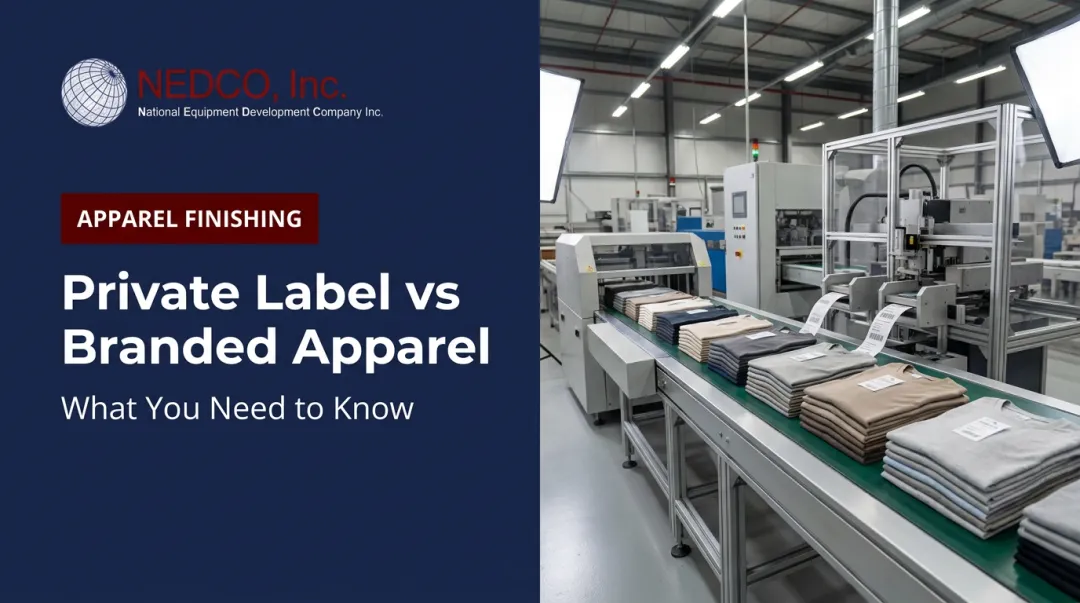
Two off-model photography methods dominate this space: flat lay and folded shots. Each serves a distinct purpose, suits different product types, and creates a very different operational demand on your team.
This guide breaks down both approaches — what they do well, where they fall short, and how to choose the right one for your brand's goals and production scale.
Key Takeaways
- Flat lay excels at storytelling and showing full garment silhouettes — ideal for social media and creative branding
- Folded shots prioritize uniformity and professionalism, making them the go-to for high-volume e-commerce catalogs
- Your choice should be driven by brand identity, product type, and how many SKUs you need to photograph
- Automated folding equipment delivers the fold consistency and throughput speed that manual methods can't sustain at scale
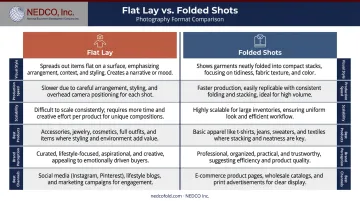
Flat Lay vs. Folded Shots: Quick Comparison
Use this side-by-side breakdown to quickly identify which shot style fits your product, channel, and production workflow.
| Factor | Flat Lay | Folded |
|---|---|---|
| Visual Style | Artistic, lifestyle-oriented, story-driven | Clean, minimalist, uniform, professional |
| What It Shows | Full silhouette, drape, garment length | Fabric texture, color accuracy, logos, tags |
| Production Speed | Slower — each garment requires individual styling | Faster — highly repeatable, especially with equipment |
| Scalability | Difficult at high volume | Designed for large-batch, consistent output |
| Best Products | Dresses, coats, unique silhouettes, full outfits | T-shirts, sweatshirts, multi-packs, basics |
| Brand Perception | Creative, trendy, personal | Organized, reliable, high-quality |
| Best Channels | Social media, lookbooks, email campaigns | Amazon, brand stores, large e-commerce catalogs |
What Are Flat Lay Apparel Shots?
Shopify defines flat lay clothing photography as arranging a garment on a flat surface and photographing it directly from above. The camera sits parallel to the subject — capturing the full shape of the piece without any distortion from angles.
Core Benefits
The format's main strength is storytelling. Styling props, coordinating accessories, or a curated background can communicate a brand's aesthetic in a single frame. For garments where cut, drape, or overall shape is the selling point — think maxi dresses, oversized coats, or tailored blazers — flat lay shows customers what they actually need to see.
That storytelling flexibility gives creative teams real room to work. Color blocking, pattern coordination, and lifestyle-forward compositions come naturally to this format — which is why it's the default choice for lookbooks and social content.
Challenges at Scale
The format gets expensive and slow when volume increases. Maintaining styling consistency across high volumes is one of the primary difficulties with flat lay production. Every garment needs individual attention — steaming, pinning, adjusting drape — before a single frame is captured.
Small details like fabric texture, chest logos, or tags can also get lost in a top-down wide shot.
Best Use Cases for Flat Lay
- Lookbooks and seasonal campaigns where each image functions as its own campaign asset
- Social media content on platforms where visual storytelling drives engagement
- Asymmetrical cuts, voluminous skirts, or layered outfits where silhouette is the selling point
- Smaller collections where each piece can receive dedicated styling time
What Are Folded Apparel Shots?
Folded apparel photography presents a neatly folded garment — typically front-facing, symmetrically arranged — to emphasize precision and consistency. Rather than showing the full shape of a garment, it prioritizes surface detail and uniformity of presentation.
Core Benefits
A well-executed folded shot puts fabric quality front and center. Weave texture, color accuracy, printed graphics, and embroidered logos all read clearly when the garment is folded flat and lit correctly.
For basics like t-shirts, polos, and crewneck sweatshirts, there's little the garment's silhouette communicates that the fold doesn't already convey.
That clarity scales well. The format is also inherently space-efficient. Gallery images on Amazon or a brand's product detail page benefit from a consistent, compact presentation across dozens of colorways — folded shots handle this cleanly.
Amazon's UK apparel style guide makes this explicit: listings with consistent formatting and accurate product information drive traffic and favorably influence purchase decisions.
The Consistency Challenge
The format's biggest promise is also its biggest production challenge. A folded shot only works if every garment is folded identically. One shirt folded slightly wider, another with a visible crease on the wrong edge — and your catalog starts to look careless, even if the photography itself is technically sound.
Manual folding can work for small batches. At scale, it's unreliable.
Best Use Cases for Folded Shots
- High-volume e-commerce catalogs requiring uniform presentation across thousands of SKUs
- Basic apparel — t-shirts, sweatshirts, joggers — where silhouette is straightforward
- Multi-packs and bundled products that need a compact, clear presentation
- Retail fulfillment and wholesale operations where packaging-ready images are needed
How to Choose the Right Style for Your Brand
The decision comes down to three factors: your brand's visual identity, the garments you're selling, and the volume you need to produce.
Choose Flat Lay for Creative Expression and Unique Silhouettes
If your brand's visual identity is built on an artistic or lifestyle aesthetic, flat lay photography communicates that before a customer reads a single word. It's the right call when:
- Your products have distinctive cuts or shapes that a folded presentation would obscure
- You're producing content for social channels where styled, editorial images perform
- You have a smaller collection and enough production time to style each piece individually
- Your audience responds to aspirational imagery over catalog-style efficiency
Choose Folded Shots for Scalability, Consistency, and Professionalism
For brands managing large SKU counts — or planning to — folded photography is the more practical system. The images are cleaner to produce, easier to keep consistent, and fit the visual expectations of major marketplaces.
The catch: every folded shot in your catalog needs to look identical — same fold width, same crease placement, same presentation angle. Done manually, that's nearly impossible to maintain across hundreds of garments. Human hands aren't that consistent, especially across long production days.
Automated folding equipment solves this directly. NEDCO Inc.'s E-Z Fold T-Shirt Folder, manufactured in Covington, Georgia since 1989, produces the same fold dimensions and crease placement on every garment — giving your photography team identical starting points for every shot, without the guesswork.
When garments arrive pre-folded to a consistent standard, setup time per garment drops. No re-steaming, no re-folding, no adjusting between shots. Your team moves through the catalog at a pace that actually scales.
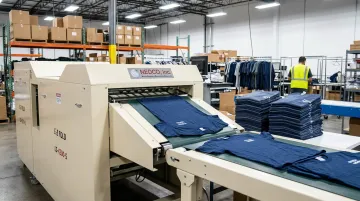
NEDCO's E-Z Fold line also integrates with downstream packaging equipment, making it a fit for operations where folding connects directly to fulfillment — not just the photo studio. Compatible downstream systems include:
- Baggers and sealers
- Labeling systems
- Automatic conveyors
Conclusion
The choice comes down to intent. Flat lay photography works best for creative storytelling — editorial imagery for social campaigns, seasonal lookbooks, and brand-driven content. Folded shots are built for commercial efficiency: consistent presentation, catalog-scale production, and repeatable results.
For textile manufacturers and high-volume apparel businesses, producing uniform images quickly is a genuine competitive advantage. Folded photography delivers that — but only when the fold itself is consistent. At production scale, that consistency has to be built into the process before the camera turns on.
To get catalog-ready results at volume, explore how NEDCO's E-Z Fold line prepares garments with uniform folds before your photography session begins.
Frequently Asked Questions
What is the main difference between flat lay and folded apparel photos?
Flat lay shows the entire garment from above, capturing its full silhouette, drape, and length. Folded shots present a compact, neatly folded garment that highlights fabric texture, color, and surface details like logos or tags — prioritizing uniformity over shape.
When is flat lay photography a better choice for clothing?
Flat lay works best when a garment's cut or shape is its primary selling point — dresses, oversized outerwear, or layered looks. It's also the stronger format for social media content and brand campaigns where a lifestyle aesthetic matters more than catalog consistency.
What are the advantages of using folded shots for an e-commerce store?
Folded shots deliver a clean, uniform look across your entire product catalog, which builds brand trust and meets the visual standards expected on major marketplaces like Amazon. The format is also faster to produce at scale, especially when garments arrive pre-folded consistently.
How do you ensure consistency in folded apparel photography?
Consistency starts with three fixed variables: identical fold dimensions, a neutral backdrop, and a locked camera position so framing never shifts between shots. At volume, manual folding introduces size variation that undermines that consistency. Automated equipment like the E-Z Fold T-Shirt Folder from NEDCO folds every garment to identical dimensions, giving your photography team a reliable starting point for every shot.
What lighting setup works best for both flat lay and folded shots?
Canon recommends a single light source positioned at roughly 45 degrees to create natural shadow and depth, with the camera parallel to the subject to avoid distortion. A large diffused source — a softbox or north-facing window — minimizes harsh shadows while revealing fabric texture.
Which photography style is better for showing product details?
Folded shots typically show fabric weave, texture, and small chest logos more clearly because the garment is positioned face-up at close range. Flat lay is better for communicating overall design, garment length, and how a piece flows — details that disappear once a shirt is folded.