This scenario plays out in plants across the country every day. Industrial spare parts identification isn't just "matching a number to a part." It depends on documentation quality, inspection method, and whether your systems can actually track what you own.
Misidentified parts cause more than annoyance. A 2024 Siemens-Senseye report estimates unplanned downtime costs Fortune Global 500 manufacturers at least $1.5 trillion annually, roughly 11% of their turnover. Ordering the wrong part doesn't cause that entire figure, but it contributes to it.
This guide walks through the identification process step by step, covers numbering and classification systems, flags common mistakes, and explains when to skip the guesswork and call the manufacturer.
Key Takeaways
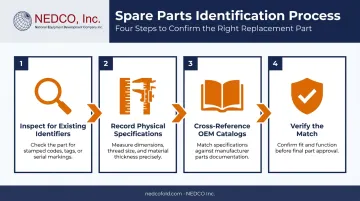
- Identification follows four stages: inspect, measure, cross-reference, verify
- Numbering systems and ABC classification decide how much effort each part needs
- Most errors come from trusting visual similarity over verified specifications
- For legacy equipment, contacting the OEM beats searching outdated catalogs
How to Identify Industrial Spare Parts: Step-by-Step Process
Skipping steps here is how you end up with a part that "looks right" but doesn't fit. Follow this sequence in order.
Step 1: Inspect the Part for Existing Identifiers
Start with what's already on the component.
- Check for stamped, embossed, or printed part numbers, serial numbers, and OEM logos on the surface
- Look for backup engravings or etched codes in less exposed areas — primary labels wear off fast in dirty, high-vibration environments
- Photograph every visible marking before cleaning the part
Worn or partially obscured engravings aren't necessarily lost causes. OCR-based tools built for industrial use (the kind Cognex and Keyence sell for direct-part-marking applications) can recover candidate text from low-contrast or cast markings. Treat that recovered text as a lead worth verifying, not a confirmed identity.
Step 2: Record Physical Specifications and Measurements
Two parts can look identical and still be wrong for your machine.
- Measure diameter, length, and thread pitch — tolerance and load rating often differ between visually similar parts
- Document voltage, RPM rating, or pressure rating for electrical and mechanical components, since these fields matter more than appearance
- Compare against a known reference sample when one's available, especially for wear items like belts, bearings, or blades
ASME B1.1 defines thread form, class, and tolerance separately from thread pitch alone. Bearing catalogs from manufacturers like Timken use entirely different identification conventions for inch-system versus metric assemblies. A part that "fits by eye" can still fail under load.
Step 3: Cross-Reference OEM Catalogs, Manuals, or Parts Diagrams
Pull the original parts manual or exploded diagram and match the number and description against the physical part.
If the catalog is outdated, discontinued, or the machine's been modified since purchase, contact the manufacturer directly. Manufacturers who retain long-term parts records can confirm exact matches even on decades-old equipment.
This is where equipment age matters most. NEDCO Inc.'s support for its E-Z Fold lineup works this way: customers running machines purchased years ago can still get confirmed part matches instead of guessing from a generic parts list.
Step 4: Verify the Match Using Digital Tools or Manufacturer Support
Verification is the step people skip, and it's the one that prevents the costliest mistakes.
- Search the part number on supplier or manufacturer sites first, it's the fastest route when the number is legible
- Use image-based search or OCR tools for unmarked or ambiguous parts, or send photos directly to a service contact
- Confirm against your machine's model and serial number, since manufacturers frequently revise part designs across production runs
Skipping this last check is exactly how a "close enough" part ends up back in a box, shipped for return.
When Should You Rely on Different Identification Methods?
No single method works for every part. The right approach depends on complexity, documentation, and how urgently the machine needs to run again.
| Situation | Best method |
|---|---|
| Common part with a clear, legible part number | Catalog-based lookup |
| Older, unmarked, or heavily worn part | Physical measurement plus cross-referencing |
| Critical, safety-related, or specialized component | Direct manufacturer verification |
Catalog searches work well when the part number is intact and the equipment is well-documented. But once labels wear off or the machine has been modified over the years, physical measurement becomes the only reliable path.
For anything tied to safety systems or specialized function, don't gamble. A wrong match on a critical component doesn't just cost the price of the part — it risks extended downtime, or worse, an equipment failure during operation.
NEDCO customers can verify directly: contact our service team with the model and serial number before ordering.
Spare Parts Numbering and Classification Systems
How you organize part numbers and prioritize inventory directly affects how fast identification happens.
Intelligent vs. "Dumb" Numbering Systems
Intelligent (significant) numbering embeds meaning into the code itself — part type, size, or category. A trained staffer can glance at a number and spot a mismatch immediately.
Sequential (non-significant) numbering assigns a plain incrementing code, like PN-100001, with zero embedded meaning.
| System | Advantage | Trade-off |
|---|---|---|
| Intelligent | Staff catch errors at a glance without cross-checking | Requires upfront training to interpret the coding logic |
| Sequential | Easy to generate and scale as inventory grows | Depends entirely on accurate descriptions in the database |
Neither system is universally "better." Intelligent numbering pays off when your team handles a wide variety of parts daily. Sequential numbering scales more easily but only works if your descriptions and metadata are airtight, since the number itself tells you nothing.
ABC Classification for Spare Parts Inventory
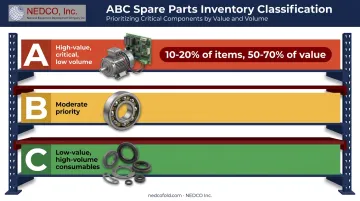
ABC classification ranks parts by value and criticality:
- A-items: high-value or critical, low volume
- B-items: moderate priority
- C-items: low-value, high-volume consumables
NEDCO applies this same logic to its OEM replacement parts catalog, tracking drive motors and control boards as A-items while treating gaskets and sealing film as routine C-items.
According to ASCM's inventory management research, A-items typically make up just 10-20% of inventory items but account for 50-70% of total sales value.
Spending equal identification effort on a $2 bolt and a $4,000 motor wastes time you don't have during a breakdown. Rank parts by criticality first, then let that ranking dictate how much verification each one deserves.
Common Mistakes in Industrial Spare Parts Identification
Most identification failures trace back to one of these four habits:
- Trusting visual similarity alone. Two parts can look identical and still differ in tolerance, load rating, or material, leading to incompatible orders
- Using generic descriptions instead of verified OEM part numbers. This creates confusion when reordering from different suppliers down the line
- Skipping metadata capture at removal. Serial numbers, revision codes, and install dates are easy to grab in the moment and painful to reconstruct later
- Assuming "equivalent" third-party parts are identical. Tolerance, material, and certification differences often go unchecked until the part fails
Wrong identifiers carry real consequences beyond wasted time. Allied Machine's own tooling catalog notes that incorrect item numbers or descriptions can trigger a 10% restocking charge on returns. That's one supplier's policy, but it illustrates a pattern that plays out across the industry.
When to Contact the Manufacturer Directly for Parts Identification
For niche, older, or heavily modified industrial equipment, calling the OEM is often faster than digging through third-party catalogs. Manufacturers who retain long-term records can match a part to a machine's exact serial number, even decades after purchase.
At NEDCO, that's the role Don Cranshaw handles for the E-Z Fold lineup. He manages service requests and parts ordering nationwide, which means customers running older folding, compression, or bagging equipment get a direct confirmation instead of a best guess. NEDCO's replacement parts program also builds in a few shortcuts that make this process faster:
- Assembly-based ordering lets customers order a complete unit instead of hunting for individual sub-components
- Teflon sheet designations (16" Roll, Upper, Lower) give a clear naming convention instead of guesswork
- Legacy sealer flagging helps customers with Old UBII Reconditioned Sealers skip straight to the most commonly needed components
Reach the team directly at 770-484-9969, don@nedcofold.com, or through NEDCO's contact page if you're not certain a part will fit. Confirming a match before ordering costs a phone call. Guessing wrong costs a shipping delay and another week of downtime.
Frequently Asked Questions
How do you identify spare parts?
Inspect the part for existing markings and record its physical specifications. Then cross-reference OEM catalogs or manuals, and verify the match digitally or through the manufacturer before ordering.
What is the ABC classification of spare parts?
A-items are high-value or critical and low in volume, B-items sit at moderate priority, and C-items are low-value, high-volume consumables. This ranking guides how much verification effort each part deserves.
What is the difference between OEM and aftermarket spare parts?
OEM parts come from the original manufacturer and are built to guaranteed specifications and tolerances. Aftermarket parts are third-party equivalents that may vary in quality, tolerance, or warranty coverage.
How do you create a spare parts numbering system?
Choose between intelligent numbering (codes that embed part attributes) or sequential numbering (simple incrementing codes), then back either choice with consistent, detailed documentation in your database.
Can spare parts be identified from a photo alone?
Photos help with visual matching and OCR recovery of printed numbers, but critical parts still need physical spec verification and manufacturer confirmation before ordering.
Why does accurate spare parts identification matter for reducing downtime?
Misidentified parts cause wrong orders, shipping delays, and restocking fees that extend machine downtime. Partnering with a parts specialist like NEDCO, which verifies OEM replacements before shipping, helps avoid these costly mistakes.