Introduction
A shipment arrives at the retailer with crushed polybags and missing care labels. The result: chargebacks, a compliance hold, and a reorder that costs twice what the original run did. That outcome traces back to decisions made long before the carton was sealed — in how garments were packaged, labeled, and prepared for distribution.
Apparel packaging and labeling cover two distinct but connected disciplines: the physical materials that protect and present finished garments, and the tags, sewn-in labels, barcodes, and stickers that communicate product details to buyers and regulators.
For textile manufacturers, screen printers, embroiderers, and bulk producers, getting both right is non-negotiable. Poor packaging damages garments in transit and signals low quality on arrival. Non-compliant labeling triggers retailer chargebacks, import holds, and FTC fines.
Without consistent, repeatable processes at each step, SKU errors multiply and fulfillment costs climb — regardless of how well the garments themselves are made.
This guide covers:
- What apparel packaging and labeling actually involve
- US compliance requirements you must meet
- The step-by-step process from garment finishing to carton sealing
- Operational decisions that determine whether your workflow can handle growth
Key Takeaways
- FTC regulations require apparel labels to show fiber content by percentage, care instructions, country of origin, and manufacturer identity
- Packaging type — polybag, hanger, or retail box — should match the sales channel, not just personal preference
- Consistent folding directly affects polybag presentation, planogram compliance, and carton pack efficiency
- Automation addresses the throughput and consistency gaps that manual folding and labeling create at high volume
- Confirm retailer routing guide requirements before production starts — specifications vary and non-compliance triggers chargebacks
What Is Apparel Packaging and Labeling?
Apparel packaging refers to the materials, containers, and methods used to protect, present, and transport finished garments. This ranges from a simple polybag for wholesale basics to branded tissue paper inside a rigid gift box for direct-to-consumer premium orders. The packaging is the outer structure — what the customer sees first and what keeps the garment intact through transit.
Apparel labeling is the information system applied to the garment and its packaging. This includes sewn-in care and content labels, hang tags with brand and pricing information, UPC barcodes for retail scanning, and any stickers or compliance markers required by retailers or regulators.
The two are distinct but must work together. Each serves a different purpose:
- Packaging protects the garment and shapes the customer's first impression
- Labeling communicates compliance, content, and care requirements to retailers and end users
A garment can be beautifully packaged but still fail retailer compliance because a hang tag is missing a UPC, or a care label uses incorrect fiber terminology. Getting both right — consistently, across every SKU and every unit — is what separates smooth retail onboarding from costly chargebacks and rejected shipments.
Why Packaging and Labeling Matters in Apparel
First impressions in apparel are shaped before a customer touches the garment. McKinsey research on packaging and purchase behavior found that 61% of e-commerce shoppers who bought luxury products were more likely to repurchase when the product arrived in premium packaging — a clear signal that presentation at delivery carries real commercial weight.
Beyond consumer perception, the apparel industry has specific demands that packaging and labeling must address:
- Retail planogram compliance — consistent fold dimensions and presentation for shelf display
- FTC textile labeling requirements — fiber content, care instructions, origin, and manufacturer identity
- Retailer-specific ticketing — hang tag placement, UPC format, and polybag specifications set by each buyer's routing guide
- Transit protection — preventing moisture, dirt, and compression damage through the supply chain
What Goes Wrong Without a System
Operations that rely on informal or inconsistent packaging and labeling processes run into predictable problems:
- Retailer chargebacks for non-compliant labeling, incorrect UPC placement, or packaging that doesn't meet routing guide specifications
- Damaged goods from polybags too thin for the product weight or cartons packed without adequate protection
- Brand inconsistency across SKUs when folding and presentation aren't standardized
- Fulfillment bottlenecks when manual processes can't keep pace with order volume
Treating packaging and labeling as a documented system — with standardized folds, compliant labels, and consistent pack specs — is what separates operations that scale cleanly from those that absorb chargebacks and rework costs. Automated folding and labeling equipment can enforce those standards at volume, removing the variability that manual processes introduce.
How the Apparel Packaging and Labeling Process Works
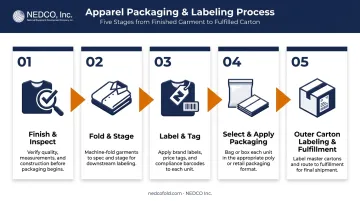
The end-to-end process moves through five sequential stages: finishing and inspection → folding and staging → labeling and tagging → packaging selection and application → outer carton labeling and fulfillment. What happens at each step affects the quality and efficiency of the next.
Step 1: Finish and Inspect the Garment
Before packaging begins, garments must be pressed or steamed to remove wrinkles, inspected for defects, and sorted by size and SKU. This step is the quality gate — anything that passes through here will be packaged, labeled, and shipped. Catching a misprint, a loose seam, or an incorrect size at this stage is far cheaper than a return or chargeback after delivery.
Organized staging by SKU also sets up the folding and labeling steps to run cleanly. Mixed or unsorted garments slow everything downstream.
Step 2: Fold and Stage the Garment
Consistent folding determines how cleanly a garment presents in a polybag, how accurately it fits a retail display slot, and how efficiently units stack in a master carton. A sloppy fold at this stage creates problems at every step that follows.
For high-volume operations, manual folding introduces real variability — fold dimensions drift across operators and shifts, increasing errors and slowing throughput. Automated folding equipment solves this directly. NEDCO Inc., a Covington, Georgia-based manufacturer building textile finishing equipment since 1989, developed the E-Z Fold T-Shirt Folder to bring speed and consistency to this step while reducing operator fatigue.
The E-Z Fold line — including the E-Z Fold 2000 — is modular by design, meaning operations can adapt it as product mix and volume change without replacing the entire system.
Step 3: Attach Labels, Tags, and Barcodes
Multiple label touchpoints happen at this stage:
- Sewn-in or heat-transfer care/content labels — if not already applied during manufacturing
- Hang tags — brand identity, size, and retail pricing
- UPC barcodes — required by most retail buyers for inventory scanning
- Retailer compliance stickers — any additional ticketing specified in the buyer's routing guide
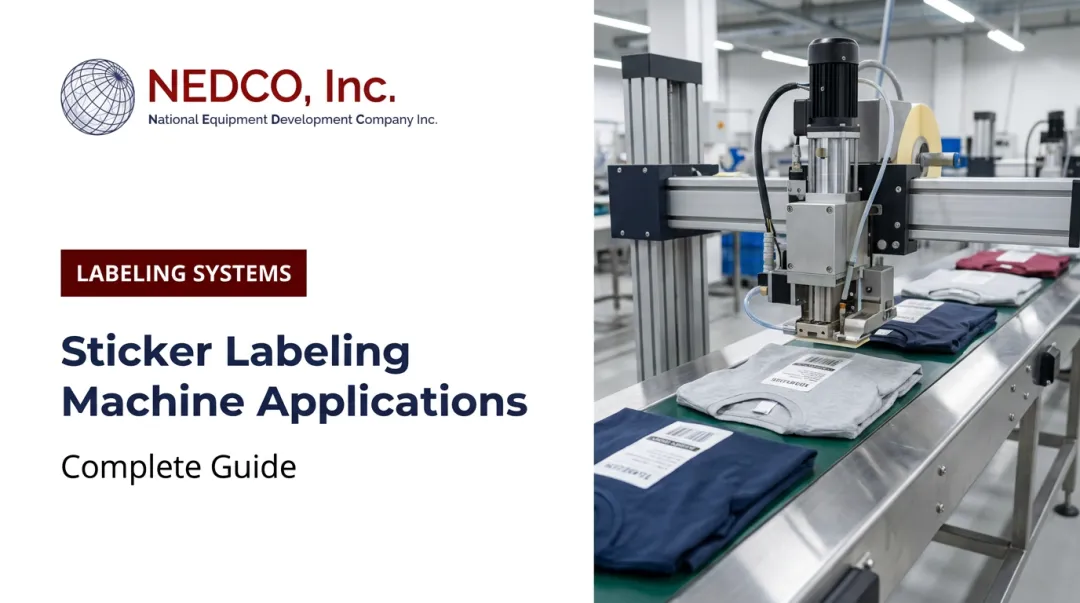
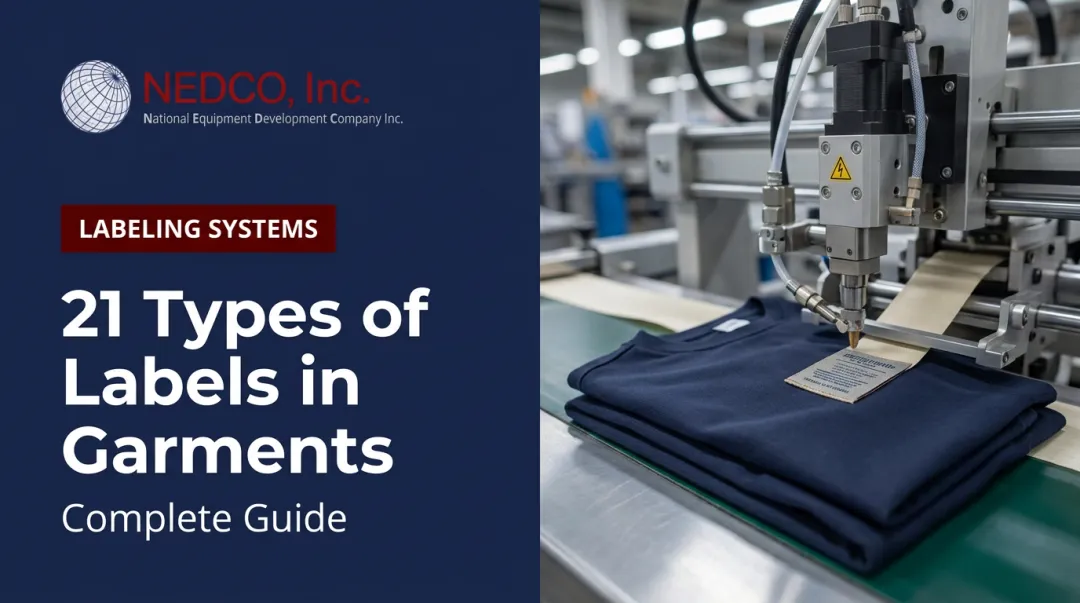
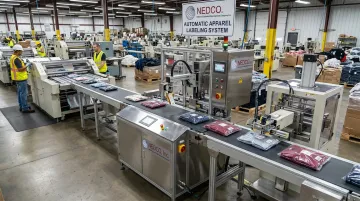
Placement must be consistent and correct. A hang tag attached to the wrong location or a barcode that doesn't scan through the polybag will trigger a chargeback at receiving. For operations running at volume, NEDCO's Automatic Apparel Labeling System handles high-speed garment tagging and precision barcode sticker application. It runs variable label sizes to reduce downtime between changeovers and integrates directly with their folding and bagging equipment on a single production line.
Step 4: Select and Apply Packaging
Packaging choice is driven by sales channel, retailer requirements, and brand positioning. The main options:
| Packaging Type | Best For | Key Considerations |
|----------------|----------|--------------------|
| Polybag | Wholesale, e-commerce | Gauge, seal type, suffocation warning if opening ≥5 inches |
| Hanger packaging | Retail floor display | Hanger type and tag position per retailer spec |
| Folded box | DTC, premium retail | Brand presentation, tissue, inserts |
| Master carton | Bulk shipment | Carton dimensions, pack count, outer labeling |
On polybag gauge: Amazon FBA, for example, requires transparent polybags at least 1.5 mil thick with a suffocation warning for any opening 5 inches or wider measured flat. Other retailers set their own specifications — check each routing guide, not just one standard.
NEDCO's Bagger/Sealer Systems combine the bagging and sealing steps into a single operation, reducing floor space requirements and operator fatigue. These integrate with the E-Z Fold line and Automatic Conveyor System to form a continuous production line from folding through sealed packaging.
Step 5: Label the Outer Packaging and Fulfill
The final stage covers:
- Shipping labels and carrier information
- Packing lists and carton content labels
- Retailer-specific ASN barcodes and routing compliance stickers
- Master carton quantity and SKU markings
Outer carton requirements vary significantly by retailer. A routing guide that specifies label placement, carton dimensions, and EDI advance ship notice (ASN) requirements should be reviewed and confirmed before packing starts — not after. Mislabeled or non-conforming cartons are a primary source of vendor chargebacks at major retailers.
US Apparel Labeling Requirements and Compliance
The FTC governs apparel labeling under two primary frameworks: the Textile Fiber Products Identification Act (implemented through 16 CFR Part 303) and the Care Labeling Rule (16 CFR Part 423). Non-compliance can result in fines, import holds, and retailer chargebacks — and enforcement is real. In July 2022, the FTC finalized a $211,335 judgment against Lions Not Sheep for removing foreign-origin labels and replacing them with false "Made in USA" labels.
The FTC governs apparel labeling under two primary frameworks: the Textile Fiber Products Identification Act (implemented through 16 CFR Part 303) and the Care Labeling Rule (16 CFR Part 423). Non-compliance can result in fines, import holds, and retailer chargebacks, and enforcement is real. In July 2022, the FTC finalized a $211,335 judgment against Lions Not Sheep for removing foreign-origin labels and replacing them with false "Made in USA" labels.
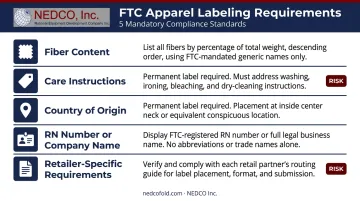
Five mandatory elements apply to virtually all covered apparel sold in the US: fiber content, care instructions, country of origin, manufacturer identification, and retailer-specific routing compliance.
Fiber Content
All covered apparel must disclose fiber content by percentage of weight in descending order of predominance. The rules governing what and how to disclose are specific:
- Generic fiber names are required ("Cotton," not "Pima" or "Supima" alone)
- Fibers under 5% of total weight appear as "other fiber" unless they serve a documented functional purpose
- Decorative trim may be excluded if it doesn't exceed 15% of the garment's surface area
Care Labeling
Garments must carry a permanent care label that remains legible and attached for the garment's useful life. Instructions must cover:
- Washing method (hand or machine) and safe water temperature
- Drying method
- Ironing when regularly needed
- Bleaching restrictions
- Dry-cleaning if applicable, including safe solvent identification
Text or ASTM D5489 care symbols are both acceptable under 16 CFR 423.8. The manufacturer must have a reasonable basis for the care instructions before the garment goes on sale — not after a return problem surfaces.
Country of Origin
All apparel must identify the country of manufacture on a permanent label. For garments with a neck, the origin label must appear at the inside center of the neck, midway between the shoulder seams. Origin is determined under 19 CFR 102.21 for textile and apparel goods — not the general substantial transformation test.
RN Number or Company Name
Apparel must include either the manufacturer's full business name or an FTC-registered Registered Identification Number (RN). An RN is optional — the company name alone satisfies the requirement. Foreign businesses cannot obtain an RN but may use the RN of a US importer. Applications and lookups are free through the FTC RN database.
Retailer-Specific Requirements
FTC compliance is the floor, not the ceiling. Major retailers layer their own requirements on top:
- Specific hang tag placement and attachment method
- UPC format and placement relative to the polybag
- Polybag gauge minimums (varies by retailer)
- EDI and ASN requirements for carton-level tracking
Request and review each retailer's routing guide before production begins. Requirements vary significantly between buyers — what satisfies one account may trigger chargebacks at another.
Key Factors That Affect Packaging and Labeling Outcomes
Operational Factors and Automation
Production volume and SKU complexity determine whether manual or automated processes are viable. For operations running a few hundred units across a small SKU count, manual folding and labeling may work. For high-SKU or high-volume runs — thousands of units across multiple colorways and size ranges — manual processes create bottlenecks, inconsistency, and elevated labor costs.
NEDCO's equipment line is built for this range. The E-Z Fold folding machine, labeling system, bagger/sealer, and automatic conveyor can be configured as an integrated production line or deployed in stages as volume grows.
Annual service plans and OEM replacement parts keep lines running. Preventive maintenance reduces unexpected breakdowns, and genuine replacement parts minimize downtime when repairs are needed.
Common Mistakes to Avoid
- Using non-permanent care label materials that fade or detach over time
- Omitting fiber percentages or using brand names instead of generic fiber names
- Applying hang tags inconsistently across size runs
- Selecting polybag gauges too light for the product weight
- Skipping the retailer routing guide review before production and labeling begins
Scale and Channel Considerations
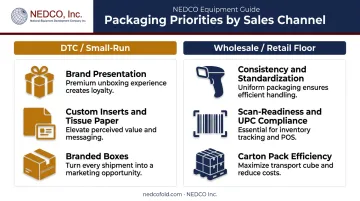
A 200-unit DTC drop and a 50,000-unit wholesale order require different packaging workflows. The priorities don't overlap much:
- DTC: Brand presentation — tissue paper, branded boxes, custom inserts
- Wholesale/retail floor: Consistency, scan-readiness, and carton efficiency
Plan packaging and labeling requirements by channel from the start of production planning. Retrofitting a DTC workflow to meet wholesale compliance is expensive and error-prone.
Conclusion
Apparel packaging and labeling is an operational process with real compliance stakes at every stage — from how a garment is pressed and folded through how a master carton is labeled before it leaves the dock. Each step in the process either supports or undermines the quality and compliance of the next.
FTC requirements for fiber content, care instructions, and country of origin aren't administrative details — non-compliance means fines and import holds. Channel-specific packaging standards carry the same weight; missing them results in chargebacks that eat directly into margin. What separates operations that fulfill orders cleanly from those that absorb the cost of doing it twice is building consistent, repeatable processes backed by equipment that scales with production demand. That's where automated folding, labeling, and bagging systems earn their place on the floor.
Frequently Asked Questions
What is packaging and labelling of a product?
Packaging refers to the materials and containers used to protect and present a product for transport and sale. Labeling refers to the informational tags, text, and barcodes applied to it. Together, they handle protection, compliance, communication, and brand identity.
What is the difference between product packaging and labelling?
Packaging is the physical structure (the bag, box, or hanger) that contains and protects the garment. Labeling is the information system — hang tags, care labels, barcodes — attached to communicate product details and satisfy compliance requirements.
What are the 4 types of labelling?
The four common label types are: brand labels (identity and logo), descriptive labels (product details and size), grade labels (quality classification), and informative labels (regulatory information like care instructions and fiber content). Apparel sold in the US requires informative labels at minimum.
What labeling is required on apparel sold in the US?
US apparel must carry a permanent label with fiber content by percentage, care instructions, country of origin, and either the manufacturer's name or an FTC-registered RN number. These requirements are governed by the FTC under the Textile Fiber Products Identification Act and the Care Labeling Rule.
What types of packaging are most common for apparel products?
Polybags are the most common for wholesale and e-commerce. Hanger packaging is standard for retail floor display. Folded boxes are used for DTC and premium retail. Master cartons handle bulk shipment. Most major retailers specify their required format in routing guides, so confirm those before finalizing your packaging approach.
What happens if apparel labeling doesn't comply with FTC rules?
Non-compliant labeling can result in FTC fines, import holds by US Customs, and retailer chargebacks. The 2022 Lions Not Sheep enforcement action resulted in a $211,335 judgment — a concrete example of the financial risk from labeling violations.