Choosing the wrong label film means peeling edges, washed-out care symbols, shrinkage that puckers surrounding seams, and costly relabeling after production runs are already complete. The damage compounds when label failures are discovered at the folding or packaging stage rather than caught before the run begins.
This guide covers the five most widely specified tumble-dry-safe label film types, the performance criteria that actually distinguish them, and the selection logic manufacturers need before they commit to a specification.
Key Takeaways
- Tumble dryers reach 60°C (low heat) to 80°C (normal heat) exhaust temperatures — label films must be rated against these specific conditions, not just general washability
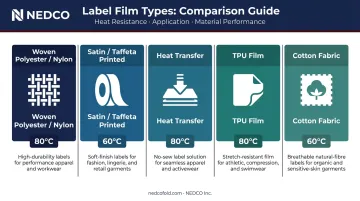
- The five leading film types are woven polyester/nylon, satin/taffeta printed, heat transfer, TPU film, and cotton fabric labels — each with different heat tolerance and application fit
- Evaluate substrate and ink system together — a stable film paired with an incompatible ink will still fail
- Always request cycle-count wash/dry test data from suppliers before locking in specifications
- Label film selection should happen alongside finishing line configuration — not after it
What "Tumble-Dry-Safe" Actually Means for Label Film
A garment care label is the substrate — woven, printed, or film-based — carrying care instructions, brand information, and size data. "Washable" and "tumble-dry-safe" are not the same specification. Washing cycles involve water and detergent at controlled temperatures; tumble drying adds sustained dry heat, continuous mechanical agitation, and repeated thermal cycling that tests entirely different material properties.
GINETEX defines two tumble dry heat levels: one dot indicates a mild process with reduced heat (max 60°C exhaust temperature); two dots indicate normal tumble drying at 80°C. These symbols appear on the care label sewn into the garment — and the label film itself must survive the same conditions the symbols are instructing consumers to use.
Why Label Films Fail in the Dryer
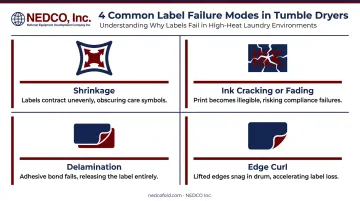
Common failure modes include:
- Shrinkage — causing care symbols to distort and sewn-in labels to pucker surrounding fabric
- Ink cracking or fading — when the ink/dye system isn't rated for repeated heat exposure
- Delamination — adhesive or print layers separating from the substrate
- Edge curl — softened adhesives allowing label edges to lift and scratch the wearer
Three standards govern this space: ISO 6330 (domestic washing and drying procedures), ISO 5077 (dimensional change), and AATCC TM135 (fabric dimensional changes after laundering). All three define test procedures — but none establish universal pass/fail thresholds for care label shrinkage or legibility.
That gap means manufacturers must set their own acceptance criteria and require suppliers to provide product-specific test data before approving any label film.
Best Tumble-Dry-Safe Garment Label Films
The five options below represent the most widely specified film types for garments intended for regular tumble drying. Each is evaluated on heat tolerance, print durability, comfort, and production practicality.
Woven Polyester / Nylon Labels
Woven labels are produced on high-density looms using polyester or nylon yarns. Because the pattern is structurally part of the fabric — not printed on top of it — there is no print layer to crack, fade, or delaminate under heat cycling.
| Performance Factor | Details |
|---|---|
| Heat Resistance | Withstands normal tumble dry cycles (up to 80°C exhaust) without shrinkage or distortion |
| Print Durability | Design is woven in — color and detail are unaffected by repeated wash/dry cycles |
| Best Application | Main brand labels and care labels on premium, workwear, and long-lifecycle garments |
Key differentiators: Available in damask, satin-weave, and taffeta-weave finishes for varied hand-feel. Long service life matched to the garment itself. No substrate that can delaminate.
Satin / Taffeta Printed Labels
Satin and taffeta are woven polyester substrates that accept high-resolution thermal transfer or screen printing. They are the most common film base for printed care and size labels in mid-to-high volume apparel production.
| Performance Factor | Details |
|---|---|
| Heat Resistance | Polyester base is stable to 80°C; verify that the ink or dye system used carries an equivalent heat rating |
| Print Durability | Research and specify ink/dye systems rated for your target garment lifespan — substrate stability alone is not sufficient |
| Best Application | High-volume care labels, size tabs, and combination brand/care labels for everyday apparel and activewear |
Key differentiator: Satin weave provides a softer hand against skin; taffeta is more cost-efficient at high volume. Both maintain dimensional stability through tumble drying when correctly heat-set during manufacturing.
Heat Transfer Film Labels (Tagless)
Heat transfer labels are applied directly to the inside of the garment using a polyester carrier film and pressure-sensitive ink. This eliminates the physical label tag, along with the sewn-in edge that commonly irritates skin.
| Performance Factor | Details |
|---|---|
| Heat Resistance | Requires adhesive and ink systems rated specifically for repeated 80°C tumble dry exposure — ask suppliers for documented cycle test data |
| Print Durability | High-quality systems maintain legibility through many cycles; budget systems crack or lift — cycle-count data is essential when sourcing |
| Best Application | Athleisure, childrenswear, and premium basics where tagless comfort and clean brand presentation are priorities |
Critical note: Lower-grade heat transfer films are among the most common label failure points in dryer conditions. What separates a reliable system from one that cracks or lifts is the adhesive and ink specification — not the film category itself.
TPU (Thermoplastic Polyurethane) Film Labels
TPU film labels use a flexible polyurethane substrate for printing or embossing. They are more suitable for sustainable product lines than PVC and offer a soft, skin-safe surface for stretch and performance garments.
| Performance Factor | Details |
|---|---|
| Heat Resistance | TPU retains flexibility and adhesion through normal tumble dry temperatures; confirm supplier data for specific exhaust temperature ratings by formulation |
| Print Durability | Screen-printed or matte-finished TPU labels maintain appearance well through wash/dry cycles — verify ink compatibility with the specific TPU formulation |
| Best Application | Swimwear, activewear, underwear, and stretch garments where label flexibility and skin comfort are essential |
Key differentiator: TPU bonds well to stretch fabrics that would stress a rigid substrate, and it won't crack under thermal cycling the way harder film types can. Note that GOTS v7 lists PVC as a prohibited accessory material, making TPU the preferred alternative for certified organic textile programs.
Cotton Fabric Labels
Cotton labels use a natural fiber substrate for printed or woven care information. They offer the softest hand-feel of all five options and are preferred in organic, sustainable, and baby apparel lines.
| Performance Factor | Details |
|---|---|
| Heat Resistance | Best suited to low-heat tumble drying; specify pre-shrunk or heat-set cotton label stock to minimize shrinkage at normal cycle temperatures |
| Print Durability | Water-based and reactive dye systems on cotton hold well; plastisol-based inks may crack after repeated heat exposure — verify system rating |
| Best Application | Organic apparel, baby clothing, and sustainable fashion lines where natural fiber labeling aligns with brand positioning |
Key limitation: Cotton has the lowest dimensional stability of all five options under repeated tumble drying. Unsanforized cotton can shrink enough to distort care text. Pre-shrunk or heat-set label stock significantly reduces this risk.
Key Performance Factors for Tumble-Dry-Safe Label Film
Heat Resistance Rating
Evaluate label films against both standard tumble dry settings — 60°C (low heat) and 80°C (normal heat) — not just general wash-safe claims. Request documented test data from suppliers showing label behavior at each setting. "Wash-safe" and "dryer-rated" are not interchangeable.
Dimensional Stability
Shrinkage distorts care symbols, compresses compliance text, and causes sewn-in labels to pucker surrounding fabric. The applicable test methods include ISO 5077 (dimensional change in washing and drying) and AATCC TM135 (dimensional changes of fabrics after home laundering). Neither standard sets a universal care-label pass/fail shrinkage percentage — manufacturers should establish their own acceptance tolerances and hold suppliers to documented results.
Ink and Print Adhesion
The substrate and ink system must be assessed together. A dimensionally stable polyester satin paired with an incompatible thermal transfer ink will still crack or fade after repeated drying cycles.
AATCC TM61 and ISO 105-C06 provide colorfastness test procedures that generate useful evidence, though neither was scoped specifically as a tumble-dry adhesion rating. Ask suppliers which test method was used and what the acceptance grade was.
Skin Comfort and Edge Finish
Tumble drying softens adhesives and can cause label edges to curl and scratch the wearer — a particular concern for childrenswear and performance apparel. Edge-cut method matters:
- Laser cutting produces a sealed edge with minimal fraying
- Ultrasonic cutting fuses synthetic fibers for a smooth finish
- Hot-knife cutting seals the edge but can leave a harder feel
Folded label construction reduces exposed edges and generally improves post-drying comfort versus flat-cut labels.
Regulatory Compliance
Three regulatory frameworks shape label requirements — none prescribe a specific film durability test, but all affect what your labels must communicate and how long they must last:
- FTC Care Labeling Rule: Requires labels to remain permanently attached and legible for the useful life of the garment; manufacturers must have a reasonable basis for any care instructions
- ASTM D5489: Governs care symbol communication for the US market
- ISO 3758:2023: Provides the international care-labeling code for export or global distribution
These standards define symbols and their meaning — durability testing is a separate supplier requirement you need to verify independently.
How to Select the Right Film for Your Application
The most common specification mistake is selecting label film on cost-per-unit or appearance without requesting wash/dry cycle durability data. Label failures discovered after a production run is complete — at the folding stage, the packaging stage, or worse, after the garment reaches consumers — cost far more than the per-label savings.
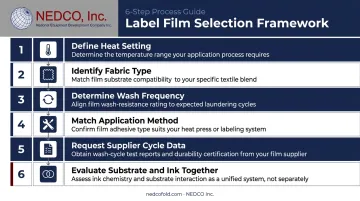
A practical selection framework:
- Define the heat setting the finished garment will be labeled for (low or normal tumble dry)
- Identify the fabric type — stretch fabrics need flexible substrates; stable wovens tolerate rigid options
- Determine wash frequency — workwear and activewear cycle far more than occasional-wear garments
- Match application method — sewn-in, heat-applied, and pressure-sensitive films perform differently depending on how they're attached
- Request supplier cycle data — ask specifically for results at the relevant exhaust temperature, not general wash ratings
- Evaluate substrate and ink together — don't approve them separately
For high-volume apparel manufacturers, label quality is also a downstream production issue. A label that curls, puckers, or delaminates after drying creates rework that backs up folding and packaging operations.
NEDCO's Automatic Apparel Labeling System integrates directly into the E-Z Fold finishing line, running alongside folding machines, conveyors, and bagger/sealer systems to minimize disruptions between labeling and downstream steps. Facilities running high-volume operations benefit from treating label specification and finishing line configuration as a single workflow decision rather than two separate ones.
Frequently Asked Questions
What is the label for tumble dry clothes?
The tumble dry symbol is a square with a circle inside it. One dot inside the circle indicates low heat (max 60°C exhaust temperature); two dots indicate normal heat (max 80°C). This symbol appears on the care label sewn or applied inside the garment.
What is the best material for garment labels on tumble-dry items?
For durability, woven polyester labels are the strongest option since the design is structurally woven rather than printed. For high-volume production, satin or taffeta printed labels on polyester substrates — paired with a dryer-rated ink system — are the most practical and cost-efficient choice.
Can heat transfer labels withstand tumble drying?
Quality heat transfer labels with dryer-rated adhesive and ink systems can withstand normal tumble dry cycles. Performance varies by product grade, so manufacturers should request supplier test data showing cycle-count durability at the relevant heat setting before specifying.
What temperature does a tumble dryer reach, and why does it matter for label film?
Standard tumble dryers reach exhaust temperatures of 60°C (low heat) to 80°C (normal heat). Label films not rated for these temperatures can shrink, crack, or delaminate — so heat resistance rating must be part of the specification process.
Are woven labels better than printed labels for tumble-dry garments?
Woven labels generally outlast printed labels in tumble-dry conditions because there is no ink layer to degrade. High-quality printed labels on polyester substrates with dryer-rated inks can perform comparably for most commercial applications at a lower cost per unit.
What US standards apply to tumble-dry-safe garment care labels?
US garment care labels must comply with the FTC Care Labeling Rule (labels must stay attached and legible for the garment's useful life), with ASTM D5489 governing care symbol use. ISO 6330, AATCC TM135, and AATCC TM61 provide relevant durability test procedures, though none establishes a universal pass/fail threshold for care labels.