Introduction
Every unplanned breakdown on a production floor costs more than just repair time. It disrupts schedules, strains teams, and erodes the capital investment those machines represent.
For manufacturers running automatic folding, packaging, or finishing equipment, the stakes are immediate: a machine that stops mid-shift doesn't just create a backlog — stoppages ripple into missed shipments and quality failures before the shift ends.
Preventive maintenance is the discipline that keeps that from happening. Rather than waiting for something to break, scheduled maintenance addresses wear, calibration drift, and buildup before they compound into failures.
Understanding that discipline — and putting it into practice — is what separates facilities that absorb breakdowns from those that prevent them. This guide covers why preventive maintenance matters, the four main types manufacturers use, the warning signs that service is overdue, and a practical scheduling framework from daily checks through annual overhauls.
Key Takeaways
- Preventive maintenance protects equipment investment by addressing wear before it causes failures.
- Four strategies — routine, corrective, predictive, and overhaul — suit different equipment criticality levels.
- NIST research found facilities with the highest reactive maintenance reliance had 3.3x more downtime and 16x more defects than those with the lowest.
- Warning signs include output changes, unusual sounds, visible wear, and rising energy consumption.
- A structured maintenance schedule covering daily checks through annual overhauls is the most cost-effective way to sustain long-term equipment performance.
Why Preventive Maintenance Matters for Manufacturing Equipment
The Cost of Letting Equipment Run to Failure
Well-maintained machines hold their performance over time. They operate within design tolerances, produce consistent output, and protect the capital investment made in acquiring them. Machines that don't receive scheduled service drift — slowly at first, then suddenly.
Siemens reports that unplanned downtime costs FMCG manufacturers $36,000 per hour on average, with automotive production lines reaching $2.3 million per hour. Contrast that with the predictable cost of a scheduled service visit, and the math isn't close.
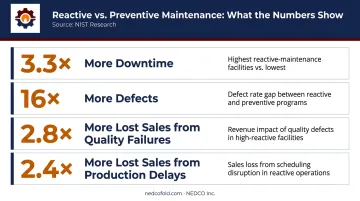
NIST's analysis of U.S. discrete manufacturers adds weight to this. Facilities in the highest reactive-maintenance quartile experienced:
- 3.3x more downtime than facilities with the lowest reactive maintenance reliance
- 16x more defects
- 2.8x more lost sales from quality failures
- 2.4x more lost sales from production delays
Safety and Compliance
Equipment condition directly affects operator safety. Worn mechanical components, degraded guards, and overloaded electrical systems create injury risk that scheduled maintenance prevents. For manufacturers subject to OSHA standards or industry-specific regulations, documented maintenance records also provide evidence of due diligence — which matters during audits and incident investigations.
Output Quality
In precision finishing and packaging environments, equipment condition and output quality are tightly linked. Two failure patterns show up repeatedly in textile operations:
- Folding equipment: Misaligned tension components or worn belts produce inconsistent folds, leading to rejects and rework
- Bagger/sealer systems: A degraded heat element creates unreliable seals that fail quality checks downstream
Keeping those tolerances in range is exactly what a structured maintenance schedule is designed to do.
Types of Preventive Maintenance in Manufacturing Equipment
No single approach fits every machine or production environment. The right strategy depends on equipment criticality, how often the machine runs, and what happens to production if it fails.
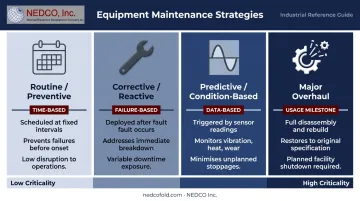
Routine / Preventive Maintenance
Time-based or usage-based maintenance performed at fixed intervals — regardless of current condition. Typical tasks include cleaning, lubrication, belt inspection, and part replacement per manufacturer recommendations.
This approach works best in consistent operating environments with predictable usage cycles. For specialized equipment like automatic folding and packaging machines, OEM-recommended intervals are the most reliable starting point. Over-maintenance is a real risk if intervals aren't calibrated to actual usage — building the schedule from manufacturer documentation keeps that in check.
Corrective / Reactive Maintenance
Addresses equipment issues after a failure or performance deviation is detected. This is distinct from full run-to-failure reactive maintenance, which carries the highest risk and cost.
Relying too heavily on reactive maintenance creates a compounding problem:
- Emergency labor commands premium rates
- Expedited parts shipping adds cost and delay
- One failed component often damages surrounding parts before it's caught
- Production disruption spreads downstream
Corrective maintenance has a role — not every minor issue warrants a scheduled service event — but it should represent a small fraction of total maintenance activity.
Predictive / Condition-Based Maintenance
Monitors specific performance indicators — vibration, temperature, noise levels, output consistency — and triggers maintenance only when data signals a problem is developing. McKinsey estimates that predictive maintenance typically reduces machine downtime by 30%–50% and extends machine life by 20%–40%, though results vary by asset type and implementation.
This approach reduces over-maintenance while catching issues before failure. The trade-off: it requires either sensor technology or attentive operator inspection routines. Without valid baselines, monitoring data is difficult to interpret.
Major / Overhaul Maintenance
Deep-service events involving significant disassembly, component replacement, recalibration, or full machine inspection — typically conducted annually or after a set number of operating hours.
Overhauls suit high-utilization equipment where accumulated wear across multiple systems needs to be addressed at once. Common overhaul tasks include:
- Replacing worn bearings, seals, and drive components
- Recalibrating sensors and control systems
- Inspecting structural welds and frame integrity
- Verifying alignment across all moving assemblies
Deferring overhauls increases the risk of cascading failures — a worn bearing that should have been replaced can take out a drive shaft it was never designed to carry alone.
Signs Your Manufacturing Equipment Needs Maintenance
Catching problems early keeps minor issues from turning into unplanned shutdowns. Production supervisors and operators should know what to look for before performance starts to slip.
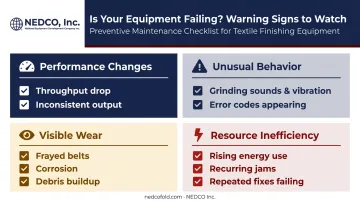
Performance or Output Changes
A drop in throughput speed, inconsistent output quality, or difficulty completing cycles reliably are often the first indicators that mechanical wear or calibration drift is affecting performance.
In textile and apparel production, even minor deviations in output consistency are worth investigating. A folder producing slightly off-center folds or a bagger leaving inconsistent seals signals that key components are no longer operating within spec.
Unusual Behavior or Operation
Sounds that weren't there before — grinding, squealing, rattling — are warning signals, not normal operating noise. The same applies to:
- Unexpected vibration during standard operating cycles
- Hesitations or pauses mid-cycle
- Irregular shutdowns or unexpected error codes
- Behavior that deviates from the machine's standard operating pattern
These are grounds for inspection, not a reset-and-continue response.
Visible Wear, Damage, or Buildup
Physical indicators worth acting on:
- Worn or frayed belts
- Corrosion on mechanical components
- Debris or material accumulation in feed areas
- Visible damage to drive components or guards
In fabric-handling and finishing equipment, lint and fiber buildup in particular can accelerate mechanical wear and create fire or jam risks if not cleared regularly. Error alerts and warning codes from the control system belong in this category too — they should be logged and investigated, not cleared and forgotten.
Increased Resource Use and Recurring Downtime
Several patterns point to underlying mechanical inefficiency before a full breakdown occurs:
- Rising energy consumption for the same production volume
- More frequent material jams or feed errors
- Increased manual intervention to maintain normal output
- The same minor issue recurring despite repeated fixes
When temporary corrections stop holding, spot fixes are no longer enough. Schedule a thorough inspection rather than continuing to patch the same problem.
Manufacturing Equipment Maintenance Schedule
Maintenance frequency depends on equipment type, daily usage hours, operating environment, and the machine's criticality to production flow. A machine running two shifts daily needs more frequent attention than one used occasionally.
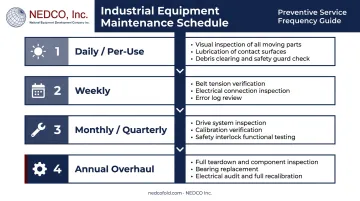
The table below provides a general framework that applies across most manufacturing equipment categories.
| Frequency | Core Tasks |
|---|---|
| Daily / Per-Use | Visual inspection for damage; lubrication spot-checks; clearing debris and buildup; verifying safety guards; confirming normal start/stop behavior |
| Weekly | Cleaning internal components and conveyor surfaces; checking belt tension and alignment; inspecting electrical connections for heat or wear; reviewing prior week's error logs |
| Monthly / Quarterly | Full mechanical inspection of drive systems, motors, and sensors; replacing wear items per OEM schedule; calibration checks; testing safety interlocks and emergency stops |
| Annual Overhaul | Full teardown inspection; bearing and seal replacement; electrical system audit; recalibrating all adjustment points; updating maintenance records |
Adjusting for Your Facility
High-utilization facilities running continuous or multi-shift operations should compress these intervals — particularly for wear-prone components. Low-usage environments may be able to extend some intervals based on documented condition assessments rather than strict calendar scheduling.
If you're running E-Z Fold automatic folding and packaging equipment, those same principles apply — but the specifics vary by model. NEDCO's service team can identify model-specific inspection points and supply genuine OEM replacement parts to keep you on schedule. Reach Don Cranshaw directly at Don@nedcofold.com or call 770-484-9969 to discuss annual service plan options or place a parts order.
Conclusion
Preventive maintenance is how manufacturers protect capital equipment, sustain production consistency, and manage long-term operating costs. Production losses, emergency repair premiums, and compounding damage from deferred maintenance consistently outweigh the cost of a structured program — often by a wide margin.
The right approach combines a structured schedule, thorough documentation, and real equipment performance data to drive adjustments. Whether that means daily operator checks, quarterly mechanical inspections, or annual overhauls, the schedule should be built around OEM guidance and actual usage patterns — not assumptions.
For manufacturers relying on specialized finishing and packaging equipment, partnering with the OEM for parts availability, service support, and model-specific guidance is one of the most practical ways to sustain a reliable maintenance program. NEDCO has supported the textile and apparel industries from Covington, Georgia since 1989 — contact the team at support@nedcofold.com or 470-592-3050 to learn more about annual service plans and genuine replacement parts for your E-Z Fold equipment.
Frequently Asked Questions
What are the main types of manufacturing preventive maintenance?
The four main types are time-based (scheduled at calendar intervals), usage-based (triggered by operating hours or production cycles), condition-based (driven by monitored performance indicators such as vibration or temperature), and predictive (using data analysis to anticipate failures before they occur). Most facilities use a combination of these approaches based on equipment criticality.
What is the 80/20 rule in manufacturing preventive maintenance?
In practice, a small number of assets drive most breakdowns. A pulp mill study at Reliable Plant found that fewer than 1% of assets — just 87 out of 12,000 items — generated 80% of unscheduled downtime. Targeting those high-risk assets cut unscheduled downtime by more than 50% within 18 months.
What is the Rule of 10 in manufacturing preventive maintenance?
The Rule of 10 — also called the 1:10:100 heuristic — holds that every $1 spent on prevention saves roughly $10 in corrective repairs and avoids up to $100 in disruption losses. It's a widely cited rule of thumb rather than a verified industry standard, but the underlying logic is sound: prevention compounds savings faster than reactive repairs ever can.
How often should manufacturing equipment undergo preventive maintenance?
Frequency depends on equipment type, usage intensity, and criticality. A general framework includes daily visual checks, weekly cleaning and lubrication tasks, monthly or quarterly mechanical inspections, and annual overhauls. OEM recommendations and actual operating conditions should drive adjustments to this baseline.
What is the difference between preventive and predictive maintenance?
Preventive maintenance runs on fixed time or usage-based schedules, independent of how the equipment is actually performing. Predictive maintenance uses real-time data, sensors, or performance monitoring to trigger service only when indicators point toward an approaching failure — reducing unnecessary interventions while catching problems earlier.
What happens if you skip preventive maintenance on manufacturing equipment?
Skipping scheduled maintenance increases the likelihood of unexpected breakdowns, shortens equipment lifespan, raises total repair costs, and can create unsafe conditions for production staff. NIST data shows the highest reactive-maintenance facilities experience 3.3x more downtime and 16x more defects than those with structured programs — far exceeding what the deferred maintenance would have cost.