The risks go beyond production delays. Degraded components — frayed belts, loose guards, overheating motors — create real safety hazards for operators. And the cost math is unforgiving: a single unplanned breakdown almost always costs more than a full year of scheduled preventive maintenance.
This guide covers why maintenance matters for textile equipment, the four main maintenance types, how to recognize early warning signs, and a practical scheduling framework to keep your machines running reliably.
Key Takeaways
- Regular maintenance reduces unplanned downtime and directly extends machine lifespan.
- Four maintenance approaches — preventive, corrective, predictive, and overhaul — each serve a distinct role in a complete maintenance strategy.
- Inconsistent output, unusual noises, and rising jam frequency are all warning signs that maintenance is overdue.
- A structured daily-to-annual maintenance schedule is the most reliable way to avoid costly reactive repairs.
- OEM replacement parts and direct access to your manufacturer's service team protect long-term machine integrity.
Why Maintaining Textile Equipment Matters
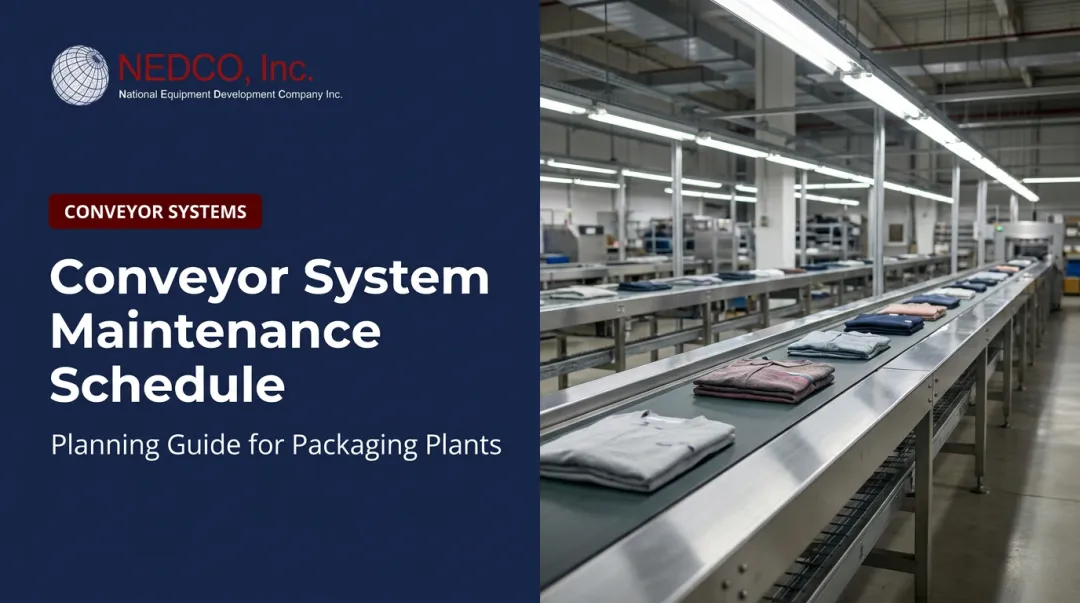
Textile machines operate in high-cycle conditions by definition. An automated T-shirt folding system running through a full production shift completes thousands of mechanical cycles — every one of which places load on belts, rollers, tensioners, and drive motors. Component fatigue is a physical certainty — the question is whether you manage it on your schedule or the machine's.
Output Quality Degrades Before Equipment Fails
Maintenance issues rarely announce themselves with a sudden breakdown. They show up first in product quality:
- Misaligned rollers produce garments with inconsistent fold lines
- Dull or worn cutting blades leave frayed or jagged edges
- Belt tension drift causes uneven feed speeds and misfolds
- Worn conveyor components create timing gaps between stations
Each of these issues increases waste and rework. What starts as a minor alignment problem compounds into scrapped product, slower throughput, and operator frustration.
Safety and Compliance Are Non-Negotiable
Equipment degradation is a safety issue, not just a productivity one. The Bureau of Labor Statistics reported 1.9 recordable injury and illness cases per 100 full-time apparel manufacturing workers in 2024 — a reminder that this is a sector with real injury exposure.
OSHA regulations relevant to textile equipment include:
- 1910.147 — Lockout/tagout requirements for servicing equipment, including lubrication, cleaning, and unjamming
- 1910.212 — Machine guarding requirements covering ingoing nip points, rotating parts, and point-of-operation hazards
- 1910.219 — Mechanical power-transmission components including belts, pulleys, and shafts
- 1910.262 — Textile-specific provisions covering certain cutters, folders, and shearing machines
A structured maintenance plan supports compliance with these standards and reduces regulatory exposure. The cost implications follow directly from that exposure.
The Cost Case for Preventive Maintenance
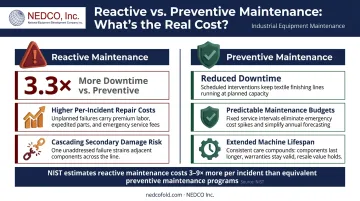
NIST research found that establishments with the highest reliance on reactive maintenance experienced 3.3 times more downtime than those with the lowest reliance — across U.S. discrete manufacturers. That's not a marginal difference. In a textile production environment where a single line stoppage idles labor and delays orders, scheduled maintenance pays for itself in avoided downtime alone.
Types of Machine Maintenance for Textile Equipment
Not all maintenance works the same way. The right approach depends on machine type, usage intensity, and the consequences of failure. Most well-run textile facilities use a combination of strategies rather than relying on any single one.
Preventive Maintenance
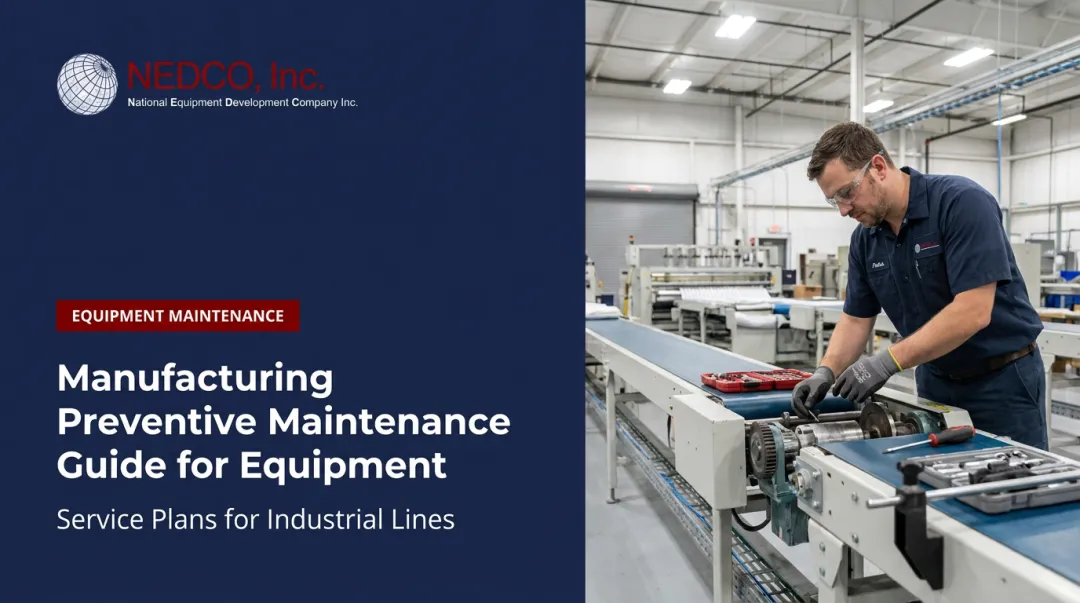
Preventive maintenance is time-based or usage-based servicing performed before failure occurs. For textile equipment, standard preventive tasks include:
- Lubricating all manufacturer-specified moving parts
- Cleaning lint and fiber buildup from motors, vents, and drive components
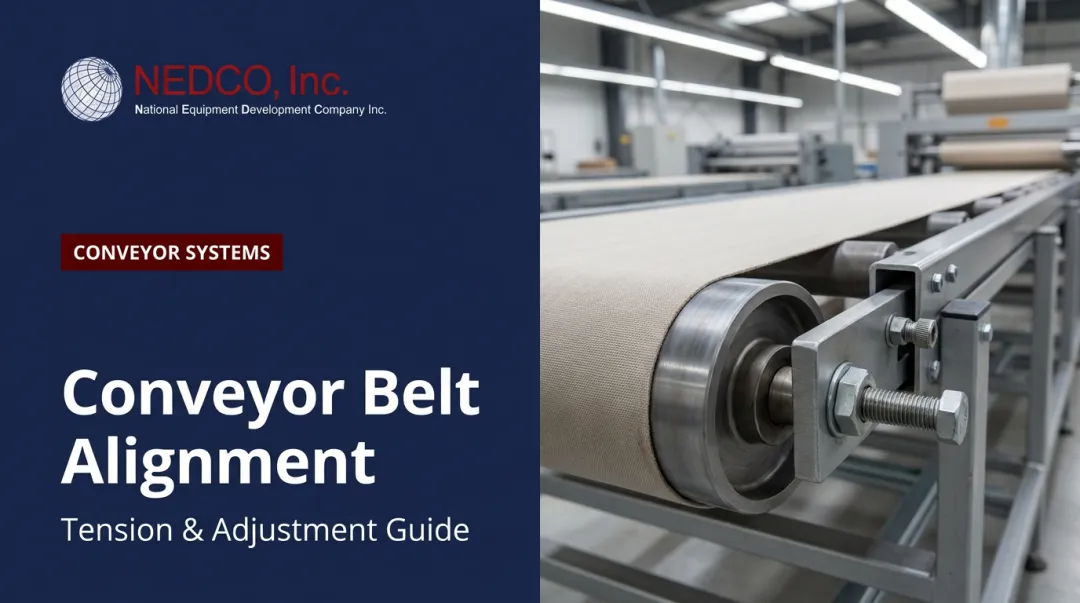
- Inspecting belts and rollers for tension, wear, and alignment
- Checking electrical connections and fasteners
- Verifying guards and safety covers are intact
Equipment manufacturers like NEDCO Inc. provide recommended service intervals for their machines. Using OEM replacement parts — rather than generic alternatives — matters: manufacturer-spec components are engineered to original tolerances and won't introduce fit or wear incompatibilities. For parts orders and service support, NEDCO's service team can be reached directly through their contact page.
Preventive maintenance is most straightforward for lower-volume operations. High-throughput facilities running multiple shifts typically need to layer in additional approaches.
Corrective Maintenance
Corrective maintenance means repairing equipment after a breakdown or malfunction. In a textile production setting, the timing is the problem: a folding system or packaging line failure can halt an entire production run mid-shift, creating order delays and idle labor.
The deeper risk with a purely reactive approach is secondary damage. When a primary component fails and goes unaddressed — a snapped belt that throws a roller out of alignment, for example — the damage typically spreads. What would have been a single-part replacement becomes a multi-component repair. Catching these warning signs early is exactly what predictive monitoring is designed to do.
Predictive / Condition-Based Maintenance
Predictive maintenance means monitoring performance indicators to catch problems before they become failures. Common monitoring parameters include vibration, temperature, motor current draw, and cycle counts.
Even without sophisticated sensor arrays, textile operators can use observable performance data as early indicators:
- Fold consistency drift that wasn't present last week
- Throughput speed that's fallen below normal without a change in product type
- Increased frequency of manual interventions or resets
McKinsey research indicates that predictive maintenance typically reduces downtime by 30% to 50% and extends machine life by 20% to 40% in manufacturing settings — though results depend heavily on the quality of monitoring data and alert thresholds.
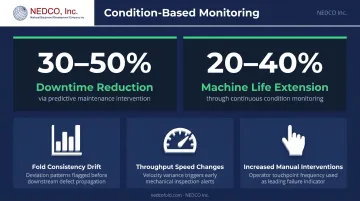
Condition-based monitoring pays off most for high-usage machines — automatic folding systems and industrial packaging lines that run continuously during peak periods are strong candidates.
Major Overhaul
Overhaul maintenance is comprehensive servicing — disassembly, full inspection, component replacement, and recalibration — typically required after extended use or when a machine's performance has significantly degraded from baseline. For complex textile machinery, overhaul work generally involves the original equipment manufacturer or a certified technician who knows the specific equipment design. NEDCO's service team can coordinate this level of service for E-Z Fold equipment.
How to Tell If Your Textile Equipment Needs Maintenance
The goal is to catch problems during normal operation — not after a failure stops production. Most equipment sends readable signals well before it breaks down.
Performance and Output Changes
Output quality shifts are often the first visible sign that something mechanical needs attention:
- Folded garments inconsistent in size or alignment from one cycle to the next
- Cutting machines producing uneven or frayed edges that weren't present previously
- Packaging lines sealing improperly or producing rejected packages
- Production cycles taking noticeably longer to complete than they normally would
Behavioral changes matter too. Difficulty starting up, extended warm-up times, mid-cycle stalls, and tasks that previously ran automatically now requiring operator intervention all suggest worn components or calibration drift.
Unusual Operation, Wear, or Error Indicators
Abnormal sounds are among the clearest early signals in textile machinery. Grinding, squealing, and clicking noises typically indicate bearing, belt, or roller degradation — often audible before any visible damage appears.
Visible indicators to watch for:
- Frayed or cracked belts
- Lint and fiber clogged in vents or around drive components
- Corrosion on metal surfaces or contact points
- Oil or grease residue where it shouldn't be present
On electronically controlled machines, error codes and alarm lights deserve immediate attention — even intermittent ones. Intermittent faults that appear and resolve on their own almost always indicate a developing problem, not a one-time anomaly.
Increased Downtime or Resource Consumption
When intervention frequency climbs without a clear cause, maintenance is overdue. A machine that needed one manual reset per week now needs several per day. A line that ran through full shifts without issue now requires constant adjustment. Those patterns mean the equipment needs attention — not that the crew is doing something wrong.
Power draw and material waste tell the same story. A machine consuming noticeably more energy for the same workload — or generating excess fabric waste with no change in inputs — is showing signs of mechanical wear, not an operator problem.
Textile Equipment Maintenance Schedule
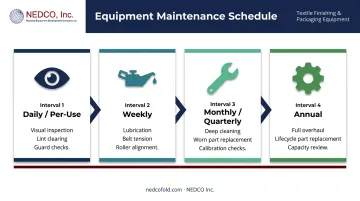
No single schedule fits every facility. Maintenance frequency depends on production volume, shift length, machine age, and environmental conditions — including airborne fiber and humidity levels that are characteristic of textile environments. Always treat your equipment manufacturer's manual as the primary reference. The framework below is a practical starting point.
| Interval | Key Tasks |
|---|---|
| Daily / Per-Use | Visual inspection for damage or wear; clear lint and fiber from vents and moving parts; verify guards and safety covers are in place; check for unusual sounds during startup |
| Weekly | Lubricate all manufacturer-specified points; inspect belts and chains for tension and wear; check roller alignment on folding and feeding systems; review logged error codes |
| Monthly / Quarterly | Thorough cleaning of internal components; inspect and replace worn belts, blades, or rollers; calibration checks for fold accuracy and cut precision; test all safety mechanisms and emergency stops |
| Annual / Long-Term | Full mechanical inspection or overhaul if required; replace high-wear parts per manufacturer lifecycle guidance; review maintenance logs for recurring issues; assess whether workload has grown beyond rated capacity |
Adjusting for Usage Intensity
High-volume facilities running two or three shifts should shift all intervals shorter: tasks scheduled weekly become daily, and monthly tasks become weekly. Equipment in intermittent or low-volume use can extend intervals slightly — but always within manufacturer guidance.
If keeping up with that scheduling feels like a burden, a structured service plan removes the guesswork. NEDCO Inc. offers annual service plans for E-Z Fold machines and related equipment, covering scheduled preventive maintenance and inspections throughout the year to keep machines running at rated capacity. Contact Don Cranshaw at Don@nedcofold.com or 770-484-9969 to enroll or to discuss a schedule appropriate for your production volume.
Conclusion
For textile equipment owners, maintenance is a discipline that protects capital investment, keeps output consistent, and keeps operators safe. A structured plan almost always costs less than a single unplanned breakdown — and far less than the cascading damage that follows when a small issue goes unaddressed long enough to take secondary components with it.
Equipment that's designed and supported by an experienced OEM makes this easier. NEDCO Inc. has manufactured E-Z Fold machines and textile packaging equipment from Covington, Georgia since 1989. Whether you need OEM replacement parts, technical troubleshooting, or a full annual service plan, Don Cranshaw is the direct contact: Don@nedcofold.com or 770-484-9969.
Frequently Asked Questions
What is machine maintenance?
Machine maintenance encompasses all scheduled and unscheduled work required to keep equipment running reliably, including inspections, lubrication, cleaning, part replacement, and repairs. The goal is to prevent breakdowns, sustain output quality, and extend machine lifespan over time.
What are the types of machine maintenance?
There are four main types:
- Preventive — scheduled upkeep before failure occurs
- Corrective — repairs made after a breakdown
- Predictive/condition-based — monitoring performance data to anticipate failures
- Major overhaul — comprehensive deep servicing at extended intervals
Most facilities use a combination of all four.
How often should textile equipment be serviced?
Service frequency depends on usage intensity and machine type. Most textile equipment benefits from daily visual checks, weekly lubrication and belt inspection, monthly calibration reviews, and annual overhauls, always aligned with the manufacturer's recommended schedule and adjusted for production volume.
What are the most common signs that textile machinery needs maintenance?
Key indicators include inconsistent output quality (uneven folds, rough cuts), unusual noises or vibrations during operation, increased frequency of jams or manual interventions, visible component wear such as frayed belts, and error codes or warning lights on electronically controlled machines.
What happens if textile equipment is not properly maintained?
Neglected maintenance leads to increased unplanned downtime, higher repair costs from secondary component damage, degraded product quality, elevated safety risks for operators, and a shortened overall machine lifespan. In most cases, a single unplanned breakdown costs more than months of scheduled upkeep.
How can I extend the lifespan of my textile folding or packaging machine?
Follow a consistent preventive maintenance schedule per manufacturer guidelines, use OEM replacement parts, keep equipment clean of lint and fiber debris, and train operators to recognize early warning signs. For E-Z Fold machines, NEDCO offers an annual service plan and parts support through Don Cranshaw at Don@nedcofold.com.