Introduction
Plastic bagging packaging is the process of enclosing finished, folded garments in a poly bag to protect them and prepare them for retail, wholesale, or e-commerce shipment. Done poorly, it generates real operational costs — rejected orders, damaged goods, missed compliance standards, and chargeback deductions that add up fast.
This guide is written for apparel manufacturers, garment production facilities, and bulk clothing brands who need to get this step right across multiple SKUs and sales channels. The scale of the operation reflects how embedded this step is: according to Fashion for Good's Circular Polybag Pilot, approximately 180 billion polybags are produced globally each year. For most mid-to-large manufacturers, it's non-negotiable.
What follows covers:
- The end-to-end bagging process
- Bag types and specification requirements
- Key factors that drive bag selection decisions
- Common mistakes that cost facilities time and money
Key Takeaways
- Plastic bagging protects garments from dust, moisture, and handling damage while meeting retailer packaging mandates.
- Bag type (OPP, LDPE, gusseted, header) should match the sales channel, not just the garment.
- Gauge requirements vary by buyer: Amazon FBA requires a 1.5 mil minimum, which many operations incorrectly assume is 2 mil.
- Consistent folding is the upstream variable that determines downstream bagging quality.
- Ventilation holes are fabric- and context-specific, not universally required.
Why Apparel Manufacturers Rely on Plastic Bagging
Plastic bagging does three jobs at once in any garment finishing operation — it protects the product, meets presentation standards, and satisfies channel compliance requirements.
On the protection side, a sealed poly bag shields finished garments from dust, moisture, and incidental handling damage during transit and warehouse storage. For folded items like t-shirts and activewear, that matters — an unbagged garment moving through a distribution center picks up contamination fast.
Channel-Specific Compliance Demands
Presentation and compliance requirements vary sharply by channel:
- Brick-and-mortar retail expects clean, uniform bags — often with header cards or hang holes — that maintain fold presentation on the shelf floor.
- E-commerce fulfillment centers (Amazon FBA, in particular) require transparent, sealed bags with specific thickness and labeling standards, including barcodes that scan through the bag.
- Wholesale distribution may specify bag type, seal method, and label placement in vendor compliance manuals — and non-compliance typically means chargebacks or rejected shipments.
Sourcing Journal confirms that polybags are standard across apparel, with individual bagging common even for commodity items like denim.
What Happens Without a Standardized Process
Skipping standardization creates predictable problems:
- Inconsistent folds make bags look misshapen at retail
- Garments shift during shipping without a snug bag fit
- Retailer compliance failures trigger chargebacks or order rejections
- Rework labor climbs as floor staff re-bag non-conforming units
The chargeback risk alone makes a reliable bagging process worth the investment — chargebacks on rejected shipments add up fast, and rework costs even faster.
How the Plastic Bagging Process Works Step by Step
The bagging workflow fits into the broader finishing line like this:
Production/decoration → Quality inspection → Folding → Bagging → Sealing → Labeling → Pack-out
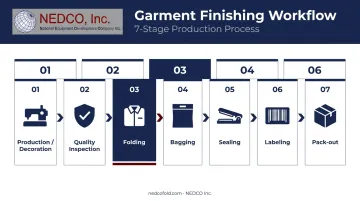
Every downstream step depends on what happens upstream. The weakest link in most operations is the folding step — not the bagging equipment.
Garment Preparation and Folding
Before a garment enters a bag, it needs to be folded to a consistent, predetermined dimension that matches the bag spec. This is where most operational variation originates.
Manual folding introduces size inconsistency across operators and shifts. A garment that's 1 inch too wide for a bag is a problem that doesn't show up until the bagging station — at which point it slows the line and creates seal issues.
Automated folding equipment addresses this directly. NEDCO Inc.'s E-Z Fold line produces uniform folds at production speeds designed to keep pace with downstream bagging and sealing equipment. The E-Z Fold system is modular, so it can be configured to the specific garment dimensions and production volumes in a given facility. It also integrates directly with NEDCO's Bagger/Sealer System via the Automatic Conveyor System, creating a continuous folding-to-bagging workflow.
Bag Loading and Insertion
The folded garment gets loaded into the appropriate poly bag. This step can be:
- Manual — for low-volume or high-mix operations
- Semi-automatic — using bag openers or dispensers to reduce operator effort
- Fully automatic — for high-volume, consistent SKUs on integrated lines
The bag must allow clean insertion without stretching while achieving a snug fit around the folded garment. Oversized bags look sloppy; undersized bags are slow to load and prone to tearing.
Sealing and Labeling
Once loaded, the bag is sealed using one of three methods:
- Self-adhesive flap — most common for retail poly bags; no equipment required
- Heat sealing — standard on high-speed production lines; NEDCO's Bagger/Sealer System uses heat sealing integrated into the same unit as bagging
- Press-to-close (zip-lock) — used for specialty or reclosable applications like accessories
After sealing, labels are applied per buyer specifications: barcodes, price tags, suffocation warning stickers, or hang tags. The sequence matters. Some retailers require labels applied before sealing; others after.
Types of Plastic Bags Used in Apparel Manufacturing
Choosing the wrong bag format wastes money, fails compliance checks, or undermines shelf presentation. Each format below has a specific job — match it to your garment type, sales channel, and buyer requirements.
OPP (Oriented Polypropylene) Bags
OPP bags are crystal-clear with a rigid feel. Biaxial orientation increases stiffness, toughness, and optical clarity, making OPP the preferred choice when shelf presentation drives the decision.
- Best for: retail-facing garments where product visibility matters
- Limitations: less forgiving under stress; suited for precisely folded, flat garments rather than bulky items
LDPE and LLDPE Poly Bags
LDPE (Low-Density Polyethylene) is softer and more flexible than OPP. LLDPE (Linear Low-Density Polyethylene) adds higher puncture resistance and impact performance to that base flexibility.
Both materials absorb handling stress better than OPP, which is why most major retailer compliance manuals default to them. Walmart, Macy's, Tillys, and DXL all require polyethylene variants — and several explicitly prohibit polypropylene in their e-commerce flows.
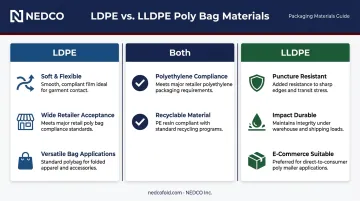
Common gauge range in apparel applications: 0.75 mil to 1.5 mil, depending on the buyer.
Gusseted Bags
Gusseted bags add extra depth to accommodate bulkier garments. HSN's vendor manual recommends a 3-inch gusset for folded apparel that is heavy, extra-large, or otherwise needs greater bag depth — which maps logically to hoodies, knitwear, and fleece.
Header Bags
Header bags have a reinforced top section (with or without a cardboard insert) and a pre-punched hang hole. They're designed for peg-hook retail environments where the header carries brand, barcode, and sizing information — keeping display-ready garments visible and organized on the floor.
Wicketed and Reclosable Bags
- Wicketed bags are pre-stacked on a metal wicket, allowing operators or automated equipment to pull each bag open quickly for high-speed loading.
- Reclosable (zip-lock) bags are better suited for accessories, gift-with-purchase items, or any situation where the end consumer might need to reseal the packaging.
Key Factors That Affect Plastic Bag Selection and Performance
Garment Dimensions and Fold Standardization
Bag dimensions follow folded garment dimensions — not the other way around. Before finalizing bag specs, standardize your fold size. If folds vary by operator or shift, your bag spec will fit inconsistently — and you'll end up over-ordering multiple bag sizes to compensate.
Automated folding equipment solves this upstream. With dimensions locked, you can specify a defined set of bag sizes mapped to your SKU range.
Gauge Selection by Channel
Gauge requirements are buyer-specific — and the common assumption that e-commerce requires 2 mil is incorrect.
| Buyer | Requirement |
|---|---|
| Amazon FBA (US) | 1.5 mil minimum |
| Tillys (e-commerce) | 1.5 mil biaxially oriented film |
| Macy's (store) | 1 mil |
| Macy's (.COM) | 0.9–1.5 mil |
| DXL | 1.0 mil LLDPE |
| Walmart | 0.75 mil LDPE |
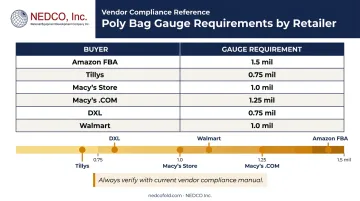
Pull the buyer's current vendor compliance manual before ordering film. Neither "1–1.5 mil for retail" nor "2 mil for e-commerce" applies universally.
Regulatory and Compliance Constraints
Two separate layers of rules apply to suffocation warnings:
- Amazon policy: Warning required on any bag with a flat opening of 5 inches or more
- California law (BPC §22200): Applies to bags under 0.001 inch thick that are large enough to fit over a child's head
- New York: Has its own prescribed warning language (10 NYCRR 12.12)
State/local law and marketplace policy operate independently. Check both for your destination markets.
Common Mistakes and Misconceptions in Apparel Plastic Bagging
Using One Bag Size Across All SKUs
This is the most common operational error. A single bag spec applied to a diverse product line leads to:
- Under-filled bags that look sloppy and shift in transit
- Overstuffed bags that are hard to seal and look misshapen
- Excess packaging waste from bags that are too large
- Increased rework when bags need to be re-done at pack-out
Define a small set of standardized bag sizes — typically 2–4 — mapped to folded garment dimension groups. Standardizing the folding step first makes this practical: if every medium t-shirt folds to the same dimension, one bag size covers the entire run.
Assuming Thicker Is Always Better
Thicker bags cost more and add no protection where thinner bags are already compliant. A 2-mil bag shipped to a retailer requiring 1 mil is wasted material cost at scale. A 0.75-mil bag sent into an e-commerce flow requiring 1.5 mil will fail channel compliance — and likely trigger chargebacks or re-pack requirements.
Specify gauge to match the channel requirement, not a generic "safe" number.
Ignoring Ventilation for Natural Fiber Garments
Sealed poly bags trap moisture. For garments going into extended storage or container shipping, that creates a mildew risk — particularly for natural fibers.
A 2025 study published via AAAS found cotton and suede highly susceptible to fungal attack in shipping conditions, while polyester and synthetic materials showed significantly lower susceptibility.
Practical guidance:
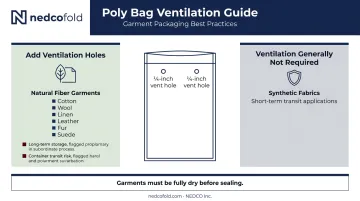
- Add ventilation holes for cotton, wool, linen, leather, fur, and suede — especially for long storage or container transit
- Tillys recommends two evenly spaced ¼-inch vent holes in heat-sealed bags
- Ventilation doesn't substitute for dry product — garments must be fully dry before bagging, and humidity control in the storage environment matters equally
- Synthetic fabrics in short-term transit generally do not require venting
Frequently Asked Questions
What type of plastic bags are used for apparel packaging?
The most common formats are OPP bags for retail shelf clarity, LDPE/LLDPE poly bags for e-commerce flexibility, header bags for peg-hook retail environments, and wicketed bags for high-speed production lines. The right choice depends on garment type, sales channel, and buyer compliance requirements.
What gauge poly bag is recommended for garment packaging?
Gauge is buyer-specific. Amazon FBA currently requires 1.5 mil minimum; Macy's store flow uses 1 mil; Walmart specifies 0.75 mil LDPE. Always pull the current vendor compliance manual for your specific buyer before ordering film — there is no single industry-wide standard.
Do plastic garment bags need ventilation holes?
Ventilation is recommended for garments made from natural fibers (cotton, wool, leather, suede) going into extended storage or container shipping, where moisture buildup can cause mildew. They're generally not required for synthetic fabrics or short-duration transit. Note that vents don't substitute for proper drying — garments must be fully dry before sealing.
What is the difference between polypropylene and polyethylene bags for clothing?
Polypropylene (OPP/BOPP) bags are clearer and stiffer, making them better for retail shelf display where product visibility drives the purchase. Polyethylene (LDPE/LLDPE) bags are softer, more flexible, and more puncture-resistant — better suited for e-commerce fulfillment and bulk shipping, and required by many major retailer compliance manuals for their e-commerce flows.
How are plastic garment bags sealed during apparel production?
The three main sealing methods are:
- Self-adhesive flap: most common for retail poly bags; no equipment required
- Heat sealing: standard on high-speed production lines (used in NEDCO's Bagger/Sealer System)
- Press-to-close or zip-lock: for specialty and reclosable applications
How does plastic bagging differ for retail versus e-commerce apparel fulfillment?
Retail bagging prioritizes visual presentation — clear bags, clean folds, header cards, and hang holes. E-commerce bagging prioritizes durability, gauge minimums, barcode label placement, and compliance with fulfillment center requirements. Even within one retailer (like Macy's), store and .COM bag specs can differ in material, gauge, and seal method.