This guide covers what bagger packaging machines are, how they work, the main equipment types, and what to evaluate before purchasing one for your facility.
Key Takeaways
- A bagger packaging machine automates filling and sealing products into bags, reducing or replacing manual packaging labor
- Equipment falls into three main classes: semi-automatic, fully automatic, and form-fill-seal — each suited to different volumes and workflows
- In apparel operations, baggers deliver the most value when integrated directly with a garment folding system to create a continuous finishing line
- Selection factors include throughput needs, bag format compatibility, changeover ease, and after-sale parts support
- 75% of end users rank immediate parts availability as a top aftermarket expectation — making service support a core purchasing factor
What Is a Bagger Packaging Machine?
A bagger packaging machine is a semi-automatic or fully automatic piece of industrial equipment that opens bags, accepts a product, and seals the bag, repeating this cycle at production speed. In textile and apparel contexts, this means packaging folded garments, printed tees, or bundled apparel into poly bags or retail-ready packaging.
Garment Baggers vs. General Industrial Baggers
General industrial baggers handle granules, powders, or food products using screw feeders, weight-based filling, or volumetric metering. Garment baggers work differently. They handle discrete, orientation-sensitive pieces — individual folded garments that need to arrive in the bag flat and undisturbed. The feeding mechanism, bag opening system, and sealing method are all designed around soft goods rather than bulk materials.
Why Manual Bagging Limits Scale
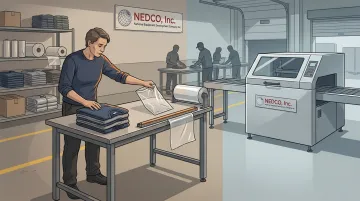
Hand-packaging garments introduces several problems that compound at volume:
- Seal alignment and fold orientation vary from one operator to the next
- Manual packers hit a throughput ceiling where speed increases only at the cost of quality
- Repetitive reach-and-seal motions cause musculoskeletal strain across a full shift
- Accuracy drops as fatigue sets in, compounding errors through multi-shift runs
Where the Bagger Fits in the Finishing Line
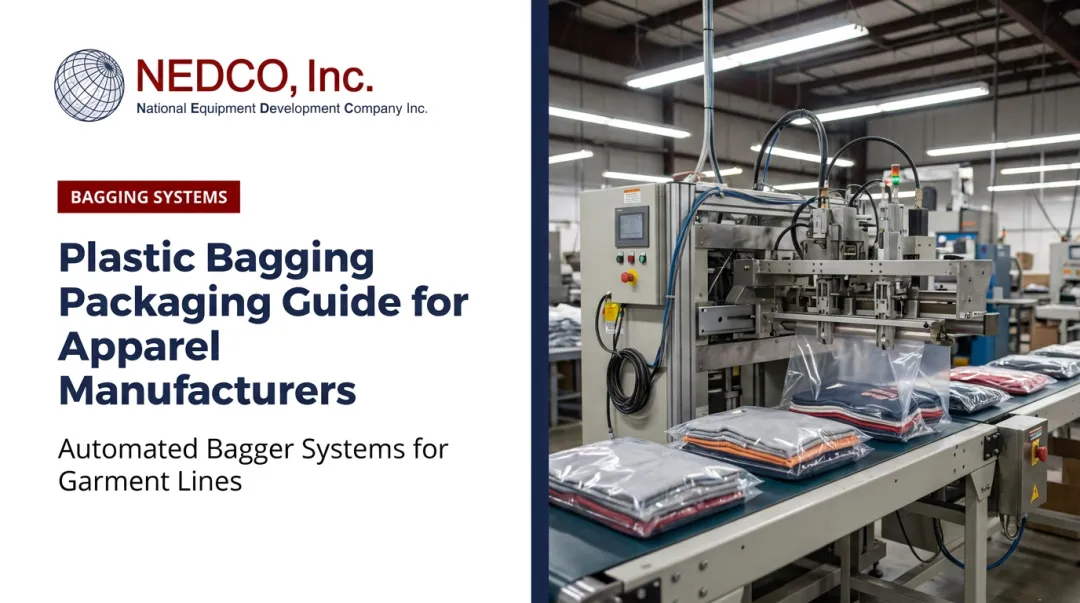
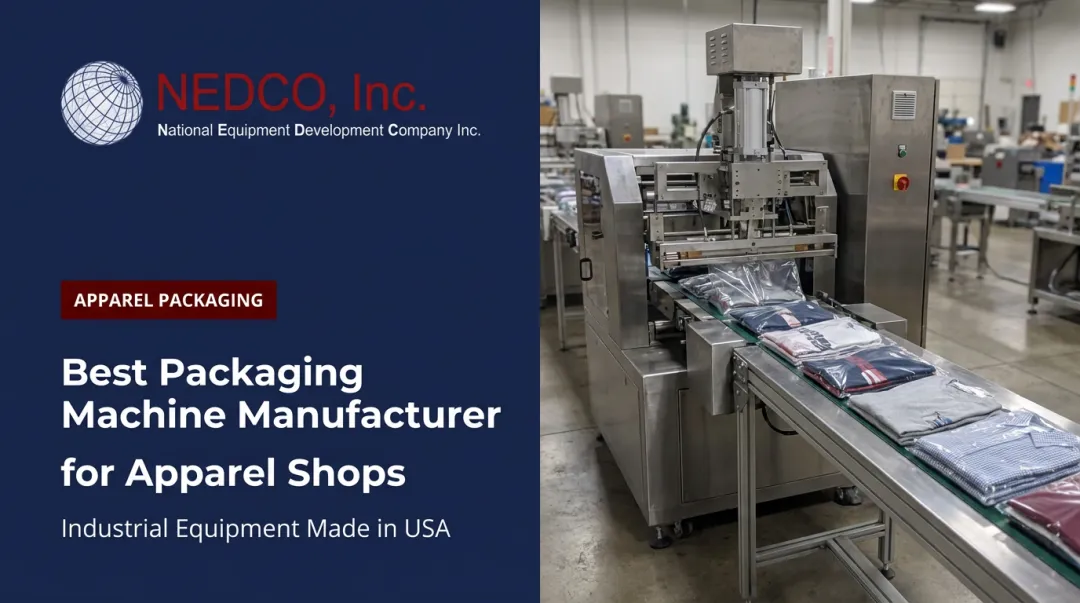
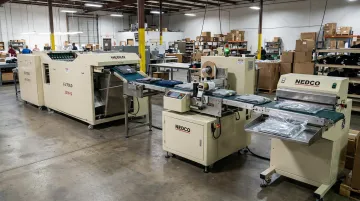
In a typical finishing line, the bagger comes after folding and labeling, and before boxing or palletizing. Many facilities position the bagger directly after an automatic garment folder so the folded garment transfers into the bagger without a manual handoff. NEDCO Inc., for example, designs its Automated Bagger and Sealer System to integrate with the E-Z Fold 2000 T-Shirt Folding Machine and Automatic Apparel Labeling System through a shared conveyor, creating a continuous fold-label-bag-seal workflow.
Bagger vs. Bagging System: What's the Difference?
A bagger is the individual machine that inserts and seals each product. A bagging system is the complete line, including a conveyor infeed, the bagger unit, a sealer, and an outfeed conveyor. Buyers shopping for equipment should clarify which they're purchasing. Some manufacturers sell integrated systems where sealing is built into the bagger unit (as with NEDCO's combined bagger/sealer), while others require a separate sealing station downstream.
How Does a Bagger Packaging Machine Work?
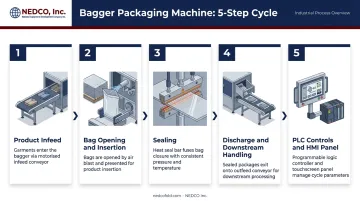
Modern garment baggers follow a reliable five-step cycle, documented across equipment from manufacturers including Pregis, M&R, and Thermotron.
Step 1 — Product Infeed
Products are fed into the machine either manually by an operator (semi-automatic) or automatically via conveyor (fully automatic). Garment baggers use flat-feed or gravity-drop mechanisms rather than the screw or belt feeders used for bulk materials — the goal is preserving fold integrity during transfer.
Step 2 — Bag Opening and Product Insertion
The machine advances a pre-made bag from a roll and opens it using a high-pressure air blast (as documented in the Pregis SX operator manual), or forms a package from rollstock in form-fill-seal configurations. Uniform bag presentation matters here. A poorly opened bag produces misaligned seals and packaging that fails retail presentation standards.
Step 3 — Sealing
The two most common sealing methods for garment baggers are:
- Impulse heat sealing — uses a wire element that heats briefly during the seal cycle, then cools; documented on the Pregis SX
- High-temperature heat sealing — continuous heat applied at the seal bar; documented on M&R's AB-9000
NEDCO's Automated Bagger and Sealer System uses heat sealing, with Teflon sheet components protecting the seal bar during each cycle. Replacement Teflon sheets are available as service parts, keeping lines running with minimal downtime.
Step 4 — Discharge and Downstream Handling
Once sealed, bags discharge onto a conveyor or collection area for labeling, boxing, or palletizing. This is where line integration matters most. A bagger that discharges onto a dead-end table creates a manual bottleneck; one connected to a downstream conveyor maintains throughput without adding labor.
Step 5 — PLC Controls and HMI Panels
Modern baggers use programmable logic controllers (PLCs) and HMI touchscreens to manage the cycle. Operators can set seal dwell time, cooling duration, bag advance parameters, and cycle counts. PMMI research identified product changeover (approximately 22%) and operator error (21%) among the leading causes of packaging machinery downtime. PLC-driven recipe management directly addresses both by reducing manual setup steps and standardizing parameters between runs.
Types of Bagger Packaging Machines for Textile & Apparel
| Type | Operator Role | Best Fit |
|---|---|---|
| Semi-automatic | Operator loads each garment; machine seals | Smaller operations, specialty garments, frequent changeovers |
| Fully automatic | Machine handles the full cycle | High-volume single or multi-shift runs |
| Form-fill-seal (FFS) | Operator manages film supply; machine forms, fills, seals | High-speed poly bagging of basic apparel |
| Inline with folder | Upstream folder transfers directly to bagger | Maximum throughput, minimum labor |
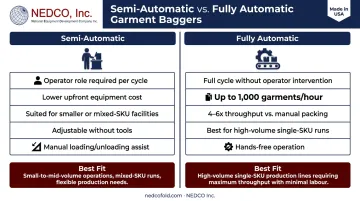
Semi-Automatic Baggers
These machines require an operator to place or position each garment before the machine seals. The M&R MB-9000, for example, is described as a semi-automated bagging/sealing machine with tool-free bag and product adjustments. Lower upfront cost makes semi-automatic baggers accessible for smaller facilities, but the per-unit labor cost is higher than automated alternatives.
Fully Automatic Baggers
Fully automatic baggers handle the complete cycle — feeding, opening, inserting, sealing, and discharging — without operator intervention at each cycle. M&R states its AB-9000, when paired with the K-950 folder, allows one operator to fold and bag up to 1,000 garments per hour. Pregis reports its automated bagging systems can produce 4–6 times the throughput of manual packing. Both figures are manufacturer-published ratings, not independent time studies, so verify both claims with an application trial before committing.
Form-Fill-Seal (FFS) Baggers
FFS machines create bags from a continuous roll of flat or tubular film, fill them, and seal them in a single continuous operation. For high-speed poly bagging of t-shirts and basic apparel, FFS reduces reliance on pre-made bags — though film compatibility, forming setup, and seal control require more careful management.
Inline Baggers Integrated with Folding Equipment
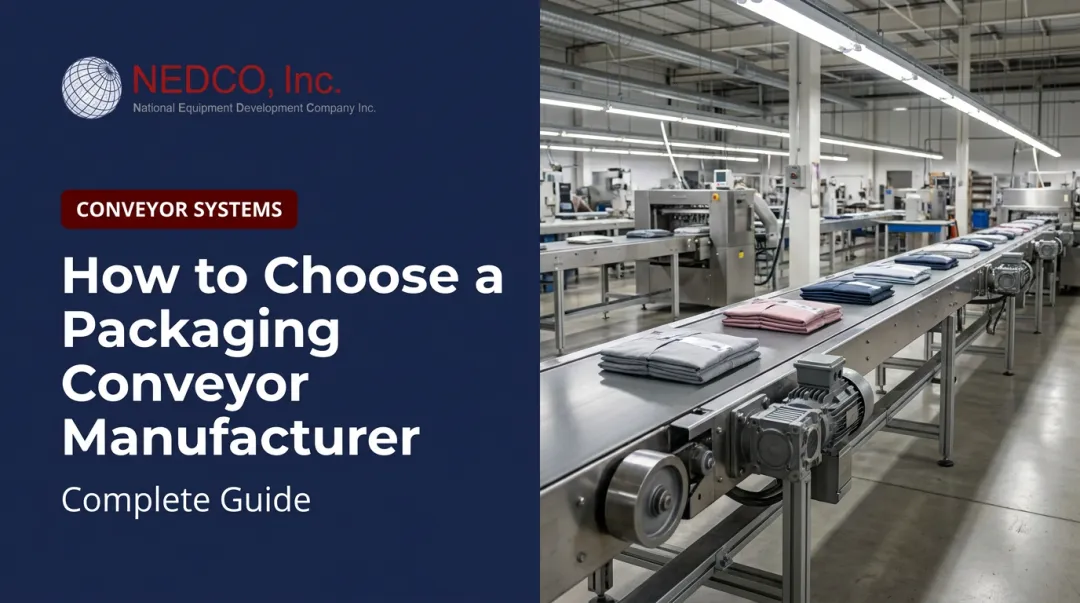
Connecting a bagger directly to the output of an automatic garment folder eliminates the manual handoff between finishing stages. The folded garment moves via conveyor directly into the bagger — no manual handoff required. This reduces labor between steps, improves package uniformity, and prevents the re-handling that causes fold distortion before sealing. NEDCO Inc. builds its modular finishing systems with this kind of integration in mind — the Automated Bagger and Sealer System connects to the E-Z Fold 2000 and Automatic Conveyor System as part of a complete fold-label-bag-seal line.
Key Benefits of Bagger Packaging Machines in Apparel & Textile Facilities
Throughput and Order Fulfillment Gains
Automating the bagging step removes one of the most time-consuming manual tasks in the finishing process. Facilities running high-volume single-SKU orders — printed tees, basic apparel, uniform programs — see the clearest gains, because the machine runs continuously without the pace variation that affects manual packers across a shift.
Operator Fatigue and Safety
OSHA identifies repetition, force, awkward posture, reaching, and static posture as musculoskeletal disorder risk factors. A 2024 NIOSH evaluation of a logistics facility found that 41% of interviewed employees reported potentially work-related pain in the prior three months, with packing and unpacking tasks among reported activities for those with back or shoulder complaints.
Automated baggers remove the repetitive reach-and-seal motion from the operator's workload — reducing exposure without requiring a change in staffing levels.
Consistency and Presentation Quality
Machine sealing produces uniform bag appearance across every unit. Seal dwell time, cooling duration, and bag advance are set once and repeat identically — no variation from operator to operator or shift to shift.
For branded retail packaging, inconsistent seals or fold orientation generate customer complaints and return requests — both of which are avoidable with machine-controlled parameters:
- Seal dwell time set once, repeated exactly on every unit
- Bag advance and cooling calibrated per garment type, not per operator
- Fold orientation locked in upstream, eliminating shift-to-shift variance
How to Choose the Right Bagger Packaging Machine for Your Operation
Match Machine Type to Production Volume and Product Mix
Start with your daily unit count and how frequently you switch between garment types or bag sizes:
- High-volume, single-SKU operations → fully automatic or FFS bagger with minimal changeover
- Mixed-SKU or specialty garment facilities → semi-automatic or automatic with recipe-driven changeover
- Facilities adding bagging to an existing folder → inline-capable automatic bagger with conveyor interface
A facility running 10,000 identical units per shift has different needs than one running 500 units across 12 SKUs with mid-shift changeovers.
Evaluate Total Cost of Ownership
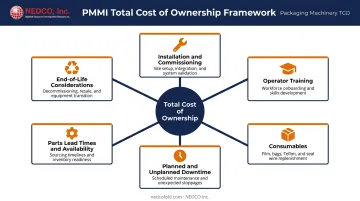
Purchase price is the least complete number in the buying decision. PMMI's Total Cost of Ownership (TCO) framework identifies the full cost picture across a machine's operating life, including:
- Installation and commissioning
- Operator training
- Consumables (film rolls, bags, Teflon sheets, seal wire)
- Planned and unplanned downtime costs
- Parts lead times and availability
- End-of-life considerations
A machine priced lower at purchase but sourced from a supplier with slow parts lead times or limited service coverage typically costs more over three to five years than a better-supported domestic alternative.
Prioritize After-Sale Support and Parts Availability
Parts availability is where TCO gets real. A bagger is a production-critical machine. When it stops, the entire finishing line stops.
Before purchasing, ask manufacturers directly:
- Which wear components are stocked, and what are normal lead times?
- Is there a named service contact for technical support?
- Do you offer preventive maintenance programs?
- What documentation and training materials are included?
75% of end users identify immediate parts availability and fast lead times as top aftermarket expectations — get written commitments, not verbal assurances.
NEDCO Inc. provides dedicated service and parts support for all equipment in its lineup. Don Cranshaw handles service requests and parts ordering directly, reachable at Don@nedcofold.com or 770-484-9969.
The company also offers an Annual Service Plan covering scheduled preventive maintenance and inspections throughout the year, a practical option for any production-critical machine. Financing through Beacon Funding is available for bagger/sealer systems and the full finishing line.
Frequently Asked Questions
What is a bagger packaging machine used for in the textile industry?
In textile and apparel operations, bagger packaging machines automate the insertion and sealing of folded garments into poly or retail bags. They replace manual packaging labor, improve consistency across units, and allow high-volume production lines to package without the pace limitations of hand-packing.
What is the difference between a semi-automatic and fully automatic bagger?
Semi-automatic baggers require an operator to load or position each garment before the machine seals the bag. Fully automatic baggers handle the complete cycle: feeding, opening, inserting, sealing, and discharging without per-cycle operator intervention, making them better suited for continuous high-volume runs.
How does a bagger packaging machine integrate with a garment folding system?
Most modern baggers can be positioned inline with automatic garment folders so the folded garment transfers directly into the bagger via conveyor. NEDCO's Automatic Conveyor System, for example, connects the E-Z Fold 2000 folder, labeling system, and Automated Bagger and Sealer System into one continuous line, eliminating manual handoffs between stages.
What bag formats and materials can textile baggers typically handle?
Most apparel baggers support poly flat bags, pre-made open-mouth bags, and film-from-roll formats across a range of sizes. Sealing method varies by machine (heat seal vs. adhesive tape). Confirm bag size range and sealing compatibility with the manufacturer before purchasing, and verify that compatible bags are available directly from the supplier.
How do I reduce downtime on a bagger packaging machine?
Choose a machine with stocked spare parts, clear HMI/PLC controls, and a manufacturer that offers direct service support. PMMI research shows changeover issues and operator error account for roughly 43% of packaging machinery downtime combined. Preventive maintenance schedules and operator training address both before they cause unplanned stops.