Introduction
Running separate folding, labeling, and bagging stations sounds manageable — until you calculate what manual transfers between them actually cost. Every handoff adds idle time, inconsistent output, and labor that doesn't move product. At scale, those inefficiencies compound into margin erosion that's hard to trace back to its source.
This guide breaks down how integrated textile finishing and packaging lines work, what components make up a complete system, how to match equipment to your production volume, and which mistakes consistently derail otherwise solid investments. Whether you're configuring your first automated apparel line or reconsidering an existing setup, the specifics here will help you make a better decision before committing budget.
Key Takeaways
- Integrated textile finishing lines connect folding, labeling, and bagging/sealing through synchronized conveyors — removing manual handoffs between stations
- Size your labeling system to match the actual throughput of your slowest upstream machine, not the peak rated speed on a spec sheet
- Garment type, fold dimensions, label placement zone, and conveyor spacing all determine whether an integrated apparel line performs as designed
- Modular equipment designs let production facilities add capacity incrementally without replacing entire finishing lines
- Running qualification tests with finished, folded garments — not flat blanks — is the step most likely to catch label placement and registration problems before full production begins
What Makes Up an Integrated Filling, Capping & Labeling System
Integration, in a packaging line context, means all three stations operate as a single synchronized system. Conveyors connect filling, capping, and labeling, while a shared control architecture manages start/stop signals, fault communication, and throughput matching. Product moves from empty container to finished, labeled package without anyone physically transferring bottles between stations.
Beyond the three core machines, a complete line typically includes:
- Bottle unscramblers — orient and feed containers onto the conveyor
- Conveyors and turntables — manage flow, spacing, and direction changes
- Coding systems — apply batch codes, expiry dates, and barcodes
- Inspection and rejection stations — detect fill level, cap, or label defects and remove non-conforming products
- Shrink tunnels — apply tamper-evident sleeves where required
Filling Machines
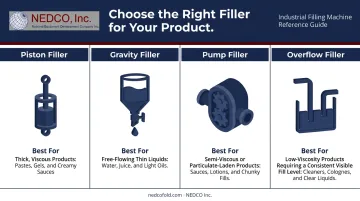
The filling machine's job is dispensing precise, repeatable volumes into containers. Machine type should match the product — choosing the wrong filler for your product's viscosity or behavior creates chronic accuracy problems:
| Filler Type | Best For |
|---|---|
| Piston filler | Thick pastes, creams, gels, sauces |
| Gravity filler | Free-flowing thin liquids (water, oils) |
| Pump filler | Foamy, corrosive, or particulate-containing products |
| Overflow filler | Products requiring a consistent visible fill level |
A food production model from PERUZA illustrates what imprecise filling costs: a facility running 2.5 million kg per year at a 5% giveaway rate loses approximately €187,500 annually. Cutting that to 2% recovers €112,500. In regulated industries like pharmaceuticals, fill-level inconsistency adds recall risk on top of that product loss.
Capping Machines
Capping machines apply closures with consistent torque and alignment. The type of capper must match the closure type:
- Spindle cappers — tighten screw caps while bottles move continuously through the machine
- Chuck cappers — grip and torque individual caps; suited to precise torque requirements
- ROPP cappers — form roll-on pilfer-proof aluminum closures for tamper-evident applications
- Snap/press cappers — mechanically press closures onto containers without screw torque
Cap quality has a direct downstream effect on labeling. Crooked caps, inconsistent seating heights, or misaligned closures cause bottles to wobble or sit unevenly as they enter the labeler, producing label skew, wrinkles, and mispositioning, particularly on tamper-evident or neck labels.
Labeling Machines
The labeler applies pre-printed labels with consistent placement, pressure, and alignment. Configuration depends on the label type required:
- Self-adhesive (pressure-sensitive) — most common; no separate adhesive system required
- Wrap-around — covers the full circumference of cylindrical containers
- Front-and-back — applies separate labels to designated container panels
- Top-surface — used for flat lids or container tops
- Tamper-evident — bridges the cap-to-bottle junction
- Shrink sleeve — full-body or neck coverage via heat shrink application
The labeler is the last quality-visible step before the product reaches the consumer. Label accuracy isn't just aesthetic — it's regulatory. Ingredient lists, barcodes, batch codes, and expiry dates all live on that label.
Top Benefits of Integrating Filling, Capping & Labeling
Increased Throughput
Synchronized machines eliminate the idle time created by manual transfers. When all three processes run at matched speeds, bottlenecks disappear. Production lines that consolidate filling, capping, and labeling into a single connected system routinely report output increases of 50–70% compared to sequential standalone setups — with the same headcount and floor space.
Reduced Labor and Operator Fatigue
With a properly integrated line, fewer operators manage fewer transitions. This matters practically: every manual handoff between standalone stations adds repetitive lifting, repositioning, and decision-making across a full shift.
Combining operations into one continuous flow eliminates the separate manual steps that accumulate into operator fatigue over time. Fewer handoffs means fewer injury-risk moments and more consistent output per shift.
Improved Product Consistency
Automation removes the variability that manual handling introduces — inconsistent fill volumes, loose caps, crooked labels. Integrated lines keep products under controlled mechanical conditions from filling through final labeling, which is especially critical in cosmetics, food, and pharmaceutical production.
Simpler Maintenance and Support
When machines come from a compatible system — or a single manufacturer — maintenance schedules, spare parts sourcing, and troubleshooting all simplify. Multi-vendor standalone setups introduce the opposite problem:
- Different PLCs with incompatible diagnostic interfaces
- Separate parts inventories for each machine brand
- Multiple service contracts with different response SLAs
- Longer troubleshooting cycles when systems don't communicate
Each of those friction points compounds during an unplanned stoppage.
Scalability Without Full Replacement
Modern integrated lines accommodate changeover through servo-controlled adjustments, recipe storage, and modular machine configurations. Manufacturers can switch between container sizes or product types without extended downtime, and add capacity incrementally as SKU counts or volumes grow.
How to Plan and Match Your Integrated Line
Start With Real Output, Not Rated Speeds
A packaging line runs at the speed of its slowest station. Ignoring this is the most expensive mistake buyers make.
Don't compare maximum rated speeds across spec sheets. Instead:
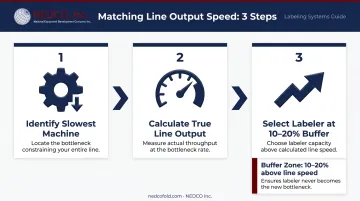
- Identify your slowest machine — often the bagger or sealer
- Calculate your true line output based on that machine's stable operating speed
- Select the labeler at 10–20% above that number to provide a working buffer
Matching Machine Speeds
A practical example: if a folder outputs 80 garments per minute but the bagger reliably handles 60, the downstream label applicator should be selected for stable operation around 70–75 units per minute. Choosing a labeler rated for 80 to "match" the folder wastes investment, adds footprint, and adds complexity — without increasing actual throughput.
Product Shape and Stability Considerations
Product geometry and packaging format determine label applicator configuration:
- Flat-folded garments in poly bags → top or front label placement
- Hanging apparel or tags → inline tag insertion or applicator arm
- Bulk-bagged units → high-speed front-face label application
Before selecting a labeler, document these specs for every SKU in your product range:
- Bag or package dimensions (width, height, depth)
- Filled weight and rigidity
- Surface material (poly type, texture, print coverage)
- Folded garment behavior under guide pressure
- Package stability on conveyor when loaded
Filled or folded package behavior differs from empty. Heavier bags shift on conveyors. Loosely folded garments can deform under guide pressure. These variables should be tested before committing to a line configuration.
Conveyor and Spacing Design
The conveyor manages more than transport — it controls package flow, spacing, and stability between all three stations. Insufficient spacing before the labeler causes missed detections and mis-applied labels.
Common package-spacing methods:
- Screw separators — precise spacing for high-speed applications
- Timing belts — consistent indexing for uniform packages
- Star wheels — accurate placement at fixed stations
- Indexing systems — batch-controlled movement for slower or specialty lines
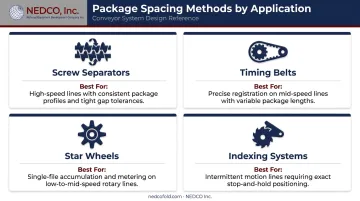
The right choice depends on speed, package shape, and accuracy requirements.
Control System Compatibility
Getting conveyor spacing right solves the physical flow problem — but machines also need to talk to each other electronically. Every station in an integrated line must exchange signals: start, stop, fault, low material, no-label detection, and emergency stop. Incompatible PLCs or HMI systems between different manufacturers cause frequent unplanned stops and make troubleshooting time-consuming.
PackML, the OMAC packaging automation standard, addresses this directly — it gives machines from different manufacturers a common look, feel, and consistently defined behavior. ISA-TR88.00.02-2022 standardizes machine and unit states as an implementation framework. Specifying PackML compliance across your line reduces custom interfaces and makes cross-vendor integration far more manageable.
Step-by-Step Guide to Implementing an Integrated Line
Step 1: Evaluate and Define Requirements
Before approaching any supplier, document:
- Production volume targets (bottles per minute or per hour)
- Container types, dimensions, and filled weights
- Product viscosity and characteristics
- Cap types and torque requirements
- Label formats and regulatory content requirements
- Floor space constraints and utility availability
Having these parameters defined prevents over-specification, scope creep, and budget overruns. Suppliers can't give you accurate recommendations without them.
Step 2: Select Compatible Equipment and Test Thoroughly
Equipment selection should prioritize compatibility across all three stations and the conveyor system — not just individual machine performance.
Once equipment is selected, testing must use:
- Real filled containers (not empty bottles)
- Real production labels (not test stock)
- Real caps with typical production variation
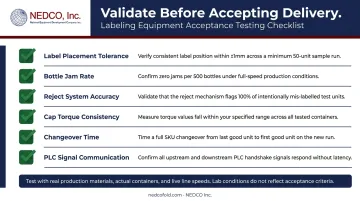
Key test metrics to validate before accepting delivery:
- Label placement tolerance
- Bottle jam rate
- Reject system accuracy
- Cap torque consistency
- Changeover time between container sizes
- PLC signal communication between machines
Step 3: Monitor, Maintain, and Plan for Change
Ongoing operation requires:
- Preventive maintenance schedules — planned downtime is far cheaper than unplanned
- Spare parts inventory — especially high-wear components for each station
- Operator training — on both normal operation and fault recovery
- OEE tracking — to identify where line efficiency is being lost
Future-proofing should be built into the selection process. Machines with adjustable guides, recipe storage, and modular components adapt as new container sizes or products are added — a capability that matters far more once your line is running at full capacity.
Common Mistakes to Avoid When Integrating Packaging Lines
Three mistakes consistently derail textile packaging line integrations — and all three are avoidable with the right evaluation approach.
1. Selecting Equipment by Peak Speed Ratings
Rated throughput numbers describe ideal conditions, not real production floors. Garment variation between SKUs, label roll changeovers, bagging film splices, and operator pace all pull actual output below the spec sheet figure. Evaluate equipment by sustained throughput across a full shift, not peak performance under controlled conditions.
2. Underestimating Upstream Effects on Downstream Quality
Each stage in a finishing line affects the next. A folding machine producing inconsistent folds creates stacking problems for the bagger; a misaligned label applicator throws off downstream conveyor timing. When quality issues appear at the final stage, the root cause is almost always upstream — and often overlooked during troubleshooting.
3. Running Acceptance Tests with Ideal Samples
Pre-purchase demonstrations using uniform garments at controlled speeds reveal little about real performance. Actual production involves material variation between batches, size range differences, temperature fluctuations in the facility, and operator-level adjustments throughout the day. Test with your real product range under conditions that reflect your production environment — not the vendor's best-case scenario.
Frequently Asked Questions
What is an integrated filling, capping, and labeling system?
It's a synchronized production line where labeling, bagging, sealing, and conveyor stations are connected under a shared control architecture. Garments or textile products move from one finishing step to the next without manual transfers between machines — reducing handling time and operator fatigue.
How do I match my labeling machine speed to my filling and capping line?
How do I match my labeling machine speed to my integrated packaging line?
Select the labeler based on the actual output of your slowest upstream machine — typically the folder or bagger — and add a 10–20% buffer. Never spec labeler capacity against a folder's peak rated speed if downstream equipment can't sustain it.
What is the difference between a monoblock system and a modular integrated line?
A monoblock combines filling, capping, and sometimes labeling into a single compact machine frame. A modular line connects separate machines via conveyors. Monoblocks offer a smaller footprint. Modular lines — like NEDCO's equipment family — offer greater flexibility and let you expand or reconfigure individual stations as production demands grow.
Which industries benefit most from integrated filling, capping, and labeling systems?
Which industries benefit most from integrated textile packaging lines?
Screen printers, embroiderers, bulk apparel manufacturers, and graphic design firms handling high-volume garment finishing. Any operation folding, labeling, bagging, or sealing textiles at meaningful production volume will see real gains from an integrated line.
Can small-scale or growing manufacturers benefit from integrated packaging lines?
Yes. Smaller automated lines are available that deliver real efficiency gains even at modest volumes. NEDCO's modular design lets manufacturers start with core equipment — a folder or labeler — and add bagging, sealing, or conveyor stations as production demands increase.
What should I test before accepting delivery of an integrated packaging line?
Run acceptance testing with your actual garments and packaging materials. Key checks include:
- Label placement accuracy across a full production run
- Bagger/sealer consistency and seal integrity
- Throughput rate against your target output
- Changeover time between different garment or container formats
- Signal communication and timing between machine stations