Choosing the right packaging conveyor manufacturer determines your throughput, your operators' daily workload, your long-term maintenance costs, and ultimately your competitive position in a market where the US textile supply chain accounts for $60.9 billion in shipments and over 453,000 workers.
This guide covers what packaging conveyor manufacturers actually do, the six factors that separate strong candidates from weak ones, the questions you should ask before committing, and how to evaluate a manufacturer built specifically for garment and textile production.
Key Takeaways
- Industry-specific experience matters — generalist suppliers don't understand fabric sensitivity, fold consistency, or garment weight variation
- Modular design lets your system grow with production demands without full replacement
- After-sale support and parts availability directly determine how quickly you recover from downtime
- Total cost of ownership, not purchase price, is the right basis for comparing manufacturers
- US-based manufacturers typically mean faster service, local parts access, and clearer accountability
What Is a Packaging Conveyor Manufacturer?
A packaging conveyor manufacturer designs, builds, and supports the conveyor-based systems that move products through a production line — handling transport, accumulation, sorting, and handoff between processing stations. This is distinct from a general industrial equipment distributor, which resells equipment built by others without the engineering depth to customize or support it.
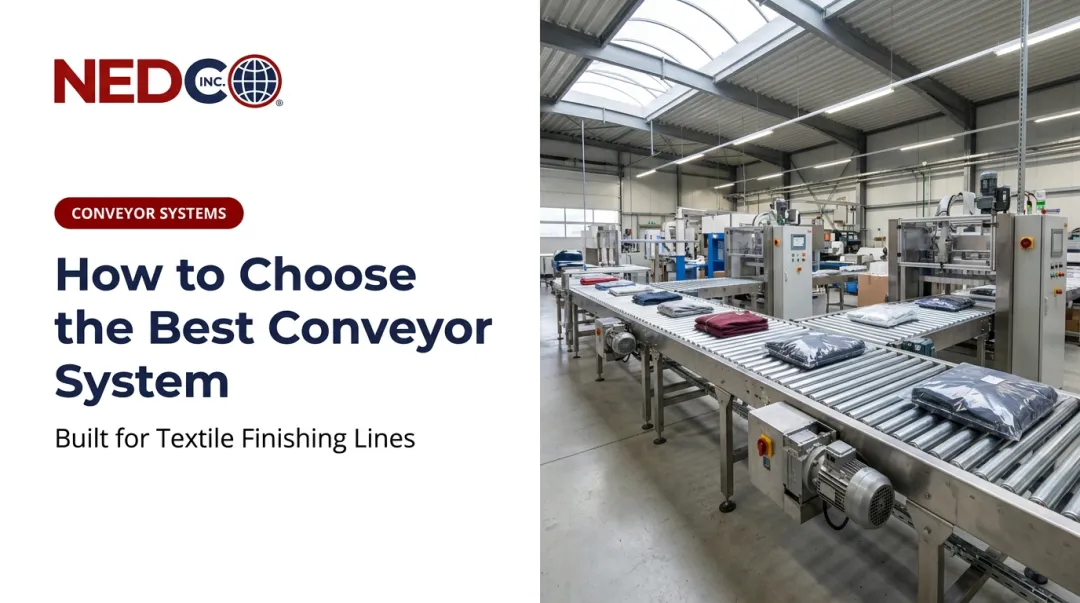
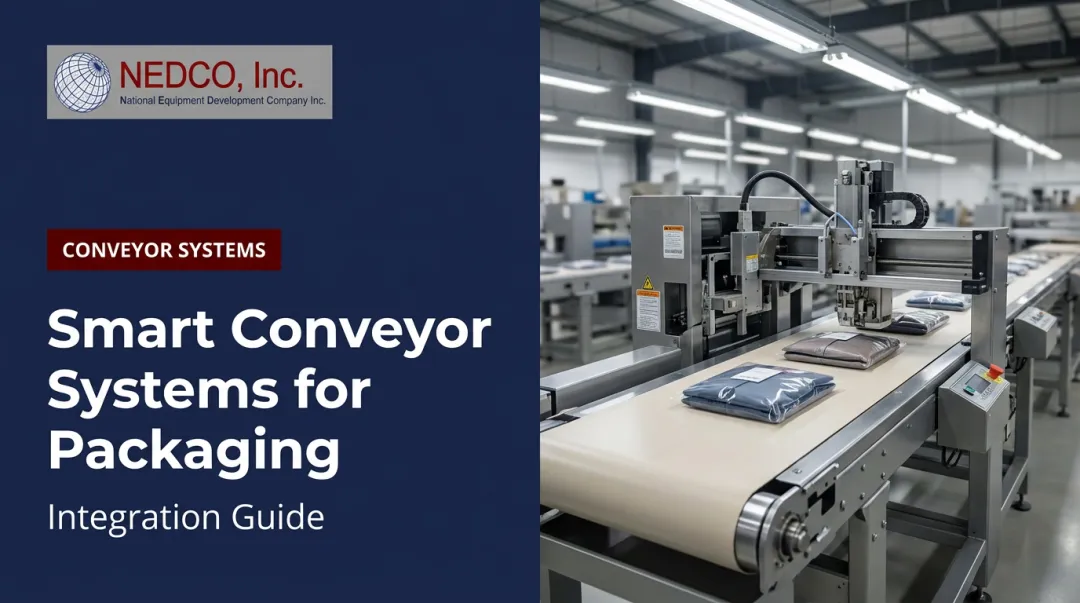
In textile and apparel contexts, "packaging conveyor" means something more specific than basic material transport. The conveyor connects every step of the finishing sequence — folding, labeling, bagging, and sealing — into a single automated workflow.
A manufacturer that understands only the conveyor segment, without understanding what surrounds it, will deliver a system that slows your line rather than advancing it.
Types of Packaging Conveyor Systems
Three primary conveyor types appear in textile finishing environments:
| Type | Primary Use | Key Consideration |
|---|---|---|
| Belt conveyor | Continuous transport of flat or wrapped products | Confirm belt interface suits your specific package type |
| Powered roller conveyor | Buffering and accumulation between stations | Not always suitable for soft bags or unstable bundles |
| Modular/specialty conveyor | Custom layouts, elevation changes, specific product formats | Confirm distinction between modular belt and modular architecture |
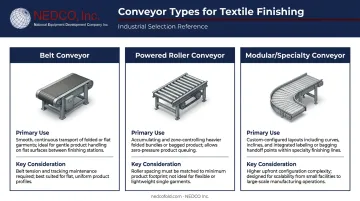
The best manufacturer for a garment or textile operation understands these distinctions and can recommend — or engineer — the right configuration for your specific product and line layout. Horizontal and inclined configurations serve different facility footprints, and width options matter when integrating with folders, labelers, or baggers at varying workstation heights.
What to Consider When Choosing a Packaging Conveyor Manufacturer
Selecting a packaging conveyor manufacturer means aligning technical specifications to operational realities. The right fit depends on your product type, facility layout, throughput targets, and support expectations — not on which supplier has the most polished catalog.
The six factors below move a procurement decision from a vendor shortlist to a confident, long-term commitment.
Industry-Specific Experience
A manufacturer with deep textile and apparel experience understands product handling characteristics that a generalist simply cannot anticipate: fabric sensitivity, garment weight variation, fold integrity during transport, and the pacing demands of a high-cycle finishing line.
Ask for a verifiable track record:
- How many years has the manufacturer served your industry?
- What facility types have they equipped — screen printers, bulk apparel manufacturers, retail fulfillment centers?
- Can they speak fluently about your finishing environment's constraints without needing you to explain basics?
Vague answers to these questions suggest experience that doesn't run as deep as the marketing materials claim.
Customization and Modular Design Capability
Fixed-configuration systems are a liability. Production volumes change, product formats shift, and facilities evolve. A manufacturer offering modular equipment design gives you the ability to add, reconfigure, or extend the system without replacing core components — a meaningful cost advantage over a 5-10 year horizon.
Beyond modularity, ask whether the manufacturer designs for integration or for isolation. A conveyor that requires a standalone "island" approach forces manual handoffs between processing stages. A properly integrated system connects your folder, labeler, bagger, and sealer into one automated sequence — cutting handling time, reducing errors, and lowering operator fatigue across the line.
Build Quality and Materials
Material quality affects equipment longevity, maintenance frequency, and total cost of ownership. Research what the manufacturer uses for frames, belts, and drive components — and whether that construction holds up in high-cycle production environments.
US-manufactured equipment carries a practical advantage here: quality accountability is more accessible, parts are domestically sourced, and you're not waiting on international logistics when something needs replacing. NIST's supply chain analysis found that nearly 50% of a typical manufacturer's purchased materials are imported, which creates supply vulnerability that domestic manufacturing can reduce.
Ask for documentation on component sourcing and any quality standards the manufacturer adheres to.
After-Sale Support, Spare Parts, and Service Access
This is the most commonly underweighted selection factor — and the most expensive one to get wrong.
NIST's research found that $119.1 billion in annual losses stem from preventable maintenance issues — $100.2 billion of that from lost sales due to production delays and defects. On a high-volume order day, a finishing line going down makes that number very concrete.
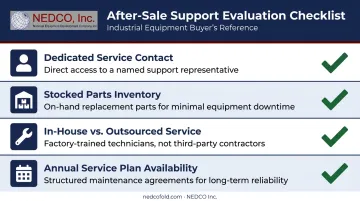
Evaluate manufacturers on:
- Dedicated service contact — Is there a named person who handles your request, or does it go into a generic queue?
- Stocked parts inventory — Are replacement components held domestically, or do they require lead time from overseas?
- In-house vs. outsourced service — Manufacturers who handle parts and repairs internally resolve problems faster than those who outsource
- Annual service plan availability — Preventive maintenance programs reduce unplanned downtime
Lead Times and Delivery Reliability
Lead time affects capital planning and production ramp-up. A multi-month gap between purchase order and commissioning delays your ROI and can disrupt expansion timelines.
Get realistic current lead time estimates — not what their website says, but what their actual production queue looks like right now. Verify their history of meeting delivery commitments. Domestically based manufacturers with focused production queues tend to offer faster, more predictable turnaround than those managing extended international supply chains.
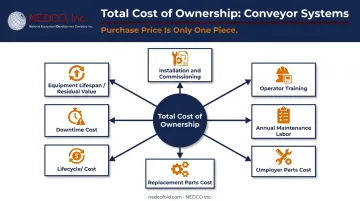
Total Cost of Ownership
Purchase price is the wrong metric for this decision. The true cost of a conveyor system includes:
- Installation and commissioning
- Operator training
- Annual maintenance labor
- Replacement parts frequency and cost
- Downtime cost when equipment fails
- Equipment lifespan and residual value
Plant Engineering's TCO framework includes all of these dimensions — and the comparison shifts significantly when you account for them. Ask each manufacturer to estimate annual maintenance cost, average parts replacement cycle, and expected equipment lifespan. Those numbers reveal the real gap between a lower sticker price and lower long-term cost.
Questions to Ask a Packaging Conveyor Manufacturer Before You Commit
A manufacturer's willingness to answer direct questions clearly — without evasion or generic responses — is itself a quality signal. Vague answers on service and support are a reason to pause before signing anything.
Ask these five questions in every manufacturer conversation:
- "Can you show me installations in facilities similar to mine?" — Verifiable references in comparable environments confirm real-world experience, not just claimed expertise.
- "Who handles service and parts requests — and do I have a dedicated contact?" — A named person with a direct line is meaningfully different from a general support inbox.
- "What happens if a component fails six months after installation?" — The answer reveals warranty commitment, parts access, and service responsiveness under pressure.
- "How does your equipment integrate with our existing folding or packaging machinery?" — A manufacturer who asks follow-up questions about your current line is thinking about your operation. One who immediately defaults to replacing everything may not be.
- "What does your delivery and commissioning process look like?" — Specificity here indicates operational maturity. Vague timelines and undefined processes are a red flag.
For textile and apparel facilities specifically, ask whether the manufacturer has experience with high-cycle finishing environments and whether their equipment has been refined based on feedback from real production lines. Equipment shaped by decades of real production feedback simply performs more reliably than designs that haven't been tested at scale.
How NEDCO Inc. (E-Z Fold) Can Help
NEDCO Inc. is a family-owned, US-based manufacturer that has built finishing and packaging equipment specifically for the textile and apparel industries since 1989 — 37 years of focused, industry-specific development. Founder Jack Dodson, Jr. helped pioneer the world's first automatic t-shirt folding machine at All-Pac before launching NEDCO and the E-Z Fold T-Shirt Folder.
That history matters: NEDCO was built from inside the industry's automation problem, not adapted from a general industrial catalog.
NEDCO's Automatic Conveyor System functions as the backbone of a complete automated finishing line. It integrates directly with:
- E-Z Fold 2000 Automatic T-Shirt Folding Machine — folded garments transfer directly to the conveyor without manual handling
- Automatic Apparel Labeling System — garments route through labeling stations on the conveyor
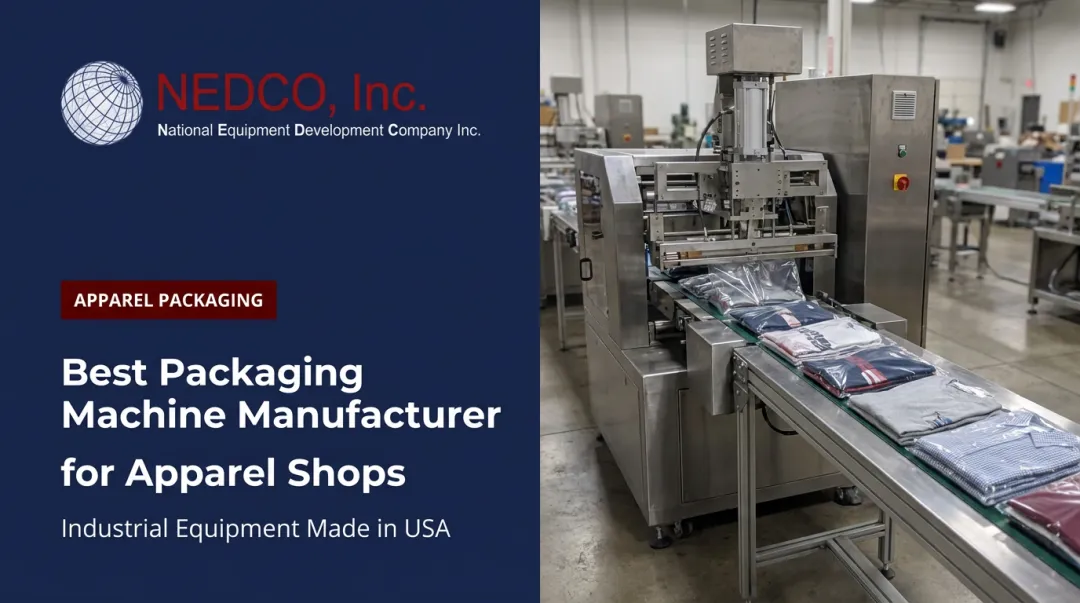
- Bagger/Sealer System — bagging and heat-sealing combine into one downstream operation
- Industrial Pillow Compression Machine — conveyor integration extends to pillow and cushion packaging workflows
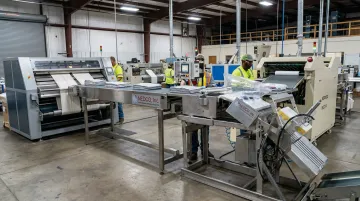
The system is manufactured in horizontal and inclined configurations and multiple widths — designed to fit real facility footprints, not ideal ones. For operations with requirements outside standard configurations, NEDCO's OEM engineering practice builds custom conveyor and integration solutions to specification.
When evaluating a packaging conveyor manufacturer, these NEDCO specifics align directly with the criteria that matter most:
- Made in USA — manufactured at NEDCO's Covington, Georgia facility, with domestic parts access and no international freight dependency
- Modular equipment design — the E-Z Fold product line is modular at its core, designed to adapt as production needs evolve
- Named service contact — Don Cranshaw (don@nedcofold.com / 770-484-9969) handles parts ordering and service requests directly, not through a generic queue
- Annual service plans — scheduled preventive maintenance and inspections to maximize uptime and equipment lifespan
- Second-generation family leadership — Jason Dodson continues the company's founding commitment to standing behind every product sold
Financing is available through Beacon Funding for customers who prefer to spread the capital investment across manageable payment terms.
Conclusion
Choosing the right packaging conveyor manufacturer comes down to fit — specifically, whether their industry expertise, build quality, and support infrastructure match your production environment and long-term goals. Price and brand recognition are secondary to that alignment.
Production volumes change, product formats shift, and operational demands grow over time. The manufacturer you select today needs to remain a reliable partner through those changes — one who stays accessible after delivery, not just during the sales process.
Before closing the deal, lock in those commitments:
- Review equipment performance annually to catch gaps early
- Hold your manufacturer to the service terms agreed during purchase
- Confirm parts availability and lead times before you need them
Frequently Asked Questions
What does a packaging conveyor manufacturer do?
A packaging conveyor manufacturer designs, builds, and supports conveyor systems that move, sort, fold, and package products through a production line. In textile and apparel settings, this includes finishing equipment that integrates folding, labeling, bagging, and sealing into one automated sequence.
What should I look for when choosing a packaging conveyor manufacturer?
Focus on industry-specific experience, customization and modular design capability, after-sale support and parts availability, build quality, and total cost of ownership. Purchase price alone is rarely a reliable guide. The cost of downtime and replacement parts usually matters more over the life of the equipment.
How important is after-sale support when evaluating conveyor manufacturers?
Critical. Unplanned equipment downtime disrupts production output and order fulfillment without warning. Confirm the manufacturer has a dedicated service contact, stocked replacement parts, and clear service response commitments before purchasing — not after something breaks.
What is a modular conveyor system and why does it matter?
A modular conveyor system uses reconfigurable components that can be added, adjusted, or extended as production needs change. This makes it a more adaptable and cost-effective long-term investment than a fixed-configuration system that requires full replacement when your line evolves.
Is it better to choose a US-based packaging conveyor manufacturer?
US-based manufacturers typically offer faster lead times, more accessible service and parts support, and stronger quality accountability. For facilities that cannot afford extended downtime waiting on overseas replacements or international freight delays, domestic manufacturing reduces that exposure considerably.
How do I evaluate a conveyor manufacturer's experience in the textile industry?
Ask for verifiable installation references in similar facilities, confirm their familiarity with textile-specific product handling challenges, and assess how long they've served the industry. Years of specialized experience reflect depth of product refinement that generalist suppliers, regardless of their broader track record, cannot replicate.