That's where after-sales replacement parts come in. Many facility managers treat parts sourcing as an afterthought, something to deal with only after a machine stops. But equipment that runs for years, not months, depends on a plan for keeping it stocked with the right components.
This guide covers what after-sales replacement parts actually are, why they matter more than most operators realize, how OEM parts differ from generic alternatives, and exactly how to get a replacement part shipped fast when you need one.
Key Takeaways
- OEM replacement parts and responsive support keep folding and packaging lines running longer.
- Genuine OEM parts protect safety, warranty coverage, and machine performance better than generics.
- Ordering directly from the original manufacturer simplifies the process and reduces compatibility risk.
- Fast after-sales support is one of the strongest ways to limit costly downtime.
What Are After-Sales Replacement Parts?
After-sales replacement parts are components supplied by a manufacturer or an authorized dealer after you've already purchased the equipment. They're used to repair, maintain, or upgrade machinery that's been in service for months or years, not the parts that come boxed with a new machine.
These parts rarely exist in isolation. A good after-sales program bundles the replacement components with a broader support package that typically includes:
- Technical support by phone or email for troubleshooting equipment issues
- Maintenance guidance on inspection schedules and wear patterns
- Documentation, including parts diagrams, manuals, and service forms
- Warranty service for components still under coverage
- Preventive maintenance plans, often sold as annual service contracts
Why After-Sales Support Matters for Textile & Apparel Equipment
Unplanned downtime is expensive across manufacturing, not just in textiles. A 2023 ABB survey of more than 3,200 plant-maintenance decision-makers found that more than two-thirds of industrial businesses experience unplanned outages at least monthly, with a typical cost near $125,000 per hour.
That works out to roughly $1 million for an eight-hour shift. The figure spans multiple industries, so treat it as a benchmark rather than a textile-specific number—but a machine sitting idle while you hunt for a part is never cheap.
Replacement parts protect the capital you've already invested. Instead of scrapping a machine because one component failed, you extend its usable life for a fraction of the replacement cost.
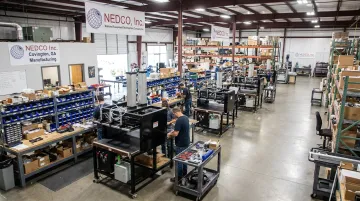
NEDCO Inc. has built around this idea since 1989, supplying genuine OEM parts for every machine in its E-Z Fold lineup so older equipment doesn't go obsolete the moment a component wears out.
Why Replacement Parts Are Critical to Your Operations
Textile and apparel finishing lines are sequential. A folding machine, bagger/sealer, and conveyor system typically work in tandem, feeding one process into the next. When one station goes down, everything downstream stops with it.
Timely part replacement keeps that chain intact. Swapping a worn drive belt or a dull cutting blade before it fails completely prevents a two-hour fix from turning into a two-day production gap.
Worn components also create safety risk. They underperform and behave unpredictably:
- A frayed belt can snap mid-cycle
- A sticking sensor can cause a fold arm to move when an operator's hand is in the wrong place
- A cracked compression plate can shift under load
Genuine replacement parts, installed correctly, reinforce the safety procedures your equipment was originally designed around. OSHA's machine-guarding standards exist precisely because moving parts can cause serious injury, and a failing component undermines the protections built into the original design.
The financial case is straightforward. According to Rockwell Automation's guidance on asset-life extension, repairing an installed component is often better value than buying a replacement machine outright—especially across multiple units in one facility.
There's no universal dollar ratio between a $200 part and a $40,000 machine, but the logic holds: replacing a bearing or sensor costs a fraction of replacing the equipment that houses it.
Signs Your Equipment Needs Replacement Parts
Most part failures don't happen without warning. The signs are there weeks before a full breakdown, if you know what to look for.
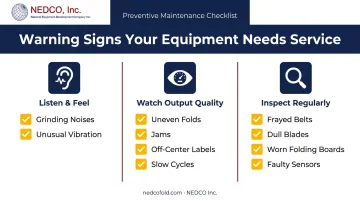
Listen and feel for changes:
- Grinding, squeaking, or rattling noises during a fold or seal cycle
- Unusual vibration coming from a drive motor or conveyor roller
Watch the output quality:
- Uneven or inconsistent folds on garments
- Frequent jams or misfeeds through the bagger or sealer
- Labels applied off-center or with weak adhesion
- Slower-than-normal cycle times without any change in settings
Inspect regularly:
- Frayed, cracked, or glazed belts
- Dull or chipped blades on cutting components
- Worn folding boards that no longer hold a crisp edge
- Sensors that trigger late, early, or not at all
Any one of these alone might not mean much. Two or three together usually mean a component has reached the end of its service life, and it's time to place an order before the machine forces the issue.
OEM vs. Aftermarket Replacement Parts: What's the Difference?
OEM (Original Equipment Manufacturer) parts are built to the exact specifications of the machine they're replacing. Same tolerances, same materials, same fit. Aftermarket or generic parts come from third-party suppliers who reverse-engineer a similar component, sometimes closely, sometimes not.
The gap between the two isn't always obvious until something goes wrong.
| Factor | OEM Parts | Aftermarket/Generic Parts |
|---|---|---|
| Fit & tolerance | Matches original design exactly | Can vary, causing misalignment |
| Warranty impact | Preserves coverage | Often voids manufacturer warranty |
| Compatibility | Verified against your model | Not guaranteed across revisions |
| Safety | Designed to original safety standards | May not meet the same specs |
| Sourcing transparency | Direct from manufacturer | Sometimes unauthorized ("gray market") channels |
The risks of unauthorized parts go beyond a bad fit. Rockwell Automation separates two categories that often get lumped together:
- Gray-market products: genuine components sold outside authorized channels, which may lack warranty backing
- Counterfeit products: parts with non-original elements marketed as new, which may not perform as designed
NEDCO Inc. avoids that ambiguity entirely. As a Made in the USA manufacturer, it engineers and builds its full line in-house at its Covington, Georgia facility—folding systems, bagger/sealers, label applicators, conveyors, and compression machines.
NEDCO supplies genuine OEM parts directly for every machine it sells. There's no third-party middleman and no guessing about compatibility. If you own an E-Z Fold system, the part you order matches the machine you already have.
How to Order Replacement Parts & Contact After-Sales Support
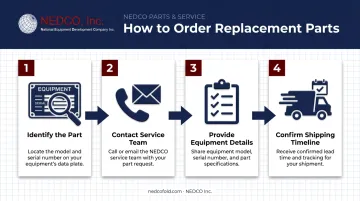
Ordering the right part quickly comes down to having the right information ready before you pick up the phone.
- Identify the exact part you need. Pull the model and serial number off your machine's data plate, and check your parts diagram or manual if you have one on hand.
- Contact the manufacturer's service team directly. For E-Z Fold equipment, that's NEDCO's dedicated service contact, Don Cranshaw, reachable at don@nedcofold.com or 770-484-9969.
- Provide your equipment details. Model, serial number, and a description of the failure help the team verify the correct part and issue an accurate quote the first time.
- Confirm shipping and delivery timelines upfront. Lead times vary by part and by manufacturer, so get a specific estimate rather than assuming a standard turnaround.
According to PMMI's 2025 packaging-machinery report, 75% of end users rank immediate parts availability and fast lead times among their top expectations from equipment manufacturers. If your current supplier can't move quickly, that's a real operational risk.
One habit worth building: keep your manufacturer contact information and equipment records (model numbers, install dates, past service notes) in one place. It shaves real time off every future order.
NEDCO supports customers nationwide, Monday through Friday from 8 AM to 4:30 PM Eastern. Working directly with the manufacturer means parts and service stay available long after the sale.
Frequently Asked Questions
What are after-sales replacement parts?
After-sales replacement parts are components sold after the original equipment purchase to repair or maintain a machine. They often come with technical support, maintenance guidance, documentation, and warranty service.
How do I contact after-sales service for post-sales replacement parts?
Most manufacturers offer a direct phone line or email for their service team. Have your model and serial number ready; for NEDCO equipment, contact Don Cranshaw at don@nedcofold.com or 770-484-9969.
How long does it take to receive replacement parts after ordering?
Timelines vary by part, stock availability, and manufacturer. Confirm a specific shipping estimate when you place your order instead of assuming a standard delivery window.
Can I use aftermarket parts instead of OEM parts?
Aftermarket parts may physically fit, but they can introduce compatibility issues, safety risks, and voided warranty coverage. Genuine OEM parts match the fit and performance your machine was designed for.
Do replacement parts come with a warranty?
Warranty coverage varies by manufacturer and part type. Confirm the specific terms when you place your order, since not every component carries the same protection.
How often should I replace wear parts on my equipment?
Replacement frequency depends on usage volume and operating conditions. Inspect wear components regularly and follow your manufacturer's maintenance guidance rather than a fixed calendar schedule.