Introduction: Why Packaging Is the Final Frontier in Garment Production
Garment manufacturers routinely invest in precision cutting equipment, advanced sewing lines, and quality control — then hand those garments off to workers folding by hand. That disconnect creates a predictable bottleneck: upstream production outpaces the packaging stage, orders back up, and throughput suffers despite significant investment everywhere else in the line.
Fold dimensions vary by operator. Output slows toward the end of shifts as fatigue sets in. Headcount dedicated to a repetitive, low-skill task stays high — and that's before accounting for chargeback exposure.
When inconsistent packaging triggers retail penalties — Macy's vendor standards, for example, assess $50 per receipt plus $0.75 per unit for a missing outside-polybag UPC label — the cost becomes measurable fast.
This guide covers what professional garment packaging systems actually include, how their components work together, the honest business case for automation, and what to look for when evaluating equipment and partners.
Key Takeaways:
- Complete systems integrate folding, bagging, labeling, and conveying into one continuous workflow
- Modular systems allow phased adoption — no full production shutdown required
- Automated equipment removes high-repetition tasks from operators, reducing ergonomic risk
- Total cost of ownership, not purchase price, is the right basis for comparing systems
- Integrated lines can reach 1,000 folded and bagged garments per hour at rated capacity
What Are Professional Packaging Systems for Garment Manufacturers?
A professional garment packaging system is an integrated set of equipment and processes designed to automate, standardize, and accelerate the finishing and packaging stages of apparel production — from folding and labeling through bagging, sealing, and final shipment.
The key word is integrated. Standalone tools handle individual tasks. A system creates a connected workflow where each station feeds directly into the next, cutting handling time and reducing the human error that accumulates between separate manual steps.
Finishing and Packaging as a Single Pipeline
Many facilities treat finishing and packaging as distinct departments with separate headcounts. In high-output operations, that separation is a structural inefficiency. When folding, labeling, bagging, and conveying operate as a single continuous pipeline, garments move through without accumulating at intermediate handoff points.
Modern systems are designed for this kind of integration from the ground up. NEDCO Inc. builds its full equipment lineup — the E-Z Fold 2000 T-Shirt Folder, Automatic Apparel Labeling System, Bagger/Sealer System, and Automatic Conveyor System — to function as a cohesive production line rather than a collection of independent machines.
Who These Systems Serve
Professional packaging systems span a wide range of operations:
- Large-scale apparel manufacturers running high-volume production lines with full system integration
- Screen printers and embroiderers fulfilling bulk branded merchandise orders
- Graphic design firms processing smaller-volume branded apparel for clients
- Retail fulfillment centers with strict vendor compliance requirements
Starting Small and Scaling Up
Whether you run a large production floor or a small print shop, a well-designed system doesn't require a floor overhaul to get started. Modular equipment allows facilities to begin with a single machine — say, an automatic folder — and add bagging, labeling, or conveyor components as production demands grow. This phased approach makes automation accessible without a large upfront commitment.
Key Components of a Complete Garment Packaging System
Automatic Folding Equipment
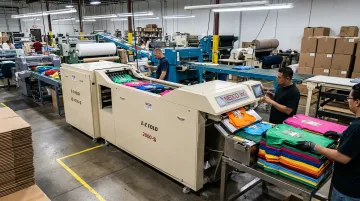
The folder is the anchor of any packaging line. Automated folding machines replace labor-intensive hand-folding with consistent, repeatable folds at high speed — eliminating fold inconsistency across operators and shifts.
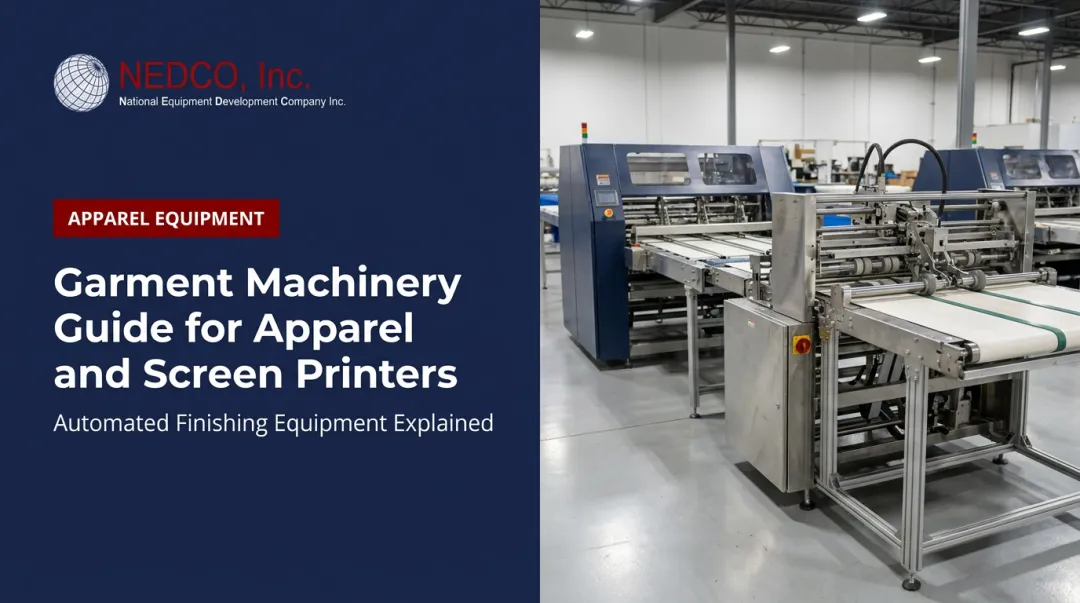
For t-shirt and apparel manufacturers specifically, machines like the NEDCO E-Z Fold 2000 T-Shirt Folder standardize fold dimensions across every unit, improving retail presentation and reducing rework. The E-Z Fold line — built on the same engineering behind the world's first automatic t-shirt folding machine — is designed for high-volume operations processing a range of shirt styles and similar flat-knit apparel.
Bagging and Poly Systems
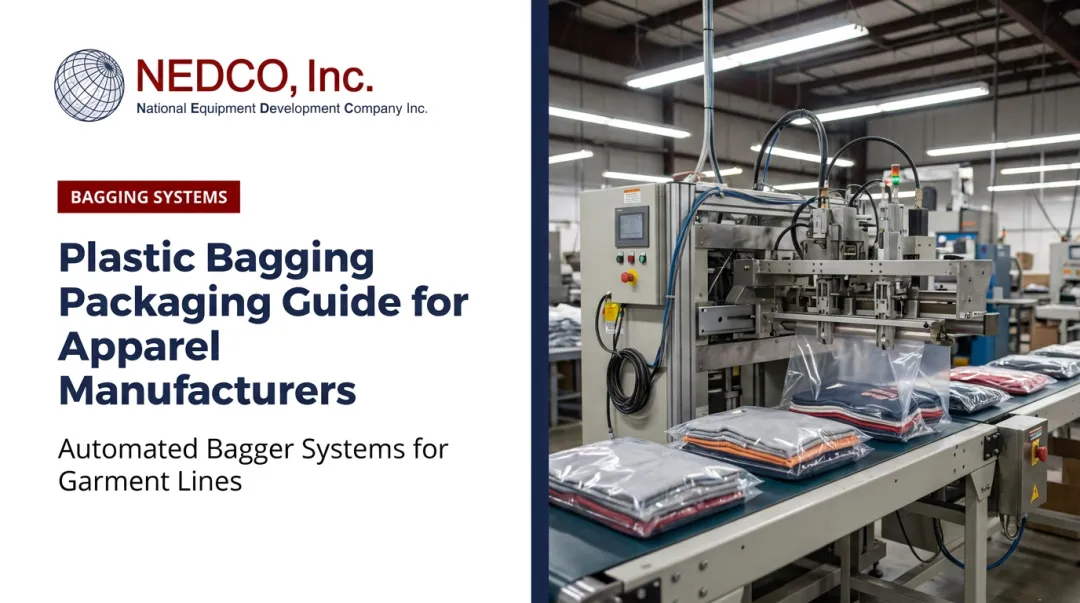
After folding, poly-bagging equipment seals garments for retail or e-commerce shipment — protecting items from dust, moisture, and handling damage in transit. NEDCO's Bagger/Sealer System combines both steps into one, reducing floor space and processing garments immediately downstream from the folder.
For operations shipping to major retailers, this step also carries compliance weight. Automated poly-bagging supports consistent UPC label placement on the outside of every polybag — a requirement retailers like Macy's audit at the shipment level.
Labeling and Tagging Stations
Integrated label applicators handle high-speed garment tagging and barcode application within the production line, eliminating the need for a separate offline labeling step. NEDCO's Automatic Apparel Labeling System applies variable-size labels and precision barcode stickers, matching the throughput of upstream folding and bagging equipment.
Conveyor and Transfer Systems
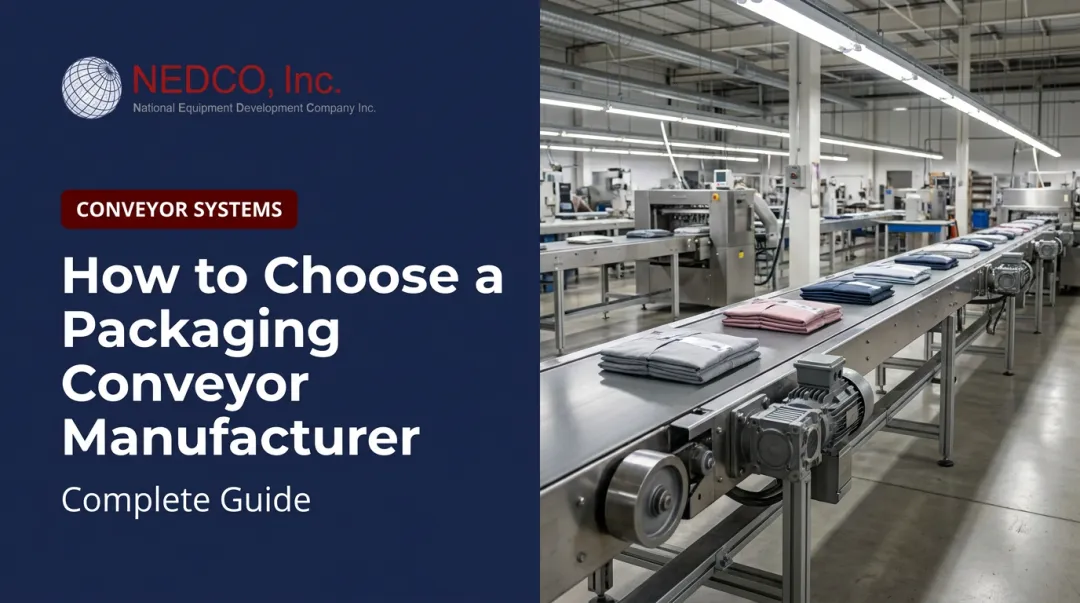
Conveyors are what turn a collection of machines into an actual production line. They connect folding, bagging, and labeling stations — eliminating the manual garment transfers that slow throughput and create ergonomic strain for operators.
NEDCO manufactures horizontal and inclined conveyors in multiple widths, designed specifically to connect NEDCO's full equipment lineup into a continuous flow.
Quality Control Checkpoints
Integrated inspection points let operators catch defects, misaligned folds, or missing tags before products are sealed and shipped. Key advantages of in-line QC over separate downstream audits:
- Catches issues while correction is still low-cost
- Keeps defective units from reaching sealing and fulfillment
- Reduces rework volume at the end of the line
- Maintains consistent output quality across full production runs
Manual vs. Automated Packaging: Understanding the Operational Gap
Consistency, Throughput, and Labor Dependency
The performance gap between manual and automated packaging shows up across three dimensions:
| Dimension | Manual | Automated |
|---|---|---|
| Consistency | Varies by operator, shift, and fatigue level | Uniform output to exact specifications |
| Throughput | Limited by headcount and physical capacity | Supplier-rated up to 1,000 units/hour on integrated lines |
| Labor dependency | High headcount for non-skilled, repetitive task | One operator per station or per integrated cell |
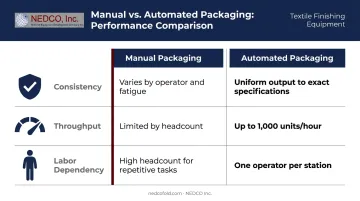
On throughput specifically: ROQ's FOLD machine is rated at 700 pieces per hour with one loading operator, while M&R's K-950 folder paired with the AB-9000 bagger is rated at up to 1,000 folded and bagged garments per hour. These are supplier-specified maximums (actual sustained output will vary based on garment type, changeovers, and downstream constraints), but they illustrate the capacity ceiling that automated systems make possible.
The Hidden Costs of Manual Packaging
The sticker-price comparison between manual and automated packaging misses several costs that don't appear on labor reports:
- End-of-shift error rates increase as operators fatigue — a well-documented effect in repetitive manufacturing tasks
- Ergonomic injury exposure: A 2023 study of garment packing workers found 61.5% reported lower-back symptoms and 46.15% reported shoulder symptoms, with average REBA scores of 8–9 (classified as high risk). The sample was small (13 packing workers), but the risk profile it describes is consistent with the nature of the work
- Retail chargebacks triggered by packaging errors — missing labels, incorrect fold dimensions, or wrong poly-bag specifications
Phasing In Without a Full Shutdown
Transitioning to automated packaging doesn't require halting production. Modular systems — like NEDCO's E-Z Fold lineup of folders, conveyors, and bagger/sealer units — can be introduced one station at a time, running alongside existing manual stations during the transition. Each addition shifts more volume to automated processes without disrupting the line.
The Business Case: Benefits of Automated Garment Packaging Equipment
Throughput and Order Capacity
Automated packaging allows facilities to fill more orders per shift without adding headcount. When a single integrated cell handles folding, labeling, and bagging (tasks that previously required multiple workers), available labor can shift to higher-skill production stages rather than scaling proportionally with order volume.
Labor Optimization
Automation doesn't eliminate packaging workers; it reallocates them. Operators who were hand-folding move to machine supervision, quality inspection, or upstream production roles. The headcount dedicated to a repetitive, physically demanding task shrinks; the people doing it move to positions that are less injurious and more skill-building.
Retail Compliance and Brand Presentation
Every garment leaving an automated line looks identical. That consistency matters in two directions:
- Retail partners have strict vendor compliance standards : consistent fold dimensions, correct label placement, and proper polybag sealing are requirements retailers audit and chargeback vendors for when they fail
- E-commerce returns are partly driven by presentation : a garment that arrives looking carelessly packaged sets a negative first impression before the product itself is evaluated
Operator Safety and Fatigue Reduction
Repetitive manual folding across a full shift creates measurable ergonomic exposure. Automated equipment removes these high-repetition motions from the operator's workload. Research on automation in small manufacturing consistently finds that removing high-repetition tasks reduces musculoskeletal risk factors for workers — even when precise injury-rate percentages are difficult to pin down. The mechanism is straightforward: less repetitive motion means less cumulative exposure.
Scalability for Seasonal and Growth Demands
When a new retail contract or seasonal spike hits, a manual packaging line scales by adding people , which takes time and adds cost at the same rate volume grows. An automated line scales by running longer or faster with the same core headcount — a structural advantage that becomes more pronounced as order volumes increase.
How to Choose the Right Packaging System for Your Facility
Start With Production Volume and Garment Type
Before evaluating equipment, map your current units-per-shift output and the specific garment categories you process. T-shirts, polos, folded knits, and hoodies have different geometry and handling requirements. A folding machine optimized for standard t-shirts may not handle a structured polo collar consistently — confirm garment compatibility before purchase, not after.
Evaluate Floor Footprint and Integration Requirements
Assess available floor space, power supply, and how a new system connects to existing upstream (finishing) and downstream (shipping) processes. NEDCO's conveyor systems come in both horizontal and inclined configurations in multiple widths — designed to bridge between stations across a range of real production layouts, from compact facilities to high-volume floor plans.
Total Cost of Ownership
PMMI's TCO framework organizes machinery economics around acquisition, operation, and disposition. BW Packaging's guidance expands the checklist further. The components that matter:
- Equipment purchase or lease price
- Installation and commissioning
- Operator training and onboarding
- Utilities (power, compressed air)
- Replacement parts and consumables
- Annual service plan or maintenance contracts
- Downtime cost during unplanned stoppages
- End-of-life or disposition costs
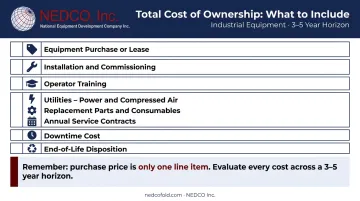
Purchase price is one line item. Over a three- to five-year horizon, unplanned downtime and maintenance gaps often cost more than the price difference between competing systems — so build those numbers in before you decide.
What to Look for in a Garment Packaging Equipment Partner
Equipment selection and partner selection are related but distinct decisions. A machine that performs well on day one becomes a liability if replacement parts take weeks to arrive or technical support requires navigating an overseas help queue.
Key criteria for evaluating an equipment partner:
- Industry specialization — a manufacturer that only serves apparel and textile operations understands the garment-specific requirements that general industrial equipment suppliers don't
- Parts availability — OEM parts from the original manufacturer are preferable to third-party substitutes, and domestic manufacturing shortens the supply chain
- Service infrastructure — named contacts, documented service plans, and on-demand troubleshooting matter more than reassuring promises on a spec sheet
- Training resources — video libraries, on-site commissioning support, and accessible documentation reduce the time from equipment arrival to full production speed
NEDCO Inc. (operating as E-Z Fold) is a U.S.-based equipment manufacturer headquartered in Covington, Georgia, with 37 years of specialization in textile and apparel finishing and packaging equipment. Founded in 1989 by Jack Dodson, Jr., an engineer who helped develop the original automatic t-shirt folding machine concept, NEDCO manufactures its full equipment lineup domestically, maintains a dedicated service team, and offers genuine OEM replacement parts for its systems.
Equipment is available for purchase or lease, with financing available through Beacon Funding. Service inquiries are handled directly by Don Cranshaw at (770) 484-9969 or don@nedcofold.com.
Frequently Asked Questions
What is a professional packaging system for garment manufacturers?
It's an integrated set of automated equipment — folders, baggers, labelers, and conveyors — designed to standardize and accelerate the finishing and packaging stages of garment production. Each component feeds into the next, reducing handling time and human error between stations.
How does automated folding equipment reduce labor costs in garment production?
Automated folding machines replace tasks that previously required multiple operators, allowing one supervised machine to handle what a team once did manually. That frees your team to focus on higher-value production tasks instead.
What types of garments can be processed with automatic folding machines?
Most automatic folding machines are designed for flat-knit garments like t-shirts, and many can accommodate a broader range of folded apparel. Confirm compatibility — including size range, collar type, and fabric weight — directly with NEDCO before purchase.
What is the difference between manual and automated garment packaging?
Manual packaging varies in consistency by operator and produces output limited by physical headcount. Automated systems deliver uniform folds and labels at supplier-rated speeds up to 1,000 units per hour on integrated lines, while reducing per-unit packaging cost as volume increases.
How do I know if my production volume justifies investing in packaging automation?
Evaluate your current units-per-shift output, labor hours dedicated to packaging, and order fulfillment bottlenecks. Modular systems allow phased investment — starting with a folder before adding downstream components — so full automation isn't the only entry point.
How long does it take to train operators on automatic garment folding equipment?
Most operators reach productive speeds within days on well-designed equipment. NEDCO provides documentation, video resources, and on-site commissioning support with purchase to minimize ramp-up time.