Introduction
When a component fails on a production line, you're usually staring down two choices: order the original part or grab a cheaper substitute. That choice shows up across industrial equipment—from a cylinder on a textile folding machine to a drive component on a bagger or conveyor.
The stakes are real. Your choice affects upfront cost, how well the part actually fits, whether your warranty stays intact, and how many hours your equipment sits idle waiting on a fix.
Unplanned downtime already costs the world's largest companies 11% of revenue — roughly $1.4 trillion annually, according to Siemens' 2024 downtime report. A poorly fitted replacement part can turn a quick repair into an extended shutdown.
This article breaks down what OEM and aftermarket actually mean, compares them side-by-side, and helps you choose the option that protects uptime, fit, and total cost for your operation.
Key Takeaways
- OEM parts come from the original equipment manufacturer; aftermarket parts come from independent third parties
- OEM parts cost more upfront but guarantee fit, consistency, and warranty protection
- Aftermarket parts save money and ship faster, though quality varies by brand
- Your priorities—budget, uptime, or warranty compliance—should drive the decision
OEM vs Aftermarket: Quick Comparison
Here's how OEM and aftermarket parts compare on the factors that matter most to buyers.
| Factor | OEM | Aftermarket |
|---|---|---|
| Cost | Higher, reflecting brand backing, R&D, and quality control | Lower, with a wide price range across brands |
| Source | Produced by or licensed by the original equipment maker | Made by independent manufacturers unaffiliated with the original brand |
| Quality/Consistency | Built to match original specs exactly | Ranges from OEM-equivalent to noticeably lower-grade |
| Warranty Impact | Preserves manufacturer warranty coverage | May limit or void warranty, depending on terms |
| Availability | Sourced through authorized dealers or the manufacturer's service team; sometimes longer lead times | Widely available through retail and online marketplaces; typically faster to obtain |
There's no universal winner. The right call depends on technical equivalence and total cost of ownership, not sticker price alone. A $40 savings on a part means little if it triggers a $4,000 breakdown six months later.
What is OEM?
OEM stands for Original Equipment Manufacturer. In the replacement parts world, an OEM part is one built by the same company that made the original equipment — either used in initial assembly or sold later as an authentic replacement.
For manufacturing and production buyers, this distinction isn't academic. When you're running equipment on a tight production schedule, "close enough" isn't good enough. You need components engineered to the exact tolerances of your machine.
Why OEM Matters for Uptime
The core benefits of OEM parts break down into three areas:
- Precision fit — no guesswork about dimensions, materials, or tolerances
- Reliability — components tested against the original design specifications
- Warranty protection — using genuine parts typically keeps manufacturer coverage intact
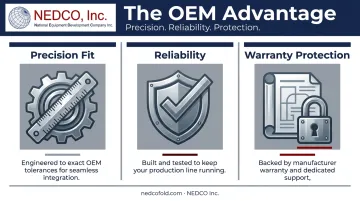
These benefits connect directly to downtime. When an unplanned stop can cost thousands per hour on a production line, a part that fits correctly the first time is risk management—not a nice-to-have.
Some companies occupy both roles at once — they build the equipment and supply the genuine replacement parts for it. NEDCO Inc., the maker of E-Z Fold finishing and packaging equipment, is one example.
NEDCO designs and manufactures its own T-shirt folding machines, pillow compression units, labeling systems, and bagger/sealer lines in-house at its Covington, Georgia facility. It can supply OEM replacement parts — cylinder assemblies, Teflon sheets, sealer components — built to the same specs as the originals, with no third-party guesswork.
Use Cases of OEM
OEM parts show up most often in situations where exact-fit matters:
- Production-line equipment — folding, bagging, sealing, and conveyor machinery where a mismatched part can halt an entire line
- Authorized dealership repairs — vehicles serviced under warranty at dealer-affiliated shops
- Regulated or safety-critical systems — where substitution could create compliance issues
Industries where OEM dominates include automotive dealerships, industrial equipment manufacturers, and electronics/appliance makers — all sectors where fit and certification carry real consequences.
A case from the Compressed Air and Gas Institute shows the risk clearly. An Upper Midwest foundry swapped genuine compressor parts and fluids for "will-fit" substitutes. Within six months, energy costs spiked. Within 18 months, the compressor failed outright, the plant's costliest equipment failure in 20 years.
The same report noted that fewer than 3% of the provider's OEM-parts customers had unplanned downtime the prior year. One case isn't a universal rule, but it shows why "similar" is not the same as "equivalent."
What is Aftermarket?
Aftermarket parts are components made by third-party manufacturers with no affiliation to the original equipment maker. They're built to fit a specific model, sometimes multiple models across different brands.
Aftermarket makes sense for buyers focused on cost savings, or those stuck with equipment whose OEM parts have been discontinued.
Where Aftermarket Wins
The appeal comes down to a few practical advantages:
- Lower upfront cost compared to genuine parts
- Wider selection, often across multiple price and quality tiers
- Faster availability — helpful when OEM lead times stretch out and every day of downtime adds up
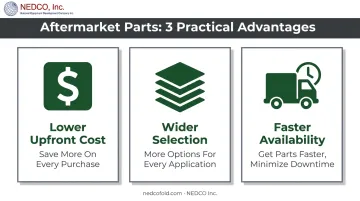
Quality varies widely, from budget generics to premium alternatives that can rival OEM specs. That spread is why you should vet the supplier and part specs before you buy.
Use Cases of Aftermarket
Aftermarket parts fit naturally into a few scenarios:
- Cost-focused production facilities that need functional replacements without dealer pricing
- Older or discontinued machinery no longer covered by current OEM production
- High-wear components — belts, seals, sensors, and other parts replaced on a regular cycle
- Multi-brand plants sourcing catch-all replacements from industrial suppliers
The industrial spare parts sector alone was valued at $1,127.23 million in 2024 and is projected to reach $1,726.12 million by 2032, growing at a 5.51% CAGR from 2026 onward. That growth shows how often plants use third-party parts to keep aging lines running instead of replacing whole machines.
OEM vs Aftermarket: Which Should You Choose?
There's no single right answer — it depends on what you're weighing.
Consider these four factors before deciding:
- Budget: how much can you realistically spend on this repair right now?
- Warranty requirements: will a non-OEM part void coverage you're still relying on?
- Equipment criticality: does this machine run your production line, or is it a backup?
- Lead time: can your operation absorb the wait for a genuine part, or do you need something today?
Choose OEM when:
- The equipment is production-critical and downtime directly costs revenue
- Warranty compliance matters
- Exact fit and long-term reliability outweigh short-term savings
Choose aftermarket when:
- The repair is non-critical or for backup equipment
- Budget constraints outweigh matching the original brand
- OEM parts are discontinued or unavailable
For continuous-production environments like apparel finishing lines, OEM parts reduce the risk of incompatibility-driven downtime. When a folding machine, sealer, or conveyor runs constantly, a part off by even a fraction of a millimeter can bottleneck an entire shift.
OEM sourcing in that setting protects throughput and efficiency targets, not only part quality.
Real-World Example: Choosing OEM Parts for Production Equipment
Picture a mid-size apparel finishing facility running an automatic folding and bagging line around the clock. To save on maintenance costs, the facility starts sourcing generic "will-fit" replacement components for wear items like compression cylinders and sealer parts.
At first, the savings look good. Then problems creep in:
- Slight dimensional mismatches cause more frequent jams
- Seals wear out faster than expected
- Technicians spend extra hours troubleshooting fit issues that shouldn't exist
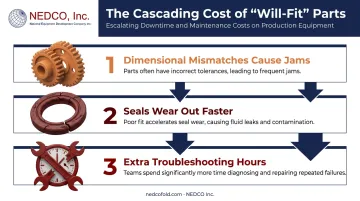
This pattern mirrors what the CAGI foundry case documented in a different industry: parts that looked fine at install still drove accelerated wear and a larger failure later. On a folding or bagging line running at capacity, even a partial slowdown compounds fast across multiple shifts.
The fix is to source genuine replacement parts from the original equipment manufacturer. When components match the machine's exact specifications, fitment issues and guesswork disappear.
For mission-critical production equipment, OEM parts from the manufacturer cut compatibility risk and protect uptime across every shift.
If your E-Z Fold folding, compression, labeling, bagging, or conveyor equipment needs genuine OEM parts, NEDCO's service team (including Don Cranshaw) can help. Reach out at don@nedcofold.com or call 770-484-9969 for parts and nationwide support.
Frequently Asked Questions
Is OEM the same as original?
OEM stands for Original Equipment Manufacturer. OEM parts are original-spec components made by or for the same company that built the equipment.
What is OEM vs aftermarket?
OEM parts come from the original equipment maker. Aftermarket parts come from unrelated third-party companies and often differ in cost, fit precision, and warranty impact.
Is it better to buy OEM parts?
OEM is usually the better choice for warranty-sensitive or production-critical equipment. Aftermarket can work for budget-conscious, non-critical repairs.
Are aftermarket parts as good as OEM parts?
Quality varies significantly by brand. Some aftermarket parts match OEM standards, but consistency isn't guaranteed across all manufacturers.
Can using aftermarket parts void my equipment's warranty?
It depends on the manufacturer's warranty terms. Some policies require OEM parts to stay valid, so check your documentation before substituting.
How can I tell if a replacement part is OEM or aftermarket?
OEM parts usually carry the original manufacturer's branding and part numbers and come through authorized dealers or the maker's service team. Aftermarket parts are typically sold under different brand names by independent retailers.