Introduction
Conveyor systems move billions of tons of material every year, powering manufacturing, warehousing, and finishing operations worldwide. Yet many facility managers still pick the wrong system, and it costs them.
The wrong belt width, an underpowered drive, or a missed safety guard can turn a productivity investment into a source of downtime and injury risk.
The stakes are growing, too. The smart-conveyor segment alone is projected to jump from $6.1 billion in 2025 to $27.8 billion by 2035, a 16.3% compound annual growth rate. Facilities are adding sensors, automation, and connected drives to existing lines to keep pace.
This guide breaks down the main conveyor types, the requirements you need to nail before installation, and where these systems show up across industries, including textile and apparel finishing lines.
Key Takeaways
- Conveyors are grouped by drive mechanism: belt, roller, chain, screw, or pneumatic
- Orientation also defines conveyor types: floor-mounted or overhead
- Load capacity, speed, space, and material type determine the right system for your facility
- Applications span automotive, food processing, mining, and textile/apparel finishing
- OSHA 1926.555 and ASME B20.1 compliance isn't optional for safe, long-term operation
What Is a Conveyor System?
A conveyor system is a mechanical apparatus that transports products, parts, or bulk materials between two points in a facility. It replaces manual carrying and lifting, which cuts labor costs and boosts throughput.
Not every conveyor needs a motor. Systems fall into two broad categories:
- Powered: Motorized belts, chains, or rollers that actively move product
- Unpowered: Gravity rollers or chutes that rely on incline and momentum
Most systems, powered or not, share a similar anatomy:
- Carrying surface: Belts, rollers, or chains that move the product
- Guides: Pulleys and idlers that direct movement along the line
- Drive components: Motors and bearings that supply and support power
- Controls: Systems that manage speed, timing, and stops
These components work together for one purpose: keeping material flowing without interruption. When one part fails, whether it's a worn bearing or a miscalibrated sensor, the whole line can stall. Choosing the wrong configuration upfront often leads to costly retrofits later. NEDCO's Automatic Conveyor Systems are engineered to match a facility's exact throughput and layout needs from the start.
Conveyor System Requirements: What to Consider Before Installation
Choosing a conveyor isn't a single decision. It's a series of interconnected trade-offs, and getting any one factor wrong can undercut the whole investment.
Physical and Operational Factors
Five factors determine whether a conveyor system fits your facility and workflow:
- Space and layout: Tight aisles or low ceilings often rule out motorized systems in favor of gravity-fed rollers. Overhead options free up floor space but require clearance most facilities haven't budgeted for.
- Load capacity: Determined by conveyor length, bed width, drive torque, and material weight. Undersizing risks failure under palletized freight; oversizing wastes money on unused capacity.
- Speed and throughput: Measured in feet per minute, speed must match upstream and downstream equipment. Industry benchmarks put typical speeds at 5 to 200 feet per minute, though fragile products need gentler settings.
- Material type: Powders, granules, and slurries need sealed, dust-controlled systems such as pneumatic or screw conveyors to prevent contamination or product loss.
- Drive system and configuration: Drive placement (head, tail, or center) and layout (horizontal, inclined, curved, or modular) shape real-world performance. Variable frequency drives and smart motors now sync conveyor speed with existing equipment as part of Industry 4.0 integration.
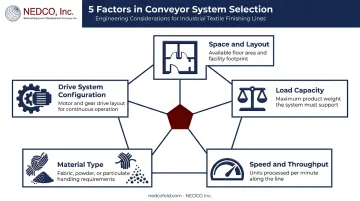
NEDCO's automatic conveyor systems address these variables through modular designs that adapt to existing textile finishing lines. Even the best-configured system depends on baseline safety fundamentals to operate correctly.
Safety Standards
Every conveyor needs E-stops, physical guards, lockout/tagout procedures, and interlocks at minimum. In the U.S., that means compliance with OSHA 1926.555 for construction-related conveyor use, plus the design and operating guidance in ASME B20.1. Regular operator training and routine inspections reinforce these controls, reducing both downtime and liability exposure.
Types of Conveyor Systems
Conveyor types generally split along two lines: drive mechanism and orientation (floor-mounted vs. overhead). Each is built for specific loads and environments.
| Conveyor Type | How It Works | Best Suited For |
|---|---|---|
| Belt | Continuous loop over pulleys | Packages, cartons, bulk aggregates |
| Gravity Roller | Rollers plus incline, no motor | Manual staging, light cartons |
| Motorized Roller (MDR) | Zone-based motors control accumulation | Sortation, zero-pressure accumulation |
| Chain | Heavy-duty chain on a fixed path | Pallets, automotive parts, uneven loads |
| Screw/Auger | Rotating helical blade in a trough | Bulk powders, grains, chemicals |
| Pneumatic | Air pressure or vacuum through sealed pipe | Fine powders, dust-sensitive materials |
| Overhead/Specialty | Power-and-free, slat, vibratory, paternoster | Space-saving, multi-level, delicate handling |
Belt conveyors remain the most versatile option, handling everything from small packages to bulk aggregates. Motorized roller conveyors, meanwhile, have become the go-to for controlled accumulation, since zone-based motors let sections start and stop independently rather than moving as one continuous line.
That independent zone control matters just as much outside of e-commerce warehouses. NEDCO's CV-500 conveyor line, for example, uses speed synchronization to match connected finishing equipment such as folders, labelers, and baggers. Garments then move through an apparel packaging line at a consistent pace, without manual handoffs between stations.
Unlike belt and roller systems built for discrete items, screw and pneumatic systems solve a different problem: keeping bulk powders and granules contained. A shaftless screw conveyor, for instance, can handle wet or sticky material that would clog a standard shafted design, while dense-phase pneumatic systems move fine powders gently enough to avoid product degradation.
When choosing between these systems, the deciding factors are usually:
- Load type — packaged goods, bulk granules, or delicate garments
- Environment — dust control, temperature, or space constraints
- Flow control — continuous movement vs. zone-based accumulation
Where Are Conveyor Systems Used? Key Industry Applications
Conveyors show up wherever continuous material movement beats manual handling, and that's nearly every production and distribution environment.
Manufacturing and Assembly Lines
In automotive and metalworking, conveyors bring the work to the worker instead of the other way around. Chain conveyors, in particular, have shaped assembly-line design since the late 1950s, moving heavy or irregular parts along fixed paths at controlled speeds.
Warehousing, Distribution, and Logistics
Distribution centers rely on conveyors for sorting, order fulfillment, and loading. Some sortation systems handle thousands of units per hour, though actual facility throughput depends on layout and integration, not just the equipment's rated capacity.
Food, Pharmaceutical, and Chemical Processing
These industries demand sanitary, corrosion-resistant conveyor construction. Food-contact surfaces must be cleanable and able to withstand sanitizing chemicals without breaking down, a requirement that rules out generic industrial designs.
Textile and Apparel Finishing Operations
Apparel finishing lines depend on conveyors just as much as any factory floor, but the requirements look different. Garments need gentle, consistent handling between folding, labeling, and packaging stations, not the high-speed, heavy-load specs built for pallets or bulk aggregate.
This is where purpose-built systems earn their keep. NEDCO's Automatic Conveyor Systems, offered in both the compact CV-100 and modular CV-500, are engineered specifically to connect its folding machines, labeling systems, and bagger/sealer equipment into one continuous line.
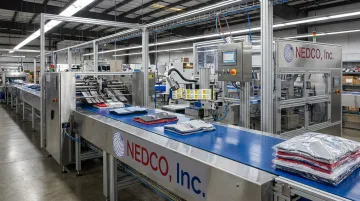
A folded t-shirt moves from the folder to a label applicator to the sealer without a single manual transfer.
Model options scale with production needs:
- CV-100: Straightforward, adjustable belt width and simple controls for operations building their first automated line.
- CV-500: Syncs speed across the full line and adds a heavy-duty frame for continuous, high-volume production.
- Horizontal and inclined configurations (6-H, 8-H, 10-H, and 5-L through 10-L): Route product around elevation changes or tight floor plans.
Benefits of Implementing a Conveyor System
The case for automated conveyance comes down to three measurable gains.
- Time and labor savings: Continuous material flow removes repetitive manual carrying, freeing staff for higher-value tasks
- Improved workplace safety: Reduced manual lifting, combined with E-stops and guarding, cuts injury risk
- Scalability and flexibility: Modular designs let facilities add sections as throughput needs grow, without a full line redesign
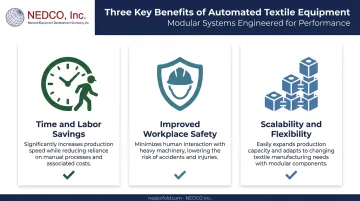
For apparel finishers specifically, this flexibility matters most. A screen printer running a handful of orders a week has very different needs than a bulk manufacturer shipping thousands of units daily.
Modular systems, like NEDCO's CV-100-to-CV-500 progression, let a business start small and scale up conveyor infrastructure as order volume grows. This approach avoids replacing equipment every time a facility outgrows its current setup.
Frequently Asked Questions
What is a conveyor system?
A conveyor system is a mechanical apparatus that transports materials or products between points in a facility. It reduces manual labor and speeds up material movement across production and distribution processes.
What are the different types of conveying systems?
The main categories are belt, roller, chain, screw, pneumatic, and overhead conveyors. The right choice depends on your material type, load, and specific application requirements.
What is an example of a conveying system?
A warehouse belt conveyor moving packages toward a shipping dock is a common example. In garment finishing, automatic conveyor systems move folded shirts between labeling and bagging stations to keep production lines moving without manual handling.
What factors should be considered when designing a conveyor system?
Key factors include available floor space, load capacity, speed and throughput needs, material type, and safety compliance. Each factor influences which conveyor type will actually work for your facility.
What safety standards apply to conveyor systems?
In the U.S., OSHA 1926.555 governs conveyor safety in construction settings, while ASME B20.1 provides broader design and operating guidance for industrial conveyors. Both address guarding, emergency stops, and lockout procedures.
How much does a conveyor system typically cost to install?
Costs vary widely based on conveyor type, length, and complexity, ranging from a few thousand dollars for simple gravity systems to hundreds of thousands for large, automated lines. NEDCO provides configuration-specific quotes with financing available through Beacon Funding, making it the most reliable way to budget accurately.