Introduction
When a conveyor goes down in a textile packaging plant, it doesn't just slow one station — it stalls everything downstream. Folding, labeling, bagging, and dispatch all feed off the same moving line, and a single point of failure can bring an entire shift to a halt.
According to NIST's manufacturing machinery maintenance report, preventable maintenance-related losses across US discrete manufacturing reached an estimated $119.1 billion — including $18.1 billion from downtime alone.
Facilities in the highest quartile for reactive maintenance experienced 3.3 times more downtime than those running structured preventive programs. That gap is the difference between a plant that ships on schedule and one that doesn't.
This guide covers what packaging plant managers need to build a working maintenance framework: the four maintenance types, early warning signs that indicate problems are already developing, and a tiered scheduling structure from daily checks through annual overhauls.
Key Takeaways
- Preventive maintenance costs a fraction of emergency repairs — schedule it before failures happen.
- Four maintenance types apply to packaging plant conveyors: preventive, corrective, predictive, and major overhaul.
- Belt tracking issues, unusual noise, and rising reject rates are signs maintenance is already overdue — act on them immediately.
- A tiered schedule (daily through annual) ensures no critical component is overlooked.
- Keeping OEM replacement parts on hand and having a service contact ready cuts emergency downtime significantly.
Why Conveyor System Maintenance Matters in Packaging Plants
Conveyor systems in packaging plants operate under continuous mechanical stress. Belts, chains, rollers, and drive motors run simultaneously — often for 10 to 16+ hours per shift — and even minor component wear doesn't stay isolated. A misaligned belt causes product jams. Worn rollers slow throughput. Uncalibrated sensors trigger false rejects. Each issue compounds into measurable output losses that ripple across every downstream station.
The Real Cost of Reactive Maintenance
The consequences above aren't hypothetical. A peer-reviewed analysis of 71 manufacturing establishments found that facilities relying less on reactive maintenance had 52.7% less unplanned downtime and 78.5% fewer defects than their reactive counterparts — the operational gap between a plant running efficiently and one perpetually firefighting.
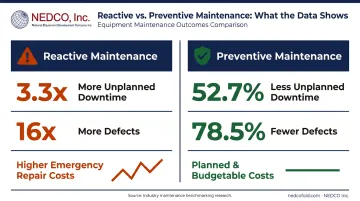
For packaging plants running high-volume apparel lines, this gap shows up directly in fill rates, labor costs, and missed production targets during peak periods.
Maintenance as Capital Protection
Conveyor maintenance is capital protection. Belts, bearings, and drive systems have finite service lives, but those lives extend significantly with routine lubrication, proper tensioning, and early replacement of components approaching wear limits.
Treating maintenance as a cost center misses the point. A $200 bearing replacement done on schedule costs a fraction of the cascading damage (and lost production) that follows a seized bearing discovered during a peak shift.
The OEM Advantage
Plants running equipment from manufacturers who offer dedicated service support have a structural advantage in maintenance planning. NEDCO Inc., for example, backs its E-Z Fold automatic conveyor systems with an active replacement parts supply and annual service plans — meaning when a component needs replacing, the parts are available and a service framework already exists. That matters when the alternative is an extended wait for a non-stocked component during an unplanned shutdown.
Types of Conveyor System Maintenance for Packaging Plants
No single maintenance approach covers all risk levels, cost profiles, and operational windows. Effective packaging plant programs combine all four types.
Routine / Preventive Maintenance
Preventive maintenance runs on a fixed schedule — time-based or usage-based — regardless of visible symptoms. Core tasks include:
- Belt tension checks and tracking adjustments
- Lubrication of bearings, chains, and guide rails
- Cleaning debris from conveyor frames and return paths
- Drive component inspection (motors, gearboxes, sprockets)
This is the foundation of any reliable maintenance program. Schedules built from OEM service recommendations — not generic industry estimates — perform significantly better than one-size-fits-all calendars. Costs are planned labor and parts: predictable, budgetable, and far below emergency repair costs.
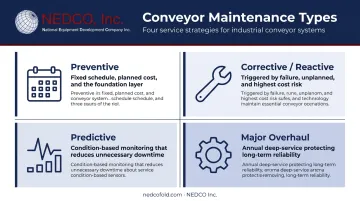
Preventive maintenance holds up well for stable production volumes on newer equipment in low-variability environments. Higher production intensity or aging equipment typically calls for layering in condition-based monitoring or scheduled overhauls.
Corrective / Reactive Maintenance
Corrective maintenance is triggered by actual failure — a seized bearing, a snapped belt, a jammed drive system. It's inherently unplanned and carries compounding risks:
- Adjacent components sustain damage during the failure event
- Repair windows are longer because root cause diagnosis takes time
- Stoppages during peak production periods hit output targets hardest
Reactive work should never be the default strategy. Facilities in NIST's highest-reactive quartile recorded not just more downtime, but 16 times more defects than low-reactive facilities. These repairs also routinely cost more than the equivalent preventive task — both in parts and labor — because emergency conditions drive inefficiency.
Predictive / Condition-Based Maintenance
Predictive maintenance monitors performance indicators to catch developing issues before failure occurs. In packaging plants, this typically involves:
- Vibration sensors on gearboxes and drive units
- Infrared thermal scans of drive motors and electrical panels
- Tracking motor current draw for early load changes
- Monitoring sensor calibration drift over time
McKinsey's manufacturing analytics research estimates predictive maintenance delivers 30–50% reductions in machine downtime and 20–40% increases in machine life across manufacturing — though these are manufacturing-wide averages, not conveyor-specific results.
The trade-off is upfront investment in monitoring tools. The benefit is that components get serviced when data says they need attention, not on an arbitrary calendar date — reducing both unnecessary downtime and surprise failures.
Major / Overhaul Maintenance
Annual overhauls are comprehensive deep-service events tied to production milestones or calendar schedules. They involve:
- Full disassembly and inspection of high-wear assemblies
- Proactive replacement of belts, seals, and bearings on critical-path components
- Full electrical insulation testing and PLC firmware backup verification
- Recalibration of all automated controls and sensors
- Operator retraining on maintenance procedures and SOPs
Overhauls require planned production shutdowns, but they protect long-term reliability in ways that routine maintenance cannot. They're also frequently required to maintain OEM warranty coverage — making them non-optional for facilities that want to preserve equipment value.
How to Tell If Your Conveyor System Needs Maintenance
Performance and Output Changes
Output changes are usually the first measurable indicator of mechanical degradation:
- Conveyor speed dropping below baseline, even slightly
- Throughput falling short of production targets
- Inconsistent product spacing or timing at downstream stations
- Difficulty reaching rated speed after startup
- Frequent manual interventions needed to maintain line pace
A conveyor running even marginally slower affects the entire packaging line's cycle rate. If the line needs constant coaxing to hit pace, schedule an inspection rather than another round of adjustments.
Unusual Noises, Vibration, or Abnormal Behavior
Physical and auditory signals are often the clearest early warnings:
- Grinding or clicking from bearing housings — indicates lubrication failure or rolling element damage
- Squealing from belt edges rubbing on guide rails — points to misalignment
- Unusual vibration in drive units — can indicate gear wear or imbalance
- Intermittent jerking in belt movement — often caused by drive sprocket wear or chain elongation
- Recurring PLC fault codes from the same component — strong indicator that corrective action is overdue
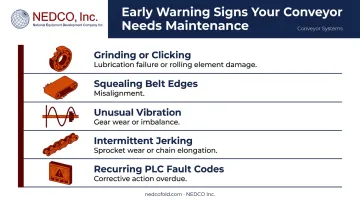
Unexpected safety shutdowns triggered by the same sensor repeatedly are not nuisance faults. They're the control system flagging a developing problem.
Visible Wear and Physical Condition Indicators
Scheduled hands-on walkthroughs — not passive observation — are required to catch these:
- Belt fraying or cracking at edges
- Worn or seized rollers
- Damaged or missing wear strips
- Excessive debris under or around the conveyor frame
- Oil or grease leaks from gearbox or bearing housings
- Drive sprocket tooth wear
- Belt splice separation
- Pulley lagging degradation
Most of these are only visible on close inspection. A walkthrough that takes 10 minutes prevents the failure event that takes 10 hours to fix.
Recurring Downtime and Temporary Fixes Failing
When the same belt retracks, the same sensor gets wiped, or the same fault gets cleared multiple times per shift, the root cause has not been addressed.
When temporary fixes stop holding — a re-tensioned belt slipping again within days, a recalibrated sensor drifting faster than before — the component has reached the end of its service interval. At that point, the answer is replacement, not another round of adjustments.
Conveyor System Maintenance Schedule (General Guidelines)
No single schedule applies to all packaging plants. Frequency should account for production hours per day, environmental conditions (lint, dust, heat, and humidity are significant factors in textile facilities), product type, and OEM-recommended service intervals for the specific equipment.
Maintenance Frequency Table
| Interval | Core Tasks |
|---|---|
| Daily / Per-Shift | Belt tracking inspection; debris and buildup check under conveyor; lubrication level verification; safety stop and interlock confirmation; HMI fault code review from prior shift |
| Weekly | Bearing, chain, and guide rail lubrication per OEM spec; drive motor and gearbox inspection (noise, vibration, heat); belt and chain tension check; sensor and reject mechanism testing; fastener tightening |
| Monthly / Quarterly | Worn belt, roller, and bushing replacement; vibration analysis on motors and gearbox housings; pneumatic system leak check; thermal inspection of electrical panels; maintenance log review to adjust task frequencies |
| Annual Overhaul | Full disassembly of high-wear assemblies; proactive belt, seal, and bearing replacement on critical-path components; electrical insulation testing; firmware and PLC backup verification; operator SOP retraining; OEM service engagement for warranted equipment |
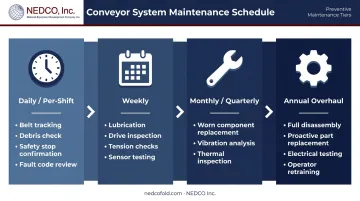
Scheduling Notes for Different Operational Profiles
High-usage facilities (16+ hours/day): Compress intervals. Tasks scheduled monthly should move to bi-weekly. Weekly lubrication cycles may need to become twice-weekly in lint-heavy textile environments where debris accumulation accelerates component wear.
Intermittent or seasonal operations: Intervals can extend, but daily visual checks should still occur at every startup following any downtime period. Equipment that sits idle accumulates its own failure risks — corrosion, belt set, and lubricant migration — that require inspection before returning to production.
For NEDCO E-Z Fold conveyor systems specifically, contact Don Cranshaw at Don@nedcofold.com or call 770-484-9969 to discuss OEM-specific maintenance intervals and annual service plans matched to your production schedule and facility environment.
Conclusion
A conveyor maintenance schedule is a proactive operational tool — not a document that gets updated after something breaks. Done correctly, it protects production uptime, extends equipment lifespan, and keeps emergency repair costs from escalating into losses that hit hardest during peak output periods.
The right maintenance program balances all four types. Preventive tasks belong in daily and weekly routines. Condition monitoring informs predictive decisions before failures occur. Corrective and overhaul resources should be reserved for genuinely unavoidable events — not treated as the standard response to every fault.
Packaging plants running equipment like the NEDCO E-Z Fold automatic conveyor line benefit from working with a manufacturer that provides ongoing service support and readily available OEM replacement parts. For parts ordering, service scheduling, or maintenance guidance specific to your equipment, reach NEDCO Inc. directly at 770-484-9969 or support@nedcofold.com.
Frequently Asked Questions
How do I create a maintenance schedule?
Start with the OEM's recommended service intervals, then layer in daily operator checks, weekly technician tasks, and quarterly inspections. Document all tasks in a written log or CMMS to track completion, identify recurring issues, and adjust intervals based on actual wear patterns over time.
What are typical preventive maintenance tasks for conveyor systems?
Common tasks — performed on daily, weekly, and monthly cycles — include:
- Belt tension and tracking checks
- Bearing and chain lubrication
- Drive motor and gearbox inspection for heat and vibration
- Sensor alignment and cleaning
- Safety interlock testing
- Visual inspection of rollers and wear strips
How often should conveyor systems be inspected in a packaging plant?
At minimum, a daily visual check before each production shift. More detailed mechanical, electrical, and lubrication inspections should happen weekly. High-speed or continuous-operation packaging lines typically require tighter intervals than the OEM's baseline recommendations.
What are the most common conveyor failure points in packaging plants?
The most frequently reported failure points are belt misalignment and fraying, bearing failure from inadequate lubrication, worn drive sprockets, sensor drift causing false rejects, and pneumatic actuator leaks — most preventable with scheduled maintenance.
What is the difference between preventive and predictive maintenance?
Preventive maintenance runs on a fixed schedule regardless of component condition. Predictive maintenance uses condition monitoring data — vibration, temperature, motor current — to service components only when indicators show developing problems. It reduces unnecessary downtime but requires monitoring tools or sensors to get started.
How do I know when to repair versus replace a conveyor component?
Replace components proactively when they're within 20% of their wear limit or failing repeatedly despite maintenance. For major assemblies, weigh cumulative repair cost and downtime risk against replacement cost, using OEM service documentation for component life benchmarks.