Introduction
The label is one of the smallest components on a finished garment — and often one of the first things to fail. Faded text, peeling transfers, frayed edges: most of these complaints trace back to a label decision made early in production, before wash conditions, skin contact, or downstream handling requirements were fully considered.
This guide focuses specifically on durability. How do woven, printed, and heat transfer labels hold up through repeated washing, industrial finishing, and everyday wear? More practically: how do you choose the right type based on what your garments actually need? Each label type is covered with its real-world strengths, failure points, and best-fit applications.
The answer isn't always one label type. Many apparel operations use all three strategically, and understanding where each one excels — and where each one falls short — is what separates a good label decision from a costly one.
Key Takeaways
- Woven labels lead on durability because the design is structurally integrated into the fabric itself
- Printed labels offer flexibility and fine detail but are surface-applied, making them vulnerable to heat, friction, and aggressive detergents
- Heat transfer labels maximize next-to-skin comfort, but require wash testing and precise application controls before bulk production runs
- Wash conditions, garment end-use, and production workflow all influence which label type is appropriate
- Most professional operations use all three label types across a single collection, each serving a distinct purpose
Quick Comparison: Woven vs Printed vs Heat Transfer Labels
| Factor | Woven | Printed | Heat Transfer |
|---|---|---|---|
| Cost | Higher upfront | Mid-range | Variable (setup fees apply) |
| Construction | Design woven into fabric structure | Ink applied to fabric base | Design heat-bonded to garment fabric |
| Wash Durability | Highest — design woven into the fabric structure | Good with quality inks; fades with heat/detergent | Variable — depends heavily on application settings |
| Design Detail | Moderate — thread count limits fine detail | High — supports complex graphics and dense text | High — supports full-color and fine detail |
| Comfort (Next-to-Skin) | Varies by weave and edge finish | Moderate — fabric base can feel stiff | Best — no sewn edge, no folded fabric |
| Best Application | Premium/heritage apparel, denim, outerwear | Care labels, compliance content, size labels | T-shirts, activewear, underwear, children's wear |
| Production Complexity | Requires sewing step | Requires sewing step | No sewing — heat press application |
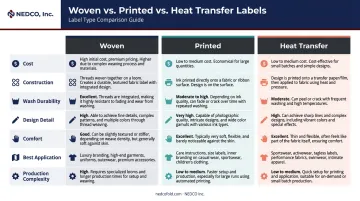
Each label type performs differently under real wash conditions — the sections below break down exactly where those differences matter most.
The Three Label Types: Construction and Use Cases
Woven Labels
Woven labels are manufactured on a loom, where threads are interlaced to build the design directly into the fabric structure. The logo, text, and colors are woven — not printed or applied after the fact. Three weave types cover most applications:
- Damask — highest thread count, tightest weave, best for fine detail and a soft hand feel
- Satin — reflective sheen, lower thread count than damask; can snag if edges aren't finished properly
- Taffeta — matte finish, medium thread count, more rigid; less suited to intricate detail but lower cost
Typical use cases include back neck branding on premium apparel, denim, outerwear, jackets, and hoodies. Because the design is structural, a well-made woven label communicates craftsmanship that printed alternatives can't replicate.
Printed Labels
Printed labels use a fabric base — satin, cotton, nylon, or polyblend — onto which the design is applied with ink. The label is sewn into the garment like a woven label, but the design sits on the surface rather than being built into the fabric.
This construction makes printed labels the go-to for:
- Care and compliance content requiring dense text
- Size labels with fine print
- Complex graphics or multi-color designs that exceed what weaving can reproduce
- Smaller production runs where quick artwork iteration matters
Printed labels are commonly used alongside woven labels — woven for brand identity at the neck, printed for care and composition content at the side seam.
Heat Transfer Labels
Where woven and printed labels are sewn in, heat transfer labels (commonly called tagless labels) bond directly onto the inside garment fabric using controlled heat, pressure, and dwell time. There's no sewn-in label, no folded edge against the skin. Different transfer systems serve different fabrics:
- Plastisol — elastic formulations suit activewear and stretch fabrics
- Nyloflex (screen-printed plastisol on carrier) — compatible with cotton, polyester, blends, mesh, and even leather; Rapid Tag rates this system 4/5 for durability
- Silicone — resistant to heat, stretch, and washing; useful on sublimated fabrics where dye migration is a concern
- Reflective — designed for high-visibility workwear applications
Application settings are the critical variable with heat transfers. According to Avery Dennison's application guidance, temperature, pressure, dwell time, press calibration, and pressure distribution all affect bonding quality. Get any of those wrong and durability drops sharply.
Durability Breakdown: How Each Label Type Holds Up Over Time
Woven Labels
Because the design is part of the textile structure itself, it physically cannot peel, crack, or delaminate. Wunderlabel specifies that its damask sew-on woven labels can withstand washing at up to 90°C / 194°F — a temperature that would destroy most heat transfers. Custom Woven Labels states that woven design elements resist fading and structural failure through the garment's life, though no standardized wash-cycle count has been published by major manufacturers.
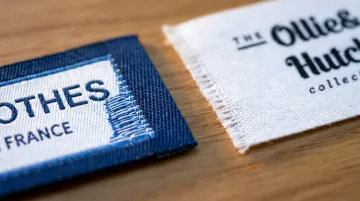
Edge finishing affects long-term performance. Hot-cut and ultrasonically sealed edges resist fraying; end-folded edges produce a softer feel and protect raw edges from unraveling. A woven label with unfinished edges will fray over time — which is why edge treatment is worth specifying at the sourcing stage.
Printed Labels
Printed label durability is directly tied to the ink system and base material. Signal's supplier testing (not an industry-wide standard) found that nylon taffeta with ink additives resisted 10 cycles at 60°C, while woven-edge polyester satin showed resistance at a single cycle at 95°C with ink additives.
As Rapid Tag notes, properly printed cotton labels withstand regular machine washing — but ink can fade with high temperatures or harsh detergents.
High-heat tumble drying is the primary threat to printed labels. The FTC's Care Labeling Rule (16 CFR Part 423) requires that care labels remain legible for the garment's useful life — meaning a printed care label that fades after 30 washes creates a compliance problem, not just a branding one.
Ink system selection makes a real difference here. Signal uses heat curing at 125°C for six hours to maximize wash resistance in its process — a detail worth asking your label supplier about directly.
Heat Transfer Labels
Heat transfer durability is the most variable of the three, and that variability is almost entirely production-driven. SML reports that its PFAS-free transfer range passed 25 wash cycles in internal testing, though the wash temperature, detergent type, and drying method used weren't disclosed on the product page. Always ask suppliers for those specifics before comparing cycle counts.
The most common failure modes are:
- Cracking and peeling — can appear after just a handful of washes when application settings were off
- Edge lift — often caused by incorrect time, temperature, or pressure during application
- Premature bond failure — accelerated by skipping the hardening window after application
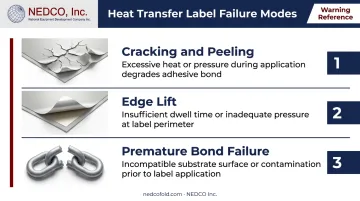
Avery Dennison advises letting a transfer harden for at least 36 hours before washing or testing, a step that's easy to skip under production pressure.
Wash testing during sampling should be treated as mandatory. Run cold, warm, and hot wash cycles plus tumble dry before approving any heat transfer label for bulk production. The AATCC TM61 accelerated colorfastness test and ISO 6330 domestic laundering procedures provide structured frameworks for this — though neither sets a label-specific pass/fail threshold.
Durability in Industrial and Finishing Contexts
Consumer washing isn't the only durability test a label faces. Labels also go through steam pressing, folding machinery, and automated packaging equipment before they ever reach a customer. Heat transfers can be vulnerable to re-heating during pressing — if a finishing line applies significant heat and pressure after the label is already bonded, an incorrectly spec'd transfer can lift. Woven labels are unaffected by this concern.
This is particularly relevant for high-volume operations where equipment like E-Z Fold's automated garment finishing lines handles garments through folding, labeling, bagging, and sealing in sequence. Label durability doesn't end at the washing machine — it has to hold through every stage of that finishing workflow.
The Durability Hierarchy
Woven (structural, highest longevity) > Printed (good with quality inks, surface-applied) > Heat Transfer (variable, process-dependent)
That order can shift based on execution. A poorly made woven label with unfinished edges may underperform a well-applied heat transfer on a compatible fabric. Spec the wrong edge finish or skip the hardening window, and the "superior" label type loses its advantage fast.
Which Label Type Is Right for Your Application?
Recommendations by Garment Category
| Garment Type | Recommended Label |
|---|---|
| Premium/heritage apparel, denim | Woven |
| Outerwear, high-wear workwear | Woven |
| T-shirts, activewear, underwear | Heat transfer |
| Children's clothing | Heat transfer |
| Garments requiring dense compliance text | Printed |
| Garments with complex graphics or multiple languages | Printed |
Many brands combine all three on a single product. A sportswear brand, for example, might use a woven damask label at the back neck of a performance jacket for brand identity while using heat transfer tagless labels inside the t-shirts and base layers in the same collection.Each garment's skin-contact requirements and wash durability determine which label belongs where.
How Wash Conditions Should Drive the Decision
For garments entering commercial or industrial laundering — workwear, hospitality uniforms, healthcare apparel — woven labels are the reliable choice. Heat transfers can withstand industrial conditions when properly specified and applied, but durability under those conditions should be explicitly tested under ISO 15797 industrial washing procedures, not assumed.
The FTC's Care Labeling Rule also matters here: compliance labels must remain legible throughout the garment's useful life. A printed care label with ink that fades under commercial laundering conditions isn't just a quality problem — it's a regulatory one.
Production Efficiency Considerations
Woven and printed labels both require a sewing step, which adds time and handling to the finishing line. Heat transfer labels apply via heat press — a step many operations already run. In high-volume finishing environments where automated folding, labeling, and bagging equipment forms a connected workflow, the label application method directly affects throughput.
E-Z Fold's modular finishing equipment, including the NEDCO Automatic Apparel Labeling System, is built for high-output environments where every step from folding through packaging affects line throughput. Choosing the right label type before production starts keeps that finishing workflow running without interruption.
A Quick Decision Framework
Three questions point you toward the right choice:
- Will the label touch skin directly all day? → Lean heat transfer or ultra-soft printed
- Is premium brand perception the main goal? → Lean woven
- Does the label need to carry dense compliance text? → Lean printed
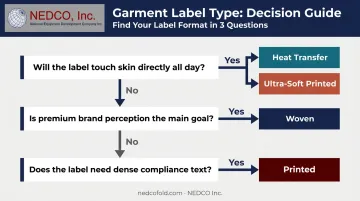
In most cases, these questions point toward more than one label type per garment. That combination approach is standard in professional apparel production — and it's why label decisions belong in the design phase, not the finishing line.
Conclusion
Label selection comes down to the specific garment, wash conditions, and production workflow in front of you — not a universal ranking. Woven labels are the durability benchmark when longevity and brand identity are the priorities. Heat transfers maximize comfort when properly applied and tested. Printed labels handle functional and detail-heavy needs that neither woven construction nor heat transfer can match efficiently.
For apparel manufacturers, label selection isn't just a branding call — it's a production and specification decision. Getting it right during sampling and tech pack development avoids costly failures later.
A label that peels after ten washes, frays in the first season, or fades below regulatory legibility requirements undermines the garment's value at every point in its lifecycle. Lock in your label specs before bulk production begins, test against your actual wash protocols, and treat it as a non-negotiable line in the tech pack.
Frequently Asked Questions
What is the difference between woven and printed labels?
Woven labels have their design structurally built into the fabric using interlaced threads on a loom — the design is the fabric. Printed labels have their design applied on top of a fabric base using ink. That structural vs. surface distinction is what drives the durability difference between the two.
How durable is heat transfer printing?
Durability depends on transfer material type, fabric compatibility, and application settings. Properly applied transfers on compatible fabrics can perform well — SML reports 25-cycle wash performance on its PFAS-free range — but wash testing during sampling is essential before committing to bulk production.
What is the best material for labels?
Woven polyester or cotton threads offer maximum structural durability; satin or cotton bases for printed labels balance softness with print quality; transfer film for heat transfers should match the specific fabric. The right material depends on the garment's actual use conditions.
Can heat transfer labels withstand commercial or industrial laundry?
Heat transfers can be vulnerable to the high heat and agitation of industrial laundering. Durability under those conditions should be specifically tested — not assumed based on consumer wash performance. For garments that will regularly go through commercial laundry cycles, woven labels are generally the more reliable specification.
Which label type is best for high-volume apparel production?
Woven and printed labels require sewing, adding a step to the finishing line; heat transfers apply via heat press, which integrates more directly into many workflows. The best choice depends on your equipment setup and where labeling sits within your production sequence.
Do woven labels scratch or irritate skin?
Scratchiness in woven labels typically comes from the weave type, edge finish, or placement — not the label category itself. Damask weaves with proper folded edges and smooth finishing can feel comfortable next to skin. Placement away from high-friction zones (collar seams, underarm areas) also reduces irritation significantly.