Skipping routine inspections leads to predictable problems: unexpected downtime, emergency repair costs, inconsistent garment output, and shortened equipment lifespan. None of these are inevitable. Proactive inspection catches problems before they become failures.
This guide covers why inspections matter, the four maintenance approaches suited to different situations, how to read early warning signs from your equipment, and a practical inspection schedule built around garment finishing and packaging operations.
Key Takeaways
- Regular inspections catch small problems before they halt production lines or trigger costly emergency repairs.
- Four maintenance types — preventive, corrective, predictive, and overhaul — each serve a distinct purpose based on equipment condition and usage.
- Inconsistent fold quality, unusual motor sounds, and repeated jams are early warning signs, not minor inconveniences.
- A structured schedule — from daily checks to annual overhauls — cuts long-term maintenance costs.
- OEM documentation and genuine replacement parts keep equipment running within manufacturer specifications.
Why Maintenance Inspections Matter for Garment Equipment
Wear Is Inevitable — Failure Doesn't Have to Be
Automated garment equipment — T-shirt folding machines, bagger/sealer systems, conveyor lines — operates through thousands of repetitive cycles per shift. Belts stretch, rollers wear, sensors accumulate fiber debris, and fasteners loosen over time. None of this is surprising. What determines whether that wear becomes a manageable maintenance task or a production-halting failure is whether someone catches it early.
Misaligned folding arms produce inconsistent fold sizes. Worn conveyor belts cause mispackaged garments. Dirty sensors on a bagger/sealer create seal failures that trigger rejected orders. All of these are downstream consequences of upstream wear — and all are avoidable with inspections scheduled before failure, not after.
The Cost Gap Between Planned and Reactive Maintenance
The financial difference between planned and reactive maintenance is substantial. The U.S. Department of Energy's Operations & Maintenance Best Practices Guide estimates that preventive maintenance programs save 12%–18% over purely reactive approaches, with predictive maintenance delivering an additional 8%–12% over preventive-only programs.
These are federal facility estimates, not apparel-specific figures — but the direction holds across industrial environments.
ABB's 2023 survey of 3,215 plant-maintenance decision-makers puts a harder number on that risk: a median unplanned outage cost of $125,000 per hour across industrial sectors. Among facilities using run-to-failure strategies, 80% experienced unplanned outages at least monthly. These figures aren't garment-specific, but they make the point: reactive maintenance is reliably more expensive than planned intervention.
Safety and Compliance
Worn components and malfunctioning safety interlocks create real workplace hazards. OSHA requires that energy-control (lockout/tagout) procedures be inspected at least annually under 29 CFR 1910.147. OSHA also classifies textile environments as locations where combustible fiber and dust accumulations can interfere with electrical equipment heat dissipation. In garment finishing operations, that's a direct fire and equipment risk.
Routine inspections address both concerns:
- Identify worn components before they fail dangerously
- Verify that safety interlocks and emergency stops are functioning as designed
Types of Maintenance for Garment Equipment
Choosing the right maintenance approach depends on the equipment, how intensively it runs, and your production schedule. No single method fits every situation.
Preventive (Routine) Maintenance
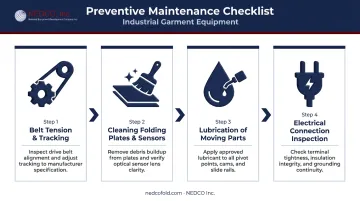
Preventive maintenance operates on a calendar or cycle-count schedule — inspections and service tasks performed before failure occurs. For garment equipment, typical preventive tasks include:
- Belt tension checks and tracking verification
- Cleaning folding plates, conveyor surfaces, and sensor faces
- Lubricating designated moving parts per manufacturer guidance
- Inspecting electrical connections and control panel indicators
This approach works best in consistent-use environments with predictable wear patterns. It is the most cost-efficient baseline option because planned interventions avoid emergency repair premiums and unscheduled production stops.
Corrective (Reactive) Maintenance
Corrective maintenance is triggered by an actual fault: a sudden jam, irregular fold output, a snapped conveyor belt, or an alarm on packaging equipment. Some corrective work is unavoidable, but over-relying on it is expensive.
When reactive repairs are necessary, parts availability determines how long the machine stays down. NEDCO Inc.'s parts and service team stocks genuine OEM components for the E-Z Fold lineup, bagger/sealer systems, conveyor systems, and labeling equipment. Assembly-level parts are available for many components, which speeds repair time compared to sourcing individual pieces. Reach Don Cranshaw directly at Don@nedcofold.com or (770) 484-9969.
Predictive (Condition-Based) Maintenance
Predictive maintenance uses observable performance indicators to time service before failure. Useful signals include:
- Rising motor temperatures during normal operation
- Increasing jam frequency at the same machine point
- Vibration or noise changes in drive components
- Gradual increase in operator resets or restarts per shift
This approach is particularly valuable for high-throughput garment operations running multiple shifts, where scheduling downtime requires advance notice. It works best when there's a measurable precursor to failure and enough lead time to act on it — a warning signal is only useful if your team has enough lead time to plan and execute the intervention before the fault occurs.
Major Overhaul Maintenance
A major overhaul is a comprehensive service event that addresses accumulated wear across critical systems. Typical scope includes:
- Replacing high-wear components: drive belts, rollers, and folding plates
- Conducting a full electrical inspection
- Servicing motors and drive systems
Timing is based on manufacturer guidelines, accumulated cycle counts, and observed component condition rather than a universal calendar.
Skipping overhaul maintenance triggers cascading failures. Individual worn components stress adjacent parts, and multiple simultaneous failures cost significantly more than a planned overhaul. Budget for overhauls the same way you budget for capital equipment — as a known, recurring operational cost.
How to Recognize When Your Equipment Needs Inspection
Performance or Output Changes
Declining output quality is almost always the first signal. On garment folding and packaging equipment, watch for:
- Fold sizes that vary batch-to-batch without operator changes
- Misaligned or inconsistently positioned labels
- Slower-than-normal cycle times on the folder or bagger
- Increased garment rejects at the packaging stage
Operators who run the same machine daily are best positioned to notice these deviations early. Documenting fold accuracy and cycle speed as baseline references gives you something to measure against — and makes early drift visible before it becomes a consistent problem.
Unusual Sounds or Behavior
Standard garment equipment has a recognizable operating rhythm. Departures from that rhythm are worth logging immediately:
- Grinding or squealing from motor or belt components
- Jerky or hesitating conveyor movement
- Delayed or incomplete folding arm actuation
- Unexpected mid-cycle stops or random alarm triggers
Any behavior outside the machine's normal operating pattern warrants inspection before it progresses. Left unaddressed, small anomalies compound — what starts as an occasional hesitation often precedes a full mechanical stoppage.
Visible Wear and Physical Indicators
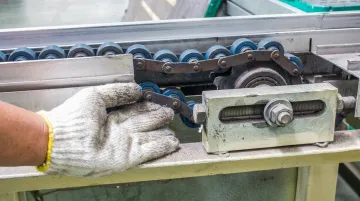
A walkaround visual check takes minutes and catches problems before they affect output. Look for:
- Frayed, cracked, or glazed drive belts
- Fiber and fabric dust accumulation on sensors or folding surfaces
- Corrosion, looseness, or missing hardware on mechanical fasteners
- Warning lights or uncleared error codes on control panels
Fabric debris is a particular challenge in garment environments. OSHA identifies textile fiber accumulation as a combustible dust and electrical heat dissipation risk. Regular sensor and motor area cleaning is both a maintenance task and a compliance requirement.
Increased Operator Interventions
A machine requiring more frequent manual resets, jam clearances, or restarts is working harder than it should. Track how often operators intervene per shift. If that number trends upward over two or three weeks, internal components are under increasing strain — and an inspection is overdue.
Recurring Issues
The same jam point triggering weekly, the same sensor tripping repeatedly, or the same fold defect reappearing after a fix are not coincidences. They indicate that a temporary repair is masking a root cause. Log recurring issues by frequency and location. When the interval between recurrences shortens, schedule a full inspection immediately — the root cause is actively progressing.
Garment Equipment Maintenance Inspection Checklist and Schedule
Inspection frequency should match usage intensity. A folding machine running two shifts daily needs more frequent checks than one used intermittently. High-volume or continuous-operation facilities should compress the intervals below — treating monthly tasks as bi-weekly, for example.
That said, the framework below applies broadly to garment finishing and packaging equipment. Model-specific service triggers and task details should always come from OEM documentation for your specific machine.
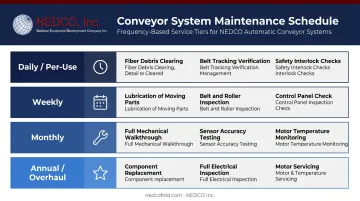
| Frequency | Key Tasks |
|---|---|
| Daily / Per-Use | Clear fiber and fabric debris from folding plates and sensors; verify belt tracking and tension; confirm safety interlocks and emergency stops are functional; listen and observe for unusual sounds during startup |
| Weekly | Lubricate designated moving parts per manufacturer guidance; inspect drive belts and rollers for visible wear or glazing; clean control panel surfaces and check for loose wiring connections |
| Monthly | Full mechanical walkthrough of all drive systems, conveyors, and actuators; test sensor accuracy; check motor temperatures; assess for abnormal vibration; document component condition against baseline |
| Annual / Overhaul | Replace high-wear components (belts, rollers, folding plates as indicated); full electrical inspection; service motors and drive systems; review manufacturer documentation; update maintenance records |
NEDCO Inc. offers Annual Service Plans for its equipment lines — including the E-Z Fold 2000 T-Shirt Folding Machine, Bagger/Sealer Systems, Automatic Conveyor Systems, and Labeling Systems. Each plan includes scheduled preventative inspections, documented condition assessments, and priority attention to keep equipment running through peak production cycles. For enrollment or coverage details, contact Don Cranshaw at Don@nedcofold.com or call (770) 484-9969.
Conclusion
Maintenance inspections are the difference between controlled downtime and the kind of failure that stops a production line mid-run. The cost gap between planned and reactive maintenance is real, and it compounds over time.
A structured approach — daily operator checks, weekly lubrication and belt inspection, monthly mechanical walkthroughs, and scheduled annual overhauls — protects equipment lifespan, maintains output quality, and cuts the unplanned costs that erode margins over time. For model-specific service intervals, replacement parts, or to set up an annual service plan for NEDCO equipment, contact Don Cranshaw directly at Don@nedcofold.com or call 770-484-9969. He handles service requests and parts ordering for the full E-Z Fold line.
Frequently Asked Questions
What does a maintenance inspection consist of?
A maintenance inspection is a structured evaluation of equipment condition covering mechanical components, electrical systems, wear indicators, and performance outputs. The goal is to catch issues — worn belts, loose fasteners, sensor fouling, abnormal temperatures — before they cause a failure or unplanned downtime.
What are the 4 types of inspection?
The four core types are:
- Preventive — scheduled proactively, before any failure occurs
- Corrective — triggered by a fault or inspection finding
- Predictive/condition-based — timed by measurable performance indicators
- Major overhaul — comprehensive deep-service aligned with OEM guidelines and accumulated run cycles
How often should garment equipment be inspected for maintenance?
It depends on usage intensity. High-volume operations running multiple shifts need daily operator checks and weekly formal inspections. Lower-use equipment can typically follow monthly and annual schedules. OEM documentation for your specific machine should define model-specific intervals.
What are the most common signs that a garment folding or packaging machine needs maintenance?
Watch for inconsistent fold sizes, unusual grinding or squealing sounds, repeated jams at the same point, visible belt wear or glazing, and uncleared error codes on the control panel. Any of these signals that an inspection should happen now, not at the next scheduled date.
What is the difference between preventive and corrective maintenance for garment equipment?
Preventive maintenance is planned and performed before anything breaks. Corrective maintenance is triggered by an actual fault or breakdown. Over time, preventive is significantly less costly because it avoids emergency repair premiums, expedited parts costs, and unplanned production stoppages.
What should be included on a garment equipment maintenance checklist?
A thorough checklist covers: mechanical wear components (belts, rollers, folding plates), electrical connections and sensor condition, designated lubrication points, safety interlock and emergency stop verification, and output performance against established baseline benchmarks for fold accuracy and cycle speed.