Introduction
Running a high-volume apparel operation — whether you're a bulk screen printer, wholesale distributor, or contract manufacturer — means packaging decisions carry real operational weight.
When you're processing thousands of t-shirts per shift, a slow bagging method, inconsistent fold, or wrong packaging format doesn't create a minor inconvenience. It creates a bottleneck that compounds across every hour of production.
The wrong packaging approach drives up labor overhead, slows line speed, generates retail chargebacks, and damages product in transit. All of that erodes margins that are already razor-thin.
This guide covers the most effective t-shirt packaging formats for high-volume operations and the factors to evaluate before committing to one. It also explains how automated folding equipment fits into the packaging workflow — and why the fold decision directly shapes everything that follows it.
Key Takeaways
- Clear self-seal poly bags are the fastest, most cost-efficient bulk format, provided upstream folding stays consistent
- Packaging format should match your fulfillment channel: wholesale, DTC, and retail floor display each demand different specs
- A $0.05 difference in poly bag cost equals $500 per 10,000 units — material costs compound fast at scale
- Automated folding equipment can process 350–1,000 garments per hour versus an estimated 200 per hour manually
- Operations running 500+ units per shift should audit folding first: it's often the real throughput bottleneck, not bagging
T-Shirt Packaging in High-Volume Apparel Operations
High-volume apparel packaging is a different discipline than retail or boutique packaging. It happens inside production facilities, contract manufacturing plants, wholesale distribution centers, and bulk screen printing shops running continuous shifts — environments where the priority is throughput consistency, not unboxing experience.
The scale of this challenge is real. According to BLS data, there were 6,338 private U.S. apparel manufacturing establishments as of Q4 2025. That number reflects an industry where packaging decisions play out across thousands of facilities simultaneously.
Consider what LT Apparel achieved operationally: the facility scaled unit-picking throughput from approximately 30,000 units per day to as many as 150,000 units per day at peak season using flexible automation.
At that volume, packaging functions as a full operational system with its own throughput ceiling, cost structure, and quality control requirements. The right packaging format, matched to your line speed, channel requirements, and fold standard, determines how many units move per shift without errors or rework.
Best T-Shirt Packaging Solutions for High-Volume Operations
These five packaging types are selected for operational suitability in high-volume environments — prioritizing consistency, speed of application, and protection across large order quantities.
Clear Self-Seal Poly Bags
Clear self-seal poly bags are the default choice for bulk garment packaging. Lightweight and moisture-resistant, they're available in standard t-shirt sizes — typically 9"x12" for small/medium folds and 12"x15" for larger or heavier garments. They protect against dust and moisture while allowing visual inspection without opening, which speeds up warehouse receiving and retail floor checks.
High-volume advantages:
- Self-adhesive closures allow fast manual or semi-automated packing
- Stack efficiently in corrugated cartons, improving fill rates
- Low per-unit cost makes them the default choice for wholesale and warehouse-to-warehouse shipments
- Compatible with automated bagging systems when integrated with upstream folding equipment
The dependency: consistent pre-folding. A garment folded to inconsistent dimensions produces a lumpy, unprofessional package that's slow to seal and poor on the shelf.
Poly Mailers
The standard for direct-to-consumer (DTC) and e-commerce t-shirt fulfillment. Poly mailers are tear-resistant, lightweight, and eliminate the need for a separate outer carton for most single or multi-shirt shipments — reducing both material costs and dimensional weight charges.
Key operational advantages:
- Compatible with pick-and-pack fulfillment workflows and automated labeling systems
- Eliminate outer carton requirements for most single or two-shirt shipments
- Reduce dimensional weight charges compared to boxed alternatives
The tradeoff: a flat, consistent garment fold is non-negotiable. Misshapen packages generate customer complaints and create downstream problems in automated sortation systems.
Flat-Fold Retail Presentation (Sleeve or Belly Band)
Used for retail-ready fulfillment to boutiques, department stores, and brand-owned retail. The t-shirt is precisely folded and either sleeved in a paper belly band, wrapped in tissue, or inserted into a branded cardboard sleeve. This method lifts perceived product value and is common in wholesale-to-retail channels.
Retailer specifications are strict. Foot Locker's vendor manual specifies adult shirt fold widths of 12 inches and 12.5 inches depth, and Orvis requires that flat-packed garments enter poly bags neck or waist first. Inconsistent folds lead to rejected shipments and chargebacks — making this format the most dependent on upstream process standardization.
Corrugated Outer Shipping Boxes
Corrugated boxes are the standard outer packaging for bulk wholesale t-shirt shipments, protecting poly-bagged or folded garments during freight transit and sized to fit standard pallet configurations. Single-wall corrugated is typically sufficient for domestic apparel shipments; retailers like Orvis specify at least 32 ECT, while Foot Locker Europe requires a minimum of 29 ECT.
In high-volume operations, box erection speed matters. Pre-folded corrugated or auto-bottom designs reduce time per carton significantly and keep the packing line moving.
Header Card Polybags (Retail Floor Display)
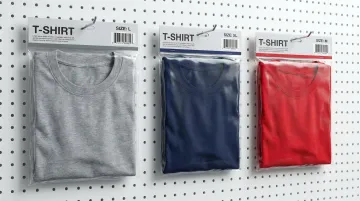
A hybrid format: folded t-shirt inside a clear poly bag, with a printed cardboard header card at the top displaying brand, size, price, and barcode. The result is a retail-ready package for hook or peg display without additional labeling at the store level.
These are common among wholesale apparel brands supplying mass-market retailers. They require a precise fold standard — the garment needs to display attractively through the bag — and operators must apply the header card consistently. Both requirements point directly back to upstream folding quality.
Key Factors When Choosing T-Shirt Packaging at Scale
Throughput Compatibility
Packaging format must match line speed. A format requiring 60 seconds per unit manually creates a hard ceiling on daily output. Industry equipment specifications show automated folding and bagging lines processing 350–1,000 garments per hour, compared to an estimated 200 shirts per hour for a single manual operator handling folding alone.
Work backward from your target units-per-hour to determine whether your current packaging format is the constraint, or whether the bottleneck sits upstream in the folding step itself.
Cost Per Unit at Volume
Once throughput is dialed in, cost per unit becomes the next lever. Material costs compound fast. A $0.05 difference in poly bag cost equals $500 per 10,000 units. Evaluate total cost of packaging across three dimensions:
- Material cost per unit at your order quantities
- Labor time per unit, including folding, bagging, and sealing
- Fulfillment surcharges from dimensional weight or irregular package presentation
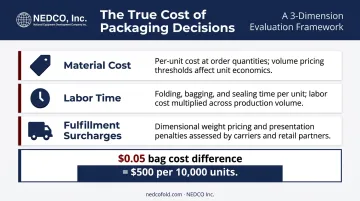
Choosing a format based on small-batch trials without accounting for shift-length labor cost will quietly erode margin at scale.
Fold Consistency and Presentation Standards
Retailers have specific fold dimension requirements, and noncompliance is expensive. Tilly's vendor compliance manual lists a $1.50 per carton chargeback for dimension or burst-strength violations. Orvis lists a $200 per item chargeback for failing to submit a required packaging sample.
Inconsistent folds generate rejected pallets, chargebacks, and returns. It's the quality control point most operations don't scrutinize until the chargebacks arrive.
Fulfillment Channel Alignment
No single packaging format works across all channels:
| Channel | Recommended Format |
|---|---|
| Warehouse-to-warehouse wholesale | Clear self-seal poly bags in corrugated cartons |
| DTC / e-commerce | Poly mailers with automated labeling |
| Retail floor display | Header card polybags or flat-fold with sleeve |
| Wholesale-to-retail buyers | Flat-fold to retailer fold spec in clear poly bags |
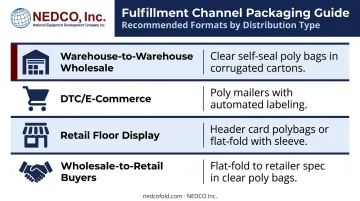
Operations serving multiple channels simultaneously need two or three formats running in parallel. Plan your line layout accordingly.
How Automated Folding Equipment Elevates High-Volume Packaging
The Manual Folding Bottleneck
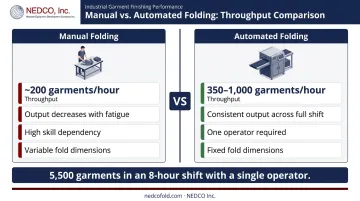
Folding is the slowest step in the packaging workflow and the most variable. A single manual operator can fold an estimated 200 t-shirts per hour — a figure that decreases over a full shift as fatigue sets in. Automated equipment specifications, by contrast, range from 350 garments per hour for semi-automatic systems up to 1,000 garments per hour for fully automated fold-and-bag lines, with many configurations requiring just one loading operator.
A 2021 trade report from Apparel Resources noted one automated line processing 5,500 garments in an 8-hour shift with a single operator — and a separate vendor-attributed system claiming savings of at least five folding and packing workers per shift. The throughput gap between manual and automated folding is substantial, regardless of which specific figures you apply to your operation.
What Automatic Folding Equipment Does
An automatic t-shirt folding machine accepts a garment via conveyor, folds it to a preset dimension, and outputs a ready-to-bag unit consistently — regardless of which operator loads it or how far into the shift it's running. This removes the skill dependency from folding, reduces operator fatigue, and eliminates the primary source of presentation inconsistency in high-volume operations.
That consistency is what makes automated folding a foundation for the rest of the line — not just a faster version of a manual step.
The E-Z Fold by NEDCO Inc.
NEDCO Inc., founded in 1989 by Jack Dodson, Jr. in Covington, Georgia, manufactures the E-Z Fold T-Shirt Folder — designed specifically for production environments where folding consistency and throughput determine packaging quality and shift economics.
Dodson developed the E-Z Fold building on his experience at All-Pac, where he worked as a lead sales engineer on the world's first automatic t-shirt folding machine. The E-Z Fold line has since grown into a modular equipment ecosystem that includes:
- Automatic T-Shirt Folding Machines (E-Z Fold 2000, LS-4200-5)
- Bagger/Sealer Systems — combines bagging and heat-sealing into one station
- Automatic Apparel Labeling Systems — applies labels and barcodes inline
- Automatic Conveyor Systems — connects all stations into a continuous workflow
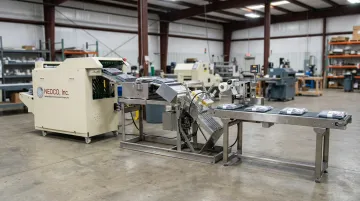
The modular design means an operation can start with just the folder and add downstream stations — bagging, labeling, conveyor — incrementally as volume grows. All equipment is manufactured in the U.S., with OEM replacement parts, annual service plans, and direct technical support available through NEDCO's Covington facility.
Downstream Impact on Packaging Quality
When garments arrive at the bagging or boxing station pre-folded to a consistent dimension, every downstream step improves:
- Poly bags seal flatter and faster
- Header cards align correctly without manual adjustment
- Retail sleeves fit without refolding
- Corrugated cartons fill to spec, reducing void fill and improving freight economics
In practice, this means fewer adjustments, less rework, and faster cycle times at every station downstream — which adds up quickly across an 8-hour shift.
Conclusion
For high-volume t-shirt operations, packaging is an operational system — not a branding decision. The right combination of packaging type, fold standard, and line speed determines units per shift, labor cost per unit, and whether retail and wholesale buyers accept or reject what you send them.
Before committing to a packaging format change, audit your finishing line first. Identify whether folding or bagging is the actual rate-limiting step. Investing in automated folding upstream often unlocks more throughput than switching packaging materials — every downstream format depends on a consistent fold to perform at speed.
For operations looking to increase finishing line speed and eliminate fold inconsistency, NEDCO Inc.'s E-Z Fold line has served textile and apparel production facilities across the U.S. for 37 years. Contact the team at (470) 592-3050 or support@nedcofold.com to discuss which configuration fits your operation's volume and garment mix.
Frequently Asked Questions
What is the most efficient packaging method for high-volume t-shirt operations?
Clear self-seal poly bags combined with a standardized upstream folding process are the most operationally efficient choice for bulk volume — they minimize per-unit time while maintaining protection and presentation across large quantities. The folding step, not the bagging step, is typically where efficiency is won or lost.
How does automated folding equipment improve t-shirt packaging throughput?
Automatic t-shirt folding machines eliminate the slowest step in the packaging workflow, producing consistent fold dimensions at rates no manual operator can sustain across a full shift. Downstream bagging and boxing stations can then run at full capacity without interruption.
What size poly bag is best for packaging folded t-shirts in bulk?
Standard sizes run from 9"x12" for small/medium folds, 10"x13" for medium/large, and 12"x15" for XL and heavier-weight shirts. Size should match the folded garment dimensions — not the unfolded garment size — to keep the package tight and professional-looking.
How do high-volume apparel operations maintain consistent fold quality across shifts?
Automated folding equipment is the most reliable solution, producing a fixed fold dimension regardless of operator, shift, or fatigue level. For operations not yet using automation, a folding board template combined with shift-level QC checks is the manual alternative.
What packaging format is best for wholesale t-shirt shipments to retail buyers?
Retail buyers typically require flat-fold presentation to a specified dimension, often inside a clear poly bag or with a header card. Meeting the retailer's exact fold specification is critical — deviations commonly trigger chargebacks, making consistent upstream folding essential for wholesale-to-retail channels.
Can automated t-shirt folding equipment integrate with existing packaging lines?
Modular folding equipment can be added to existing finishing lines without a full facility redesign. NEDCO Inc. offers direct consultation on integration — reach out to discuss your current line layout, volume, and garment mix before selecting a configuration.