Introduction
U.S. parcel volumes hit 23.1 billion shipments in 2025, up 3.3% year-over-year according to the Pitney Bowes Parcel Shipping Index. Behind that number is a fulfillment infrastructure under constant pressure — consumers now expect same-day or next-day delivery as standard, and a 2024 FedEx study found 55% of shoppers would pay a premium for same-day service.
Conveyor systems sit at the center of every warehouse's response to that pressure. They move goods from receiving through picking, packing, and outbound shipping without relying on manual transport — directly cutting order cycle times and reducing labor dependency at scale.
The catch: not every conveyor handles e-commerce well. Systems built for manufacturing assume uniform products moving at predictable cadences. E-commerce throws polybags, padded envelopes, and mixed-SKU parcels at equipment that simply wasn't designed for that variety. This guide covers the five systems best suited for direct-to-consumer fulfillment, including what each does, where it fits in a warehouse layout, and how to compare your options.
Key Takeaways
- Conveyor systems automate product movement across all fulfillment stages, reducing manual labor and improving throughput consistency
- Top e-commerce systems include live-roller, MDR zero-pressure accumulation, high-speed sortation, telescopic dock, and spiral vertical conveyors
- E-commerce conveyors must handle soft, irregular packaging that traditional manufacturing systems aren't designed for
- Selection should be driven by workflow stage, package type, throughput volume, and WMS integration capability
- System complexity should match operational need — not the other way around
Overview of Conveyor Systems in E-Commerce Warehouses
An e-commerce conveyor system is a motorized material handling system designed to transport goods through inbound, picking, packing, and outbound stages — built to handle the speed, variety, and volume that direct-to-consumer fulfillment demands.
A 2024 Modern Materials Handling automation study found that 49% of respondents used conveyor and sortation systems, with 52% of those users planning implementation or upgrades within the next 24 months — a clear signal that adoption is accelerating.
What Makes E-Commerce Conveyors Different
Standard warehouse conveyors are built around uniform loads — consistent dimensions, predictable weight distribution, stable surfaces. E-commerce breaks every one of those assumptions.
Key differences that determine system selection:
- Package surface variety — Polybags and padded envelopes collapse or snag on widely spaced roller conveyors; belt-style surfaces are required
- SKU diversity — High-volume mixed-SKU operations need sortation capability to route items accurately without manual intervention
- Seasonal volatility — Peak-season surges demand modular, adaptable designs that can scale up or down without full system replacement
- Software integration — conveyors without WMS and WCS connectivity create blind spots at every scan point, breaking routing accuracy across the entire fulfillment flow
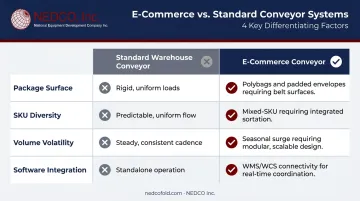
Understanding these differences is the foundation for choosing the right conveyor type — covered in detail in the sections below.
Best Conveyor Systems for E-Commerce Warehouses
The systems below were selected based on their fit for specific e-commerce fulfillment workflows — covering transport, accumulation, sortation, dock operations, and vertical movement across inbound, picking, packing, and outbound stages.
Hytrol E24 24V Live-Roller Accumulation Conveyor
Hytrol is one of the most widely deployed conveyor manufacturers in U.S. distribution centers. Their E24 system is a 24V DC live-roller accumulation conveyor built specifically for operations that need fast installation and the ability to reconfigure as workflows shift.
What sets it apart is the elimination of traditional drive components. The 190-E24 replaces drive belts, chains, line shafts, and pneumatics with individual 24V DC motors on each roller zone.
That means faster electrical installation, simplified wiring runs, and compatibility with modern WCS platforms — without the mechanical complexity that slows maintenance and reconfiguration.
| Specification | Detail |
|---|---|
| Key Feature | 24V DC motorized rollers eliminate drive belts, chains, and pneumatics — enabling simplified wiring and faster zone-level installation and reconfiguration |
| Best Fulfillment Use | Inbound transport, pick-to-pack lanes, connecting workstations — especially in facilities requiring seasonal reconfiguration |
| Drive Type | All-electric modular design; Hytrol describes the 190-E24MC as built for "quick installation and reconfiguration" |
Omni Metalcraft MDR Zero-Pressure Accumulation Conveyor
Omni Metalcraft is a U.S.-based manufacturer with a strong footprint in motor-driven roller (MDR) solutions. Their zero-pressure accumulation conveyor is the default choice for high-volume fulfillment centers processing mixed product types.
The core mechanism is zone-independent control. Photo eyes monitor each zone independently, so items accumulate without physical contact between adjacent products. No collisions, no jams, and no downstream damage to fragile goods or polybags.
EtherNet/IP-conformance-tested drive cards support integration with control systems programmed in RSLogix 5000, giving WCS-driven routing real-time zone-level authority.
| Specification | Detail |
|---|---|
| Key Feature | Zero-pressure zone control prevents product collisions; each zone activates independently via photo eye sensors to protect goods and prevent line jams |
| Best Fulfillment Use | Picking-to-packing lanes, sortation induction, shipping line buffering in high-volume mixed-SKU environments |
| Speed Range | Model maximums span 60 to 180 FPM depending on configuration (MO-1.9, MP-1.9, FO-1.9 reach 180 FPM; MC-1.9 reaches 120 FPM; others reach 60 FPM) |
Span Tech High Speed Switch Sortation Conveyor
Span Tech specializes in custom modular conveyor systems, with a sortation line designed for e-commerce distribution centers routing products to multiple destinations simultaneously. Their High Speed Switch uses a patented toggle mechanism — not a conventional diverter — to push items toward correct destinations at speed.
The system handles 1:2, 1:3, 1:4, and 2:4 sorting or converging arrangements, with a manufacturer-rated maximum of 275 FPM (subject to Span Tech design department approval). Minimum product length is 4 inches with a 4-inch gap between products. Integration with barcode scanners and vision systems enables automated item identification and routing — eliminating the manual sortation labor that creates bottlenecks in multi-carrier outbound operations.
| Specification | Detail |
|---|---|
| Key Feature | Patented toggle mechanism routes items to correct destinations automatically — integrates with barcode scanning and vision systems for WMS-directed sortation |
| Best Fulfillment Use | Multi-carrier outbound sortation, zone routing in pick-and-pass systems, returns processing lanes |
| Sorting Configurations | 1:2, 1:3, 1:4, and 2:4 arrangements; max speed 275 FPM with 4-inch minimum product length and 4-inch gap requirement |
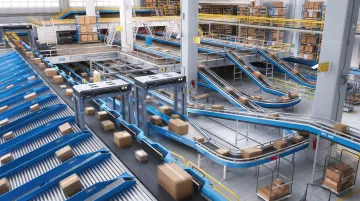
For broader context: a 2021 Modern Materials Handling benchmark cited 2,000 to 8,000 items per hour for rapidly deployable e-commerce sortation systems of this class — though actual throughput depends heavily on product dimensions, spacing, and operating conditions.
FMH Conveyors MaxxReach Telescopic Belt Conveyor
FMH Conveyors is the specialist in extendable and telescopic belt conveyor solutions for loading docks. The MaxxReach addresses one of the most labor-intensive and time-sensitive points in any fulfillment operation: trailer loading and unloading.
The conveyor extends directly into the trailer, bringing the belt to the worker instead of forcing workers to carry packages the full depth of the truck. That reduced travel distance lowers physical strain and speeds dock turnaround.
FMH's own case study from a major retailer's Dallas outbound distribution center reports that a two-person crew using MaxxReach conveyors can operate up to four dock doors simultaneously — a material labor efficiency gain at high-volume outbound facilities.
| Specification | Detail |
|---|---|
| Key Feature | Extends into trailers to bring the belt to the worker — reduces manual carrying distance and lowers dock injury risk during inbound receiving and outbound parcel loading |
| Best Fulfillment Use | Inbound receiving docks, outbound parcel loading, cross-dock operations, and multi-dock facilities with shared portable units |
| Extension Range / Drive | Contracted length 14 to 30 ft; extended length 34 to 95 ft; 480 VAC with 3 or 5 hp belt drive; standard variable speed 60 to 120 FPM, optional 80 to 160 FPM |
FMH also offers the NestaFlex gravity series (models reaching 68 ft extended) and the BestFlex powered roller for operations that don't require the full telescopic belt configuration.
Ryson International Spiral Conveyor
Ryson International is the market leader in spiral conveyor systems, with installations across multi-level fulfillment centers and mezzanine pick modules where vertical product movement is needed without consuming large floor areas.
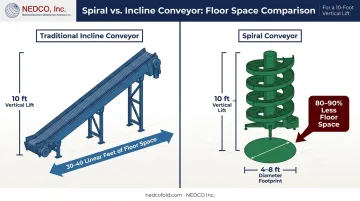
The engineering advantage is the continuous helical belt path. Unlike traditional incline conveyors, which require 30 to 40 linear feet of floor space to achieve a 10-foot elevation change, a Ryson spiral handles the same lift within a 4 to 8-foot diameter footprint. Ryson states their spirals use 80% to 90% less floor space than conventional incline conveyors — a manufacturer-stated figure.
| Specification | Detail |
|---|---|
| Key Feature | Compact vertical footprint connects multiple warehouse levels without interrupting horizontal conveyor flow — available in powered-ascent and controlled-descent configurations |
| Best Fulfillment Use | Mezzanine-to-ground-floor carton flow, connecting pick modules to outbound packing areas in multi-level e-commerce facilities |
| Throughput Capacity | Up to 200 FPM; handles vertical lifts up to 50 ft; supports loads up to 75 lb per linear foot and up to 3,600 lb total in the spiral |
How We Chose the Best Conveyor Systems for E-Commerce
Systems were evaluated against the specific demands of textile finishing and apparel production lines — not general-purpose warehouse benchmarks. The focus was garment compatibility, throughput capacity, finishing line integration, and demonstrated performance across folding, labeling, bagging, and sealing stages.
Common Selection Mistakes to Avoid
Apparel manufacturers and screen printers consistently make the same errors when buying conveyor systems:
- Prioritizing unit cost over total cost of ownership — installation, integration, and maintenance costs often exceed the purchase price for production-grade systems
- Selecting systems designed for non-textile applications — conveyors built for rigid cartons or food packaging fail when handling soft goods, folded garments, and polybag-sealed apparel
- Ignoring production scalability — a system that handles average daily output comfortably may bottleneck during high-volume seasonal runs
- Overlooking finishing line compatibility — a conveyor that doesn't integrate with your folder, labeler, or bagger adds manual steps that defeat the purpose of automation
Shortlisting Criteria
These systems were selected based on:
- Ability to handle mixed garment types (t-shirts, folded soft goods, bagged apparel)
- Speed and reconfigurability for fluctuating production volumes
- Integration readiness with folding, labeling, and bagging equipment
- Vendor support and domestic parts availability
- Proven deployment in high-volume textile finishing environments
Conclusion
The best conveyor system for an e-commerce warehouse is the one that solves the right problem at the right workflow stage — not necessarily the most technically advanced or most expensive option available. A zero-pressure accumulation conveyor does nothing useful at a loading dock. A telescopic belt conveyor can't sort outbound shipments by carrier. Matching system type to workflow stage is the decision that drives real throughput gains.
Before purchasing, audit your current fulfillment flow. Identify where manual handling bottlenecks or product damage are occurring, then match the conveyor type to that specific problem. For most facilities, it's a combination of system types — not a single solution — that drives meaningful throughput improvement.
For apparel and clothing e-commerce operations, conveyor automation handles transport — but the finishing stage is where throughput often stalls. Pairing your conveyor setup with downstream equipment like the E-Z Fold T-Shirt Folder from NEDCO Inc. addresses the garment folding and prep stage that conveyors alone can't solve, reducing manual folding labor and improving pack-ready throughput.
NEDCO's Automatic Conveyor System is designed to connect directly with their folding, labeling, and bagger/sealer systems — forming a complete integrated processing line rather than a collection of disconnected equipment.
If you're evaluating finishing and packaging equipment to complement your conveyor-driven fulfillment workflow, contact NEDCO Inc. at 770.484.9969 or visit nedcofold.com/equipment/ to discuss your operation's specific requirements.
Frequently Asked Questions
What type of conveyor is best for e-commerce fulfillment?
MDR zero-pressure accumulation and high-speed sortation conveyors are the most commonly deployed for high-volume e-commerce. Both handle mixed-size parcels without damage and route items accurately via WMS integration. Belt conveyors and live-roller systems complement these for induction, transport, and workstation connections.
How much does a conveyor system cost for an e-commerce warehouse?
Published prices aren't available from manufacturers directly, as systems are configured and quoted based on facility requirements. Cost drivers include belt speed, zone count, switch configuration, scanner integration, and installation complexity. Budget separately for integration and commissioning beyond the base equipment cost.
What makes e-commerce conveyor systems different from traditional warehouse conveyors?
E-commerce conveyors must handle soft, irregular packages like polybags and padded envelopes that snag on widely spaced rollers. They require belt-style surfaces, zero-pressure accumulation to prevent product damage, and high-speed sortation capability. Traditional manufacturing conveyors are not designed for any of these requirements.
What is zero-pressure accumulation in conveyor systems?
Zero-pressure accumulation means items in adjacent conveyor zones never physically touch. Each zone is independently controlled, so products hold in place without upstream items colliding into them, which protects fragile goods, prevents jams, and keeps zone-to-zone flow consistent.
How do conveyor systems integrate with warehouse management software?
WMS and WCS integration allows the warehouse management system to direct routing decisions, update inventory location at scan points, and instruct sortation systems on destination lanes, ensuring physical product movement matches order records in real time.
How do I choose the right conveyor for my e-commerce warehouse?
Start by identifying the specific workflow stage creating bottlenecks. From there, assess product type and weight range, peak throughput requirements, and floor space constraints. Confirm WCS compatibility with your existing WMS before committing to a system type.