Introduction
Getting garments from cut fabric to retail-ready product requires a carefully selected lineup of machines at every stage. Choose the wrong cutting configuration and fabric waste climbs. Pick the wrong sewing machine for your fabric type and seams fail quality inspection. Skip proper finishing equipment and your fastest sewing floor still ships late.
This guide walks through the primary machinery categories used across the garment production workflow — from fabric spreading and cutting through sewing, finishing, and packaging. Production managers and facility owners will come away with a clear picture of what each category does, how machine types differ at each stage, and which selection criteria matter most for their operation.
Key Takeaways
- Garment production spans five core stages — spreading/cutting, sewing, embroidery/printing, finishing, and packaging — each requiring distinct machine types
- Sewing machines are the most varied category; the wrong stitch type directly affects seam strength, fabric integrity, and production speed
- Finishing and packaging equipment is chronically underinvested in, yet it directly controls how fast orders move off the production floor
- Total cost of ownership — including parts availability, training, and after-sale support — matters as much as sticker price
Pre-Production Machines: Fabric Spreading and Cutting
Before any stitching begins, fabric must be spread evenly across cutting tables in multiple layers and cut precisely to pattern specs. Errors here cascade through every downstream step — a misaligned layer means dozens of off-spec cut pieces.
Fabric Spreading Equipment
Manual spreading is common in small operations, but it introduces layer inconsistency and operator fatigue on long runs. According to Oshima's spreading machine guidance, manual spreading can require 2–6 workers depending on roll weight and length, while motorized spreading machines can reach speeds up to 90 m/min with consistent edge alignment and tension control.
Key differences between the two approaches:
- Manual spreading: Labor-intensive, 2–6 operators per run, prone to layer misalignment on long rolls
- Motorized spreading: Up to 90 m/min with consistent tension control and edge alignment
- Labor impact: Motorized systems reduce headcount requirements significantly on continuous production runs
For mid-to-large facilities running continuous production, motorized spreaders recover their cost primarily through reduced labor and improved layer consistency.
Cutting Machine Types
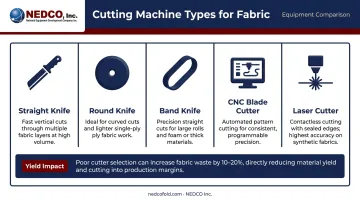
Lectra reports that cutting-room fabric waste typically runs 10%–20% of total material — which means yield should drive cutting equipment decisions as much as throughput speed.
| Cutter Type | Best Fit |
|---|---|
| Straight knife | General multi-layer cutting across diverse fabric types; Eastman offers 5–13 inch knife heights |
| Round knife | Straight lines and large-radius curves; soft through industrial fabrics |
| Band knife | Fine cutting of knits, crocheted fabrics, and technical textiles; max cutting height ~250mm |
| CNC blade cutter | Software-controlled for both small-series and mass production runs |
| Laser cutter | Contact-free cutting for synthetics; thermal cutting seals edges to prevent fraying |
Pattern plotters and digitizing boards feed accurate cutting guides into computerized systems — and marker planning automation is where the biggest yield gains typically emerge. One Lectra customer reduced fabric waste by 30% after automating motif-panel management.
Sewing Machines: Core Types for Garment Production
Sewing machines are the largest and most varied equipment category in any garment factory. The right selection depends on fabric type, garment style, stitch requirement, and production volume. ISO 4915 classifies stitch types; ISO 4916 classifies seam types — writing specifications around these standards, not just machine brand names, produces more consistent procurement outcomes.
Lockstitch Machines
The single-needle lockstitch is the workhorse of woven garment production — used for seams across shirts, pants, and outerwear. It creates a basic two-thread locked seam suited to general joining and topstitching.
Two common configurations:
- Single-needle — General seaming and topstitching on woven garments
- Double-needle — Two parallel locked rows for decorative topstitching or reinforcement on waistbands and plackets
Overlock and Serger Machines
Overlock machines simultaneously trim the seam allowance and encase the fabric edge — essential for knit garments where fraying must be controlled. Thread count determines the application:
- 3-thread overlock — Light fabrics, edge neatening, basic fray control
- 4-thread overlock — Joining and finishing stretch and knit seams
- 5-thread safety stitch — Heavy-duty workwear and sportswear requiring maximum seam strength
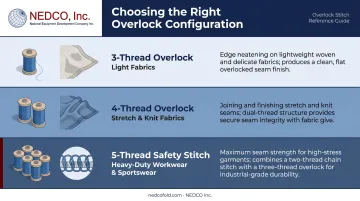
Any facility producing t-shirts, activewear, or underwear at scale needs overlock capacity matched to its volume. Running 3-thread machines on heavy sportswear is one of the more common configuration mistakes.
Coverstitch Machines
Coverstitch machines are the standard for hemming and topstitching on stretch garments — t-shirts, athletic wear, sweatshirts. Two configurations:
- Flatbed coverstitch — Flat, open garment components; standard hemming on knit panels
- Cylinder-bed coverstitch — Tubular areas like cuffs, sleeves, and collar openings
The cylinder-bed distinction matters for high-volume knitwear production. Trying to hem cuffs on a flatbed slows throughput considerably.
Chainstitch and Specialty Machines
Where coverstitch handles knit and stretch, chainstitch machines shift focus to heavier woven fabrics — particularly denim. High-volume applications include:
- Single-needle chainstitch for denim seams — the characteristic stitch used in jeans manufacturing
- Double-needle chainstitch for hemming operations on heavier fabrics
Specialty machines every mid-to-large factory needs:
- Bartack machines — Dense reinforcement at pocket corners, belt loops, and strap attachment points
- Buttonhole machines — Dedicated straight or eyelet buttonhole cycles with fabric-specific configurations for materials including denim
- Blind stitch machines — Invisible hemming on dress pants, skirts, and tailored garments
Embroidery, Printing, and Specialty Decoration Machines
This category covers value-add machinery for decoration, branding, and structural preparation. These machines don't assemble garments — they differentiate them.
Embroidery Machines
Single-head vs. multi-head selection comes down to run type:
- Single-head (e.g., Tajima SAI: 1 head, 8 needles, 800 rpm max) — Small runs, sampling, personalization work, varied designs
- Multi-head (e.g., Tajima TMEZ-KC: 2–8 heads, up to 1,100 rpm; Barudan K Series: 2–56 heads) — Identical designs across many garments simultaneously, critical for uniform and branded apparel orders
Head count, not rated stitch speed alone, drives production capacity for identical-unit orders.
Printing Machines
| Method | Best For | Consideration |
|---|---|---|
| Screen printing | Medium-to-long runs, repeat designs | Setup cost amortizes across high unit counts |
| DTG/digital | One-offs, short runs, complex graphics | Unit cost stays constant; works best on 100% cotton |
| Heat transfer | Short personalized runs; avoids screen setup | Verify substrate compatibility with your fabric type |
FESPA's comparison of screen and digital printing places DTG firmly in very short and one-off runs and screen printing in medium-to-long runs. There's no universal crossover point — calculate setup cost separately from per-piece cost for your specific order mix.
Fusing Machines
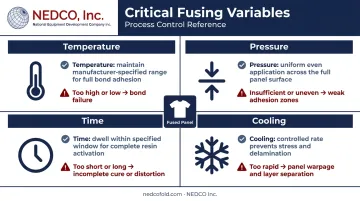
Fusing machines bond interfacing to fabric panels, providing structure in collars, cuffs, waistbands, and jacket fronts. Four variables must be controlled precisely:
- Temperature — too high or too low causes bond failure
- Pressure — insufficient pressure leads to delamination
- Time — under- or over-fusing both compromise adhesion
- Cooling — inadequate cooling causes bubbling at the interface
A peer-reviewed study published in MDPI links bubbling and delamination directly to any of these variables being out of spec, along with resin-fabric incompatibility. Without correct fusing, garments lose shape integrity after washing — a returns issue with direct cost implications.
Finishing and Packaging Equipment: The Critical Final Stage
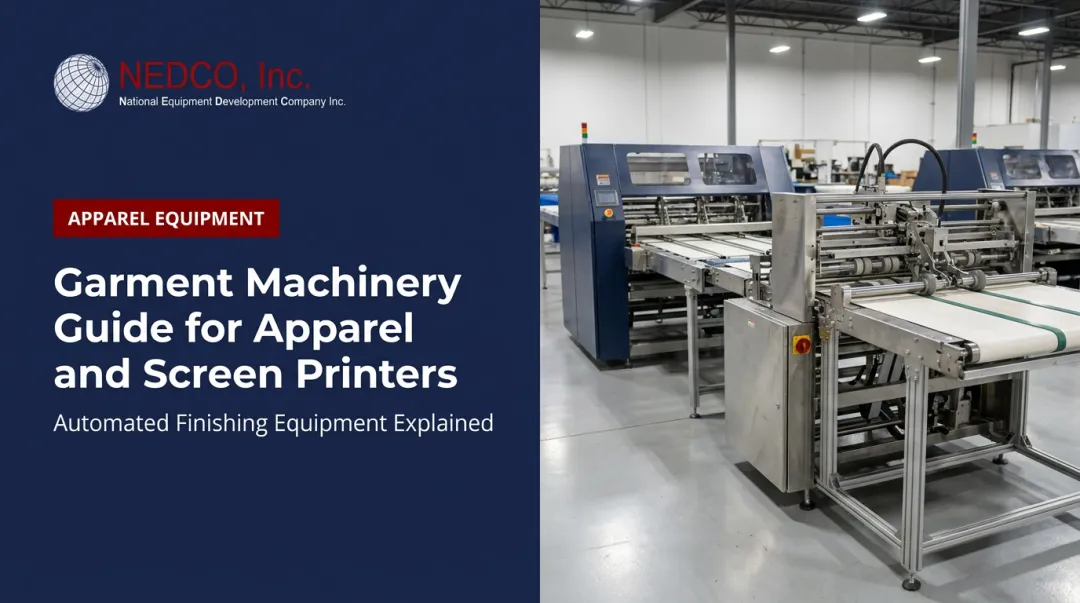
Finishing and packaging machinery is where production speed translates into fulfilled orders. An understaffed or under-equipped finishing floor becomes the bottleneck that delays shipments regardless of how fast cutting and sewing run.
Pressing and Steam Machines
Industrial pressing and steam equipment removes wrinkles, sets seams, and gives garments their retail-ready appearance before quality inspection. Three primary types at scale:
- Steam irons and tables — Localized underpressing and final crease work; VEIT rates its 8940 Double Legger press at up to 40 trousers/hour
- Tunnel finishers — Bulk wrinkle removal via modular steam and air treatment; VEIT's TF 57 is rated at approximately 2,500 pieces/hour
- Form/cabinet finishers — Garment-specific shaping for shirts, jackets, and stretch-sensitive items
The throughput gap between tunnel finishers and form finishers is significant — distinguish bulk wrinkle removal from garment-specific shaping when specifying equipment.
Thread Trimming and Needle Detection
Thread trimming machines remove loose threads before final inspection — a step that's easy to understaff and consistently becomes a bottleneck when order volumes spike.
Needle detection is both a safety and quality control requirement. Primark's Metal Control Policy requires 100% metal detection for children's wear and adult lingerie, underwear, nightwear, and swimwear — specifying detection of 1.2mm ferrous metal and checks at least four times daily. This is a retailer requirement, not a universal legal standard. Get each buyer's current policy in writing rather than assuming one global specification applies.
Automatic Garment Folding Machines
High-volume apparel facilities — particularly those producing t-shirts, knits, and casualwear — rely on automatic folding machines to standardize fold dimensions, reduce operator fatigue from repetitive manual folding, and increase throughput in the final packaging stage.
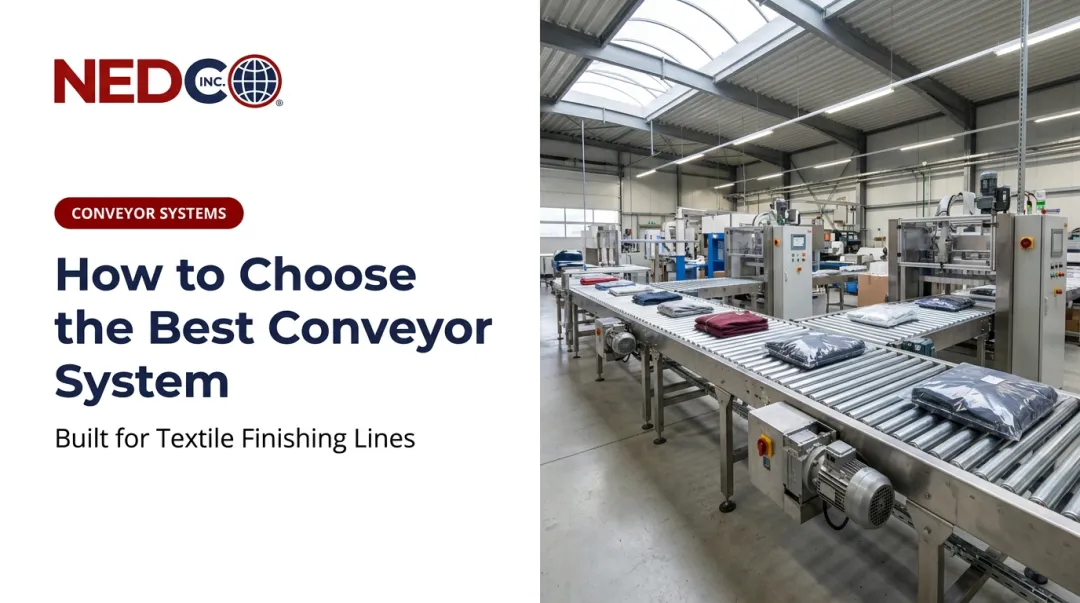
NEDCO Inc.'s E-Z Fold T-Shirt Folder was engineered specifically to address this bottleneck. Built on a modular design, the E-Z Fold integrates directly with NEDCO's bagger/sealer systems, automatic labeling systems, and conveyor equipment — building a continuous fold-to-package workflow from connected components rather than isolated manual steps. Facilities can start with the folder and add components incrementally as production demands grow.
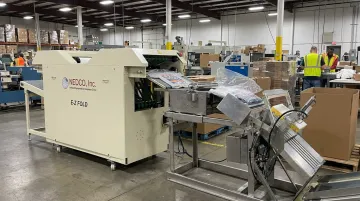
NEDCO has manufactured finishing and packaging equipment from its Covington, Georgia facility since 1989, serving screen printers, apparel manufacturers, and fulfillment operations nationwide.
Packing and Labeling Equipment
The packing and labeling stage directly determines how fast finished goods reach customers:
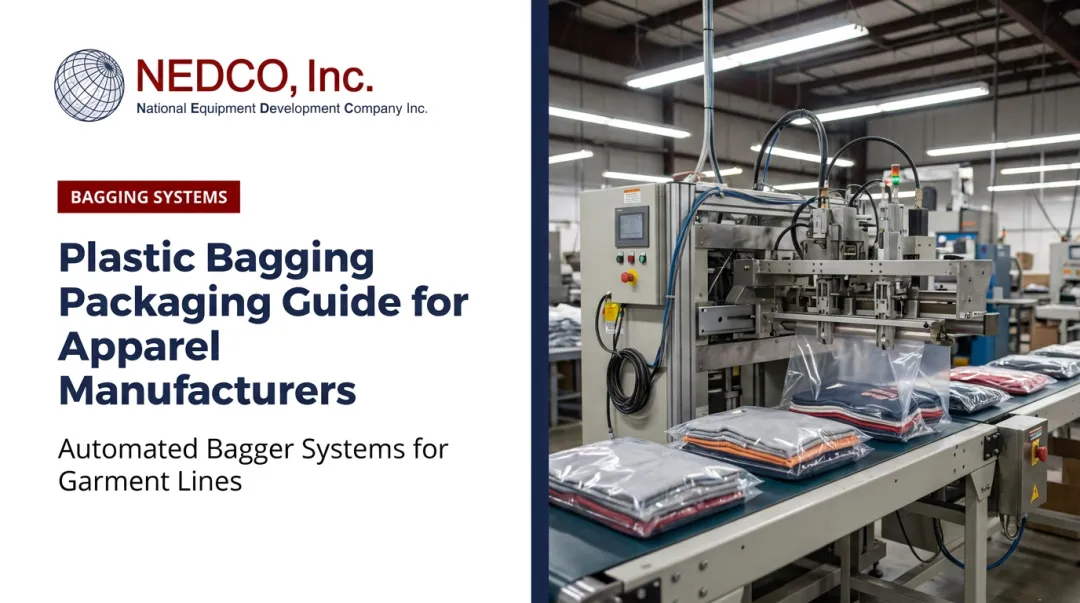
- Polybag sealing machines — Heat-seal folded garments into bags for retail or DTC shipment
- Shrink wrap equipment — Multi-unit packaging for retail distribution
- Barcode label printers and applicators — Inventory identification and retail compliance; Avery Dennison provides in-plant printers, scanners, and applicators for barcode and RFID encoding
- Tagging machines — Hang tags and price tickets for retail floor preparation
How to Choose the Right Garment Manufacturing Machinery
Matching equipment to your operation's actual needs prevents two costly mistakes: under-investment that creates bottlenecks and over-investment in machines that sit underutilized.
Match Equipment to Production Volume and Garment Type
Production volume determines whether semi-automatic or fully automatic equipment is justified. A facility producing thousands of units daily needs different configurations than one running small custom batches.
Fabric and garment type narrow the field further:
- Knit-heavy operations — Prioritize overlock and coverstitch capacity
- Woven and structured garments — Need more lockstitch and fusing capacity
- Mixed product lines — Require flexible, reconfigurable equipment rather than highly specialized single-purpose machines
Evaluate Total Cost of Ownership
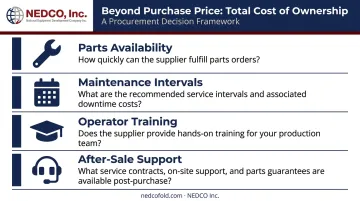
Purchase price is only one number in the evaluation. Factor in:
- Parts availability — How quickly can the supplier fulfill replacement parts orders?
- Maintenance intervals — What does the manufacturer's schedule require, and at what cost?
- Operator training — How long before a new operator reaches full productivity?
- After-sale support — Does the supplier offer service plans, or is support ad hoc?
Downtime on a key machine can stall an entire production line. NEDCO's annual service plan, for example, is built around scheduled preventative maintenance — keeping equipment running before problems develop, not after. Ask any equipment supplier whether their support works the same way.
Prioritize Modular and Scalable Equipment
Equipment that can be reconfigured or expanded as production needs shift avoids full replacement costs when order volumes grow. A modular finishing line — where a folding machine connects to a labeler, bagger, and conveyor — grows with your operation far more cost-effectively than a fixed-function installation.
Test and Verify Before Committing
- Request demonstrations or review manufacturer videos before purchasing
- Speak with existing customers of the equipment where possible
- For finishing equipment specifically, verify the machine handles your garment dimensions and fold specs
- Confirm the supplier's parts and service infrastructure is genuinely accessible, not just listed on a website
Frequently Asked Questions
What machines are used in a clothing factory?
Clothing factories use cutting machines (straight knife, laser, CNC), sewing machines (lockstitch, overlock, coverstitch, chainstitch), embroidery and printing equipment, finishing machines (pressing, thread trimming, needle detection), and packaging equipment (automatic folding, bagging, labeling). The specific mix depends on garment type and production volume.
What are the 7 types of sewing machines?
The primary industrial types are single-needle lockstitch, double-needle lockstitch, overlock/serger, coverstitch, chainstitch, interlock, and specialty machines (bartack, buttonhole, blind stitch). Each serves a specific stitch type, fabric category, and garment application — no single machine covers all use cases.
What is a garment finishing machine?
Garment finishing machines handle post-sewing processes — including pressing and steaming, thread trimming, needle detection, and automatic folding — that prepare completed garments for quality inspection and retail packaging. Reliable finishing equipment directly affects throughput speed and the consistency of goods reaching the shelf.
What machines are used in the packaging section of a garment factory?
Packaging sections use automatic folding machines, polybag sealers, shrink wrap equipment, barcode label printers and applicators, and tagging machines. This stage directly determines how fast finished goods can be shipped, making it a critical throughput bottleneck in high-volume operations.
How do I choose the right machinery for my apparel production?
Match machine type and automation level to your production volume and garment category, then evaluate total cost of ownership beyond purchase price. Prioritize suppliers who provide after-sale support, accessible replacement parts, and service plans — these factors determine long-term uptime more than any spec sheet.
How do I maintain industrial garment machinery?
Clean feed mechanisms and bobbin areas regularly, follow manufacturer lubrication schedules, and replace needles and wear parts on time. Address tension or stitch irregularities immediately — deferred maintenance on small issues routinely causes larger failures during peak runs.