Introduction
Automatic t-shirt folding machines, baggers, labeling systems, and conveyor lines share one thing in common: they run hard. High-cycle, repetitive operation puts constant stress on belts, rollers, sensors, and drive components — and when those components aren't maintained, output quality drops before anything visibly breaks.
The consequences of neglected maintenance show up fast: inconsistent fold alignment, increased jam frequency, slower cycle times, and unplanned downtime that stalls entire finishing lines.
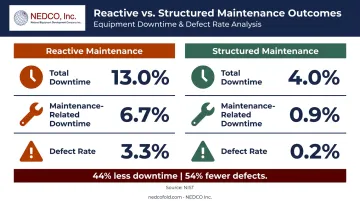
Research from NIST found that facilities with high reactive-maintenance dependency recorded 13.0% total downtime compared to 4.0% for those with structured maintenance programs. In high-volume apparel operations, that gap compounds quickly.
This guide covers why maintenance matters, the four core maintenance types, how to recognize warning signs early, and a practical tiered schedule you can apply to your apparel packaging equipment today.
Key Takeaways
- A structured maintenance program reduces unplanned downtime and protects output consistency
- Facilities with lower reactive-maintenance dependency show significantly less downtime and fewer defects
- Warning signs include inconsistent fold quality, unusual sounds, visible wear, and recurring jams
- Maintenance should be tiered: daily, weekly, monthly, and annual
- Manufacturer support — including parts availability, service plans, and direct technical contact — is critical to long-term performance
Why Maintenance of Apparel Packaging Equipment Matters
Apparel packaging equipment doesn't get occasional use. A commercial t-shirt folder running two shifts processes thousands of garments daily — and every cycle puts wear on mechanical components. That wear is manageable when addressed on a schedule. Left unattended, it compounds.
The Cost of Reactive-Only Approaches
NIST data shows the gap directly. Facilities in the highest reactive-maintenance quartile recorded:
- 13.0% total downtime vs. 4.0% for low-reactive facilities
- 6.7% maintenance-related downtime vs. 0.9%
- 3.3% defect rates vs. 0.2%
For a folding line producing hundreds of units per hour, a 9-point swing in total downtime translates directly into lost production capacity and higher labor costs from manual intervention.
The same NIST study found that establishments reporting moderate or major maintenance investment had 44% less downtime and a 54% lower defect rate than those with minimal maintenance investment. For high-volume operations, that spread determines whether a facility runs at capacity or constantly plays catch-up.
Safety and Compliance
Worn components create more than efficiency problems. OSHA's general duty clause requires employers to keep workplaces free from recognized hazards — and OSHA 29 CFR 1910.212 sets specific machine guarding standards that apply directly to automated packaging lines. Federal enforcement data confirms that unsafe maintenance has caused fatalities and serious injuries in industrial environments.
In high-speed packaging environments, a misaligned conveyor, a fatigued belt, or an exposed mechanical component is an operator hazard. A maintenance program that includes regular guard inspection and safety checks isn't optional — it's a liability management tool.
Output Quality as a Maintenance Indicator
Well-maintained folding and packaging machines produce consistent output. Fold alignment stays within tolerance. Cycle times stay predictable. Garments don't require re-processing.
When those metrics drift, it's rarely a sudden failure. In most cases, it's accumulated wear signaling that maintenance is overdue.
Types of Maintenance for Apparel Packaging Equipment
No single approach fits every situation. The right strategy depends on your production volume, equipment criticality, and operating environment. Most facilities benefit from a combination of all four types.
Preventive Maintenance
Preventive maintenance is time-based or cycle-based — performed on a schedule regardless of whether anything appears wrong.
For apparel packaging equipment, this includes:
- Cleaning lint and fabric dust from sensors, channels, and mechanical surfaces
- Lubricating moving parts per manufacturer guidelines
- Checking belt tension and alignment
- Inspecting rollers and blades for early wear
- Testing sensor responsiveness
This approach works well in stable, moderate-volume operations where equipment performs consistently. NEDCO Inc.'s E-Z Fold equipment supports this approach directly: replacement parts are available from the manufacturer, and annual service plans give operators scheduled professional care built into their maintenance calendar.
Corrective / Reactive Maintenance
Reactive maintenance happens after a failure: a jammed folding mechanism, a misaligned conveyor, a sensor error that stops the line. It's unavoidable in some cases, but it should never be the primary strategy.
The problem with reactive-only maintenance is timing. Failures don't happen during slow periods. They happen mid-shift during peak production runs, when downtime costs are highest and replacement parts may not be on hand.
Use reactive maintenance as a fallback. The other three maintenance types exist specifically to reduce how often you end up here.
Predictive / Condition-Based Maintenance
Rather than following a fixed calendar, condition-based maintenance uses observable indicators to determine when service is actually needed.
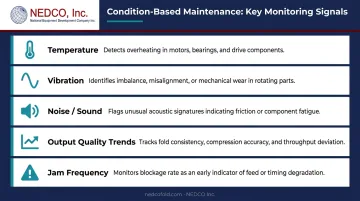
Key signals that packaging equipment monitoring should track include:
- Temperature — motor and bearing heat outside normal range
- Vibration — patterns that differ from baseline operation
- Noise — grinding, clicking, or squealing that wasn't present before
- Output quality trends — fold consistency drifting over time
- Jam frequency — increasing incidents per shift
PMMI research on packaging machinery identifies current and voltage draw, PLC telemetry, and servo-axis failure patterns as condition-monitoring inputs for packaging lines. Even without sensor infrastructure, operators who track jam frequency and fold quality trends over time are practicing predictive maintenance.
Major / Overhaul Maintenance
Overhaul maintenance is deep servicing — significant component replacement, full mechanical inspection, and system recalibration. It's typically performed annually or after a defined number of operating cycles.
An overhaul is warranted when:
- Cumulative wear is too extensive for routine maintenance to address
- The machine is being recommissioned after an extended period of inactivity
- Recurring faults suggest underlying mechanical degradation rather than surface-level issues
For NEDCO E-Z Fold equipment specifically, contact Don Cranshaw (don@nedcofold.com | 770-484-9969) to discuss overhaul scope, parts availability, and service scheduling before returning an inactive machine to production.
How to Tell If Your Equipment Needs Maintenance
Early detection prevents small problems from becoming line-stopping failures. These warning signs are worth monitoring consistently across any apparel packaging equipment.
Performance or Output Changes
Output quality is often the first indicator of mechanical wear. Watch for:
- Inconsistent fold alignment or garments folding unevenly
- Higher rejection or re-fold rates
- Slower cycle times without a change in programming
- Increased operator intervention to correct output
These symptoms often point to belt wear, roller degradation, or sensor drift — components that respond well to preventive attention but worsen quickly if left alone.
When output quality starts slipping, mechanical symptoms usually aren't far behind.
Unusual Behavior During Operation
Sounds and motion irregularities are reliable early-warning signals:
- Grinding or clicking — often indicates lubrication failure or bearing wear
- Squealing — common with belt tension issues or pulley misalignment
- Unexpected stops or error codes — may point to sensor faults or overload conditions
- Vibration changes — any pattern that differs from normal baseline operation
If the machine sounds different than it did last month, that difference is worth investigating before it becomes a breakdown.
Visible Wear, Buildup, or Recurring Faults
Physical inspection reveals what performance metrics sometimes miss:
- Lint and fabric dust accumulating in sensor housings or mechanical channels
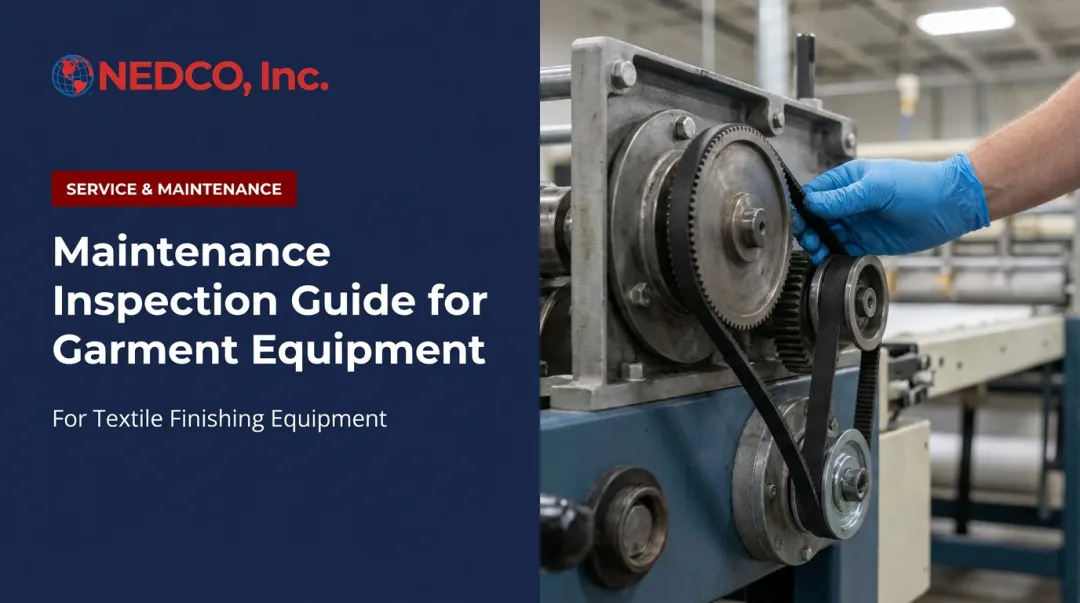
- Visible belt fraying or cracking
- Roller surfaces showing uneven wear or flat spots
- Evidence of heat stress on components
One particularly telling sign: if temporary fixes — manual resets, minor adjustments — are no longer holding between shifts, the underlying issue has grown beyond surface-level correction. Schedule a full inspection rather than another temporary reset.
Note on textile dust: OSHA housekeeping standards and industry best practice recommend at least weekly visual checks of textile-dust buildup in production environments. Always vacuum lint from sensor housings and mechanical channels — compressed air redistributes dust rather than removing it, creating secondary contamination risks.
Apparel Packaging Equipment Maintenance Schedule
Maintenance frequency should match your production environment. A facility running continuous two-shift operations needs more frequent attention than one running a single shift with scheduled downtime. The tiered structure below provides a baseline — adjust intervals based on your volume and conditions.
| Frequency | Tasks |
|---|---|
| Daily / Per-Use | Visual inspection of folding surfaces and output quality / Clear lint and fabric debris from sensors and mechanical channels / Confirm all safety guards are in place |
| Weekly | Lubricate moving parts per manufacturer guidelines / Check belt tension and alignment / Inspect rollers and blades for signs of wear / Test sensor responsiveness |
| Monthly / Quarterly | Full mechanical inspection of all drive components / Check electrical connections and control panel indicators / Review fold accuracy and cycle time against baseline performance |
| Annual / Overhaul | Full component inspection and replacement of worn parts (belts, blades, rollers as needed) / Recalibrate sensors and controls / Deep clean internal mechanisms / Review maintenance log for recurring issues and adjust schedule accordingly |
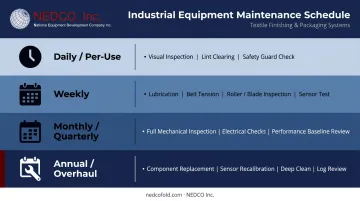
High-volume continuous production facilities should treat weekly tasks as a minimum baseline — some checks (lint clearing, output quality review) warrant daily attention at full capacity.
For NEDCO E-Z Fold equipment: Consult your equipment manual and contact Don Cranshaw directly at don@nedcofold.com or 770-484-9969 for parts ordering, service requests, and interval guidance tailored to your specific machine model and usage volume. NEDCO also offers annual service plans that deliver professional preventive maintenance on a set schedule — a practical option for operators who want manufacturer-backed support built into their program.
Conclusion
Structured maintenance pays off in ways reactive repair never can. Operations that commit to daily clearing, weekly mechanical checks, and scheduled overhauls keep machines running longer, protect operators, and hold output quality steady across high-volume production.
When service is needed — whether that's replacement parts, a scheduled inspection, or technical guidance — having direct access to the original manufacturer matters. For E-Z Fold equipment, that access runs straight to the NEDCO Inc. team in Covington, Georgia: the same people who engineered and built the machine.
Frequently Asked Questions
What is a maintenance program?
A maintenance program is a structured set of scheduled tasks and procedures designed to keep equipment operating reliably, prevent unexpected failures, and extend machinery lifespan. It defines what gets checked, when, and by whom — replacing reactive firefighting with planned upkeep.
What are the benefits of a maintenance program?
A structured program reduces unplanned downtime, lowers long-term repair costs, and extends equipment lifespan. It also maintains consistent output quality and improves operator safety. According to NIST research on maintenance economics, facilities with proactive maintenance programs report up to 44% less downtime and 54% fewer defects compared to reactive-only operations.
What are the 4 types of maintenance?
The four primary maintenance types are:
- Preventive — scheduled, time-based care
- Corrective/Reactive — triggered by equipment failure
- Predictive/Condition-Based — triggered by measured indicators like vibration or temperature
- Major/Overhaul — deep servicing with significant component replacement and recalibration
What is an example of a maintenance program?
For apparel packaging equipment, a program might include daily debris clearing from sensors and folding surfaces, weekly lubrication and belt tension checks, monthly mechanical and electrical inspections, and an annual overhaul replacing worn belts, rollers, and blades while recalibrating controls.
How often should apparel packaging equipment be serviced?
Service frequency depends on usage volume. High-volume facilities benefit from weekly mechanical checks, while lower-volume operations may follow monthly intervals. Annual overhauls are recommended regardless of volume. Consult your equipment manufacturer for intervals specific to your machine model.