Introduction
Walk any textile finishing floor and you'll spot the bottleneck fast: it's usually the gap between the folding table and the packaging station. Garments pile up, operators scramble, and orders slip behind schedule.
The conveyor system linking those stations often determines whether your finishing line hums or grinds to a halt. Choose wrong, and you get operator fatigue, product damage, and downtime that eats into margins. Choose right, and finishing steps shrink while daily order counts climb.
The stakes are real. A case study from the EASE Council illustrates the impact. Switching from manual unloading to a portable conveyor cut a two-person, 17-hour unloading job down to a five-hour task handled by three workers. Throughput jumped from 142 to 480 cases per hour, and injuries dropped too.
This guide breaks down what actually matters when selecting a conveyor system for apparel and textile finishing lines.
TL;DR
- Conveyor systems automate movement between finishing stages, cutting handling and boosting throughput.
- Six factors decide fit: handling needs, volume, conveyor type, motor control, layout, and cost.
- Integration with existing folding and packaging equipment matters more than spec sheets.
- Getting this right cuts bottlenecks, lowers downtime, and protects your investment.
What is a Conveyor System?
A conveyor system is a mechanical material handling setup that moves products along a fixed path using belts, rollers, or chains, with little to no manual labor required.
Systems range from simple gravity chutes that rely on slope and manual pushes to fully motorized, automated lines synchronized across multiple stations. The main format types are belt, roller, chain, and overhead conveyors, each suited to different loads and layouts.
Core Components of a Conveyor System
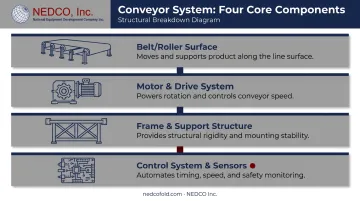
Every conveyor, regardless of type, breaks down into four functional building blocks. Understanding each one helps you evaluate specs against your actual production needs rather than marketing claims.
Belt/Roller Surface This is the load-bearing element that touches and moves the product directly. Material choice here isn't cosmetic — it affects durability and product safety, plus how much noise the line generates on the floor. For apparel, a continuous belt surface avoids the gaps that folded garments or bagged items could snag on when crossing individual rollers.
Motor & Drive System The motor powers movement and governs speed. This single component drives throughput and energy costs more than any other part of the system. Underpowered motors strain under load; oversized ones waste energy.
Frame & Support Structure Frame construction determines load capacity, stability, and how easily the layout adapts down the road. A heavy-duty frame built for continuous operation looks different from one designed for light, intermittent use.
Control System & Sensors Controls regulate speed and direction, while triggering automation cues throughout the line. This is the piece that determines whether your conveyor talks to your folding machine and bagger, or just runs on its own island.
Benefits of Conveyor Systems in Textile & Apparel Production
Conveyors do more than move product from point A to point B. In finishing and packaging lines specifically, the benefits stack up in ways that show up directly on the production floor:
- Reduced manual handling — fewer lifts, carries, and repetitive reaches per shift
- Faster station-to-station movement — garments flow from folding to packaging without operators walking product between machines
- Improved order fulfillment speed — continuous flow means fewer stalls between finishing steps
- Fewer handling errors — automated transfer reduces dropped, mishandled, or misplaced items
- Better safety compliance — less manual lifting means fewer strain injuries and OSHA exposure points
Real-world apparel operations back this up. Retailer Stockmann built an integrated conveyor system spanning 1,500 meters of carton conveyor and 3,500 meters of overhead conveyor, designed to support 55,000 order lines and 180,000 items per day.
Boohoo's carton and pouch sorter system shows similar results, reporting up to 40,000 items handled per hour. These are whole-system figures, not conveyor-only numbers, but they show what's achievable when conveyors connect the full finishing line rather than sitting in isolation.
What to Consider When Choosing the Best Conveyor System
There's no single "best" conveyor system. Needs vary by product type, facility footprint, and production goals. The right fit for a small screen-printing shop looks nothing like the right fit for a bulk apparel manufacturer shipping tens of thousands of units weekly.
The six factors below connect technical specs, such as speed, load capacity, and motor size, to outcomes you actually care about: throughput, downtime, and cost per order.
Product Type & Handling Requirements
Size, weight, and fragility dictate conveyor type. Folded garments, bagged products, and boxed goods each behave differently on a moving surface.
- Small or irregular packages need continuous belt surfaces to avoid gaps that rollers can't cover
- Fragile or soft goods benefit from zero-pressure accumulation zones that prevent product-to-product contact
- Heavier or rigid loads can tolerate roller-based systems
- Products feeding directly into folding or bagging equipment need speeds matched to that machine's cycle time to prevent jams
KPI to watch: product damage rate and handling speed at each transfer point.
Production Volume & Throughput Needs
Matching conveyor speed and capacity to your actual daily order volume prevents two costly mistakes: bottlenecks from under-capacity, or wasted spend from over-investing in a system built for volume you won't reach for years.
Throughput follows a straightforward relationship: units per hour equals belt speed divided by the average spacing between products. Interroll's planning guidance frames this as T = 3600 × v ÷ a, where v is speed in meters per second and a is the average center-to-center spacing.
Derive your required speed from your actual order rate, not a generic industry benchmark.
KPI to watch: units or orders processed per hour.
Conveyor Type & Configuration
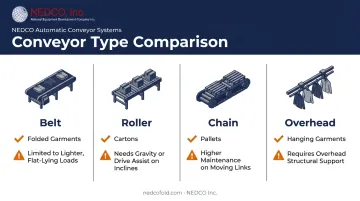
Gravity conveyors cost less and require no power, but they offer little speed control and can't move product uphill. Powered systems, whether belt, roller, or chain, give you control over pace and accumulation, at the cost of added complexity.
| Type | Best fit | Tradeoff |
|---|---|---|
| Belt | Folded garments, bagged goods, fragile items | Needs tracking/tension upkeep |
| Roller (powered) | Cartons, boxed products | Requires at least 3 rollers under load |
| Chain | Pallets, heavy unit loads | Usually overkill for apparel |
| Overhead | Hanging garments, space-constrained floors | Needs structural review and guarding |
KPI to watch: line flexibility and space efficiency.
Motor Power, Speed & Control
Motor strength and speed control determine how much load the system handles without strain or premature wear. Most facilities prefer variable frequency drive (VFD) motors here because they match speed to load automatically and reduce mechanical stress from abrupt starts and stops. A line running heavier boxed goods, for instance, needs more torque headroom than one moving lightweight folded shirts, even at the same belt speed.
KPI to watch: uptime and energy efficiency.
Facility Layout & Space Constraints
Floor space, ceiling height, and workstation placement decide whether a straight, inclined, or overhead conveyor design makes sense. Overhead conveyors free up floor area for facilities tight on square footage, but they demand structural verification and fall-protection guarding. A single-story shop with 20-foot ceilings, for example, has far more overhead routing options than a facility limited to standard 10-foot clearance.
KPI to watch: space utilization and workflow continuity.
Integration, Durability & Total Cost of Ownership
A conveyor's ability to plug into your existing folding, packaging, or bagging equipment affects long-term ROI more than the sticker price ever will. Total cost of ownership includes purchase price plus installation, controls, energy use, preventive maintenance, spare parts, and downtime over the equipment's working life.
KPI to watch: equipment lifespan, maintenance frequency, and downtime cost accumulated over time.
How E-Z Fold Can Help
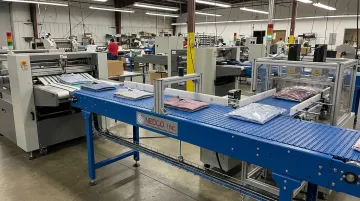
NEDCO, doing business as E-Z Fold, builds modular folding and packaging equipment for textile and apparel producers from its Covington, Georgia facility. Our conveyor systems, the compact CV-100 and the full modular CV-500, are engineered specifically to connect folding, labeling, and bagging stations into one continuous line.
The CV-500 syncs belt speed directly with connected NEDCO equipment, so a folding machine's output pace matches the conveyor, which matches the bagger/sealer's intake. Nothing piles up. Nothing sits idle waiting on the next station.
The value here extends beyond the hardware itself:
- Modular equipment design that adapts as production needs change, from a first automated line to a full high-volume setup
- Nationwide service and parts support — Don Cranshaw and the NEDCO team handle service requests and parts ordering directly
- 37 years of made-in-the-USA manufacturing, family-owned since 1989
- Ongoing optimization support that continues well after installation
If you're weighing conveyor options, the real question is whether it fits your floor plan today and connects to everything else running on it. That's the problem our engineering team scopes on every consultation call.
Conclusion
Choosing the right conveyor system means matching it to your product type, daily volume, and finishing line layout, not chasing the most popular model on the market.
Integration with existing folding and packaging equipment matters more than any single spec on a data sheet. A conveyor with impressive throughput numbers is worthless if it can't sync with the machines on either side of it.
Revisit your conveyor selection periodically, since production volume and equipment needs change over time. NEDCO can help evaluate whether your setup still fits as your operation reaches its next stage.
Frequently Asked Questions
How long do conveyor systems last?
Most industrial conveyor systems last 10 to 15 years with proper maintenance, though actual lifespan depends on component quality, usage intensity, and the type of material handled.
What are the main types of conveyor systems?
The main types are belt, roller, chain, overhead, and gravity conveyors. Each suits different load types, from soft folded garments to heavy pallets, and different facility layouts.
What is the best motor for a conveyor system?
Motor choice depends on load weight and required speed. Variable frequency drive (VFD) motors are often preferred because they allow precise speed control and reduce mechanical wear.
Can conveyor systems be integrated with existing folding and packaging equipment?
Yes. Most modern conveyors, including NEDCO's CV-100 and CV-500 lines, can be configured to connect with finishing equipment, creating one continuous line from folding to packaging to shipping.
How much does a conveyor system typically cost?
Costs vary widely based on length, conveyor type, automation level, and customization. Since pricing depends on your specific configuration, request a quote based on your production needs.
What maintenance does a conveyor system require to minimize downtime?
Routine care includes belt or roller inspection, lubrication, motor checks, and prompt sourcing of replacement parts. NEDCO's annual service plans help catch wear before it causes unplanned downtime.