Introduction
Every conveyor belt stretches. Heat, load cycling, and general wear all cause gradual elongation — and when nothing compensates for that stretch, the belt loses the grip needed to move material reliably. That's when slippage starts, tracking drifts, and throughput drops.
Belt tensioning is the controlled application of force to a conveyor belt to maintain that grip. Applied correctly, it keeps the belt seated on the drive pulley, centered on the system, and moving product without sagging or slipping. Applied incorrectly (too loose or too tight), it accelerates wear on bearings, pulleys, and splices — and creates the conditions for unplanned stoppages.
This guide covers what belt tensioning is, why it matters, the four main tensioning methods used in conveyor systems, and how to choose the right one for your application.
Key Takeaways
- Belt tensioning applies a calculated force to prevent slippage, maintain tracking, and compensate for natural belt elongation over time.
- Four methods cover most applications: manual screw take-up, gravity (counterweight) take-up, spring-loaded take-up, and hydraulic automatic take-up — each suited to different load and space conditions.
- No single method suits every application — conveyor length, load variability, available space, and maintenance capability all drive the decision.
- Excess tension damages bearings and splices — over-tensioning causes wear just as surely as running a belt too loose.
- Tension and tracking are separate problems requiring separate solutions.
What Is Belt Tensioning in Conveyor Systems?
Belt tensioning is the process of applying a specific pulling force to a conveyor belt so it maintains contact with the drive pulley, stays centered on the system, and moves material without slipping or sagging between idler rollers.
That force is applied through a take-up unit (a tensioning device at the tail pulley end) that either moves the tail pulley away from the drive pulley, increasing belt path length, or holds it under constant load. Choosing the right take-up type directly affects how well tension is maintained over the belt's service life.
Why Belts Lose Tension
Belts don't stay at their initial tension. According to Habasit's engineering guide, belts elongate through a combination of:
- Recoverable elastic elongation (the belt stretches under load and recovers)
- Permanent viscoelastic relaxation (creep, where the belt gradually takes a longer set)
- Temperature and moisture variation (which cause dimensional changes in both the cover and tensile members)
Polyester tensile members typically require a minimum take-up travel of 1.5% of belt length to compensate for this elongation; polyamide belts require 2.5%. These figures come from belt construction, not conveyor length — which is why selecting the right take-up starts with knowing your belt type, not just your conveyor dimensions.
Why Belt Tensioning Matters in Conveyor Operations
Proper tension serves three functions simultaneously: it gives the drive pulley enough friction to move the belt under load, it keeps the belt running straight to prevent edge damage and spillage, and it reduces stress on bearings, pulleys, and splices.
Both failure modes — too little and too much tension — cause real damage.
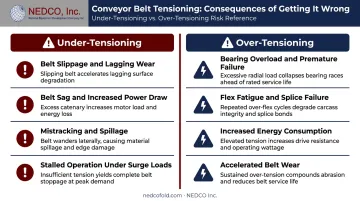
Under-tensioning leads to:
- Belt slippage on the drive pulley, generating heat and lagging wear
- Belt sag between idlers, increasing rolling resistance and power consumption
- Mistracking, which causes edge wear and material spillage
- Stalled operation under surge loads
Over-tensioning leads to:
- Excess shaft and bearing load, accelerating bearing failure
- Flex fatigue and premature splice failure
- Increased energy consumption
- Accelerated belt wear, particularly on nosebar and small-radius transitions
These failure modes carry extra weight in precision finishing and packaging lines. In textile and apparel operations, small tension shifts can disrupt how consistently products feed through folding, labeling, or bagging equipment — throwing off timing across the entire line. NEDCO Inc.'s Automatic Conveyor Systems are built into complete garment processing lines where that consistency directly determines throughput and output quality.
Types of Belt Tensioning Methods for Conveyor Systems
The right tensioning method depends on four variables: conveyor length, load profile, available space, and how much operational oversight your facility can support. Manual systems work fine for short, stable runs. Longer conveyors with variable loads need passive or active compensation. Understanding how each method applies force makes the selection straightforward.
Manual (Screw) Take-Up
A manual screw take-up uses threaded rods to physically move the tail pulley along the conveyor frame. An operator turns the screws to increase or decrease tension; the system holds whatever position it's set to until someone adjusts it again.
According to Douglas Manufacturing's technical guidance, both screws must stay within one turn of each other to keep the tail pulley square — unequal adjustment introduces misalignment, not just tension change. Martin Sprocket specifies wide-slot frames with 6–30 inches of travel and heavy-duty frames with 12–60 inches. Both frame styles are designed to account for 2–3% belt stretch on conveyors typically under 150 feet.
Best suited for: Short in-plant conveyors with stable, predictable loads — light industrial equipment, textile packaging lines, and low-speed applications where load variation is minimal.
Strengths:
- Lowest cost of any tensioning method
- Compact footprint, simple installation
- No moving parts to maintain
Limitations:
- Cannot adapt to load changes — tension is fixed until manually adjusted
- Belt stretch eventually exhausts travel range, requiring belt shortening and re-splicing
- Entirely dependent on operator attention and scheduling
Gravity (Counterweight) Take-Up
A gravity take-up suspends a weighted carriage from the take-up pulley via cables. Gravity pulls the counterweight down continuously, applying tension to the belt. As the belt stretches or load changes, the counterweight drops farther — automatically maintaining near-constant slack-side tension (T2) without operator input. The governing relationship is Cwt = 2T2; Fenner Dunlop recommends setting the counterweight at 30% of its travel range at installation, leaving the remaining 70% to accommodate elongation over the belt's service life.
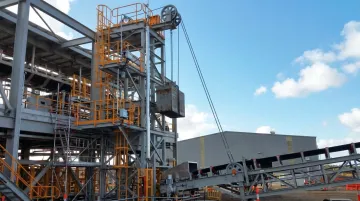
Best suited for: Medium to long conveyors with variable loads; fixed outdoor or large-scale industrial installations where consistent tension under changing conditions is required.
Strengths:
- Automatically compensates for load changes, start/stop cycles, and thermal expansion
- Low maintenance — no springs or actuators to service
- Consistent performance across wide operating ranges
Limitations:
- Requires significant vertical clearance for the counterweight drop
- Impractical for compact, mobile, or space-constrained installations
- Counterweight travel can be obstructed by dust buildup or guide corrosion
Spring-Loaded Take-Up
Spring-loaded take-ups mount compressed mechanical springs on a sliding carriage that holds the take-up pulley. As the belt stretches, the springs extend and the carriage moves, absorbing slack automatically — up to the limits of the spring travel and force rating.
PCI's tension-indicating frames illustrate the range available: spring options from 150 to 3,200 lb and travel from 1.5 to 48 inches depending on frame style. A built-in scale displays remaining adjustment, giving operators a visible indicator before manual intervention is needed.
Best suited for: Shorter to medium-length conveyors with moderate, somewhat variable loads; indoor, space-constrained installations where some automatic adjustment is needed but a full gravity or hydraulic system isn't feasible.
Strengths:
- More compact than gravity systems — no vertical clearance required
- Self-adjusts within its rated range without operator input
- Handles thermal expansion and shock loading within spring limits
Limitations:
- Finite travel range — springs cannot compensate indefinitely; eventually require manual reset or belt shortening
- Spring performance degrades over time, particularly in high-temperature or corrosive environments
- Force output must be matched carefully to belt requirements at the design stage
Hydraulic (Automatic) Take-Up
Hydraulic take-up systems use pressurized cylinders controlled by sensors and a hydraulic power unit to move the take-up pulley in real time. As belt tension changes — due to load, speed, or temperature — the system responds automatically to maintain the target tension level. Electric winch take-ups operate on a similar principle, using a motorized drum and control loop instead of hydraulic cylinders.
Habasit identifies constant-force tensioning as the right choice when belt length changes are too significant to ignore. Lengthy conveyors, rapidly fluctuating loads, heavy loads relative to belt modulus, and polyamide belts in high-humidity environments all favor active compensation over passive methods.
Best suited for: Long, high-tension conveyor systems; operations with frequent or unpredictable load changes; demanding environments — mining, heavy bulk handling, high-throughput processing — where manual adjustment is impractical and downtime is costly.
Strengths:
- Precise, continuous tension control regardless of load variation
- Fully automated — no operator adjustment during operation
- Handles large belt stretch ranges without travel exhaustion
Limitations:
- Significantly higher upfront cost and installation complexity
- Requires routine maintenance of hydraulic components (seals, fluid, pressure sensors)
- Over-engineered for short conveyors or stable-load applications
How to Choose the Right Belt Tensioning Method
Match your tensioning method to what your conveyor actually does — the application requirements, not habit or technical prestige, should drive the decision.
| Factor | Manual Screw | Spring-Loaded | Gravity | Hydraulic |
|---|---|---|---|---|
| Conveyor length | Under ~150 ft | Short–medium | Medium–long | Long, high-tension |
| Load variability | Stable, predictable | Moderate variation | Variable | Highly variable |
| Space requirements | Minimal | Compact | Vertical clearance needed | Power unit + piping |
| Maintenance complexity | Low (operator-driven) | Low–moderate | Low | Moderate–high |
| Automation level | None | Partial | Passive/automatic | Fully automatic |
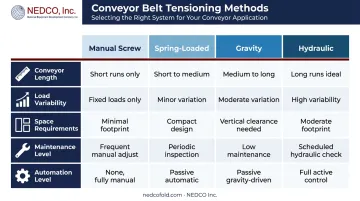
Four additional factors sharpen the selection beyond what the table captures:
- Belt material: Polyamide stretches more than polyester, so verify your take-up travel range against actual belt specs before finalizing the method.
- Start/stop frequency: Repeated starts create tension spikes that fixed manual systems can't absorb — gravity and hydraulic designs handle this without operator intervention.
- Environment: Heat degrades spring performance; dust and corrosion attack counterweight guides and hydraulic seals. Account for these conditions before installation, not after.
- Total cost of ownership: Manual systems have lower upfront costs but accumulate operator time and re-splicing expenses. Hydraulic systems cost more initially and pay back through fewer belt-related interventions over time.
Common Belt Tensioning Mistakes to Avoid
Over-Tensioning to Stop Slippage
Adding tension is the instinctive fix for a slipping belt, but it's often wrong. Slippage frequently signals a worn drive pulley surface, contamination, or misalignment — problems that excess tension won't solve. What it will do is accelerate bearing wear and splice failure.
Using Tension to Correct Tracking
Belt tracking and belt tension are separate issues. A belt drifting to one side needs idler or pulley alignment adjustment — not by adding tension to one side of the take-up. Unequal screw adjustment to "steer" the belt creates misalignment and component stress without fixing the root cause.
Defaulting to Manual Systems Regardless of Conveyor Length
Manual screw take-ups are well-suited for short, stable conveyors. Applied to a longer conveyor with variable loads, they'll require constant re-adjustment and will struggle to maintain minimum tension between service intervals. That chronic under-tensioning gradually damages both the belt and drive components.
Frequently Asked Questions
What happens if a conveyor belt is over-tensioned?
Over-tensioning places excess load on bearings, pulleys, and belt splices, accelerating wear and increasing the likelihood of premature component failure. It also raises energy consumption and can cause poor tracking despite the belt appearing tight — often masking the actual source of a tracking problem.
How often should conveyor belt tension be checked?
Tension should be checked after initial installation (new belts stretch during break-in) and then at regular intervals per the manufacturer's schedule. High-load or high-cycle systems need more frequent inspection; the right interval depends on operating conditions, not a fixed calendar rule.
What is the difference between a screw take-up and a gravity take-up?
A screw take-up is manually adjusted by turning threaded rods to reposition the tail pulley; tension stays fixed until an operator changes it. A gravity take-up uses a counterweight to apply and maintain tension continuously and automatically, making it better suited to longer conveyors or those with variable loads.
Can the same tensioning method be used for all conveyor lengths?
No. Manual screw systems are practical only for shorter conveyors where belt stretch is limited and loads are stable. Longer conveyors require the continuous adjustment capability of gravity or hydraulic take-ups to maintain consistent tension across changing operating conditions.
How do I know if my conveyor belt tension is correct?
Correct tension allows the belt to move material without slipping, maintains consistent tracking, and shows no excessive sag between idler rollers. Habasit's field method (marking 1,000 mm on a relaxed belt, then measuring elongation after tensioning) gives a percentage-based reference to check against the belt supplier's specification.
What causes a conveyor belt to lose tension over time?
Belts elongate through load cycling, heat, and wear (elastic stretch combined with permanent creep), which reduces the tension the take-up applies. Self-adjusting systems like gravity and hydraulic take-ups compensate automatically; manual and spring systems need periodic re-adjustment or belt shortening once travel is exhausted.
Conclusion
Belt tension is a foundational requirement for any conveyor system. It enables power transfer at the drive pulley, keeps the belt running straight, protects bearings and splices from overload, and directly determines how long the belt and surrounding equipment will last.
The four main tensioning methods — manual screw, gravity, spring-loaded, and hydraulic — each serve different operational needs. No single method is universally superior. A manual screw take-up suits a short, stable in-plant conveyor; a hydraulic system fits a long, high-load application with variable demands.
The right choice comes down to four factors:
- Conveyor length and how much elongation the belt will experience under load
- Load profile — whether demand is steady or fluctuates across shifts
- Available space for take-up travel and tensioning hardware
- Maintenance resources the facility can realistically commit to over time
For operators and engineers in textile and apparel manufacturing — where conveyors integrate directly into folding, labeling, and bagging lines — understanding these differences translates to fewer unplanned stoppages, longer equipment life, and production lines that stay consistent across shifts. A well-matched tensioning system keeps throughput predictable and reduces the reactive maintenance that disrupts finishing line output.