Both models are widely used across U.S. apparel and textile operations. But they serve different strategic goals and come with fundamentally different operational demands. Understanding the distinction — and knowing which fits your business — is what separates a reactive operation from a deliberate one.
Key Takeaways
- Private label gives you full control over design, pricing, and margins — but requires upfront brand-building investment
- Branded apparel offers instant consumer recognition with lower marketing burden, but limits your pricing flexibility
- Private label generally yields higher gross margins; branded apparel typically means faster inventory turnover
- Many successful operations run a hybrid model: branded blanks for decoration and private label for flagship products
- At scale, finishing and packaging efficiency directly impacts throughput and cost — regardless of which model you run
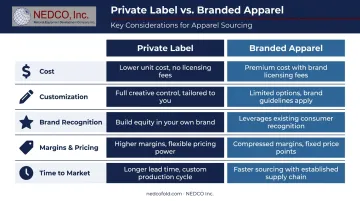
Private Label vs. Branded Apparel: Quick Comparison
Here's how private label and branded apparel compare across the factors that matter most to apparel businesses and manufacturers.
| Factor | Private Label | Branded Apparel |
|---|---|---|
| Cost | Lower per-unit costs; direct manufacturer relationships | Higher costs due to licensing fees and wholesale markups |
| Customization | Full control over design, fabric, and fit | Little to no customization — product is pre-developed |
| Brand Recognition | Requires investment to build from scratch | Leverages existing consumer trust and loyalty |
| Margins & Pricing | Set your own price points freely | Constrained by MAP policies and distributor agreements |
| Time to Market | Longer — requires upfront design and development | Faster — product development handled by brand owner |
What Is Private Label Apparel?
Private label apparel is clothing manufactured by a third-party producer but sold exclusively under the retailer's or brand's own label. The seller controls brand identity, design decisions, and quality standards — while the manufacturer handles production.
That distinction matters operationally. You're building an asset, not reselling someone else's product. Brand equity accumulates on your side of the ledger.
Core Business Benefits
- Higher gross margins — no brand licensing premium eating into your price
- Exclusive product lines — competitors can't carry the exact same item
- Design flexibility — adapt to market demand without waiting on a brand owner
- Consistent repeat orders — especially valuable for high-volume production facilities
The Four Types of Private Labels
Private label isn't one-size-fits-all. Operations differ significantly across four models:
- Store brands — a retailer's in-house label exclusive to their stores (think a department store's own clothing line)
- Exclusive brands — developed for one retailer but positioned as a distinct brand with its own identity
- Premium private labels — higher-quality lines priced to compete directly with national brands
- Generic or budget private labels — value-priced products with minimal branding, built for cost efficiency
Each type serves a different market position and price tier. A corporate uniform program runs differently than a premium e-commerce brand, even if both are private label.
Where Private Label Dominates
Private label thrives where product exclusivity matters and order volumes are predictable. Strong use cases include:
- Retail house brands — Macy's launched its On 34th women's line with more than 750 SKUs and followed it with Mode of One, a contemporary menswear brand, in 2024
- Corporate uniform programs — Aramark has designed customized branded uniforms for more than 6,500 wearers across a single program
- E-commerce brands — direct-to-consumer apparel businesses building a curated identity without retail intermediaries
- Promotional and bulk apparel — high-volume programs where repeat-order predictability makes production planning straightforward
NPD data published in 2018 found that private label represented nearly one-third of U.S. apparel dollar sales — a figure that underscores how embedded the model already was, even before the DTC and e-commerce surge that followed.
What Is Branded Apparel?
Branded apparel is clothing produced and sold under an established, widely recognized brand name: Nike, Hanes, Gildan, Bella+Canvas. The brand owner controls design, quality standards, and marketing. Retailers and distributors carry the product and build their business around the brand's existing equity.
Core Business Benefits
- Instant consumer recognition — no brand-awareness spend required at point of sale
- Built-in trust signals — consumers already know what they're getting
- Faster inventory turnover — brand loyalty drives more predictable purchasing behavior
- Known print characteristics — critical for decoration businesses that depend on consistent substrates
Key Limitations to Factor In
Branded apparel's advantages come with real trade-offs that affect the bottom line:
- MAP policy constraints — minimum advertised price agreements limit pricing flexibility and can compress margins at the distributor level
- Lower margins than private label — the brand premium paid upstream shows up in your cost structure
- No product differentiation — if a competitor carries the same SKU, you're competing on service, price, or relationships rather than the product itself
Where Branded Apparel Works Best
Screen printing and decoration businesses are the clearest example. Shops buying Gildan, Bella+Canvas, or Next Level blanks benefit from consistent quality, broad consumer familiarity, and proven printability.
Gildan's 2025 Plasma Print launch illustrates this well: the product was specifically designed to improve direct-to-garment printability, the kind of R&D that branded blank suppliers invest in because their decorator customers depend on it.
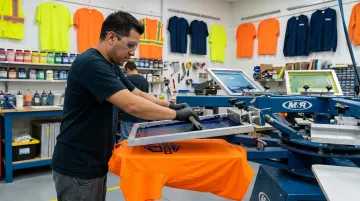
For promotional merchandise companies and retailers relying on name-brand recognition to drive traffic, branded apparel reduces the selling burden at the point of sale. U.S. promotional product distributor sales reached $26.78 billion in 2024, with wearables and apparel leading all categories at 26.6% — a clear signal of how central branded apparel is to that market.
Which Model Is Right for Your Business?
There's no universal answer. The right choice depends on your margin targets, operational capacity, brand ambitions, and how you add value to the product.
Choose Private Label If:
- You want to build a distinctive brand identity over time
- Maximizing gross margins is a primary business goal
- You sell through your own channels (DTC, branded retail, e-commerce)
- Your operation handles high, consistent volumes where repeat orders justify the investment in design and development
- You want product exclusivity that competitors can't replicate
Choose Branded Apparel If:
- Your core value-add is decoration — screen printing, embroidery, heat transfer
- You want to minimize design and development overhead
- You're testing a new product category before committing to private label development
- Brand recognition drives your customers' purchase decisions
The Hybrid Model: How Smart Operations Use Both
Many successful apparel businesses don't choose one model exclusively. They allocate strategically.
SanMar's portfolio is a clear example: the distributor carries its own private label lines — Port Authority and Sport-Tek — alongside established outside brands like Nike, Carhartt, and The North Face. The same distribution infrastructure supports proprietary margin-control products and outside brands that customers already know and trust. That's not a compromise. It's a deliberate portfolio decision.
A decoration shop might run branded Gildan blanks for high-volume screen print orders while maintaining a private label line for their retail or e-commerce channel. A uniform supplier might fulfill corporate programs under a client's private label while stocking branded workwear for clients who want name-brand recognition built in.
Finishing Efficiency: The Factor Both Models Share
Regardless of which model you run — or both — the finishing line is where profitability gets won or lost at scale. Manual folding becomes a throughput bottleneck fast. BLS data from May 2023 counted 2,530 hand packers in U.S. apparel manufacturing at a mean wage of $16.02 per hour — labor costs that compound quickly at volume.
Automated finishing equipment from NEDCO Inc. addresses this directly. The E-Z Fold T-Shirt Folder is built for high-volume production settings where consistency, speed, and reduced operator fatigue determine output and profitability.
NEDCO's modular lineup — folding, labeling, bagging/sealing, and conveyor systems — fits together as a complete finishing line. The same equipment footprint handles decorated branded apparel and private label bulk orders, making it practical for graphic design firms and large-scale manufacturers alike.
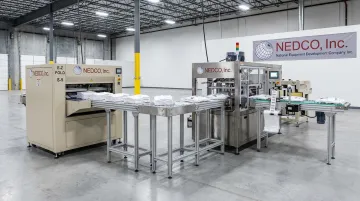
If you're scaling a private label or branded apparel operation and want to improve your finishing line efficiency, explore the E-Z Fold equipment lineup from NEDCO Inc. at nedcofold.com or call (770) 484-9969.
Conclusion
Private label and branded apparel aren't competing opposites — they're different tools for different strategic goals. Private label tends to favor margin and ownership; branded routes favor speed to market and built-in recognition. The businesses that struggle are those that choose by default rather than by design.
Evaluate your margin targets, your brand ambitions, your production capacity, and your customer expectations. Then decide — or decide to run both. Whatever model you land on, the decision only holds up if your production line can execute it. From sourcing through to the finishing floor — folding, labeling, packaging, and fulfillment — the throughput you can sustain will determine whether your margins survive at volume.
Frequently Asked Questions
What is the difference between private label and branded products?
Private label products are manufactured by a third party but sold under the retailer's or seller's own brand name. Branded products are made and sold under the manufacturer's established brand. The key distinction is who owns and controls the brand identity and product design.
What are the four types of private labels?
The four types are store brands, exclusive brands, premium private labels, and generic/budget private labels. Each serves a different market positioning and price tier strategy, from value-focused basics to premium lines competing directly with national brands.
Is private label apparel more profitable than branded?
Private label typically yields higher gross margins because the seller controls pricing and eliminates brand licensing markups. Profitability still depends on volume, operational costs, and how effectively the brand is built and marketed.
Can a business sell both private label and branded apparel?
Many apparel businesses run a hybrid model, using branded blanks for decorated or promotional merchandise while maintaining a private label line for their core or exclusive offerings. SanMar's portfolio is a well-known industry example of this approach.
How does private label vs. branded apparel affect production operations?
Private label typically drives higher, more consistent production volumes, making automated finishing equipment — folding, bagging, and labeling systems — a stronger investment. Branded apparel orders vary more by model, though high-volume decoration shops face similar finishing demands.