Variable speed drives (VSDs) solve all three problems. This guide covers what VSDs are, how they work, the main types available, their operational benefits, and the key factors to evaluate when choosing one for a belt conveyor system.
Key Takeaways
- VSDs control belt speed by adjusting the frequency and voltage of power supplied to the drive motor
- Variable Frequency Drives (VFDs) are the current industry standard for belt conveyor speed control
- Direct-on-line motor starts draw up to 600% of full-load rated current; VFDs eliminate that inrush entirely
- Motor power varies proportionally with speed on constant-torque conveyor loads, not cubically
- Before retrofitting, confirm existing motors are inverter-rated — VFD compatibility isn't automatic
What Is a Variable Speed Drive for a Belt Conveyor System?
A variable speed drive is an electronic device that regulates the rotational speed of the electric motor driving a conveyor belt. It does this by adjusting the frequency and voltage of the electrical power delivered to the motor — allowing the belt to run faster or slower based on actual production demand rather than locking into a single fixed speed.
A typical belt conveyor VFD installation links four core components:
- AC induction motor — converts electrical power to mechanical torque
- VFD controller — adjusts output frequency and voltage to the motor
- Gearbox/coupling — transmits and reduces motor shaft speed to belt speed
- Drive pulley — transfers rotational movement to belt travel
When the VFD lowers its output frequency, the motor slows proportionally, and the belt speed drops accordingly. Raise the frequency, and the belt speeds back up. The relationship is direct and linear for a given motor and gearbox combination.
VFD vs. Variable Speed Controller — What's the Difference?
Variable Speed Drive (VSD) is the broad umbrella term covering all methods of controlling motor speed — electronic, mechanical, hydraulic, or DC-based. NEMA classifies VFDs as the AC-motor subset within this larger VSD category.
Variable Frequency Drive (VFD) refers specifically to an electronic AC drive that changes motor speed by varying supply frequency. It's the standard term in industrial electrical and manufacturing contexts.
When someone refers to a "variable speed controller" on a simple or low-power conveyor, they may mean a mechanical or basic electronic adjuster — not a full VFD. For industrial belt conveyor systems in textile and apparel production, VFD is the precise term to use.
Types of Variable Speed Drives for Belt Conveyor Systems
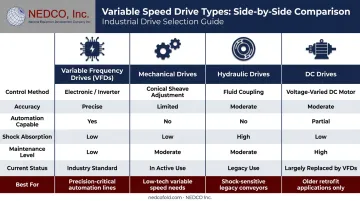
The right drive type depends on conveyor load, motor size, process control requirements, and budget. Four main categories exist.
Variable Frequency Drives (VFDs)
VFDs are the dominant choice for modern belt conveyor speed control. A VFD works in three stages: a rectifier converts incoming AC mains power to DC; capacitors in a DC link smooth the waveform; an inverter then converts that DC back to variable-frequency, variable-voltage AC for the motor.
Reducing output frequency from 60 Hz to 30 Hz, for example, drops motor speed by roughly half. Because belt conveyors are constant-torque loads, motor power output varies linearly with speed — not cubically as it does for fans and pumps.
This is a critical sizing point: a motor running at half frequency produces approximately half its rated horsepower. Beyond speed control, VFDs support external speed references (analog signals, potentiometers, preset values), digital start/stop commands, and network integration via EtherNet/IP or other industrial protocols.
Mechanical Variable Speed Drives
Mechanical VSDs change speed through physical adjustment of drive components — typically conical sheaves that shift the belt's effective pitch diameter and transmission ratio. Some models are rated from fractional horsepower up to 15 hp.
The trade-offs are significant, though:
- Less accurate speed control than VFDs
- No automation capability
- Belt slip generates heat and accelerates wear over time
Hydraulic Variable Speed Drives
Hydraulic fluid couplings sit between the motor and gearbox. A pump wheel transfers energy through fluid to a turbine wheel; variable-fill units regulate speed by changing how much fluid is present.
These drives absorb startup shock and provide some speed variation, which is why they were widely used in heavy-duty bulk material conveyor applications. They remain common in older installations, though new construction projects have shifted almost entirely to VFDs.
DC Drive Systems
DC drives control speed by varying voltage to a DC motor. They were common in earlier industrial installations but have largely given way to AC/VFD systems. The reason comes down to maintenance:
- Brushes and commutators wear regularly and require servicing
- Squirrel-cage AC induction motors (used with VFDs) are considerably more rugged and need far less upkeep
Key Benefits of Variable Speed Drives for Belt Conveyor Systems
Energy Savings
Fixed-speed conveyors run at full motor power continuously, regardless of actual load. That's wasted electricity every time the line runs below capacity.
VFDs let the motor run only as fast as needed. Because conveyors are constant-torque loads, reducing speed proportionally reduces power consumption. A NEMA illustrative conveyor case reported 10% energy savings from VFD speed matching, with additional cost reductions from scheduling operation to match actual demand and time-based electricity pricing.
Savings vary by application — mining conveyor benchmarks from ABB show 5%–8% from drive modernization combined with operational optimization. The key variable is how often your conveyor runs below full load.
Reduced Mechanical Wear and Lower Maintenance Costs
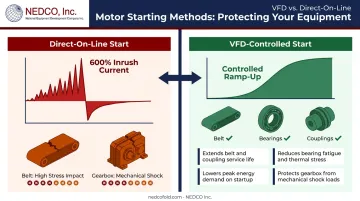
Direct-on-line (DOL) motor starts apply full voltage instantly, drawing up to 600% of full-load rated current and slamming mechanical components with immediate full torque. Every hard start stresses the belt, pulleys, bearings, and gearbox.
VFDs eliminate this by ramping motor speed up gradually during acceleration and down gradually during deceleration. Smoother torque application means:
- Less stress on belts and couplings at startup
- Reduced bearing loads during direction changes
- Lower risk of gear tooth impact from sudden load application
- Fewer unplanned stoppages from stress-related failures
Improved Throughput Control and Product Quality
Precise speed adjustment lets conveyor lines synchronize with upstream and downstream equipment. A Dailycer cereal-bar packaging installation used PowerFlex variable-speed drives to coordinate conveyors, wrappers, and cartoners via EtherNet/IP — keeping line speeds matched without manual intervention at each station.
In textile finishing operations, belt speed control is equally critical. NEDCO Inc.'s folding and packaging conveyor systems, for example, use fine speed adjustment to align product flow with folding machine cycle rates — reducing pile-ups, improving presentation consistency, and cutting down on operator corrections.
Enhanced Workplace Safety
Sudden belt starts and stops create unpredictable movement — a risk for both products and people working near the line. VFD-controlled conveyors accelerate and decelerate smoothly, keeping products moving steadily and eliminating abrupt belt jolts.
Operators can also deliberately reduce belt speed when personnel are working near the conveyor, without stopping the line entirely. That flexibility makes VSD-equipped systems safer in active production environments.
Operational Flexibility
A VFD-equipped conveyor adapts to changing production demands without hardware swaps. Key advantages include:
- Handles materials of different sizes, weights, or densities by adjusting speed electronically — no pulley or gearbox changes
- Reduces changeover time when switching between product types
- Scales throughput up or down across shifts without mechanical reconfiguration
How Variable Speed Drives Control Belt Conveyor Speed
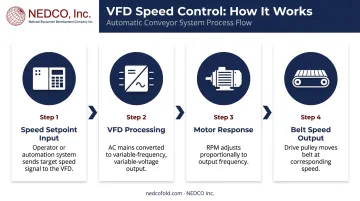
A VFD adjusts belt speed by converting fixed-frequency AC mains power into variable-frequency, variable-voltage output. The control sequence runs in four steps:
- Speed setpoint input — an operator sets a target speed via a control panel, or a PLC/production system sends an automated speed reference signal (0–10V analog, digital preset, or network command)
- VFD processing — the drive converts incoming AC mains to variable-frequency, variable-voltage output
- Motor response — motor RPM responds proportionally to output frequency
- Belt speed output — the drive pulley moves the belt at the corresponding speed
The Power Limitation You Must Account For
Running a VFD at half frequency (30 Hz instead of 60 Hz) means the motor produces roughly half its rated horsepower. That's a direct consequence of the constant-torque relationship between speed and power — not a malfunction.
The practical implication: size the motor for the required belt pull at the lowest intended operating speed, not just at full speed. A motor correctly sized for full-speed operation may lack the power to move a loaded belt at 40% speed. Overlooking this in VFD conveyor retrofits is where most sizing mistakes originate.
Automated and Remote Control Integration
Modern VFDs support full integration with:
- PLCs that trigger speed changes automatically based on upstream production logic
- Industrial networks (EtherNet/IP, DeviceNet) for real-time command and performance data exchange
- Load sensors and encoders that adjust belt speed based on live feedback, removing the need for manual intervention
- SCADA systems providing plant-wide visibility into drive status and operating conditions
This integration allows belt speed to track actual production conditions — slowing during low-demand periods, accelerating when throughput increases, and responding to upstream equipment signals without operator involvement.
How to Choose the Right Variable Speed Drive for Your Belt Conveyor System
Key Selection Factors
| Factor | What to Evaluate |
|---|---|
| Motor rating | Size from nameplate full-load current, not horsepower alone |
| Belt pull at low speed | Calculate required torque at minimum operating speed |
| Overload capacity | Conveyors may need 150%–160% current overload for starting |
| Speed range | Verify motor and gearbox can operate across the full intended range |
| Electrical supply | Match VFD input to available voltage, phase, and frequency |
| Environment | Enclosure rating, ambient temperature, altitude, contamination |
| Stopping requirements | Check for downhill/overhauling loads requiring braking resistors |
Danfoss explicitly recommends sizing VFDs from motor current and required overload, not from horsepower alone — this matters most for conveyors with variable loading or heavy starting conditions.
New Build vs. Retrofit
New installations allow the motor, gearbox, and VFD to be matched from the start. All components can be specified to work together across the full intended speed range.
Retrofitting an existing fixed-speed conveyor requires additional checks:
- Verify the existing motor is inverter-rated (NEMA MG 1 Part 31 compliant) — standard motors are not automatically suitable for VFD waveforms
- Check insulation condition and cable length — PWM switching can cause voltage spikes that stress older insulation systems
- Confirm adequate motor cooling at low speeds; shaft-mounted fans move less air at reduced RPM, and constant-torque conveyor duty may require auxiliary forced cooling
- Assess gearbox lubrication and coupling ratings for the intended speed range
- Evaluate bearing current risk and whether shielded motor cable or output filters are needed
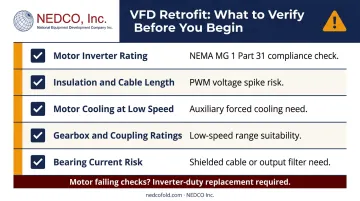
If the existing motor fails these checks, replacement with an inverter-duty motor is typically required alongside the VFD installation.
Working With NEDCO on Conveyor Drive Configurations
NEDCO Inc., based in Covington, Georgia, has 37 years of experience manufacturing belt-conveyor-based textile finishing and packaging equipment — including horizontal and inclined Automatic Conveyor Systems designed to integrate with T-shirt folding machines, labeling systems, bagger/sealers, and pillow compression machines. Facilities looking to optimize folding and packaging line throughput can contact NEDCO directly to discuss drive configurations for their specific production requirements.
Reach NEDCO's engineering team at (770) 484-9969 or support@nedcofold.com.
Frequently Asked Questions
What is a variable speed drive for a belt conveyor system?
A VSD is an electronic device that controls belt speed by varying the frequency and voltage of power supplied to the drive motor. This lets the conveyor run at different speeds matched to production demand, rather than only at a fixed maximum speed.
How do you control the speed of a belt conveyor with a variable speed drive?
An operator or control system sends a speed setpoint to the VFD, which adjusts its AC output frequency to the motor. Motor RPM — and therefore belt speed — responds proportionally. Most installations automate this via PLCs, sensors, or industrial network signals.
What is the difference between a VFD and a variable speed controller?
A VFD (Variable Frequency Drive) is a specific electronic controller that adjusts AC motor speed by changing supply frequency. Variable speed controller is a broader term covering electronic, mechanical, and hydraulic methods. VFD is the correct and most common term for industrial belt conveyor applications.
What are the main types of variable speed drives for belt conveyors?
The four main types are Variable Frequency Drives (VFDs/electronic), mechanical drives (variable-pitch pulley systems), hydraulic drives (fluid couplings), and DC drives. VFDs are the current industry standard for most belt conveyor installations.
Can I retrofit a VFD onto an existing fixed-speed belt conveyor?
Retrofits are often possible but require verifying the existing motor is inverter-rated and properly sized for the required torque at reduced speeds. Insulation condition, cable length, and cooling capacity also need evaluation — motor replacement may be necessary if the existing unit falls short.
How does running at lower frequency affect motor power output?
Motor power scales proportionally with VFD output frequency — half frequency delivers roughly half the rated horsepower. Size the motor for adequate power at the lowest intended belt speed, not just at full speed.