Introduction
Conveyor belt alignment rarely gets attention until something breaks. By then, the damage — frayed belt edges, worn bearings, jammed transfer points, or a full production stoppage — is already underway.
In textile finishing environments, the stakes are higher than in most industries. When a conveyor feeding an automated folding or packaging line drifts even slightly off-center, downstream effects appear immediately.
Misfolded garments, misaligned labels, products arriving out of position for the next machine — a small tracking error compounds fast across a production run.
Neglected alignment also drives up operating costs in less obvious ways. A belt running against its frame creates additional friction, forcing the drive motor to work harder. That extra load accumulates across shifts and accelerates wear on rollers, pulley faces, and the belt itself.
This guide covers why alignment matters, what causes it to fail, how to recognize warning signs early, and a step-by-step process for correcting tension and tracking problems.
Key Takeaways
- Misaligned belts increase motor load and accelerate wear on drive components
- Tracking problems usually start with unsquared pulleys, misaligned idlers, or uneven tension — not a defective belt
- Belts drift toward whichever roller end they contact first; use this to guide every tracking correction
- Fix tension before adjusting idlers or pulleys — sequence matters
- High-use systems need daily visual checks and at least monthly tension and squareness inspections
Why Conveyor Belt Alignment Matters
A conveyor belt running off-center creates a chain of mechanical problems that compound quickly over long production shifts.
The Friction and Load Problem
When a belt tracks to one side, its edge contacts the conveyor frame or idler stands. That contact creates drag. The drive motor compensates by drawing more power to maintain belt speed, and over long shifts, that elevated load adds wear to bearings and drive components that were designed to operate under normal, centered-belt conditions.
Habasit's fabric belt engineering guide confirms that dust, dirt, and humidity compound this friction effect further — a factor particularly relevant in textile finishing facilities where lint accumulation on rollers and pulley surfaces is constant.
Output Quality and Safety
For operations like automated t-shirt folding lines, belt tracking is a quality variable, not just a maintenance concern. Dorner's conveyor accuracy resources identify printing, labeling, indexing, and robotic pick-and-place as processes that require products to arrive at an exact lateral position. A belt drifting even a small amount delivers garments or products slightly offset, which cascades into misfolded items, misapplied labels, or packaging errors at the next station.
Quality failures aren't the only risk. A belt contacting guarding structures or frame components shouldn't be forced back using the guard as a makeshift guide. Under OSHA 29 CFR 1910.212, those contact points should trigger a shutdown and correction.
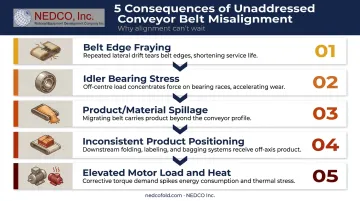
Key consequences of unaddressed misalignment:
- Uneven or accelerated wear on the belt's leading edge (fraying, delamination)
- Increased stress on idler bearings and pulley faces
- Material or product spillage off the belt edge
- Inconsistent product positioning at downstream equipment
- Elevated motor load and heat buildup during extended operation
Common Causes of Conveyor Belt Misalignment
Misalignment is almost never random. It has identifiable root causes, and finding the right one before making adjustments prevents wasted effort.
Pulley and Roller Issues
Head and tail pulleys must be square to the conveyor centerline (shafts running perpendicular to belt travel) and level with each other. A pulley that is skewed even slightly will steer the belt toward the side it contacts first, similar to how a rubber band slips sideways on a tilted post.
Idler problems contribute frequently:
- Frozen or seized rollers apply a braking force to one side of the belt
- Unequal roller diameter creates an asymmetric contact surface that steers the belt
- Misaligned idler frames cause drift even when the roller itself spins correctly
- Material buildup (lint, adhesive, coating residue) creates localized high spots that push the belt sideways
Tension Imbalance
Pulling the take-up system more on one side than the other creates a diagonal pull across the belt width. According to Habasit's installation and maintenance guide, the belt tracks toward the side with least tension — so uneven take-up adjustment is a direct cause of consistent directional drift.
Beyond uneven take-up, overall tension level matters too. Both extremes cause problems:
- Over-tensioning stresses the splice joint and overloads roller bearings
- Under-tensioning causes slippage on the drive pulley, belt bounce, and unstable tracking
Loading and Belt Condition
Off-center loading shifts the load's center of gravity, and the belt migrates toward the lightly loaded edge. This happens frequently during startup when feed chutes aren't positioned correctly, or when garment stacks are placed to one side of the belt.
The belt itself can also be the source of the problem:
- A splice cut at an angle (not square to the belt centerline) will cause the joint to steer the belt every time it passes over a roller
- Belt warping from improper storage creates a permanent curve in the running direction
- Existing deformation or uneven fabric weave in the belt construction applies asymmetric tension across the width
Signs Your Conveyor Belt Needs Realignment
Most alignment problems announce themselves before causing serious damage. Early detection almost always costs less than reactive repair.
Visible Belt Drift and Edge Wear
The clearest sign: the belt consistently runs to one side and makes contact with the frame, idler stands, or guarding. Watch one complete belt circuit — if edge clearance changes progressively through the loop, you have a tracking problem.
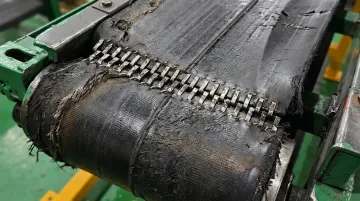
Uneven edge wear (fraying, delamination, or surface loss concentrated on one side of the belt) is a lagging indicator — it means the drift has been happening long enough to cause physical damage.
Unusual Noise, Vibration, and Friction
A misaligned belt scraping against frame components produces squealing or grinding sounds that are hard to miss. Additional signals:
- Thumping or rhythmic vibration — often tied to a damaged splice passing over rollers
- Increased motor temperature or load — the drive working harder to compensate for belt drag
- Slipping belt — insufficient tension causing the belt to lose traction on the drive pulley
These are machine-side symptoms. The next set shows up in what your line actually produces.
Material Spillage and Inconsistent Output
Lateral belt drift causes products or garments to shift off-center during transport. On a folding or packaging line — including conveyor systems integrated with NEDCO's E-Z Fold equipment — garments arrive at the folding mechanism misaligned, which degrades fold consistency and throughput.
Watch for these production-side symptoms:
- Products falling or sliding off one belt edge
- Jams at transfer points between conveyor and downstream equipment
- Inconsistent fold placement or label positioning at output
Recurring Small Fixes
A belt that "keeps going left," a splice that keeps failing before its expected service life, or idler bearings that need frequent replacement — these recurring symptoms point to an underlying alignment or tension problem that hasn't been fixed at the source.
How to Adjust Conveyor Belt Tension and Alignment
The foundational rule for all tracking adjustments: the belt moves toward the end of the roller it contacts first. Every steering correction works by manipulating this principle. Tension must also be set correctly before any tracking adjustments begin — adjusting idlers on an improperly tensioned belt produces inconsistent, hard-to-diagnose results.
Step 1: Set Correct Belt Tension
Tension the belt symmetrically, turning the take-up adjustment equally on both sides. The target is a belt that doesn't slip on the drive pulley at full load, without being so tight that it strains the splice or overloads bearings.
Practical approach:
- Start with both take-up sides at equal positions
- Increase tension incrementally — small, equal turns on each side
- Run the belt unloaded and check for slippage at the drive pulley
- Recheck tension after placing a normal product load on the belt, since a loaded belt behaves differently
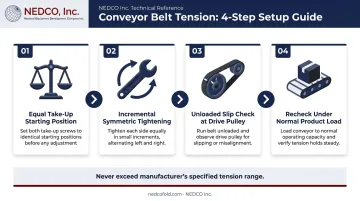
Never use a generic stretch percentage without confirming against the manufacturer's specification for your belt type.
Step 2: Check and Square All Pulleys and Rollers
Use a tape measure to compare distances from each pulley shaft end to the conveyor frame. Equal measurements on both sides confirm squareness — any difference means the pulley is skewed and will steer the belt toward the side it contacts first.
Run through these checks before touching any adjustment:
- Pulley squareness: Equal tape measurements from each shaft end to the frame on both sides
- Shaft level: A pulley tilted low on one end pulls the belt toward that side
- Idler rotation: Hand-spin each idler to confirm it rotates freely — under lockout only
- Seized rollers: A roller that won't spin is one of the most overlooked causes of persistent drift, especially in textile facilities where lint and fiber accumulate
Step 3: Adjust Idlers to Steer the Belt
To correct drift toward the left side: shift the idler frame slightly forward (in the direction of belt travel) on the left side. This creates a corrective steering force pushing the belt back toward center.
Important rules for idler adjustment:
- Make small adjustments — one idler at a time
- Wait several full belt revolutions after each adjustment before assessing the result
- Work on the idler immediately upstream of where the drift is observed
- If you over-correct, reverse the adjustment on the same idler — don't add corrections on the opposite side
Step 4: Address Return Belt and Tail Pulley
Return idlers can be adjusted using the same steering principle, with the corrective end moved in the direction of return belt travel. For persistent drift at the tail end, recheck tail pulley squareness first.
One important caution: if your conveyor runs in reverse at any point, idlers angled to correct tracking in forward travel will worsen tracking in reverse. Return idlers on reversing conveyors should remain squared.
Step 5: Test Run and Verify Under Load
- Run the conveyor at low speed with no load
- Observe belt tracking for several complete belt revolutions
- Confirm the belt maintains a centered path with no edge contact
- Load the conveyor to normal operating conditions and recheck
- Listen for any scraping, squealing, or unusual noise
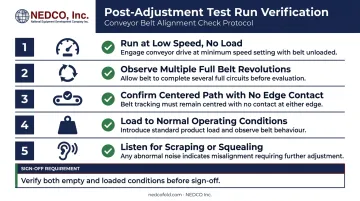
A belt that tracks well empty may still drift under load if the load is placed off-center. Confirm both conditions — empty and loaded — before signing off on the adjustment.
Conveyor Belt Alignment Maintenance Schedule
Inspection frequency should match how hard the conveyor works. Environmental factors specific to textile finishing — lint from garment fibers, adhesive from labeling, temperature swings — all accelerate the rate at which alignment drifts and components wear.
| Interval | Key Actions |
|---|---|
| Daily / Per Shift | Visual check for belt drift and edge contact; listen for scraping or squealing; check for material spillage; inspect splice passage for changing clearance |
| Weekly | Check take-up symmetry; inspect rollers for free rotation; clean belt surface, pulley faces, and idler surfaces of lint and debris |
| Monthly | Full tension check; verify pulley squareness with tape measure; inspect splice condition and belt edge integrity; review idler bearing condition |
| Quarterly / Annual | Comprehensive evaluation of belt carcass, pulley lagging wear, idler bearings, frame fasteners, and drive system performance |
For E-Z Fold equipment users, NEDCO's service team handles component sourcing and technical guidance when inspections reveal worn parts. Contact Don Cranshaw at Don@nedcofold.com or 770-484-9969.
NEDCO also offers annual service plans covering scheduled preventative maintenance — a practical option for high-throughput operations where an unplanned stoppage costs hours of production time.
The CIA daily habit:
- Clean — remove lint, adhesive, and buildup from belt, pulleys, and rollers before it creates tracking problems
- Inspect — check for drift, edge wear, and tension
- Adjust — make small, targeted corrections rather than waiting for a visible problem to worsen
Conclusion
Conveyor belt alignment is an ongoing maintenance discipline — one that directly affects equipment lifespan, production consistency, and operator safety.
The investment in routine checks — a daily visual scan, a monthly squareness verification, a quarterly bearing inspection — is far less than the cost of a belt failure, a jammed transfer point, or extended unplanned downtime.
Start with a written inspection log using the schedule in this guide as a baseline. At minimum, record:
- Every tension or tracking adjustment made
- The belt revolution count at which drift appeared
- Each component replacement and its service interval
Patterns in that log will surface root causes faster than any single inspection can.
When those patterns point to something beyond routine adjustment — persistent misalignment, worn components, or recurring drift — reach out to your equipment manufacturer's support team. For NEDCO E-Z Fold conveyor systems, Don Cranshaw and the NEDCO service team can be reached at 770-484-9969 or Don@nedcofold.com.
Frequently Asked Questions
What is the most common cause of conveyor belt misalignment?
Pulleys or idlers that aren't square to the belt path are the most frequent culprit, often combined with uneven tension on the two sides of the take-up system. Material buildup on pulley faces, particularly common in textile environments, compounds both problems and is easy to overlook.
How do you adjust tension on a conveyor belt?
Increase tension gradually and equally on both sides of the take-up system until the belt no longer slips on the drive pulley under normal load. Avoid over-tightening — if the splice or bearings are under excessive stress, you've gone too far. Small, symmetric adjustments are the right approach.
How do I know if my conveyor belt is misaligned?
The clearest signs are the belt consistently running to one side of the frame, uneven or accelerated wear on one belt edge, and scraping or squealing noise during operation. Material or product spillage off one side of the belt during normal use is another reliable indicator.
What happens if a conveyor belt is too tight or too loose?
Over-tension stresses the splice joint and overloads roller bearings, accelerating failure of both. Under-tension causes the belt to slip on the drive pulley, bounce, and lose tracking stability. Either extreme shortens belt and component service life significantly.
How often should conveyor belt alignment be checked?
For high-use systems, do a daily visual check for drift, edge contact, and unusual noise. Run a full tension and squareness inspection at least monthly, and increase that frequency in dusty, humid, or high-temperature environments where lint and wear accelerate faster.
Can I fix conveyor belt misalignment myself, or do I need a professional?
Most tension and tracking adjustments are manageable in-house using the steps in this guide. Persistent problems tied to worn components, a distorted frame, or a damaged belt warrant professional service or component replacement.