Introduction
A conveyor belt failure mid-shift doesn't just stop one machine. In a textile or apparel facility running automated folding, labeling, bagging, and sealing in sequence, the entire line goes quiet — and every minute of that silence has a price tag.
As automation expands across the garment industry and production margins tighten, conveyor maintenance has moved from a back-burner operational concern to a front-line business priority. Facilities that treat their conveyor systems reactively face real consequences:
- Unplanned downtime that ripples across the full production line
- Cascading output losses when integrated systems stall in sequence
- OSHA compliance exposure from deferred mechanical upkeep
This guide covers what you actually need to know heading into 2026: the financial case for proactive maintenance, the most common failure points in textile environments, and a practical framework for deciding when to repair, when to replace, and how to choose the right service partner for conveyor-integrated packaging equipment.
Key Takeaways
- Unplanned conveyor downtime compounds quickly — lost output, emergency labor, and delayed orders add up well beyond the repair bill
- Belt misalignment, slippage, material buildup, and component wear are the four leading failure causes in production environments
- Structured daily, weekly, monthly, and annual routines prevent most conveyor failures before they start
- The broader conveyor systems market is growing at a 5.2% CAGR through 2033, reflecting rising industrial automation and increasing demand for maintenance support
- Textile finishing conveyors depend on OEM service and genuine parts to protect system integrity and limit downtime
Why Conveyor Belt Maintenance Is a Business Priority in 2026
The Real Cost of Reactive Maintenance
An ABB survey of 3,215 plant-maintenance decision-makers found the median cost of an unplanned industrial outage is $125,000 per hour. That figure covers industrial businesses broadly — not conveyors specifically — but it illustrates why reactive maintenance is expensive thinking. An eight-hour outage represents roughly $1 million in exposure before a single repair invoice is written.
The three maintenance approaches produce very different outcomes:
| Approach | How It Works | Best Fit |
|---|---|---|
| Reactive | Fix after failure | Low-volume, low-integration environments |
| Preventive | Scheduled intervals | Most mid-size production facilities |
| Predictive | Condition-based monitoring | Enterprise-scale or high-automation operations |
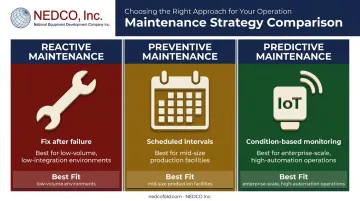
Preventive maintenance offers the strongest ROI for most mid-size textile facilities: predictable costs, schedulable labor, and far fewer emergency shutdowns. Predictive maintenance uses IoT sensors to monitor belt tension, motor temperature, and vibration in real time. It's growing in adoption, though it remains most practical at larger operational scales.
Cost exposure is only part of the picture. Deferred maintenance also creates regulatory and physical hazards that compound quickly in textile environments.
Safety and Compliance Stakes in Textile Environments
OSHA Standard 1910.219 requires that covered power-transmission equipment — including belt and pulley systems — be inspected at intervals not exceeding 60 days and maintained in good working condition. The standard specifically requires bearings to remain aligned, pulleys to stay true, and belts, lacings, and fasteners to remain in good repair.
In textile environments, OSHA separately identifies excessive lint deposits as a serious fire hazard in the context of belt-and-pulley guard design. Frayed belts, misaligned pulleys, and degraded fasteners aren't just equipment issues — they create physical hazards for operators and real compliance exposure.
The Cascading Failure Effect
In a conveyor-integrated finishing line, a single belt failure doesn't stop one machine. For facilities running equipment like NEDCO's automated T-shirt folding, labeling, bagging, and sealing systems linked by conveyor, a belt stoppage shuts down every downstream process simultaneously. Folded garments can't reach the labeling station. Labeled garments can't reach the bagger/sealer. The entire line idles. Downtime losses multiply across every connected process simultaneously.
The Most Common Conveyor Belt Problems and Their Root Causes
Misalignment
Belt misalignment occurs when the belt drifts off-center, causing uneven wear, frayed edges, and eventual jams. The root causes include:
- Improper loading distribution across the belt width
- Skewed or misaligned pulleys
- Damaged idler rollers creating uneven support
Early warning signs to catch during daily walkthroughs: the belt consistently tracking toward one side, visible edge wear patterns, or fraying along one belt margin.
In textile environments, lint and fabric fiber accumulation around idlers and rollers creates uneven friction surfaces that drive gradual misalignment — even without any mechanical damage. OSHA standards flag lint buildup as a hazard that directly affects belt-and-pulley guard design, making this a compliance issue, not just a maintenance one.
Belt Slippage and Tension Failures
Belt slippage occurs when the belt loses grip on the drive pulley, producing inconsistent speeds, sudden stops, or complete loss of drive. Common causes:
- Insufficient belt tension
- Worn or contaminated drive pulley surfaces
- Over-lubrication of the belt surface reducing traction
Correct tension range is equipment-specific — always reference your OEM equipment manual rather than a generic benchmark. Tension requirements vary by belt construction, load, pulley geometry, and drive type.
Material Buildup and Debris Accumulation
In textile operations, material buildup is more insidious than in most other industries. Fine fabric fibers, lint, and thread accumulate inside roller housings and beneath the belt surface, causing:
- Increased rolling friction
- Disrupted belt tracking
- Fire risk from lint accumulation near heat-generating components
Cleaning frequency in textile environments should exceed generic industry standards. Depending on production volume and fiber type, cleaning intervals may need to run every two to three operational days rather than weekly.
Wear, Tear, and Component Failure
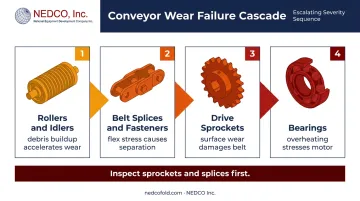
The components most prone to accelerated wear in conveyor systems:
- Rollers and idlers — especially under high loads or with debris buildup
- Belt splices and fasteners — subject to repeated flex stress at joints
- Drive sprockets — surface wear accelerates belt wear in turn
- Bearings — misalignment or debris ingress causes overheating and motor stress
Wear failures cascade: worn sprockets damage belt surfaces, degraded splices cause separation, failing bearings overheat motors. Inspect sprockets and splices first during scheduled checks — these are the earliest indicators that downstream components are under stress.
Conveyor Belt Maintenance Checklist: Daily, Weekly, Monthly, and Annual Tasks
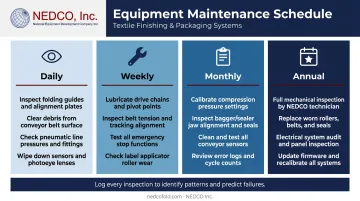
Daily Tasks
These checks take minutes but prevent hours of downtime. Each shift should include:
- Visual scan of belt surface for cracks, fraying, cuts, or embedded debris
- Check belt tracking — is it running centered, or drifting?
- Clear debris from around rollers and beneath the belt
- Listen during startup for abnormal motor sounds or roller squealing
Weekly Tasks
- Lubricate bearings, chains, and applicable moving components per OEM specifications
- Inspect pulleys and drive components for surface wear or lagging deterioration
- Check for material buildup beneath the belt or around seals
- Deep-clean the belt surface
Note for textile facilities: In high-fiber environments, cleaning intervals may need to move to every two to three operational days. Lint accumulation doesn't wait for the weekly schedule.
Monthly Tasks
With the system shut down:
- Inspect belt splice integrity, fasteners, and joints
- Check structural alignment of the conveyor frame
- Verify proper belt tension and adjust if needed per manufacturer specifications
- Lubricate bearings and rollers according to OEM guidelines
- Review the maintenance log for recurring issues — a belt that consistently drifts or a component that keeps wearing faster than expected may indicate a structural or load problem
Annual Tasks
Once a year, schedule a full system review with the line stopped:
- Complete motor diagnostic under load and without load
- Assess overall belt wear level against manufacturer replacement thresholds
- Review and test emergency stop systems
- Plan major component replacements before failure — not after
Logging every inspection result, adjustment, and repair gives maintenance teams the data to identify patterns — a belt that consistently misaligns after roughly 200 operating hours, for example — predict part replacements before failure, and make a documented case for scheduled interventions over reactive repairs.
Repair vs. Replace: How to Make the Right Decision
No single cost-percentage rule works for every facility. The decision comes down to total cost of ownership — calculated with your actual numbers, not industry averages.
When Repair Makes Sense
Repair is the right call when:
- Damage is localized — a few broken modular links, minor surface tears, an isolated splice failure
- The belt is structurally sound beyond the damaged zone
- The cost of repair is a fraction of full replacement, factoring in installation downtime
When Replacement Is Necessary
Replace when:
- Belt degradation spans multiple zones across the belt width
- Tracking or alignment failures persist after adjustment, suggesting structural belt deformation
- The same location fails repeatedly, indicating a design or load issue the belt can't survive
- The belt has exceeded the manufacturer's recommended service life
Building a TCO Case
The decision shouldn't rest on belt price alone. The relevant inputs for a complete comparison:
- Labor cost for repair vs. full replacement installation
- Downtime duration for each option — calculated against your facility's documented cost per hour of lost production
- Remaining belt life after repair and the realistic probability of recurrence
- Risk exposure of operating a repaired belt that may fail again before the next scheduled maintenance window
A belt that costs less to patch but fails again in three months may cost more in total than a replacement done once. Build the comparison with your actual numbers — not a generic percentage rule.
2026 Market Trends Reshaping Conveyor Belt Repair and Maintenance
Market Growth Context
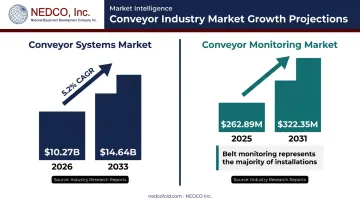
MarketsandMarkets projects the broader conveyor systems market will grow from $10.27 billion in 2026 to $14.64 billion in 2033, a 5.2% CAGR. More conveyor systems in operation across more facilities means growing demand for maintenance services, replacement components, and service expertise.
The conveyor monitoring segment tells a parallel story. Mordor Intelligence values global conveyor monitoring at $262.89 million in 2025, projected to reach $322.35 million by 2031, with belt monitoring representing the majority of installations. That growth reflects a clear directional shift: operators are investing in visibility, not just repair.
Key figures at a glance:
- Conveyor systems market: $10.27B (2026) → $14.64B (2033) at 5.2% CAGR
- Conveyor monitoring market: $262.89M (2025) → $322.35M (2031)
- Belt monitoring accounts for the majority of monitoring installations globally
The Rise of Predictive Maintenance
IoT-enabled sensors monitoring belt tension, motor temperature, vibration, and roller performance in real time are no longer exclusive to enterprise-scale manufacturing. Condition-based monitoring allows maintenance teams to address developing problems before failure rather than during it.
Verified cost-effectiveness data for mid-size textile facilities specifically is limited, however. If you're evaluating predictive monitoring technology, ask vendors for facility-specific ROI figures rather than market-level projections.
Sustainability as a Procurement Factor
Extending conveyor belt lifespan through proper maintenance reduces material waste and the environmental impact of manufacturing replacement components. According to a Textile World 2024 supply-chain review, sustainability, technology integration, and sourcing practices are defining themes across textile operations. In 2026, sustainability considerations are increasingly factored into vendor selection and procurement decisions — maintenance strategy included.
Choosing the Right Service Partner for Your Conveyor System
What to Evaluate
When selecting a conveyor maintenance or parts service partner, assess:
- OEM parts availability — Genuine OEM parts protect system integrity. As Pacteon notes for integrated packaging systems, OEM components ensure compatibility, reliable performance, and minimal downtime. Aftermarket substitutes may not meet original design specifications.
- Warranty implications — Dorner's official warranty, for example, explicitly voids coverage when non-OEM replacement parts are used. Check your equipment's specific warranty terms before sourcing parts externally.
- Response time and accessibility — When a belt fails mid-shift, you need a service contact who answers, not a ticket queue.
- Technical depth — Does the provider understand your specific equipment, or just conveyors generically?
- Post-sale track record — Look for providers with documented repeat customers and structured service plans — not just one-time parts vendors.
Why OEM-Backed Service Matters for Integrated Systems
Textile finishing lines built around precise belt specifications — where the conveyor links folding, labeling, bagging, and sealing equipment — have no tolerance for compatibility guesswork. Incompatible parts can introduce misalignment, accelerate wear on adjacent components, and void equipment warranties outright.
The manufacturer who built the system knows its tolerances, failure modes, and correct replacement specifications. Third-party providers working from generic conveyor knowledge don't have that context.
NEDCO Inc. (E-Z Fold): OEM Parts and Service Since 1989
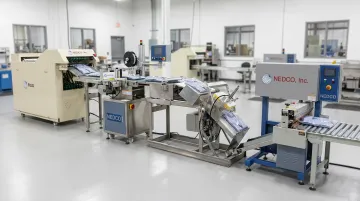
For textile and apparel production facilities running conveyor-integrated packaging equipment, NEDCO Inc. (E-Z Fold) has provided OEM-backed parts and service since 1989. Based in Covington, Georgia, NEDCO manufactures horizontal and inclined automatic conveyor systems designed to integrate with their full equipment lineup — T-shirt folding machines, labeling systems, bagger/sealer systems, and pillow compression machines. Because NEDCO builds the equipment, their service team understands the entire integrated system, not just the conveyor component in isolation.
Direct service requests and parts orders to Don Cranshaw at don@nedcofold.com or 770-484-9969. Annual service plans are also available for scheduled preventive maintenance throughout the year.
Frequently Asked Questions
How often should a conveyor belt system be inspected for maintenance?
Daily visual checks are the minimum baseline: belt surface, tracking, debris, and motor sounds should be assessed every shift. Weekly and monthly inspections go deeper into components, tension, and alignment. In high-production textile environments, fiber and lint accumulation may require cleaning and closer inspection every two to three operational days.
What are the most common signs that a conveyor belt needs repair?
Key warning signs include visible belt damage or fraying, the belt drifting consistently to one side, unusual motor sounds during startup, inconsistent belt speed, and material spillage or buildup around rollers. Any one of these warrants investigation before the next full shift.
When should you repair a conveyor belt rather than replace it?
Localized damage — minor surface tears, isolated splice failures, a few broken modular links — typically favors repair when the belt is otherwise structurally sound. Widespread degradation, repeated failures in the same location, or a belt that has exceeded its service life all point toward replacement. Total cost of ownership, not just belt price, should drive the decision.
How does neglected conveyor belt maintenance affect textile production output?
In conveyor-integrated finishing lines, a belt failure doesn't stop one machine; it halts every downstream process simultaneously. Folded garments can't reach the labeling station, labeled garments can't reach the bagger/sealer, and the entire production line idles until the belt is restored.
Which components of a conveyor belt system wear out the fastest?
Rollers, idlers, belt splices, drive sprockets, and bearings are the components most subject to accelerated wear — particularly in environments with heavy loads, abrasive materials, or debris accumulation. Wear on any one of these tends to accelerate wear on the next, so catching roller and bearing degradation early prevents most cascade failures.
How do you find reliable parts and service support for conveyor-integrated packaging equipment?
Prioritize OEM-certified service providers who stock genuine replacement parts, offer accessible technical support, and have a demonstrated track record of post-sale service. For specialized systems like textile folding and packaging equipment, working directly with the equipment manufacturer provides the most compatible parts and the most complete technical knowledge of the integrated system.