Three forces are pushing that growth: automation adoption on packaging lines, rising demand for packaged goods across food and pharma, and steady technology upgrades like servo controls and IoT monitoring. This article breaks down how these machines work, where the market stands heading into 2026, and what this automation wave means for finishing and packaging-focused businesses — including textile and apparel manufacturers watching the same trends unfold in their own production lines.
Key Takeaways
- Pillow packing machine market projected at roughly 5–6% CAGR through the forecast window
- Horizontal form-fill-seal (HFFS) machines dominate current market share; pharmaceutical end-use is projected to grow fastest
- Asia-Pacific leads regional market share; North America leads in automation adoption
- Weigh machine type, industry fit, and vendor support before investing in automated packaging equipment
What Is a Pillow Packing Machine and How Does It Work?
A pillow packing machine, also called a flow wrapper or horizontal form-fill-seal (HFFS) machine, wraps and seals individual products in a continuous motion. The name comes from the finished package's shape: a crimped, pillow-like seal at both ends with a flat seam running down the back.
ULMA, a major equipment manufacturer, describes its own HFFS unit as producing a "three-seal pillow pack", a description that directly ties the flow wrap process to the pillow-pack terminology used across the industry.
These machines are used across several industries:
- Food and beverage (snacks, baked goods, produce)
- Pharmaceuticals (blister cards, medical devices)
- Cosmetics and personal care
- Electronics and small consumer goods
Core Components of the Machine
Every pillow packer relies on a handful of coordinated parts:
- Film feeding system: unwinds and tensions the packaging film
- Forming section (former): shapes flat film into a tube around the product
- Product infeed conveyor: feeds items into the forming area at a controlled pace
- Longitudinal and end sealing units: seal the back seam and both ends
- Output conveyor: discharges finished packs for boxing or palletizing
How the Packaging Process Works
The sequence runs in a tight loop:
- Product feeding: items enter on the infeed conveyor at set intervals
- Film forming: the film wraps around the product into a tube shape
- Longitudinal sealing: a fin seal closes the back seam
- End sealing and cutting: jaws crimp and cut between packages
- Discharge: finished pillow packs exit for downstream handling
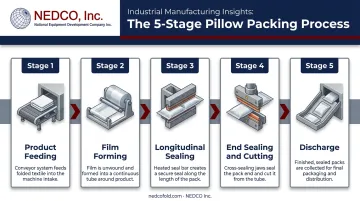
Modern machines use PLC touchscreens, sensors, and adjustable settings so operators can change product sizes and speeds without manual retooling. ULMA's Sienna line, for example, lets operators adjust bag length, speed, and sealing time on the fly from the touchscreen.
Key Benefits Driving Adoption
Speed is the headline benefit. Packaging Digest notes common flow-wrapper rates of 50-150 packages per minute, with some high-speed units well beyond that. Plants also gain:
- Hygienic sealed packaging for food and pharma compliance
- Flexibility with irregular and mixed product shapes
- Lower labor costs from reduced manual handling
Product-specific speeds vary widely by manufacturer. PAC Machinery's FW 400F runs up to 120 packages per minute (or 180 with twin jaws). Syntegon's Pack 403 HE reaches up to 600 packages per minute on high-speed lines.
Pillow Packing Machine Market Size & Growth Forecast for 2026
Market sizing depends heavily on scope. Reports that isolate flow-wrap machinery specifically show smaller figures than reports covering the full horizontal-plus-vertical form-fill-seal category.
| Source | Scope | 2026 Size | Forecast | CAGR |
|---|---|---|---|---|
| Future Market Insights | Flow-wrap machines | $2.10B | $3.02B by 2036 | 3.9% |
| Grand View Research | Wider FFS machinery | $8.1B | $10.6B by 2030 | 6.6% |
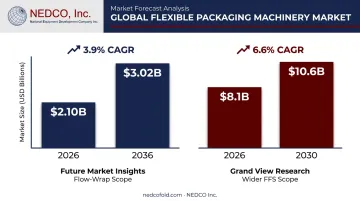
Don't compare figures across reports without checking scope and base year first.
What's Driving the Growth
Demand-side pressure is coming from several directions:
- Packaged consumer goods demand rising across food, beverage, and retail
- E-commerce growth pushing more products through automated fulfillment lines
- Pharmaceutical expansion needing hygienic, compliance-ready packaging
Grand View Research projects pharma FFS demand at a 7.6% CAGR, linked to stricter rules such as the FDA's Drug Supply Chain Security Act.
Technology is speeding adoption as well. Servo-driven systems, IoT monitoring, and AI-based predictive maintenance are shifting from premium options to standard features, including remote dashboards for performance tracking and optimization.
Restraints Worth Noting
Common barriers still slow buyers down:
- High upfront capital costs for new equipment
- Integration challenges when adding automated lines to older production setups
- Fluctuating raw material and component prices affecting machines and parts
Fresh demand is also building in industrializing regions—Latin America, Southeast Asia, and Africa—as packaged goods manufacturing spreads beyond traditional hubs. That regional expansion sits on top of a steady post-pandemic recovery in capital equipment spending.
Market Segmentation and Regional Growth Trends
Machine type and end-use segmentation tell slightly different stories depending on the source, which matters if you're benchmarking your own industry against the trend.
By machine type:
| Metric | Finding | Source |
|---|---|---|
| HFFS share of flow-wrap orientation, 2026 | 57.8% | Future Market Insights |
| VFFS share of broader FFS market, 2025 | 57.83% | Mordor Intelligence |
| HFFS forecast growth rate, through 2031 | 6.58% CAGR | Mordor Intelligence |
The pattern isn't perfectly consistent across studies. One report has horizontal leading; another has vertical leading with horizontal growing faster. Both formats remain relevant, and the right choice still depends on product shape and line speed.
By end-use:
Food and beverage remains the largest segment (27.91% of the broader FFS market per Mordor Intelligence). Pharmaceuticals and biologics show the strongest growth, at 6.66% CAGR (Mordor) and 7.6% CAGR (Grand View Research).
By region:
- Asia-Pacific leads with roughly 39.75% of the broader FFS market, driven by industrialization in China and India
- North America holds a smaller share but leads in automation, near $1.78 billion in 2024 and heading toward $2.43 billion by 2030
- Europe is on a steady climb from about $2.07 billion in 2025 to $3.17 billion by 2033
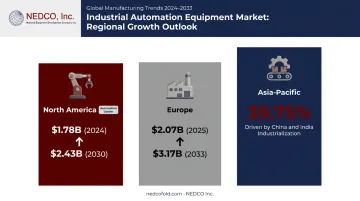
Emerging Trends Shaping the Pillow Packing Machine Market Through 2026
Four shifts are changing how pillow packing machines are designed, connected, serviced, and inspected through 2026.
Sustainable film compatibility is moving from brochure language into real machine design. Builders are testing recyclable paper alternatives to plastic film, but the tradeoffs are clear. One documented case, the FW 650SI flow wrapper, runs at roughly 80 packages per minute with plastic film versus 30 with curbside-recyclable coated paper, because paper needs a heat-sealable coating and costs more to run.
Connectivity expectations are rising just as fast. Industry 4.0 integration is close to standard on new models:
- Real-time remote monitoring and OEE (overall equipment effectiveness) reporting
- MES/ERP connectivity for batch control and traceability
- Predictive maintenance alerts based on cycle counts
Service economics are shifting with those smarter machines. Aftermarket support is outpacing new equipment sales. A PMMI report found 98% of end users expected their 2025 service budgets to grow or hold steady, and 94% of equipment makers expect aftermarket demand to keep climbing over the next three years. Parts availability and lead time ranked as the top priority for 75% of buyers surveyed.
On the line itself, robotics and AI-based inspection are gaining ground. Machine-vision systems catch defects such as cracks or misprints before packs leave the line, cutting waste without slowing throughput.
What Growing Packaging Automation Means for Textile, Apparel & Finishing Businesses
The same forces reshaping food and pharma packaging (labor pressure, throughput demands, and equipment that ties into existing lines) are playing out in textile and apparel finishing too. PMMI research found warehouse automation penetration climbing from 14% in 2017 to 18% in 2021, with projections topping 25% by 2027. That trajectory isn't unique to food packaging; it's a signal for any operation still relying on manual finishing steps.
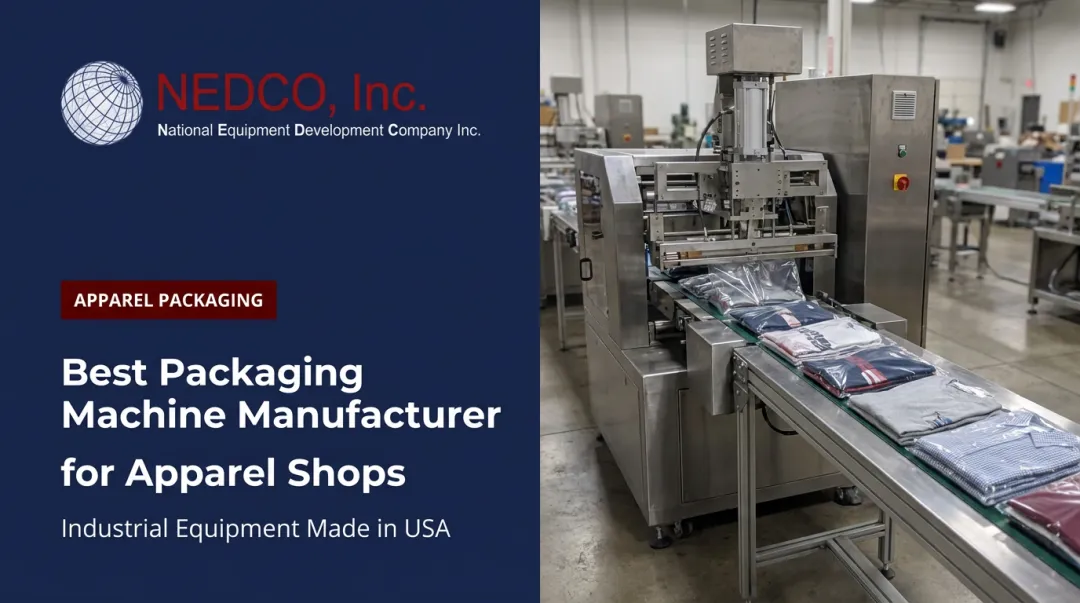
For apparel producers, folding and packaging is often the last bottleneck before product ships. Modular, made-in-the-USA lines are built for that gap.
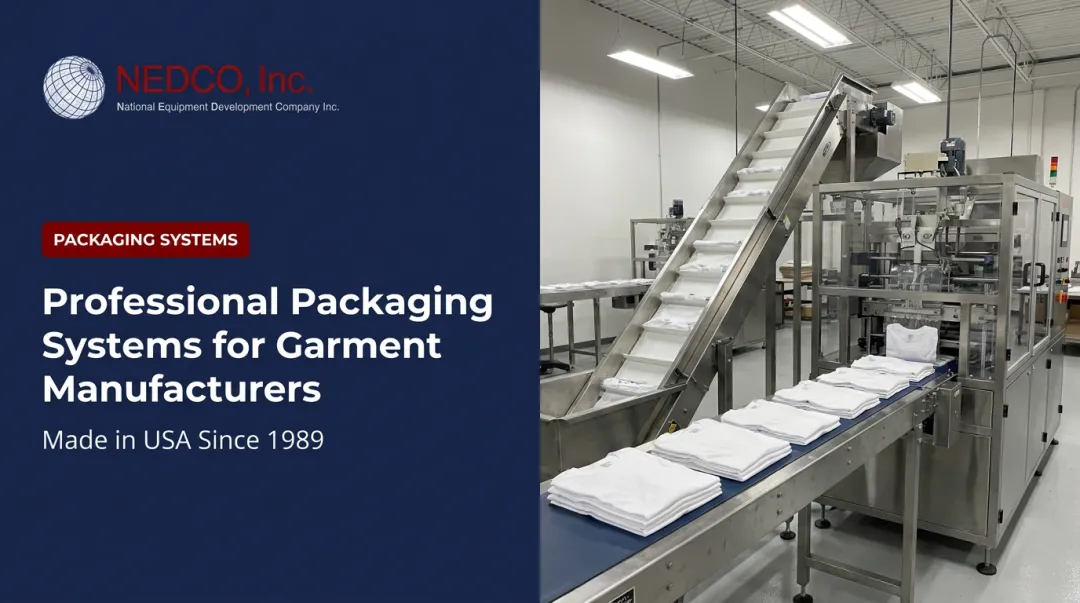
NEDCO Inc. in Covington, Georgia, designs its E-Z Fold lineup as connected stations instead of one oversized machine:
- E-Z Fold 2000-S and TX-5-S folding systems for high-volume garment folding
- PC-1000 and PC-3000 pillow compression machines to cut package volume on soft goods
- L-15, UPAII, and L-60 labeling systems for consistent tag and barcode placement
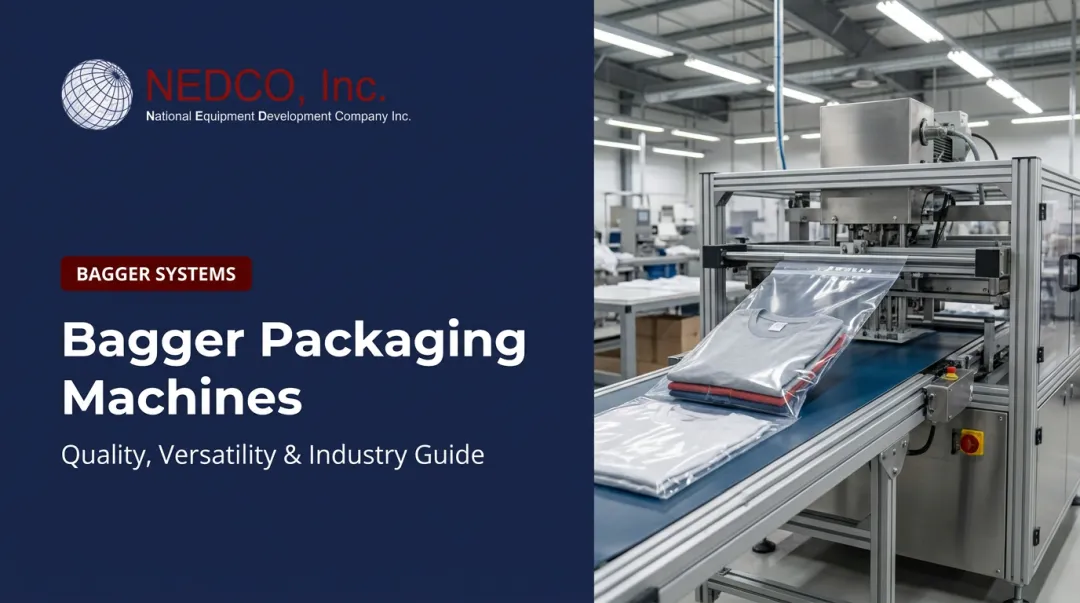
- MAX-UBII and T-1000 Autobagger units that bag and seal in one step
- CV-100 and CV-500 conveyors that keep every station at matched speed
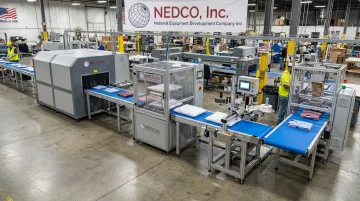
The CV-500 matches belt speed with connected NEDCO equipment, so product moves from folding to labeling to bagging without manual transfers.
Evaluating Any Automated Packaging Investment
Whether you are pricing a pillow compression unit for soft goods or a full folding-to-bagging line for garments, ask the same questions:
- Can the equipment scale with production, or will you outgrow it within two years?
- What is the total cost of ownership once parts, maintenance, and downtime risk are included?
- How fast is service response, and are replacement parts available before you sign?
NEDCO supports buyers with financing through Beacon Funding, annual service plans, and direct parts ordering. Request those details before any purchase decision.
Frequently Asked Questions
What is a pillow packing machine used for?
A pillow packing machine wraps and seals individual products (food, pharmaceuticals, small consumer goods) into pillow-shaped packages. That seal protects the product and creates a clean, shelf-ready package.
How much does a pillow packing machine cost?
Cost varies widely based on speed, automation level, and customization such as film type or jaw width. Request quotes directly from manufacturers for accurate, application-specific pricing.
What is the difference between a pillow packing machine and a flow wrapping machine?
They're the same technology: horizontal form-fill-seal equipment. "Pillow pack" simply refers to the crimped-seal shape of the finished package, while "flow wrapper" describes the machine itself.
Which industries rely most heavily on pillow packing machines?
Food and beverage, pharmaceuticals, and cosmetics are the top adopters, driven by hygiene requirements and high-speed packaging needs across their production lines.
What is driving the growth of the pillow packing machine market?
Automation demand, rising packaged goods consumption, e-commerce growth, and technology upgrades like servo drives and predictive maintenance are the main drivers.
Which region leads the global pillow packing machine market?
Asia-Pacific leads due to rapid industrialization in China and India. North America and Europe follow closely, driven by advanced automation in manufacturing plants.