Introduction
Every production floor runs on a chain of equipment decisions. Buy the wrong press and you cap your output. Skip an automated folding step and your finishing crew becomes the slowest part of an otherwise fast operation — whether you're cutting and sewing from scratch or decorating blanks for screen printing clients.
This guide covers every major garment machinery category: cutting and preparation, sewing and stitching, printing and decoration, and finishing and packaging.
Whether you manufacture apparel from raw fabric or run a screen printing shop buying wholesale blanks, understanding the full equipment landscape helps you make smarter investments and identify where your current setup is losing time.
Key Takeaways
- Garment machinery is organized by production stage — you don't need every category, just the ones that match your workflow
- Screen printers need a press, flash cure units, and a conveyor dryer at minimum — plus finishing equipment for fulfillment
- Finishing and packaging is the most commonly overlooked bottleneck in high-volume shops
- Automated folding machines eliminate the most labor-intensive fulfillment step without adding headcount
- Total cost of ownership, not sticker price, is the right framework for evaluating any equipment investment
What Is Garment Machinery?
Garment machinery covers any industrial equipment used across the full lifecycle of apparel production — from transforming raw fabric into cut panels, to sewing those panels into finished garments, to decorating, inspecting, folding, and packaging them for shipment.
Industry organizations like JUKI and SPESA classify this equipment by production function: cutting, sewing, decoration, and finishing. Each production stage has its own equipment category, and most operations only need a subset of that full range.
Apparel Manufacturers vs. Screen Printers
The right equipment mix depends heavily on your role in the supply chain:
- Apparel manufacturers who cut and sew their own garments need cutting equipment, spreading tables, sewing machines, and finishing lines
- Screen printers and decorators who buy wholesale blanks typically skip cutting and sewing entirely — their core equipment is the press, cure units, and packaging line
- Both benefit from understanding the full picture, especially when specifying construction requirements for blank suppliers or communicating with cut-and-sew partners
Cutting and Preparation Machines
For manufacturers who start from fabric, cutting is where production begins. Getting panels cut accurately — and efficiently — determines how much waste ends up on the floor and how well downstream sewing goes.
Manual Cutting Machines
The four main blade types each serve a different purpose:
- Straight knife — the most versatile manual cutter; Eastman's straight-knife models accommodate blade heights from 5 to 13 inches, handling varied fabric types and lay heights
- Round knife — best for straight lines and large-radius curves; Eastman's round-knife models handle lay heights from 1 inch (smaller models) up to 7.5 inches on larger industrial versions
- Band knife — a stationary precision cutter suited for knits, crocheted fabrics, and technical textiles; used when accuracy on complex curves matters more than speed
- CNC/computerized cutting — automated systems like the Lectra Vector cut low-to-high fabric plies at speeds up to 8 meters per minute, with optical matching and automated sorting assistance
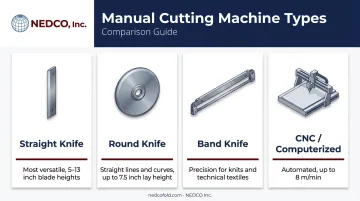
Manual cutting works well for smaller operations and simpler shapes. Once fabric waste reduction and nesting efficiency become priorities at volume, CNC systems are worth the investment.
Spreading and Pattern-Making Equipment
Upstream of cutting, high-volume operations use fabric spreading machines to layer fabric plies evenly across a cutting table before the blade touches it. Pattern-making relies on CAD and plotter systems that generate precise cut templates.
Screen printers and decorators working from pre-cut wholesale blanks can skip this category entirely — it's not part of that workflow.
Sewing and Stitching Machines
For garment manufacturers, the sewing room is the production core. Understanding machine types here also helps screen printers make sense of the blanks they decorate: why a t-shirt stretches without popping a seam, or how a welt pocket is constructed.
Primary Stitch Machines
| Machine Type | Primary Use |
|---|---|
| Single Needle Lockstitch (SNLS) | Straight seams on woven fabrics; JUKI's automatic welting version runs up to 3,000 stitches/minute |
| Overlock / Serger | Edge finishing on knits; sews over one or two fabric edges to prevent fraying |
| Flatlock / Interlock | Seamless joins on sportswear and activewear; lies flat against the skin |
| Coverstitch | Hem finishing on t-shirts and knitwear; Yamato's VT2500 series is purpose-built for this application |
| Chainstitch | Core industrial stitch for knit construction; Pegasus identifies this as a primary industrial specialization |
Specialized Production Machines
Beyond the stitch families above, high-volume sewing operations rely on task-specific automation:
- Buttonhole machines — automate one of the most repetitive sewing operations in wovens production
- Button attach machines — consistent attachment speed across large runs
- Bartack machines — reinforce stress points (belt loops, pocket corners) with dense stitch clusters
- Blind stitch machines — invisible hem finishing on dress pants and skirts
JUKI's computer-controlled belt-loop attacher completes one loop in 1.2 seconds with seven selectable sewing patterns. That kind of task-specific automation achieves throughput no general-purpose machine can match.
Programmable Sewing Attachments
For high-volume shops, attachments like pocket setters, placket attachers, and elastic-waistband systems reduce operator steps on repetitive construction tasks. These aren't separate machines so much as automation upgrades for existing sewing lines.
Screen printers won't run these machines, but knowing how a blank is built makes it easier to specify construction requirements and catch quality issues before they reach a customer.
Printing and Decoration Machines for Screen Printers
For screen printers and apparel decorators, this is the operational center of the business. Three pieces of equipment form the core production chain: the press, the flash cure unit, and the conveyor dryer.
Screen Printing Presses
Manual presses are the entry point — lower cost, simpler setup, and adequate for smaller runs. Anatol's 2020 vendor benchmarks estimate roughly 25 shirts per hour on a manual press with flashing. Automatic carousel presses operate in the 300–400 pieces per hour range under comparable conditions, with output depending heavily on garment handling, job complexity, and number of colors.
The move from manual to automatic makes sense when you have a steady stream of large jobs — not just because of speed, but because automatic presses allow one operator to load while the machine indexes, rather than requiring hands on every print stroke.
Flash Cure Units
Flash cure units (spot dryers) sit between print heads on multi-color jobs. Their job is to gel an intermediate ink layer until it's tack-free, preventing smearing during registration and allowing the next color to print cleanly on top.
They're especially critical for:
- White underbases on dark garments
- Specialty inks that won't hold registration wet-on-wet
- High-color-count designs where each layer needs to be stable before the next
The number of flash stations relative to your press size affects both print quality and throughput. A six-color job that needs two flashes, on a six-station press, requires careful scheduling.
Conveyor Dryers
The conveyor dryer (tunnel dryer) is the final cure step — where ink bonds permanently to the fabric. Getting this wrong means prints that wash out.
Cure temperatures vary by ink type:
- Standard plastisol (Wilflex, Union Ink): 320°F final cure temperature
- Low-cure plastisol: typically 250°F–320°F depending on the specific formulation
- Water-based inks: Anatol recommends a printed-ink temperature of 300–320°F for 2–3 minutes, with evaporation and airflow both affecting the result
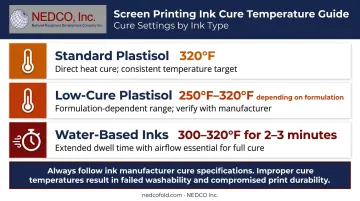
Never apply one universal cure setting across all inks. Always follow the specific ink manufacturer's technical guide and validate with wash testing.
Dryer capacity must match press output. A bottleneck here — where printed shirts pile up waiting for the dryer — is one of the most common causes of production slowdowns in screen printing shops.
Complementary Decoration Equipment
Beyond traditional screen printing, several decoration methods expand a shop's service range:
- Heat press machines — for transfers, vinyl, and sublimation; lower setup complexity than screen printing
- Direct-to-garment (DTG) printers — digital image directly onto a pretreated garment; supports short runs and complex multicolor designs without screen setup
- Embroidery machines — thread-based decoration using a digitized design file; different skill set, different equipment, different customer expectations
Each method has distinct setup requirements, substrate limitations, and run-size economics. Impressions Magazine's 2023 apparel decoration guide covers these distinctions clearly for shops evaluating which methods to add.
Finishing and Packaging Machines
Finishing and packaging is consistently the most underestimated stage in screen printing and apparel fulfillment. A shop can run a fast press and a well-tuned dryer, then lose all that throughput gain to manual folding, slow bagging, and inconsistent labeling.
Pressing and Steaming Equipment
Before inspection and packaging, garments often need finishing:
- Steam irons — standard in manufacturing environments for panel and final-garment pressing
- Tunnel steamers — continuous-feed steaming for high-volume finishing lines
- Heat sealing machines — used to apply fused labels or close packaged items
These are more common in cut-and-sew manufacturing, but decorators finishing premium retail orders often benefit from at least basic steaming equipment.
Quality Control at the Finishing Stage
Three tools appear at the end of most garment production lines:
- Needle detectors — end-of-line QC equipment that identifies broken needles or metal fragments before garments ship; Oshima describes these as standard practice for export quality control, and Intertek confirms their recognized role across textile and apparel operations
- Thread trimmers — remove loose threads before inspection or packaging
- Inspection tables — lit surfaces where QC staff examine garments for defects, print registration issues, or packaging errors
Automated Folding Machines
Manual folding is where labor piles up fast at scale. A team folding and bagging by hand becomes the production ceiling — no matter how fast the press runs.
Automated t-shirt folding machines eliminate that ceiling. M&R reports that one operator can fold and bag up to 1,000 garments per hour with an integrated folder and bagging system — a claim tied to their specific K-950 system configuration and garment type.
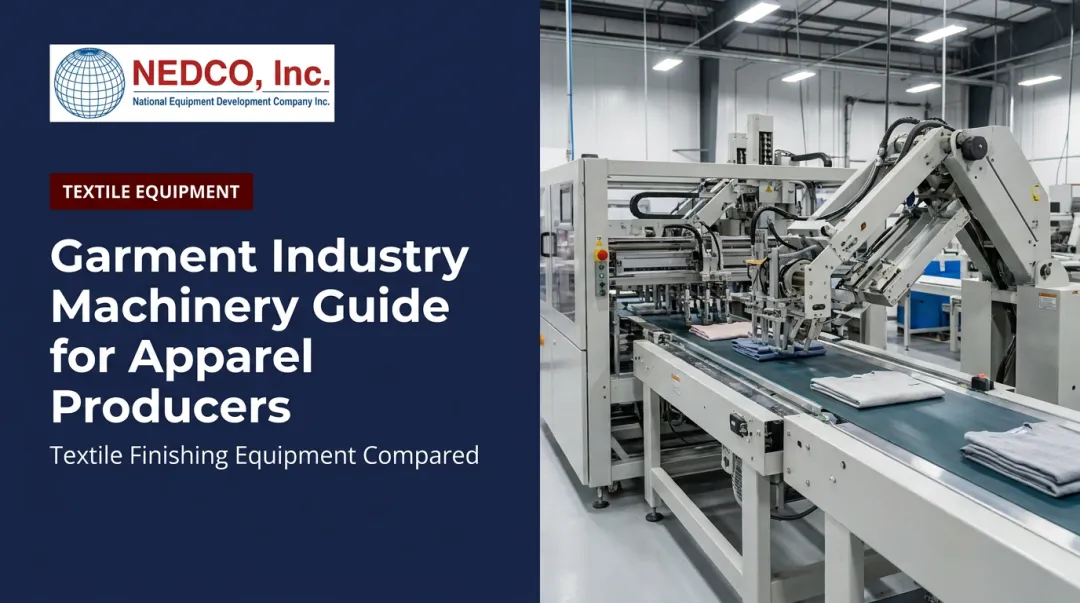
NEDCO Inc. (operating as E-Z Fold) has been manufacturing automatic t-shirt folding machines in Covington, Georgia since 1989 — the company traces its roots directly to the development of the world's first automatic t-shirt folder. Their E-Z Fold 2000 is built for high-volume production environments, with a modular design that scales from smaller screen printing shops to large-scale apparel fulfillment operations.
The E-Z Fold system's practical advantage is its modularity. A shop can start with the folding machine alone, then connect a labeling system, bagger/sealer, and automatic conveyor as volume grows — building a complete, integrated fulfillment line over time without replacing earlier investments.
Integrated Fulfillment Line: How It Works
A complete NEDCO finishing line runs in five steps:
- Operator loads garments onto the folding machine's infeed conveyor after printing and curing
- E-Z Fold folder automatically folds each shirt to a consistent, retail-ready result
- Automatic conveyor moves folded garments downstream without operator handling between stations
- Automatic Apparel Labeling System applies barcode stickers, price tags, or brand labels — sized and positioned to spec
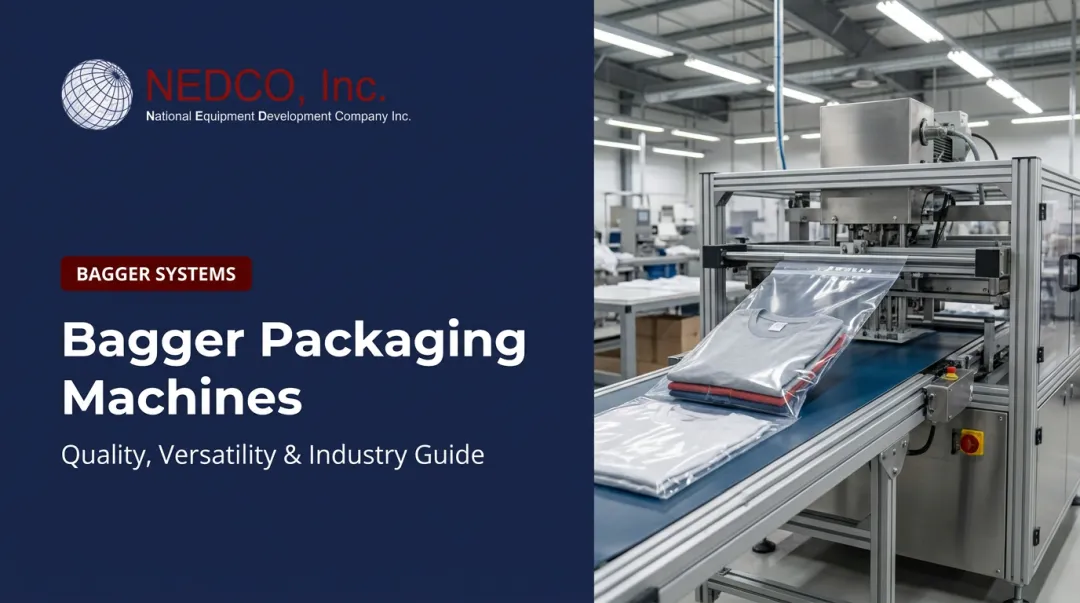
- Bagger/Sealer System bags and heat-seals each garment in one combined pass, producing a retail-ready package without additional handling
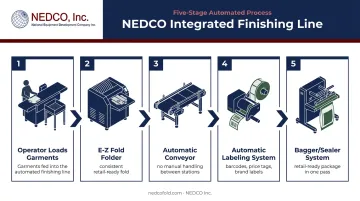
The result: one operator manages a process that would otherwise require several people working manually at each station.
Ancillary Packaging Equipment
Beyond folding and bagging, a complete fulfillment line typically includes:
- Poly bagging machines — for individual garment poly bags before boxing
- Label printers — print-on-demand labels for SKUs, shipping, or retail compliance
- Barcode printers — generate scannable barcodes for retail and e-commerce integration
- Tagging guns — manual or semi-automated hang tag application
- Shrink wrap systems — multi-unit bundling for wholesale or club-store fulfillment
These connect with folding and bagging equipment to build a complete, continuous finishing line.
How to Choose the Right Machinery for Your Operation
The right equipment mix starts with mapping your actual workflow — not what you aspire to produce, but what you're producing today and where time is being lost.
Start with Your Production Role
A cut-and-sew manufacturer and a screen printer buying wholesale blanks have almost no equipment overlap. Before evaluating any machine, confirm which stages of production you actually own:
- Do you cut your own fabric, or do you buy pre-cut blanks?
- Do you decorate in-house, or outsource printing?
- Do you handle fulfillment — folding, bagging, labeling, shipping — yourself?
Each "yes" means that stage's equipment is relevant. Each "no" means you can skip that category entirely.
Key Evaluation Factors
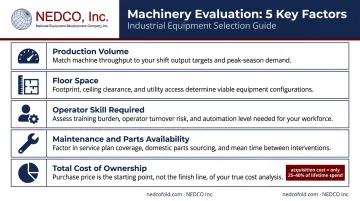
For any machine you're considering, evaluate:
- Production volume — units per hour or per day; does the machine match your current output, or your target output?
- Floor space — what's the machine footprint, and does your facility accommodate it (including operator clearance and infeed/outfeed zones)?
- Operator skill required — some equipment needs trained operators; some can be run by any production employee after brief training
- Maintenance and parts availability — domestic manufacturers with in-house parts inventory reduce downtime risk; imported equipment with long overseas supply chains can add days or weeks to repairs
- Total cost of ownership — PMMI's TCO framework divides machinery costs across design, application, operation, and maintenance; acquisition cost typically represents only 25–40% of what you'll spend over a machine's lifetime
Sequence Your Investments
Most shops make the mistake of investing in capacity before the bottleneck. The right sequence:
- Core production equipment — presses, dryers, or sewing machines that directly generate finished output; get these running reliably before anything else
- Bottleneck automation — once core output is consistent, identify where finished goods pile up; for most high-volume decorators, that's finishing and packaging
- Integration and scaling — connect individual stations with conveyor and labeling automation only after each station performs consistently on its own
Phasing investments this way keeps capital requirements manageable at each stage. For finishing and packaging equipment specifically, NEDCO offers pricing on request — contact the team at (770) 484-9969 or support@nedcofold.com to discuss options.
Frequently Asked Questions
What is garment machinery?
Garment machinery refers to the industrial equipment used across all stages of apparel production — from cutting fabric and sewing panels to decorating, finishing, and packaging finished garments. The specific machines any operation needs depend on which production stages they handle in-house.
What are the finishing machines used in the garment industry?
The main finishing equipment categories include pressing and steaming equipment, thread trimmers, needle detectors, folding machines, and packaging systems (baggers, sealers, labelers). These systems prepare garments for delivery — and the finishing line is where high-volume operations most often lose time to manual labor.
What machines do screen printers need?
Screen printers need three core production machines: a printing press, flash cure units, and a conveyor dryer. For fulfillment, screen printers also need finishing and packaging equipment — at minimum a folding machine and poly bagger — to process printed garments efficiently before they ship.
What is the most important machine in garment manufacturing?
It depends on the production stage. For apparel manufacturers, lockstitch and overlock sewing machines are central to construction. For high-volume decorators and fulfillment operations, the folding machine is often the critical bottleneck — the single point that limits how many orders ship per day.
How does an automatic folding machine improve apparel production?
Automated folding machines — like the E-Z Fold from NEDCO Inc. — replace the most labor-intensive step in garment fulfillment with consistent, fatigue-free output. In an integrated line, one operator handles folding, labeling, and bagging where manual methods would require several.