Introduction
Textile and apparel production floors generate waste in small, unremarkable ways. A mis-folded garment gets re-done. A packaging station backs up and product wrinkles. A manual transfer between stations drops a shirt on the floor.
None of these events feel significant in isolation—but across a high-volume shift, they compound into real material loss, labor cost, and rework time.
Lean manufacturing addresses this directly. Its core premise is simple: eliminate every step that consumes resources without adding value to the finished product. And in a garment finishing facility, conveyors are where lean principles either succeed or fail. They set the pace, sequence, and consistency of every stage from folding through final packaging.
This guide breaks down where conveyor-integrated lean systems reduce waste, what features separate effective systems from underperforming ones, and how OSHA standards apply to conveyor operations in U.S. finishing facilities.
Key Takeaways
- Conveyors eliminate at least four of lean manufacturing's eight wastes at once
- Automated garment sortation can increase picks from 12 to 50 orders per employee-hour while cutting seasonal staffing by 33%
- OSHA 29 CFR 1910.212 and 1910.147 are the two primary standards governing conveyor safety compliance
- Modular conveyor systems reduce equipment replacement waste by allowing individual sections to be reconfigured
- A floor waste audit against the eight lean wastes is the right first step before any conveyor upgrade
Lean Manufacturing and Why Conveyors Are Central to It
The Eight Wastes in a Garment Facility
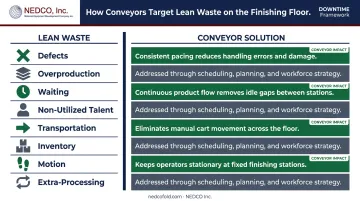
The Lean Enterprise Institute defines eight wastes using the DOWNTIME framework:
| Waste | What It Looks Like on a Finishing Line |
|---|---|
| Defects | Mis-folded garments, incorrect labels, damaged poly bags |
| Overproduction | Folding more units than the bagger can process |
| Waiting | Operators standing idle while upstream stations catch up |
| Non-utilized talent | Skilled workers doing manual transfers instead of quality work |
| Transportation | Carrying garments between stations that could be conveyor-linked |
| Inventory | Stacked WIP piling up between folding and packaging |
| Motion | Reaching, walking, turning to retrieve or hand off product |
| Extra-processing | Re-folding garments that were folded correctly the first time |
Every one of these appears on a typical garment finishing floor. Conveyors directly address at least four—transportation, motion, waiting, and defects—by creating a controlled, automated flow that replaces manual handling between stations.
Where the Impact Is Greatest
Lean conveyor integration delivers the most measurable return during finishing and packaging. This is where manual handling of folded garments, poly bags, and stacked product introduces the most variability.
A single operator working between a folder and a bagger creates a rhythm that shifts constantly—speeding up, slowing down, dropping items, re-orienting garments. Removing that manual handoff step keeps pace consistent across the entire line, which is where throughput gains actually compound.
The Zero Waste Framework Applied to Conveyors
Rather than a fixed five-pillar model, the Zero Waste International Alliance defines zero waste as "the conservation of all resources by means of responsible production, consumption, reuse, and recovery of all products, packaging, and materials." In a manufacturing context, this translates into five operational principles:
Refuse Unnecessary Processing
Smart conveyor routing refuses unnecessary handling steps before they create waste. When garments travel through an automated line—folder to labeler to bagger—there's no intermediate hand-off where a shirt gets dropped, mis-oriented, or handled twice. Each unnecessary touch is a waste the conveyor refuses to allow.
Reduce Product Damage
Precision-controlled conveyors reduce damage rates by eliminating the variable pressure, speed, and orientation of manual handling. Automated apparel sortation at Boux Avenue demonstrated this clearly: replacing manual picking with automated sortation increased picks from 12 to 50 orders per employee-hour and reduced seasonal staffing by 33%. Fewer touches means fewer errors.
Reuse and Recycle Equipment Components
Modular conveyor systems are designed so individual sections can be replaced without discarding the full line. Belt materials have also advanced: Forbo's Transilon ECOFIBER belts use rPET yarns from post-consumer beverage bottles as the tension member, with tensile and thermal stability matching virgin PET belts.
Equipment built to be repaired rather than replaced supports circular maintenance practices and reduces capital waste over the long run.
Recover Energy During Low-Demand Periods
Variable speed drive (VSD) technology in conveyor motors reduces electricity consumption during low-throughput periods by matching motor output to actual load. A 2025 peer-reviewed belt conveyor review identifies load-dependent variable-speed operation as an established approach to cutting conveyor energy costs. For a finishing facility running multiple shifts, idle-state power reductions across several conveyor lines can eliminate thousands of kilowatt-hours annually — without any change to production output.
Together, these four principles show that zero waste in a textile finishing environment isn't a single technology decision. It's the cumulative result of routing fewer touches, controlling handling precision, maintaining equipment rather than replacing it, and running motors only as hard as the load demands.
How Conveyors Eliminate Waste at Each Production Stage
Pre-Folding and Feeding
Conveyors that consistently orient and feed garments into folding machines at a controlled rate prevent jams, misfolds, and operator over-reach. Each jam requires clearing time—and every time an operator reaches awkwardly to reposition a garment, the fold is compromised before it even begins. At high volume, even small improvements in feed consistency compound across an eight-hour shift into meaningful rework reduction.
Folding and Finishing
Automated folding equipment integrated directly with conveyor lines removes the variability of hand-folding. That consistency — same fold dimensions, same output rate — means fewer rejects reach the packaging stage.
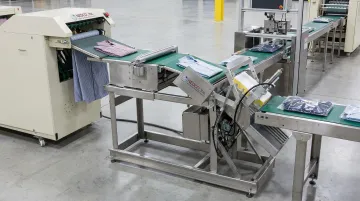
Two systems illustrate this well. The ROQ FOLD processes up to 700 pieces per hour with a single loading operator across T-shirts, sweatshirts, polos, trousers, and skirts. NEDCO's E-Z Fold 2000 connects directly to its conveyor system, maintaining continuous garment flow through the folding mechanism without manual handoffs.
Packaging and Stacking
Conveyors that pace product delivery to packaging stations prevent the bottleneck where garments pile up, wrinkle, or need re-folding before bagging. Consistent pacing also prevents packaging material overruns—when a station isn't flooded with product, operators don't reach for extra poly bags or tape to compensate for disorder.
Sortation and Dispatch
Sensor-assisted sortation conveyors route finished goods accurately to the correct order staging area. A 2022 peer-reviewed study found that NIR/CNN textile-sorting systems identified and sorted 13 textile classes with above 95% accuracy in under 2 seconds per sample. Mis-sorts are expensive: repackaging an incorrectly routed item costs material, labor, and time. Accurate sortation eliminates that loop.
Waste Separation
Beyond finished goods, conveyors also manage what leaves the line as scrap. Dedicated waste-separation conveyors use vibration, magnets, or sensor-assisted sortation to pull fabric scraps, trim waste, and unusable materials out of the main production stream in real time. Instead of mixing with finished product or ending up in a general waste bin, these materials route directly to recycling streams. Facilities pursuing zero waste certification under frameworks like the ZWIA hierarchy benefit from this separation happening at the source, not after the fact.
Essential Conveyor Features for Lean Operations
Modular Design
Modular conveyor systems allow individual sections to be added, removed, or reconfigured as production needs change—without scrapping the full line. This directly reduces equipment replacement waste and lowers capital costs when a facility adds a new product category or reconfigures its floor layout.
NEDCO's E-Z Fold Automatic Conveyor System is built on this philosophy. Available in horizontal and inclined configurations across multiple widths, it integrates directly with the full E-Z Fold ecosystem: T-shirt folders, labeling systems, bagger/sealer systems, and pillow compression machines.
A small operation can start with just a folder and add conveyor links as volume grows. A high-volume facility can deploy the full integrated line with zero manual handoffs between stations.
Variable Speed and Automation Controls
Unsynced conveyors are one of the quieter sources of waste on a finishing line. When the bagger slows down, the conveyor upstream should slow with it—not keep pushing product into a growing pile. Programmable speed settings and smart start/stop controls keep the line in sync, cut idle energy consumption, and prevent over-processing before it starts.
Durable, Low-Maintenance Belt Materials
Every unplanned belt failure creates a backlog of rework. According to ABB's 2025 cross-industry downtime survey, 83% of respondents associated unplanned downtime with at least $10,000 per hour. Belts with abrasion-resistant, easy-clean surfaces appropriate for textile environments—where lint accumulation and garment contact are constant—extend service life and reduce reactive maintenance.
For textile and apparel environments, belt material choice comes down to two practical options:
- Fabric belts — smooth, non-marking garment contact and good shape retention under load
- Modular plastic belts — individual damaged modules replace without pulling the full belt
Ergonomic Design
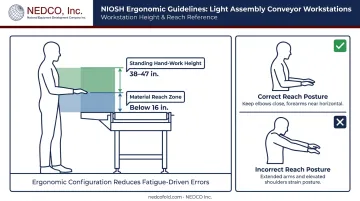
Fatigue-related handling errors don't show up on a defect log until it's too late. NIOSH ergonomic guidance for light assembly work recommends standing hand-work heights between 38–47 inches and material reaches below 16 inches. Conveyors configured to these parameters cut repetitive reaching, reduce errors across long shifts, and keep operator performance consistent from hour one to hour eight.
NEDCO's horizontal and inclined conveyor configurations give facilities the flexibility to match discharge heights and approach angles to operator workstations—eliminating the awkward reaches that drive the most preventable rework.
OSHA Conveyor Safety Standards in Zero Waste Facilities
Safety compliance is not separate from lean goals. An injured worker is the most disruptive and costly form of production waste a facility can experience.
Primary OSHA Standards
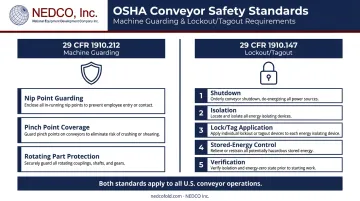
Two standards govern conveyor operations in U.S. manufacturing facilities:
- 29 CFR 1910.212 — General machine guarding. Requires one or more methods of guarding to protect employees from ingoing nip points and rotating parts. Every pinch point on a conveyor—where the belt meets a roller, pulley, or adjacent machine—must be guarded.
- 29 CFR 1910.147 — Lockout/tagout (LOTO). Requires employers to establish an energy-control program for servicing and maintenance. Procedures must include shutdown, isolation, lock/tag application, stored-energy control, and verification before any maintenance begins.
Practical Safety Requirements
Beyond the two primary standards, conveyor safety in practice includes:
- Emergency stop cables accessible from any point along the conveyor line
- Clear aisle markings around moving equipment
- Documented operator training records
- ASME B20.1-2024 compliance for stop/start controls and emergency stop identification
Safety as Part of Lean Commissioning
Lean conveyor implementations should include a safety audit at commissioning, built into the process from the start. Preventive maintenance schedules that follow lean principles reduce the likelihood of mechanical failures that would trigger OSHA recordable incidents.
An unguarded conveyor that injures a worker creates more than a compliance problem. It pulls a trained operator off the floor and typically forces unplanned line shutdowns that result in hours of rework and backlog.
Getting Started: Implementing Lean Conveyors in Your Textile Facility
The most practical starting point is a production floor waste audit. Walk the line with the eight lean wastes as your checklist:
- Map current conveyor locations — where is material already moving automatically?
- Identify manual transfer points — where are operators carrying product between stations?
- Flag backlog zones — where does WIP stack up between steps?
- Count rework events per shift — misfolds, re-bags, mis-sorts, and damaged garments
- Note idle time at each station — waiting is a waste with a real labor cost
- Review packaging material usage — overruns at bagging stations signal a pacing problem
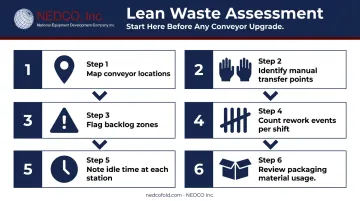
The output of this audit becomes the specification for conveyor additions or upgrades. You'll know exactly which gaps need conveyor linking and which stations need speed control.
For textile and apparel operations ready to move from audit to action, NEDCO's Automatic Conveyor Systems—part of the E-Z Fold line built in Covington, Georgia since 1989—connect directly with folding, labeling, bagging, and compression equipment. The modular design scales from small finishing rooms to high-volume production floors, with OEM replacement parts, annual service plans, and on-demand technical support available to minimize downtime.
Contact NEDCO at 770.484.9969 or support@nedcofold.com to talk through your audit findings and identify where conveyor additions fit your line.
Frequently Asked Questions
What are the five pillars of zero waste?
No single body officially defines "five pillars," but manufacturing practice commonly groups zero waste principles as: Refuse unnecessary steps, Reduce material consumption, Reuse components, Recycle production scrap, and Recover energy from operations. These five align closely with EPA and Zero Waste International Alliance frameworks.
What is a conveyor belt system for waste separation in zero waste production?
Waste separation conveyor systems use belt design, vibration, magnets, or sensors to actively sort production scrap, defective items, or recyclable materials out of the main product stream. Materials are routed to recycling or recovery rather than landfill disposal, supporting zero waste certification targets.
What are OSHA safety rules for conveyor belts?
The two primary standards are 29 CFR 1910.212 for machine guarding—covering nip points and rotating parts—and 29 CFR 1910.147 for lockout/tagout procedures during maintenance. Facilities must also provide emergency stop access along the full conveyor length and maintain documented operator training records.
How does lean manufacturing reduce production costs in textile facilities?
Lean manufacturing reduces costs by eliminating non-value-adding steps (rework, excess motion, waiting time, and overproduction) that consume labor, materials, and energy without improving the finished product. Fewer manual transfers and production errors directly lower per-unit costs across every shift.
What types of conveyors work best for garment and apparel manufacturing?
Flat belt conveyors and modular belt systems are most common in apparel finishing because they handle folded garments gently, allow easy cleaning, and integrate well with automated folding and packaging equipment. Inclined configurations add flexibility for facilities where stations sit at different heights.
How does modular conveyor design support zero waste goals?
Modular conveyors allow individual components to be replaced or reconfigured without discarding the entire system. This reduces equipment waste, lowers capital replacement costs, and enables production lines to adapt to new garment categories or layouts without starting over from scratch.