
Introduction
Wholesale apparel businesses, screen printers, and private label brands are under constant pressure to deliver faster while cutting per-unit costs. In that environment, finishing details that seem minor — like how a garment's neck tag is constructed — end up mattering more than most buyers expect.
Tear-away labels rarely make it into procurement conversations. Yet their presence (or absence) shows up directly in how long label removal takes per unit, whether garments get damaged in the process, and how professional the final product looks when it reaches the end client.
According to PPAI's 2024 sales data, wearables and apparel account for 26.6% of promotional products distributor sales across a $26.78 billion channel. At that volume, small per-unit inefficiencies compound fast.
This article breaks down the specific operational advantages of tear-away labels in wholesale apparel — and what operations risk by skipping it.
Key Takeaways
- Tear-away labels are manufacturer neck tags designed to be removed cleanly by hand, without tools or garment damage
- They are the default choice for decorators, private label brands, and bulk operations that need to replace manufacturer branding
- Their advantages are operational: faster label removal, cleaner brand presentation, and smoother finishing workflows
- Skipping tear-away-ready garments in procurement creates avoidable damage, cost, and slowdowns at scale
- Choosing tear-away garments upfront is a simple procurement call — time and labor savings multiply as order volume scales
What Are Tear-Away Labels in Wholesale Apparel?
A tear-away label is a manufacturer's neck tag made from a lightweight material — often a taffeta-style or paper-like construction — designed to be removed from the garment by hand. No scissors, no seam rippers, no risk of pulling fabric.
How They Differ From Other Label Types
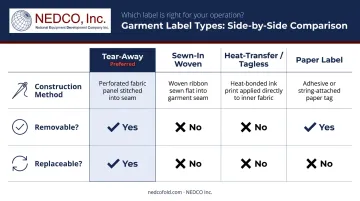
| Label Type | Construction | Removable? | Replaceable? |
|---|---|---|---|
| Tear-away | Physical neck tag with light-release stitching | Yes, by hand | Yes |
| Sewn-in woven | Permanently stitched label | Only with tools | Yes, but risky |
| Heat-transfer / tagless | Printed directly onto fabric | No | No |
| Paper label | Adhesive or lightly attached | Yes, easily | May leave residue |
Major wholesale blank suppliers — including Gildan, Hanes, BELLA+CANVAS, Next Level Apparel, and American Apparel — explicitly designate specific styles as tear-away labeled, with the stated purpose of enabling rebranding and customization. Hanes, for example, formally distinguishes tear-away tags from their tagless heat-transfer products as two separate constructions for two different use cases.
Why This Matters for Production
Tear-away labels exist to solve a production problem, not a comfort one. Their design supports one purpose: removing the manufacturer's brand and replacing it with the buyer's. For any business running private label, branded merchandise, or decorated apparel, that distinction matters at the procurement stage.
One important caveat: not every style from every brand carries a tear-away label. Verify at the product specification level before committing to a bulk order.
Key Advantages of Tear-Away Labels in Wholesale Apparel
The advantages below are grounded in operational outcomes — cost, time, quality, and brand performance. Each one matters more as order volume scales up.
Advantage 1: Effortless Private Label Rebranding at Scale
Private labeling is a core business model for a wide range of wholesale apparel buyers. Screen printers, promotional merchandise companies, boutique clothing startups, and corporate uniform suppliers all share the same requirement: the manufacturer's branding needs to come off cleanly before their own goes on.
With a tear-away label, that process is a single hand motion. A worker grips the tag and pulls — the label releases. With a permanently sewn-in label, the same step requires a seam ripper, careful handling to avoid nicking the neckline fabric, and more time per garment.
Why it compounds at volume:
- At 500 units, extra handling time per garment adds up to hours of labor
- At 5,000 units, garment damage from improper sewn-label removal becomes a write-off problem, not just a nuisance
- At any volume, a cleaner removal process shortens the overall finishing timeline, enabling faster client turnaround and more orders per production cycle
BELLA+CANVAS describes the process directly: tear-away tags can be ripped out to make room for a woven label installed with an industrial sewing machine. That sequential workflow — remove, replace, done — is only possible without risk when the original tag is designed for removal.
KPIs impacted: labor time per unit, garment damage rate, order turnaround time, cost-per-unit in finishing
Advantage 2: Professional Brand Presentation Across Bulk Orders
When a garment reaches an end client — whether a corporate employee, a retail customer, or an event attendee — the neck label is one of the first things they see. A Gildan or Hanes tag on an otherwise well-decorated shirt signals that the brand bought blank stock and did not invest in the details. A custom woven or satin label signals the opposite.
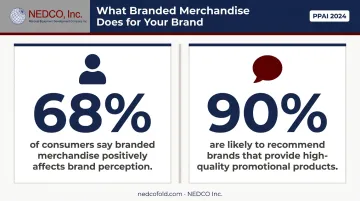
PPAI's 2024 consumer research found that 68% of consumers say branded merchandise positively affects brand perception, and 90% are likely to recommend brands that provide high-quality promotional products. While these figures relate to branded merchandise broadly, they point to a consistent finding: product finish and presentation influence how people perceive the brand behind it.
What this means in practice:
- Decorators and promotional apparel companies who deliver custom-labeled garments build client confidence and repeat business
- Corporate uniform programs that show a private brand label — not a blank manufacturer tag — present a more polished, intentional product to employees
- Across a bulk order of hundreds of units, tear-away construction ensures uniform relabeling is even possible at every position in the run
Client impact: client satisfaction, repeat order rate, brand consistency across units, perceived product value
Advantage 3: Smoother Production Workflow and Improved End-Wearer Comfort
Brand presentation (Advantage 2) gets the client's attention. This advantage is what protects that investment — both on the production floor and on the person wearing the garment.
On the production side, tear-away label removal is a one-motion step. It requires no tools, no specialized skill, and no careful handling. In a bulk finishing operation, any step that slows throughput or introduces error has a measurable cost — and that simplicity matters.
Label removal from non-tear-away garments requires more time, more attention, and more risk of damaging the neckline seam. Tear-away removal is, by design, the simplest possible version of this step — and in high-volume finishing, simpler always wins.
Label discomfort is also a documented complaint category on the wearer side. Research on sensory-sensitive wearers — particularly in workwear, activewear, and children's apparel contexts — consistently identifies tags, seams, and labels as the primary source of garment discomfort. Delivering a garment without a scratchy neck tag reduces the chance of complaints reaching back to the business that sold or issued it.
KPIs impacted: units processed per hour in finishing, operator error/rework rate, end-customer complaint rate, garment return rate
What Happens When Tear-Away Labels Are Overlooked in Wholesale Buying
Purchasing non-tear-away garments without considering downstream label removal needs is a procurement oversight with real operational consequences.
Common outcomes:
- Cutting or seam-ripping permanent sewn labels risks fraying, neckline distortion, or fabric pulls — damaged units become write-offs at the buyer's expense
- Label removal on standard garments requires more time per unit, more skilled handling, or third-party services — all of which add cost and delay
- Rushed manual cutting leads to inconsistent neckline appearances across bulk orders, undermining the brand presentation decorators are trying to deliver
- A minor procurement oversight scales into a meaningful cost driver when multiplied across thousands of units per month
Industry pricing guidance consistently flags time and waste at every production step. Label-related errors and rework are the kind of per-unit cost that gets absorbed invisibly — until someone runs the numbers.
Tear-away-ready garments cost no more than standard wholesale blanks. The risk reduction happens at the procurement stage, before any of these problems develop.
How to Get the Most Value From Tear-Away Labels at Scale
Tear-away labels deliver their full value when the production workflow is built around them — not treated as an afterthought.
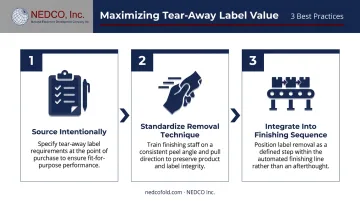
Three practices that matter most:
Source intentionally — Confirm at the style specification level that garments feature tear-away labels before purchasing. A brand's general reputation for tear-away construction does not guarantee every style has it. Check the spec sheet, not just the brand name.
Standardize removal technique — Train workers to place a thumb on the neck ribbon edge, grip the label firmly, and pull in one crisp motion. Slow or uneven pulling risks leaving label remnants or straining the neckline seam. Consistent technique across operators reduces variation and keeps throughput steady.
Integrate label removal into the finishing sequence — For high-volume operations, position tear-away removal as a defined, measurable step in the finishing process — before folding, packaging, or custom label application. This keeps the workflow clean and auditable.
When label removal is built into the finishing sequence, the steps that follow — folding, bagging, labeling, sealing — run faster and with fewer interruptions. NEDCO Inc.'s E-Z Fold line (automatic T-shirt folding machines, labeling systems, bagger/sealer units, and conveyor systems) is built for exactly this kind of sequential workflow, where each station hands off cleanly to the next.
NEDCO serves screen printers, embroiderers, and apparel manufacturers nationwide from their facility in Covington, Georgia, and offers custom OEM engineering for operations with specific throughput or integration requirements.
Conclusion
Tear-away labels touch more of the finishing process than most buyers anticipate. Label removal speed, garment damage risk, finished presentation, and overall line throughput all shift — sometimes significantly — based on this one construction detail.
Custom apparel demand and private label growth keep pushing decorators and wholesale buyers to move faster at lower cost per unit. In that environment, procurement decisions that look minor on paper — like whether a blank comes with a tear-away label — tend to compound across thousands of units. The operations that build these small advantages into every order are the ones that scale without adding labor.
Key reasons tear-away labels belong in your sourcing criteria:
- Clean removal without scissors, knives, or rework steps
- Reduced garment damage during label replacement
- Faster throughput on relabeling and finishing lines
- More polished private label presentation at no added cost
Frequently Asked Questions
How do tear-away labels work?
Tear-away labels are neck tags stitched with lightweight material that releases cleanly by hand. Place a thumb on the neck ribbon edge, grip the label firmly with the other hand, and pull in one firm motion. No tools are needed, and the garment fabric should be undamaged when done correctly.
Can I put my own label on wholesale clothing?
Yes — wholesale garments with tear-away labels are specifically designed for this purpose. After removing the manufacturer tag, a custom woven, satin, or printed label can be sewn or applied in its place, making the garment fully private-label ready. Confirm the manufacturer permits relabeling before proceeding.
What are the four types of garment labels?
The four main types are:
- Tear-away labels — removable by hand and replaceable with a custom tag
- Sewn-in woven labels — permanent; require scissors or a seam ripper to remove
- Heat-transfer (tagless) labels — printed directly onto fabric; cannot be removed or replaced
- Paper labels — easy to remove but not wash-durable and may leave adhesive residue
What are the advantages of keeping care labels on clothes?
Care labels communicate washing, drying, and handling instructions that protect garment longevity, and they meet FTC compliance requirements in the US market. Many tear-away label garments keep the care label permanently attached even after the branding tag is removed, since the two tags are built as separate constructions.
What is the difference between tear-away labels and tagless labels?
Tear-away labels are physical tags that can be removed and replaced with a custom label, making them ideal for private labeling and rebranding. Tagless labels are heat-pressed directly onto the fabric and cannot be removed or replaced, making them better for end-use comfort but unsuitable for wholesale rebranding workflows.
Are tear-away labels suitable for high-volume wholesale production runs?
Tear-away labels are specifically advantageous at high volumes. The tool-free, one-motion removal process allows operators to work through large quantities efficiently without risking garment damage — a meaningful labor and cost advantage compared to cutting or seam-ripping permanent labels from non-tear-away garments.