Introduction
Getting garments through customs, past retail compliance checks, and into consumers' hands involves many moving parts — and label film is one that factories consistently underestimate.
The wrong label film can mean a care instruction that fades after 15 washes, a barcode that won't scan at the distribution center, or a country-of-origin disclosure that fails a CBP audit. For export factories, any of these outcomes creates real consequences: chargebacks, customs holds, and damaged relationships with retail buyers.
This guide covers the main use cases for label films in export garment production, profiles five suppliers worth evaluating, and gives factories a practical framework for choosing the right film before volume production begins — before a compliance rejection forces the decision.
Key Takeaways
- Heat-transfer (TPU/PU), pressure-sensitive, and printed film labels each serve distinct use cases — match film type to application before selecting a supplier
- Export programs must meet care labeling requirements under 16 CFR Part 423 (US) and EU Regulation 1007/2011, plus chemical compliance regimes like REACH and CPC
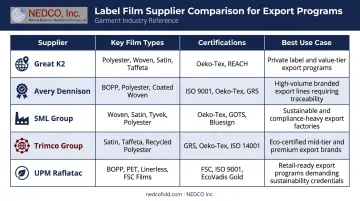
- Top supplier options include Great K2, Avery Dennison, SML Group, Trimco Group, and UPM Raflatac — chosen for compliance depth and export capability
- Validate every label film against wash durability, print stability, and chemical safety certifications before approving for export
- Automating downstream finishing (labeling, folding, bagging, dispatch) delivers measurable throughput gains at the production line level
What Are Label Films for Export Garment Factories?
Label films are film-based substrates — as opposed to woven or cotton labels — used to carry care instructions, size information, brand identity, compliance data, and barcodes on finished garments. They are applied via heat transfer, pressure-sensitive adhesion, or direct printing, and they sit in a distinct performance category from traditional woven labels.
Three primary film categories are relevant to export programs:
- Heat-transfer films (TPU/PU): Applied using heat and pressure, bonding directly to fabric — no adhesive backing. Common for tagless brand labels in activewear and knitwear.
- Pressure-sensitive films: Pre-coated adhesive layer, applied without heat. Suited to care labels, size labels, name labels, and temporary compliance tags.
- Printed care/size label films: Film stocks designed for high-resolution printing of care symbols, fiber content, and origin data — applied via sewing, heat bonding, or adhesive.
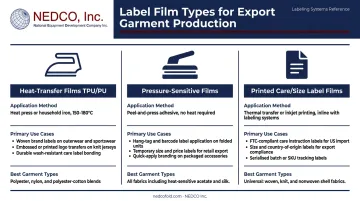
Export programs demand tighter performance from all three categories than domestic programs typically require. Labels must survive repeated international washing cycles under varying water temperatures and detergent chemistries, hold up across diverse climate conditions during transit, and satisfy regulatory scrutiny in multiple markets simultaneously. Get the film specification wrong and labels peel at customs inspection, fail wash tests in the destination market, or trigger compliance holds — any of which can delay shipment or trigger chargebacks.
Key Use Cases for Label Films in Export Garment Production
Selecting the right film starts with identifying the primary use case. Adhesion chemistry, substrate thickness, and print method requirements differ significantly across applications — a film that excels for care labeling may fail entirely as a barcode carrier.
Care and Wash Labels
Care and wash labels are legally mandated in most export markets. In the US, 16 CFR Part 423 requires a permanent care label that remains legible for the garment's useful life and provides at least one safe care method. EU Regulation 1007/2011 requires fiber names and percentages by weight, with labels that are durable, legible, visible, and securely attached.
Film choice here must prioritize:
- Legibility retention through repeated washing cycles
- Resistance to heat and detergent degradation
- Permanent adhesion or secure attachment that doesn't degrade over garment lifetime
Size and Brand Identity Labels
Pressure-sensitive films dominate this use case for "no-iron" and "no-sew" applications in knitwear, activewear, and childrenswear. The two key selection criteria are adhesion performance on the target fabric and printability under the factory's chosen print method — eco-solvent, UV, or latex.
Brand labels also serve a retail buyer compliance function beyond consumer communication. Consistent placement, print quality, and legibility directly affect how a factory's product is received at the buyer's distribution center.
Compliance and Country-of-Origin Labels
Regulatory compliance labels carry fiber content disclosures, country-of-origin declarations, and chemical compliance markers. Under 16 CFR 303.16, garments with a neck must display the country-of-origin label on the inside center of the neck, midway between the shoulder seams. CBP requirements under 19 U.S.C. 1304 require marking to be legible, indelible, permanent, and conspicuous in English.
These labels must meet both FTC placement rules and Customs durability standards — making film durability and secure attachment non-negotiable requirements.
Barcode, SKU, and RFID Tracking Labels
Export factories rely on film-based labels for supply chain tracking, barcode scanning, and item-level RFID. According to NRF reporting from October 2025, retailers using RFID can achieve inventory accuracy above 98%, with major apparel brands deploying item-level tagging across their supply chains.
Tracking labels must survive factory handling, packing, and transit without:
- Adhesive failure or delamination
- Print smear or barcode unreadability
- RFID inlay damage from compression or heat exposure
Suppliers like Avery Dennison and SML Group offer RFID-integrated label films designed specifically for apparel traceability programs.
Finishing Workflow Integration
Each label type above feeds into the same downstream sequence: once applied, garments must be folded, packaged, and prepared for export dispatch. Label film selection only delivers its full value when the finishing workflow around it runs efficiently.
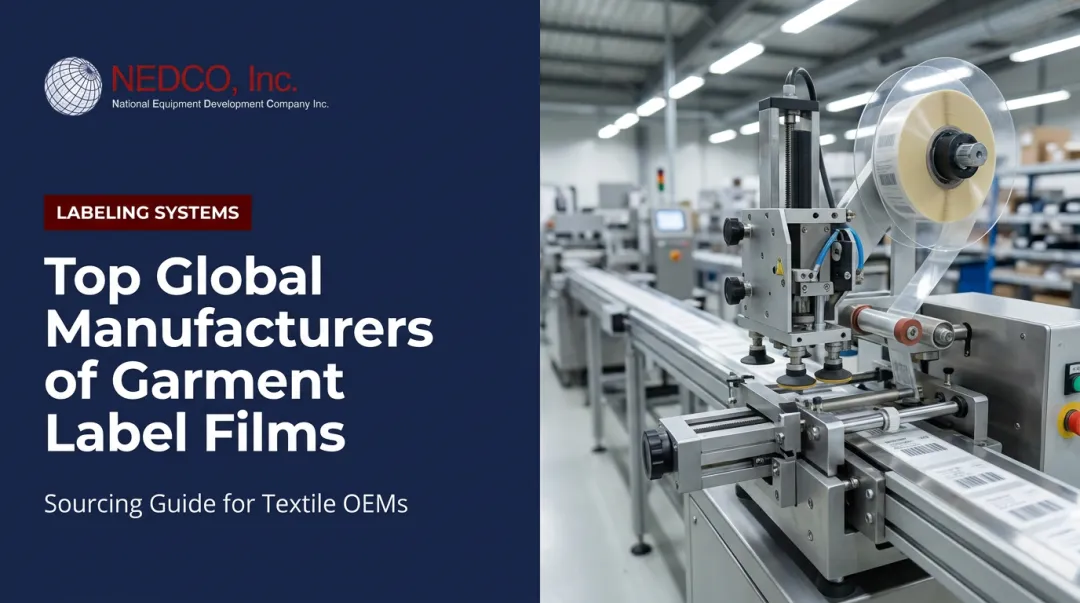
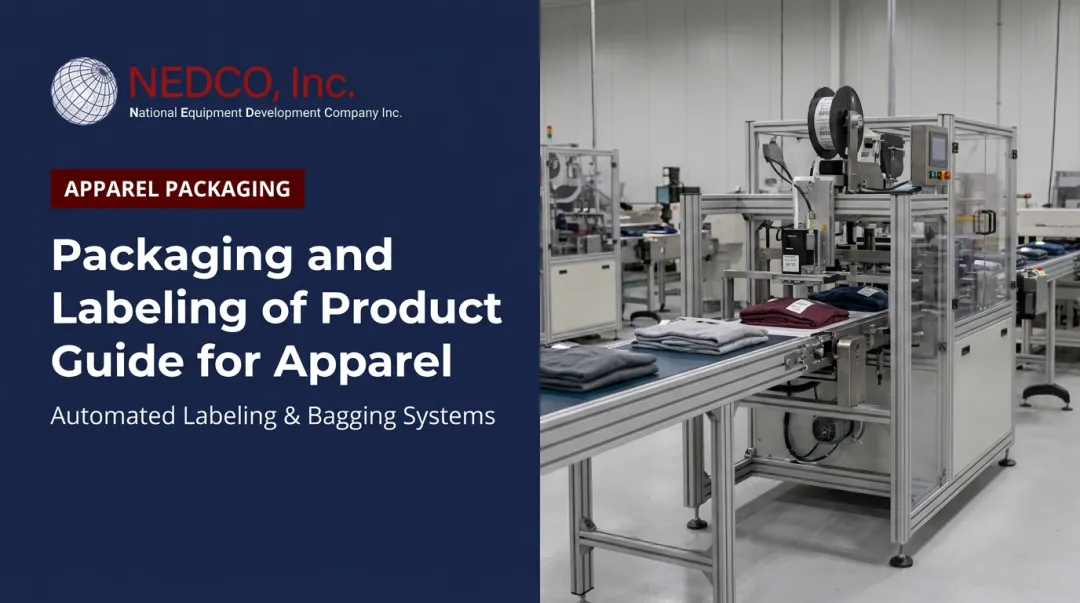
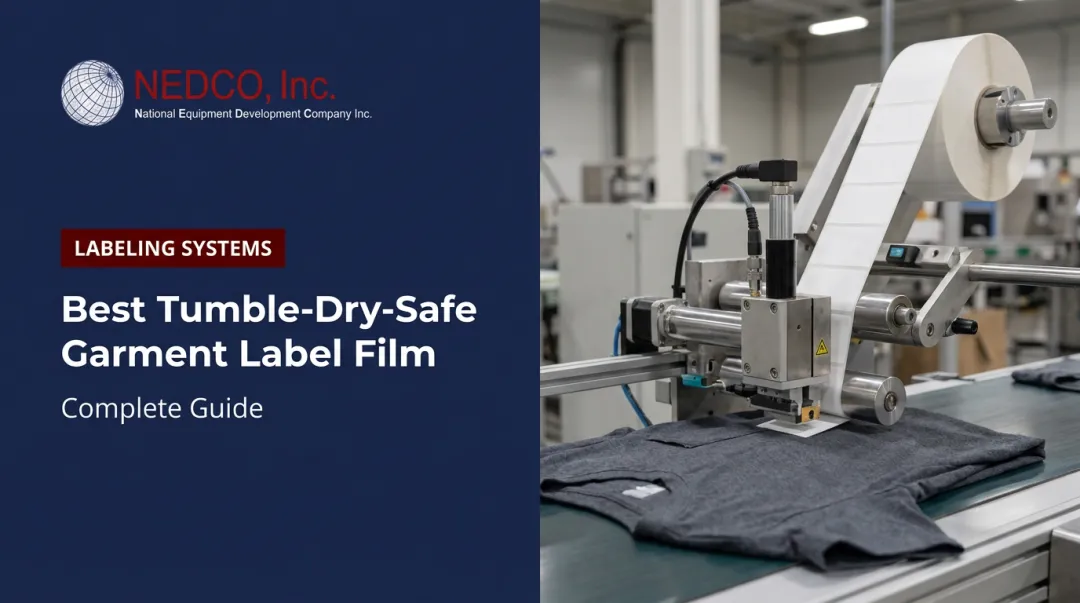
Factories that automate those downstream steps gain a compounding advantage. NEDCO Inc.'s Automatic Apparel Labeling System integrates directly with automated folding, bagging, and conveyor systems, so the label-to-dispatch sequence runs as a single continuous line. A typical integrated configuration includes:
- E-Z Fold 2000 T-Shirt Folder — connects directly downstream from label application
- Bagger/Sealer System — packages finished garments into retail-ready poly bags
- Automatic Conveyor System — links each stage into one uninterrupted line
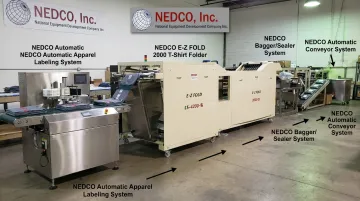
Factories building out export finishing lines can contact NEDCO at nedcofold.com to explore integrated configurations.
Best Label Films for Export Garment Factories
Every supplier below was evaluated against the same standards export garment programs actually run into: wash durability claims, chemical safety documentation, print compatibility, export service capability, and QC consistency.
These criteria separate general-purpose label suppliers from ones built for the demands of international production. Profiles move from specialized niche suppliers to full-service global providers.
Evaluation criteria:
- Wash durability claims and testing data
- Chemical safety documentation (REACH, RoHS, Prop 65)
- Print compatibility across inkjet, thermal, and heat-transfer methods
- Export service capability and regional lead times
- QC consistency across production batches
Great K2 Industry Co., Ltd.
Best for: Kidswear, no-sew applications, and retail export programs
Shanghai-based Great K2 specializes in pressure-sensitive, washable vinyl label films for apparel. Their product range covers stick-on clothing labels, printable name stickers, and washable/no-iron films. The company claims resistance to more than 30 machine-wash cycles and conducts 40+ QC checks per batch across exports to 50+ countries.
Great K2 stands out for its child-safe compliance documentation — REACH, RoHS, CPC, and California Prop 65 — along with rapid sampling capability and multilingual technical onboarding, making it a practical fit for kidswear, uniforms, and retail export programs.
| Category | Details |
|---|---|
| Key Film Types | Pressure-sensitive washable vinyl, printable name stickers, no-iron label films |
| Certifications | REACH, RoHS, CPC (children's products), California Prop 65 |
| Best Use Case | Size/brand identity labels, childrenswear care labels, no-sew applications |
Avery Dennison
Best for: Enterprise programs requiring multi-country compliance and RFID integration
A global leader in apparel identification materials, Avery Dennison offers an end-to-end portfolio: printed label films, care/content solutions, heat transfers, adhesive stocks, hangtags, and RFID/NFC-integrated label films. Its strength is enterprise-scale service — compliance documentation, standardized quality across sourcing regions, and advanced RFID integration for brand traceability programs.
Best suited to large programs requiring consistency across multiple factories or sourcing hubs.
| Category | Details |
|---|---|
| Key Film Types | Printed label films, care/content solutions, heat transfers, adhesive stocks, RFID/NFC |
| Certifications/Standards | Global compliance documentation; sustainability-aligned R&D |
| Best Use Case | Multi-country care/compliance labeling, RFID tracking, enterprise branding programs |
SML Group
Best for: Asia-based multi-factory RFID programs with fast regional lead times
SML Group operates in 20+ countries with 25+ production facilities, making it one of the most geographically distributed apparel label suppliers in Asia. The company delivers label films, heat transfers, and item-level RFID tags in self-adhesive, hangtag, and embedded formats.
Its integrated RFID and source-tagging encoding services make it particularly valuable for brands deploying standardized label and RFID programs across Asia-based export factories, with fast regional lead times as a competitive differentiator.
| Category | Details |
|---|---|
| Key Film Types | Apparel-grade label films, heat transfers, RFID/source-tagging films |
| Certifications/Standards | Export documentation and compliance support; regional sourcing proximity |
| Best Use Case | RFID tracking labels, regional multi-factory programs, fast-turnaround export needs |
Trimco Group
Best for: Fashion and sportswear brands with ESG and sustainability documentation requirements
Denmark-headquartered Trimco covers printed label films, care labels, hangtags, packaging, and RFID — with particular emphasis on sustainable materials and product traceability for fashion and sportswear export programs. Its design-to-delivery approach combines trim sourcing with sustainability and ESG documentation that brands increasingly require from their supply chains.
| Category | Details |
|---|---|
| Key Film Types | Printed label films, care/content labels, sustainable/recycled label films, RFID |
| Certifications/Standards | Sustainability documentation, circularity-aligned materials, global logistics compliance |
| Best Use Case | Fashion/sportswear care and brand labels, ESG compliance labeling, sustainability-tracked programs |
UPM Raflatac
Best for: Delicate fabric substrates, clean-removal requirements, and recyclable material programs
Finnish specialty adhesive label material manufacturer UPM Raflatac produces advanced self-adhesive label stocks for apparel and retail — including residue-free textile solutions and recyclable label constructions distributed via a converter model for flexible local finishing.
Its adhesive science focus solves challenging export scenarios: labels on delicate substrates, clean removal requirements, and brands' environmental compliance documentation needs.
| Category | Details |
|---|---|
| Key Film Types | Specialty adhesive stocks, residue-free textile films, wash-off constructions, recyclable substrates |
| Certifications/Standards | Sustainability documentation; converter-enabled regional availability |
| Best Use Case | Specialty care/compliance labels on delicate fabrics, wash-off price labels, recyclable material programs |
How to Choose the Right Label Film for Your Export Program
The most common mistake: selecting a film based on price or supplier familiarity, then discovering adhesion failure or compliance rejection at customs. Validation should happen before volume production begins.
Performance Validation Checklist
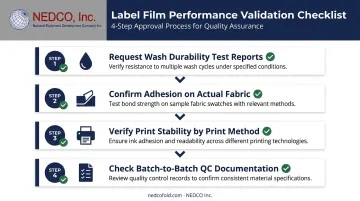
Work through these steps before approving any film for a production run:
- Request wash durability test reports — specify wash cycle count, water temperature, and tumble-dry conditions relevant to your target market
- Confirm adhesion on your actual fabric — peel performance on the test substrate in your lab does not guarantee performance on production fabric
- Verify print stability under your print method (eco-solvent, UV, thermal transfer) — inks that bond well under one method may smear or fade under another
- Check batch-to-batch QC documentation — supplier claims about wash performance mean little without documented QC records per production batch
Chemical Safety and Export-Market Compliance
Different compliance regimes cover different things — they are not interchangeable:
- REACH (EU): Under Article 33, suppliers of articles containing Candidate List substances above 0.1% w/w must disclose substance identity and safe-use information
- RoHS: Covers electrical and electronic equipment — relevant to RFID-integrated label films, as the EU Commission's RoHS FAQ confirms active and passive RFID tags are in scope
- CPC (US children's products): A Children's Product Certificate must be based on testing by a CPSC-accepted third-party laboratory — it is not a generic material certificate
- California Prop 65: Requires warnings before knowingly causing exposure to listed chemicals, subject to applicable exemptions
- FTC labeling (16 CFR Part 303): Requires fiber content in descending order by weight, country of origin, and manufacturer name or RN number — with origin disclosure in English on the inside center neck
Suppliers should provide Safety Data Sheets and batch QC documentation to support customs clearance and retailer compliance audits. Verify that the documents are product-specific, not generic marketing claims.
Service-Level Factors
For export programs, supplier service matters as much as film performance:
- Response speed on technical queries and sample requests
- MOQ flexibility for pilot runs vs. mass production
- Multilingual technical support if your factory team works in multiple languages
- Export documentation experience, including SDS and compliance certificate provision
- After-sales warranty procedures if adhesion or print failures surface post-shipment
Downstream Compatibility with Finishing Equipment
Label film type and placement affect how garments move through folding and packaging equipment. Factories running automated finishing lines should confirm that their chosen film's thickness, placement zone, and heat sensitivity are compatible with equipment settings before volume production.
A heat-transfer label on a neck seam, for example, may behave differently under mechanical folding pressure than a pressure-sensitive label applied to the hem. That distinction matters most on integrated lines, where a labeling problem cascades downstream through every subsequent station.
For factories using NEDCO's modular finishing line, the Automatic Apparel Labeling System feeds directly into the E-Z Fold 2000 and then the Bagger/Sealer System. Confirming film-to-equipment compatibility during the pilot run prevents jams or label displacement at any point in that sequence. NEDCO's engineering team can advise on integration specifics at (770) 484-9969 or support@nedcofold.com.
Conclusion
There is no single best label film for all export garment use cases. The right choice depends on garment type, target market regulations, application method, and the service requirements your factory needs to meet at scale.
Treat label film selection as a compliance and operations decision — not just a materials purchase. Pilot testing, certification verification, and supplier service evaluation should all happen before volume production, not after a customs hold or retailer complaint.
Label selection is one piece of a larger finishing picture. Factories that get labeling right still need reliable downstream workflows for folding, packaging, and export prep. NEDCO Inc. manufactures the E-Z Fold line of finishing and packaging equipment, built for apparel production facilities that need consistent output and reduced operator fatigue. Visit nedcofold.com to see how automated finishing equipment fits into your operation.
Frequently Asked Questions
How do you label garments produced in garment making?
Garments are labeled using sewn-in labels (woven or printed fabric), iron-on/heat-transfer labels, or pressure-sensitive adhesive films, applied at locations mandated by regulation. For example, country-of-origin disclosures must appear on the inside center neck for garments with collars.
What are the requirements for FTC clothing labels?
Under the Textile Fiber Products Identification Act, labels must include fiber content listed in descending order by weight, country of origin (in English, on the inside center neck midway between shoulder seams), and the manufacturer's name or Registered Identification Number.
What material is used for clothing labels?
The main categories are woven fabric labels (polyester, satin, nylon, cotton), printed fabric labels (satin, taffeta, cotton), and film-based labels — TPU/PU heat-transfer films, pressure-sensitive vinyl or polyester films, and specialty adhesive stocks. Film-based options are increasingly favored in export programs for wash durability, print clarity, and no-sew application speed.
What is the difference between heat-transfer and pressure-sensitive label films for garments?
Heat-transfer films (TPU/PU) are applied using heat and pressure, bonding directly to fabric without adhesive backing — ideal for tagless brand labels in activewear and knitwear. Pressure-sensitive films use a pre-coated adhesive layer for direct application without heat, suited to care labels, size labels, name labels, and temporary compliance tags.
How do I verify wash durability for label films used in export garments?
Request documented test reports specifying wash cycle count, water temperature, tumble-dry conditions, and acceptance criteria for adhesion and print legibility. Then run pilot wash tests on actual production fabric before approving any film for volume use, since supplier reports reflect controlled lab conditions rather than your specific materials.
What chemical safety certifications should label films carry for international export?
Key requirements vary by regime: REACH (EU restricted substances disclosure), RoHS for RFID-integrated films, CPC certification for childrenswear destined for the US market (requires third-party lab testing), and California Proposition 65 warning compliance. Suppliers should provide Safety Data Sheets and batch QC documentation to support customs clearance and retailer audits.