Introduction
Picture this: a shipment of 10,000 units arrives at a retailer's distribution center, only to be flagged and held because the fiber content label lists "bamboo" instead of "rayon." Or an FTC inquiry letter arrives because care instructions appear only on a removable hang tag. Either scenario means delays, costs, and potential civil penalties — all from labeling errors that are entirely preventable.
US apparel labeling isn't a suggestion. Three federal laws govern what must appear on virtually every garment sold in the country: the Textile Fiber Products Identification Act (TFPIA), the Wool Products Labeling Act (WPLA), and the FTC Care Labeling Rule.
The FTC enforces all three. US Customs and Border Protection (CBP) separately administers import marking requirements, so non-compliant goods face scrutiny from two federal agencies — not one.
This guide covers exactly what every apparel label must include, the rules manufacturers and importers must follow, and how to integrate compliance into production workflows before errors reach the distribution center.
Key Takeaways
- US law requires four disclosures on most apparel labels: fiber content, country of origin, manufacturer identity, and care instructions
- Every fiber at 5% or more of total fiber weight must be listed by FTC-approved generic name, in descending order
- "Made in USA" is a strict standard — imported inputs require a qualified statement
- Care labels must be permanently attached and legible for the garment's entire useful life — a hang tag alone does not qualify
- Civil penalties reach $53,088 per violation, and each mislabeled garment counts as a separate offense
The Legal Framework: FTC Laws and Who Must Comply
Three federal statutes form the backbone of US apparel labeling requirements:
| Statute | Year Enacted | Current Citation |
|---|---|---|
| Textile Fiber Products Identification Act | 1958 | 16 CFR Part 303 |
| Wool Products Labeling Act | 1940 | 16 CFR Part 300 |
| FTC Care Labeling Rule | 1971 (last amended 2000) | 16 CFR Part 423 |
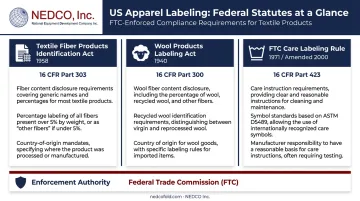
The FTC enforces all three and can pursue civil penalties, injunctions, and consumer redress in federal court. A 2014 amendment to Part 303 updated manufactured-fiber name standards and modified hang-tag disclosure rules.
CBP enforces import marking requirements separately: it can withhold release of improperly labeled goods and assess liquidated damages independent of any FTC action.
Who Must Comply
Compliance obligations fall on any party that manufactures, imports, sells, distributes, or advertises covered textile products. Key exemptions include:
- Common carriers acting in the ordinary course of transport
- Contract processors or finishers who don't alter fiber content contrary to their manufacturing contract
- Exporters selling exclusively outside the US
Retailers are not exempt. They cannot remove required labels without attaching a complete, accurate replacement — and the substituting party must preserve the original information for three years.
Which Products Are Covered
The TFPIA covers wearing apparel, bedding, towels, curtains, rugs, and other household textiles. Products excluded from coverage include:
- Upholstery stuffing
- Structural linings not used for warmth
- Sewing thread
- Items incorporated into footwear or headwear
Two notable exceptions apply: hats and slippers containing wool remain covered under the WPLA even when exempt from TFPIA, and military exclusions apply only to consumer-ready products procured to specification, not exchange or commissary sales.
What Must Be on Every Apparel Label: The 4 Mandatory Requirements
The FTC requires four specific disclosures on covered apparel. All required information must be clearly legible, conspicuous, and accessible — not hidden in a pocket lining or placed where a consumer cannot find it after purchase. These disclosures may appear on one label or across multiple labels and may be combined with care instructions.
Fiber Content
Every fiber comprising 5% or more of total fiber weight must be listed by its FTC-approved generic name (such as "cotton," "polyester," "rayon," or "nylon") in descending order by weight, with percentages. Fibers below 5% are grouped as "other fiber(s)" — with two exceptions:
- Wool must always be named and percentaged, even below 5%
- A below-5% fiber with clearly established functional significance at that level may be named separately
A product made entirely of one fiber may use "All Cotton" as an alternative to "100% Cotton." Non-fibrous components — zippers, buttons, beads — are excluded from disclosure.
Country of Origin
Imported goods must identify the country where they were processed or manufactured. An unqualified "Made in USA" claim is only appropriate when the product is entirely made in the US from US-origin materials. When imported inputs are used, a qualified statement is required — for example:
- "Made in USA of imported fabric"
- "Made in Sri Lanka, finished in USA"
The FTC's one-step-removed rule requires disclosure of the imported material immediately preceding the finished step: a US yarn maker identifies imported fiber; a US apparel maker identifies imported fabric. Country names must appear in English.
Manufacturer Identity
Labels must identify the manufacturer, importer, or other responsible party by either their full business name (as it appears on business documents) or their FTC-issued Registered Identification Number (RN). A brand name, designer name, or trademark is insufficient unless that name is also the actual operating business name. Foreign companies cannot obtain an RN but may use their full business name.
Care Instructions
The FTC Care Labeling Rule (16 CFR Part 423) requires care instructions before the point of sale. The label must remain attached and legible for the garment's useful life; a removable hang tag alone does not satisfy this requirement.
For symbol usage, US rules are specific:
- English-language words are always acceptable
- ASTM D5489-96c symbols may be used as a standalone alternative
- ISO/GINETEX symbols do not satisfy the US requirement
Manufacturers must also have documented "reasonable basis" for every instruction listed. Acceptable documentation includes test data, supplier information, or professional knowledge about the materials used.
Fiber Content Labeling Rules: Specifics Manufacturers Need to Know
The 3% Tolerance
Actual fiber content may vary up to 3 percentage points from the label due to unavoidable manufacturing variation. This tolerance cannot be used to knowingly misrepresent content — if testing shows 37% cotton, the label must say 37%, not 40%. No tolerance applies to "100%" or "All" claims.
Sectional Disclosure
When a garment has distinct sections with different fiber compositions, separate disclosure is required to avoid deception. Under 16 CFR 303.25:
- A structural lining not used for warmth may be excluded
- A lining, filling, or padding used for warmth must be disclosed separately
Example label language for a jacket: "Shell: 80% Wool, 20% Nylon; Lining: 100% Polyester"
Fiber Naming and the Bamboo Problem
Generic names for manufactured fibers must match those listed in 16 CFR § 303.7 or ISO 2076:2010(E). Fiber trademarks (such as Lycra® Spandex) may appear alongside — never instead of — the generic name, in equal-size type.
The bamboo/rayon issue carries serious enforcement risk. Chemically processed bamboo cellulose is rayon or viscose — it cannot be labeled "bamboo." The FTC permits "rayon made from bamboo" when substantiated, but "bamboo fabric" on its own is a misrepresentation.
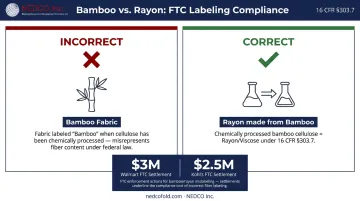
The FTC has pursued this aggressively. In 2022, Walmart agreed to pay $3 million and Kohl's $2.5 million in separate enforcement actions over rayon products marketed as bamboo.
Trim, Ornamentation, and Hang-Tag Rules
Two fiber content exclusions apply under federal rules:
- Decorative trim not exceeding 15% of surface area (under 16 CFR 303.12)
- Ornamentation not exceeding 5% of total fiber weight (under 16 CFR 303.26)
When excluding these, the label must include a statement such as "exclusive of decoration" or "exclusive of ornamentation." If any excluded fiber is referenced elsewhere — in advertising, hang-tags, or signage — full disclosure becomes required.
Under the 2014 hang-tag amendment, a hang tag may mention a fiber name without repeating full fiber content, as long as it clearly states: "This tag does not disclose the product's full fiber content" or "See label for the product's full fiber content." This disclosure must appear close to and in the same type size as the fiber reference.
Care Labeling and Label Placement Rules
Placement for Neck and Non-Neck Garments
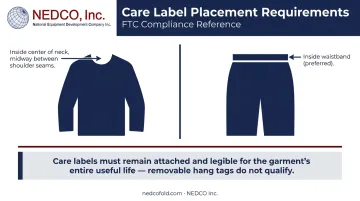
For garments with a collar or neckline, country of origin must appear on the front of a label at the inside center of the neck, midway between the shoulder seams, or adjacent to another label at that location. Fiber content and manufacturer identity may appear on the front or back of that same label, or on a separate label attached nearby — provided both remain conspicuous and accessible.
For garments without a neck — skirts, pants, shorts — the FTC identifies the inside waistband as an acceptable location. Pocket or sleeve placements aren't explicitly banned, but they can't substitute for the required neck-origin label on a necked garment and rarely meet the conspicuousness standard. Acceptable placement options by garment type:
- Necked garments: Inside center of neck, midway between shoulder seams, or adjacent to another label at that location
- Non-necked garments: Inside waistband (preferred); other accessible interior locations where conspicuousness can be demonstrated
- Avoid: Pockets, sleeves, or exterior tags that consumers are likely to remove before wearing
Care Label Permanence
Once placement is sorted, permanence is the next compliance hurdle — and care labels face a stricter standard than any other required disclosure. While fiber content, origin, and identity labels only need to remain attached until the consumer receives the product, care labels must stay attached and legible for the garment's entire useful life. The CFR requires durable attachment — but does not mandate sewing as the only method. A hang tag that can be removed after purchase doesn't meet the requirement.
Optional and Additional Information
Size labeling is not federally mandated under FTC textile rules, though it is standard practice and some states may have additional requirements. Brand names, environmental certifications, and care tips may appear on labels alongside required disclosures — as long as that information is truthful and does not minimize or contradict the required content.
Penalties for Non-Compliance and How to Stay Compliant
FTC Enforcement and Penalty Structure
Each mislabeled garment is treated as a separate violation. The current civil penalty ceiling is $53,088 per violation — a figure that remained unchanged after the FTC announced no 2026 inflation adjustment. This maximum applies to companies subject to prior FTC administrative orders under Sections 5(l) and 5(m)(1)(A)/(B) of the FTC Act.
Even without a prior order, the FTC can seek federal-court penalties against companies with knowledge that the conduct was previously determined unfair or deceptive. Notably, "knowledge" includes knowledge of applicable law — not just awareness of a specific prior ruling. CBP can also withhold release of improperly marked imports and assess liquidated damages independently of any FTC proceeding.
Most Common Compliance Mistakes
Avoid these recurring errors:
- Fiber percentages that don't add up to 100% — rounding errors are common and costly
- Using ISO/GINETEX symbols alone without English-language care words
- "Bamboo" labeling on rayon products — the FTC's enforcement record on this is extensive
- Unqualified "Made in USA" on products containing any imported materials
- Care instructions on removable hang tags rather than permanently attached labels
- Advertising origin that conflicts with the product label — under 16 CFR 303.34, mail-order and e-commerce listings must state whether products are US-made or imported, consistent with the label
Production Compliance Checklist
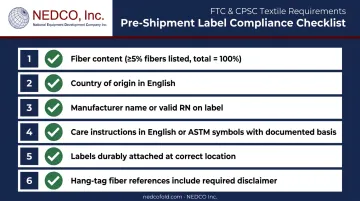
Before garments move to finishing and packaging, verify:
- ✅ All fibers ≥5% listed by FTC generic name, percentages totaling 100%
- ✅ Country of origin meets the unqualified or qualified standard, stated in English
- ✅ Manufacturer name or valid RN appears correctly on the label
- ✅ Care instructions use English words (or ASTM D5489-96c symbols) with documented reasonable basis
- ✅ Labels are durably attached in the correct location — neck center for necked garments, waistband for others
- ✅ Hang-tags referencing fiber names include required disclaimer language
For high-volume facilities moving hundreds or thousands of units daily, label compliance has to be built into the production workflow — not verified at the end of the line when corrections are expensive. NEDCO Inc.'s E-Z Fold Automatic Apparel Labeling System is engineered to fit directly into folding, bagging, and conveyor sequences, so each unit is labeled and traceable before it ships without slowing throughput.
Frequently Asked Questions
What information is legally required on a clothing label in the US?
US law requires four disclosures on most apparel: fiber content (generic names and percentages by weight), country of origin (in English), manufacturer or importer identity (business name or RN number), and care instructions (in English words or ASTM D5489-96c symbols). The FTC enforces all four, and CBP independently enforces import marking for goods crossing the border.
What are the 4 types of labels in apparel?
The four functional label types are the brand/main label (identity and logo), the care label (washing instructions), the content/fiber label (material composition), and the size label (garment sizing). US federal law mandates the care and content labels; brand and size labels are standard industry practice, not federal requirements.
Which clothing label is the most expensive to produce?
Woven labels — particularly high-definition damask woven labels produced on narrow-fabric jacquard looms — are typically the most expensive due to production complexity and premium feel. They are the preferred choice for luxury and high-end apparel brands.
Is a care label required on all clothing sold in the US?
Yes. Care labels are mandatory for textile wearing apparel under 16 CFR Part 423, with limited exceptions for items sold with clearly implied care (such as disposable garments). The label must remain attached and legible throughout the garment's useful life, not just at point of sale.
What are the penalties for clothing label non-compliance?
Each mislabeled garment counts as a separate violation. Civil penalties can reach $53,088 per violation for companies under prior FTC orders, and CBP can independently hold imported goods and assess liquidated damages. The FTC has secured multi-million dollar settlements, including $3 million from Walmart and $2.5 million from Kohl's in 2022 bamboo labeling cases.
What is an FTC Registered Identification Number (RN) and do I need one?
An RN is a free identification number issued by the FTC to US-based textile businesses, used on labels in place of a full company name. It is not required to operate, but it satisfies the manufacturer identity disclosure requirement, saves label space, and makes your business searchable in the FTC's public RN database. Foreign companies are ineligible for an RN and must use their full business name on labels instead.