Misreading that matrix leads to real consequences: stalled production timelines, budget overruns, and partnerships with factories that were never the right fit for the brand's current scale. According to Maker's Row, MOQ in apparel operates across at least four distinct layers — per style, per colorway, minimum spend, and custom fabric yardage — and each one can independently block a production run from moving forward.
This guide covers how MOQ works in practice, what drives it, how it varies by garment type and brand stage, and what you can realistically do to work within or around it.
Key Takeaways
- MOQ applies per style per colorway — not as a total across your entire order
- Fixed production costs — setup, pattern grading, cutting, and QC — are what factories protect with MOQs
- Realistic 2026 MOQs range from 25 units at small-batch studios to 5,000+ at large export factories
- Each added colorway multiplies your total unit commitment, so limit colors before limiting sizes
- Negotiating MOQs is possible — factories are more flexible on minimums when you commit to reorders or consolidate styles
What Is MOQ in Clothing Manufacturing?
MOQ — Minimum Order Quantity — is the lowest number of units a factory will accept for a single production run. Below that threshold, the run doesn't generate enough revenue to cover the factory's fixed setup costs, so it's not worth starting.
The Four MOQ Constraints You Actually Face
Maker's Row identifies four separate minimums that can apply to a single production relationship:
| MOQ Layer | Typical Range | What It Controls |
|---|---|---|
| Per style | 50–500 units | Floor for one garment design |
| Per colorway | 25–200 units | Floor for each color within a style |
| Minimum spend | $2,000–$10,000 | Revenue floor regardless of unit count |
| Custom fabric | 100–500 yards | Mill requirement that can override sewing MOQ |
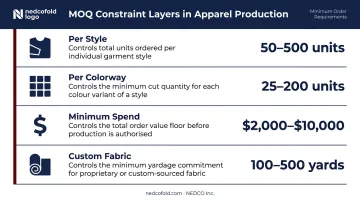
When you receive a quote from a factory, ask about all four — not just the unit count per style.
How Colorways Multiply Your Commitment
This is where new brands underestimate their total order size. If a factory sets a 100-unit MOQ per colorway, and you're launching a single tee in three colors, you're not ordering 100 units — you're ordering 300.
A Maker's Row worked example takes this further: 300 units × 3 colors = 900 units. Add two more colors and you're at 1,500 units before production starts.
Before approaching any manufacturer, confirm whether their MOQ applies per style or per colorway — the answer can change your total commitment by hundreds of units.
MOQ Tiers by Factory Type
That per-colorway question also shapes which factory tier makes sense for your volume. Use the ranges below as a starting filter — direct quotes will vary.
| Factory Model | Published MOQ Range | Best For |
|---|---|---|
| US small-batch custom | 25–150 units per style | Brand validation, early-stage |
| Larger US or short-lead overseas | 300–500 units | Growth stage, repeat styles |
| Overseas export factories | 1,000–5,000 units | Established, forecastable demand |
Why Factories Set MOQ: The Economics Behind the Number
MOQ isn't a negotiating position or an arbitrary policy. It's the point at which a factory's fixed costs per unit become economically acceptable.
Every production run — regardless of how many units you order — generates fixed costs the factory must absorb:
- Pattern grading and fit revisions
- Machine calibration and changeover
- Cutting setup and marker-making
- Quality control staffing
- Fabric and trim procurement coordination
Maker's Row estimates development costs at $300–$1,500 per style. Those costs don't decrease if you order 50 units instead of 500. They just get distributed across fewer garments — making each unit dramatically more expensive for the factory to produce profitably.
The MOQ-to-Unit-Cost Relationship
Fabric alone accounts for 40–60% of garment cost, according to Maker's Row. When order quantity increases, fabric is purchased in greater yardage at lower per-meter cost. Fixed setup costs are also spread across more units. A 50-unit run will always carry a higher per-unit cost than a 500-unit run of the same garment. That's production economics — not a gap in your negotiating skills.
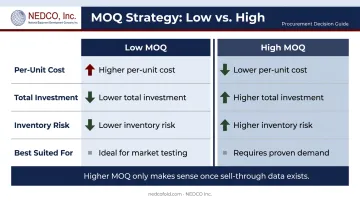
The trade-off for early-stage brands:
- Low MOQ = higher per-unit cost + lower total investment + lower inventory risk
- High MOQ = lower per-unit cost + higher total investment + higher inventory risk if demand isn't proven
Higher MOQ only makes financial sense once you have sell-through data to back it. Until then, the elevated per-unit cost at small batch is what you're paying to test the market — and that's the right call.
Key Factors That Influence MOQ in Apparel Production
MOQ isn't fixed — it shifts based on production variables. Knowing what drives it helps you choose the right factory and plan your range with realistic expectations.
Fabric Type and Sourcing
Fabric is often the primary MOQ driver. Stock fabrics (cotton jersey, basic polyester blends) can be purchased in smaller rolls, keeping minimums lower. Custom or specialty fabrics — jacquard weaves, performance textiles, dyed-to-order colorways — typically require bulk purchasing from mills, with fabric supplier MOQs reaching 100–500 yards.
When a mill's yardage minimum exceeds what your unit count requires, the garment manufacturer's minimum increases to absorb it. That cascade effect is one of the most common reasons brands hit MOQ walls they didn't anticipate.
Level of Customization
Each customization layer adds setup cost:
- Screen printing requires per-colorway screen creation, which becomes expensive fast at low volumes
- DTG/DTF printing skips screen setup entirely, making it better suited to short runs
- Embroidery adds digitizing and stitch-time overhead that factories price into their minimums
- Custom trims (branded zippers, woven labels, hardware) are sourced in bulk by trim suppliers, making small quantities costly or unavailable
Design Complexity
Garment complexity scales directly with MOQ. Maker's Row estimates:
- Basic t-shirts: 8–12 operations
- Activewear: 15–25 operations
- Structured outerwear: 30–40+ operations
More operations mean more machine changeovers, longer labor times, and higher setup overhead — all of which factories offset through higher minimums.
Factory Type
Large export-oriented factories need volume to justify their fixed-cost infrastructure. Small-batch manufacturers build their workflows specifically for lower-volume runs. Choosing the right factory type for your current scale is as important as any MOQ negotiation you pursue.
MOQ Ranges by Garment Type and Brand Stage
2026 MOQ Benchmarks by Garment Category
| Garment Category | Approximate MOQ Range | Primary Driver |
|---|---|---|
| Basic t-shirts | 50–200 units | Simple construction, common machinery |
| Hoodies/fleece | 100–300 units | Heavier fabric, rib trims, pockets |
| Custom woven shirts | 300–500 units | Pattern pieces, pressing, fit control |
| Denim/jeans | 200–500 units | Specialized machines, hardware, washing |
| Activewear | 100–300 units | Performance fabric, technical seams |
| Structured outerwear | Varies significantly | Linings, hardware, high operation count |
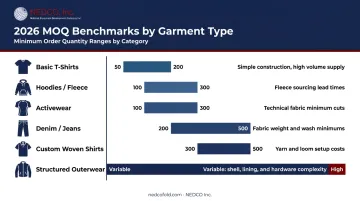
These ranges come from Alibaba's apparel sourcing platform data and reflect broad industry patterns — individual factory quotes will vary.
Matching MOQ Strategy to Brand Stage
| Brand Stage | Recommended Approach | Principal Risk to Avoid |
|---|---|---|
| Testing/validation | One hero style, limited colors, low-MOQ specialist | Paying more per unit is fine — limit unsold inventory |
| Growth | Repeat proven styles, present a 12-month production roadmap | Expanding SKUs faster than sell-through data supports |
| Established | Use repeat volume to pursue bulk economics | Large commitments amplify any forecast error |
Each stage carries a distinct failure mode — and the "Principal Risk to Avoid" column above is worth taking seriously. Overcommitting on volume before demand is proven ranks among the most common causes of inventory overstock and cash flow strain for new brands.
Start with domestic small-batch production to validate the product. Once you have real sell-through data, scale into larger overseas runs with confidence.
How to Negotiate or Reduce MOQ
MOQ is sometimes negotiable, but finding a factory whose standard MOQ already matches your current scale is the more reliable path forward.
Practical levers that can reduce your effective minimum:
- Limit colorways — each color is typically a separate MOQ run, so cutting from three to one reduces your total commitment by two-thirds.
- Choose simpler constructions — fewer operations mean lower setup overhead, which factories can absorb at smaller quantities.
- Use stock fabrics where possible — custom or printed materials reintroduce their own minimums that can override your unit count.
- Show up production-ready — a tech pack, approved sample, and graded pattern signal you're serious and reduce the factory's risk in taking your order.
The Relationship Approach
Factories are more willing to accommodate smaller runs for brands that demonstrate long-term value. When approaching a new manufacturer, include:
- Order quantity projections across multiple seasons (not just the current run)
- A clear growth plan showing how volumes are expected to increase
- A history of reliable payment if you have one from a previous manufacturer
The most reliable way to access genuinely low MOQs is to select manufacturers specifically built for small-batch production. A factory designed for 2,000-unit runs carries fixed costs and workflow expectations that a 100-unit order simply can't absorb — no matter how strong the relationship.
From Production Floor to Packaging: What MOQ Scale Means for Your Operations
MOQ decisions don't stop at the sewing machine. They cascade into every downstream operation: folding, labeling, bagging, and packaging for shipment or retail fulfillment.
At low-MOQ small-batch runs, finishing is typically handled manually — one operator folding and bagging while another labels. That process works at 100 units. It becomes a serious bottleneck at 500.
When Manual Finishing Stops Scaling
As brands move from validation runs into higher-volume production, three problems surface simultaneously:
- Produces variable fold dimensions that hurt retail presentation and packaging fit
- Falls behind on throughput when order volume triples but headcount stays the same
- Increases labeling errors and packaging inconsistencies under sustained volume pressure
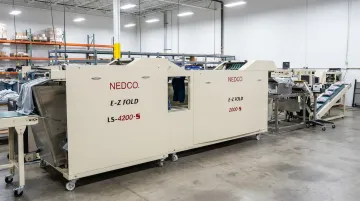
For production facilities managing higher-volume runs, automated finishing equipment addresses all three. Equipment like the E-Z Fold line from NEDCO Inc. is designed specifically for this stage — reducing operator fatigue, standardizing fold presentation, and cutting finishing time so facilities process more orders per shift without adding staff.
NEDCO's equipment is also modular, meaning a facility can start with the folding machine alone and add bagger/sealer systems, labeling systems, and automatic conveyors incrementally as production volume grows. Financing is available through Beacon Funding for facilities that want to build out their finishing line in phases rather than all at once.
Scale MOQ Strategy and Finishing Capacity Together
A manufacturer that successfully moves from 100-unit test runs to 500-unit production runs needs two things aligned:
- A manufacturing partner capable of that volume
- A finishing operation equipped to process that volume consistently and on time
When finishing capacity lags behind production volume, on-time delivery suffers — even when the sewing floor hits its targets. Brands that plan their MOQ scale-up without accounting for downstream finishing typically discover this gap when it's already affecting orders.
Frequently Asked Questions
What is a MOQ for clothing brands?
MOQ is the minimum number of units a factory will produce per style per run. For most clothing brands in 2026, realistic MOQs range from 50 units at startup-friendly small-batch manufacturers to 500+ at larger export-focused factories — the actual threshold depends on garment complexity and factory type.
How much does it cost to manufacture custom clothing?
Per-unit cost depends on garment type, customization level, order quantity, and factory location. Industry estimates place basic tees around $15–$25 per unit at ~300 units, and structured jackets at $50–$80+. Smaller runs in the 50–250 unit range typically cost more per unit.
What is the difference between MOQ per style and MOQ per colorway?
MOQ per style means the minimum applies across all colorways of one design combined. MOQ per colorway means the minimum applies separately to each color — so three colors at a 100-unit-per-colorway MOQ requires 300 total units. Always confirm which counting method a factory uses before committing to a range.
Can you negotiate MOQ with a clothing manufacturer?
Sometimes, particularly with relationship-based manufacturers who know your order history. A more reliable strategy is choosing a factory whose standard MOQ already fits your scale and arriving prepared — tech pack, approved sample, and graded pattern in hand.
Why do factories set MOQ requirements?
Factories set MOQs to ensure production runs cover their fixed setup costs — pattern grading, machine configuration, fabric procurement, and labor scheduling — which remain nearly constant regardless of run size. Very small orders don't generate enough revenue to make those fixed costs economically viable.
Does MOQ change based on garment type?
MOQ varies significantly by garment type. Basic knit items like t-shirts typically carry lower minimums than complex structured garments like denim jackets or outerwear — more involved pieces require longer setup times, specialized machinery, and additional construction steps that factories offset through higher minimums.