The decision touches per-unit packaging cost, carrier fees, seal integrity, and the customer unboxing experience. For operations shipping hundreds or thousands of units, getting this wrong at scale compounds fast.
This guide covers the recommended sizes by hoodie type, a practical measurement formula, the key factors that actually drive bag selection, and why consistent folding is the foundation that makes all of it work.
Key Takeaways
- Most adult S–L hoodies fit a 12×15.5-inch poly bag when neatly folded
- XL–3XL, zip-up styles, and heavyweight fleece typically need 14.5×19 inches or larger
- Always measure your folded hoodie — length, width, and thickness — before ordering bags
- Bag width minimum = hoodie width + (2 × thickness) + 1–2 inches sealing tolerance
- Inconsistent folding is the single biggest variable in bulk bag sizing; standardize your fold before ordering
What Are Poly Bags and Why Sizing Matters for Hoodies
Poly bags (or poly mailers) are lightweight polyethylene shipping envelopes used to protect and ship garments. Most e-commerce flexible packaging, including poly mailers, is made from LDPE — a material that's flexible, moisture-resistant, and light enough to keep shipping weights down. They come in flat and gusseted variants, standard and heavy-duty thicknesses, and clear or opaque finishes.
Hoodies are harder to size for than almost any other garment. Unlike t-shirts, which fold predictably flat, hoodies vary by:
- Pullovers fold flatter than zip-ups, which add zipper bulk
- Lightweight cotton compresses more easily than heavyweight French terry fleece
- A "large" from one brand can produce noticeably different folded dimensions than a "large" from another
The cost of getting sizing wrong comes from two directions. An undersized bag risks seal failure and transit damage. An oversized bag triggers dimensional weight (DIM) charges with UPS and FedEx, where carriers bill based on package volume rather than actual weight.
Recommended Poly Bag Sizes for Hoodies
These are widely stocked commercial sizes: use them as starting points, not guarantees. Brand-to-brand variation can shift you by one full size increment, so always validate with your specific folded garment.
Size Reference by Hoodie Type
| Hoodie Style | Garment Size Range | Folded Dimensions (approx.) | Recommended Poly Bag | Suggested Mil |
|---|---|---|---|---|
| Lightweight pullover | S–L | 12–13" L × 9–10" W × 1–1.5" thick | 12×15.5" | 2–2.5 mil |
| Standard pullover | XL–2XL | 14–15" L × 11–12" W × 1.5–2" thick | 14.5×19" | 2.5–3 mil |
| Zip-up hoodie | S–XL | 13–15" L × 10–12" W × 2–2.5" thick | 14.5×19" | 3 mil |
| Heavyweight fleece pullover | All | 13–16" L × 11–13" W × 2–3" thick | 14.5×19" | 3–4 mil |
| Oversized/streetwear | All | 15–17" L × 12–14" W × 2.5–3"+ thick | 19×24" | 3–4 mil |
| Multiple hoodies | 2+ units | Varies | 19×24" | 3–4 mil |
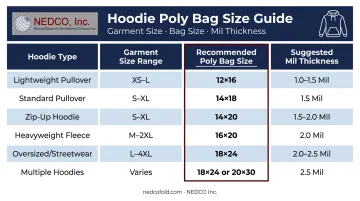
Note: UPrinting's supplier guide maps a single hoodie to the 14.5×19-inch size as a documented starting point. PAC and Uline both stock 12×15.5, 14.5×19, and 19×24-inch mailers.
Flat vs. Gusseted Bags
Flat mailers work well for tightly folded, lighter hoodies. They're cheaper and take up less storage space.
Gusseted bags have an expandable bottom (PAC's garment model expands 6–7 inches), making them better suited for thick fleece hoodies or zip-ups where the fold creates significant depth. If your flat mailer is straining at the seams or the adhesive strip won't lay flat, a gusseted bag is the right move.
Bag shape handles the fit. Mil thickness handles the protection.
Mil Thickness by Hoodie Weight
- 2–2.5 mil — lightweight cotton hoodies, short shipping distances
- 2.5–3 mil — standard pullover hoodies, typical e-commerce routes
- 3–4 mil — heavyweight fleece, zip-ups, longer fulfillment distances
Uline identifies 2 mil as its most popular thickness for shipping clothing generally, but heavier hoodies benefit from the added puncture resistance of 3–4 mil.
How to Measure Your Hoodie and Calculate the Right Poly Bag Size
Step 1: Establish a Consistent Fold First
Before you measure anything, lock in your folding method. The fold determines final package dimensions — and switching between folding styles across operators produces measurements you can't rely on.
A standard retail fold works like this: fold the hoodie in thirds lengthwise, then fold in half. This produces a compact, consistent rectangle that minimizes thickness variation.
Step 2: Measure Three Dimensions
Lay the folded hoodie flat and measure:
- Length — the longest edge
- Width — the widest edge
- Thickness — how tall the folded stack is
Thickness is the most commonly missed measurement. It's also the most common cause of bag failures at volume — operators underestimate it and order bags too narrow.
Step 3: Apply the Sizing Formula
Use this formula to calculate your minimum bag dimensions:
- Minimum bag length = Hoodie length + 1–2 inches
- Minimum bag width = Hoodie width + (2 × hoodie thickness) + 1–2 inches
Worked example: A folded hoodie measuring 13" long × 10" wide × 2" thick requires:
- Minimum length: 13 + 2 = 15 inches
- Minimum width: 10 + (2 × 2) + 2 = 16 inches
The closest standard commercial size is 14.5×19 inches — which fits here, with the 19-inch dimension covering length with room for the sealing strip.
Step 4: Validate Before Bulk Orders
Always add 1–2 inches beyond your calculated minimum for the adhesive strip to seal cleanly. Then order sample bags in your estimated size and pack-test actual hoodies from across your SKU range before committing to bulk.
That validation step matters most at scale. In operations processing hundreds of units daily, folding consistency is what keeps bulk bag sizing predictable. Manual folding introduces variation that compounds across a run — some units pack cleanly, others don't seal or require a repack. Automated folding equipment standardizes output dimensions, so your sizing formula holds across the full production run rather than just the first few units off the line.
Key Factors That Drive Poly Bag Selection
Hoodie Style and Garment Size
Pullover hoodies fold flatter than zip-ups because the zipper track adds meaningful thickness. Youth sizes fold much smaller than adult XL. Oversized streetwear styles require larger bags than their nominal size suggests.
Start by sizing to your most common SKU, then audit your outliers. This prevents over-stocking three or four bag sizes when two usually cover the range.
Material Weight
Standard cotton fleece, heavyweight French terry, and thin performance fabric all produce different folded thicknesses that directly drive the width side of your sizing formula. If you carry multiple hoodie weights, test each weight class separately — a single bag size won't cover all of them accurately.
Folding Consistency at Scale
This is the factor most often overlooked in high-volume operations. Inconsistent folds mean bags that fit 80% of the time fail or waste material the other 20%.
Documenting a standard fold procedure is the baseline fix. At production scale, automated folding equipment eliminates variability entirely: every unit exits at the same dimensions, which makes bulk bag selection accurate rather than approximate.
Carrier Dimensional Weight Pricing
UPS and FedEx both apply DIM pricing using the formula: (L × W × H) ÷ 139 for domestic shipments, with no minimum volume threshold — meaning DIM can apply even to small packages. USPS activates DIM pricing only above 1,728 cubic inches (effective July 12, 2026).
A quick example: moving from a 14.5×19-inch bag (laying roughly 0.5" thick when packed) to a 19×24-inch bag adds meaningful cubic volume. At scale, that extra bag size can cost more per shipment than the savings from buying cheaper bags in bulk.
Branding and Environmental Considerations
At low volumes, standard off-the-shelf bags are sufficient. At higher volumes, custom-printed bags become cost-competitive — published MOQs range from 100 units at some suppliers to 25,000 units per size at wholesale levels.
If you're making recycling claims on packaging, note that California SB 343 restricts unqualified recycling symbols on products manufactured after October 4, 2026. The law doesn't require every bag to carry a recycling label — it controls when such claims may legally appear. Review your packaging artwork before that date to avoid compliance issues.
How E-Z Fold Can Help Streamline Your Hoodie Packaging Operation
For apparel businesses packaging hoodies at volume, the quality and consistency of the fold upstream is what makes reliable poly bag sizing possible downstream. This is where NEDCO's E-Z Fold automated folding equipment removes the guesswork from poly bag selection.
The E-Z Fold system — designed and manufactured in Covington, Georgia since 1989 — folds garments quickly and consistently, with a modular design built to adapt to changing production needs. When every unit exits the folder at the same dimensions, operations can size poly bags to specification rather than building in excess buffer for fold variation.
Key operational benefits relevant to hoodie packaging at scale:
- Produces consistent folded dimensions across every unit, so bag sizing stays locked to spec rather than guessed
- Combines bagging and sealing into one step via the integrated Bagger/Sealer System, cutting labor and floor space
- Reduces repack events because consistent output means bags seal cleanly through the full run
- Connects directly with NEDCO's Labeling System and Automatic Conveyor, creating a continuous fold-to-bag line
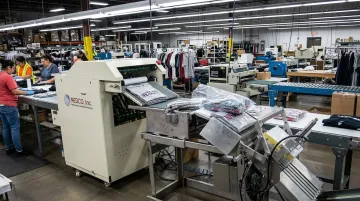
The E-Z Fold is optimized for t-shirts and similar flat-fold apparel. For hoodie-specific applications — particularly heavyweight fleece or zip-up styles — NEDCO also offers custom machinery engineering for specialty configurations. Reach out to discuss your garment type and throughput requirements: support@nedcofold.com or 770-484-9969.
Conclusion
Getting poly bag sizing right for hoodies takes a methodical approach: establish a consistent fold, measure all three dimensions of the folded garment, apply the sizing formula, and test a sample run before ordering in bulk.
Revisit bag sizing decisions whenever your product mix changes — new styles, expanded size runs, or higher volumes all shift the math. Operations that lock in a standardized fold first will find the rest of the sizing process faster, more repeatable, and far less prone to costly reorders.
Frequently Asked Questions
What size poly bags for clothing?
General sizing by category: small accessories like socks use 6×9 inches; a single t-shirt fits a 9×12-inch bag; sweaters and hoodies typically use 12×15.5 to 14.5×19 inches; larger outerwear may need 19×24 inches. The actual size always depends on the folded dimensions of the specific garment.
How do you calculate poly bag size?
Measure the garment after folding in its shipping configuration, then apply: Bag Length = Garment Length + 1–2 inches; Bag Width = Garment Width + (2 × Garment Thickness) + 1–2 inches for sealing tolerance. Always add sealing allowance — skipping it causes seal failure and damaged product in transit.
What size poly bag fits a hoodie?
Most S–L adult hoodies fit a 12×15.5-inch poly bag when neatly folded. XL–3XL, zip-up styles, and heavyweight fleece typically require 14.5×19 inches. Measure your actual folded hoodie first — brand variation alone can change which size you need.
Does hoodie size (S, M, L, XL) affect poly bag selection?
Yes. Larger garment sizes produce larger folded dimensions — particularly in width and thickness. Measure your largest SKU to set the upper bag size limit, then evaluate whether a two-size inventory approach covers your range without over-bagging smaller styles.
What mil thickness should poly bags for hoodies be?
Use 2.5–3 mil for standard cotton hoodies and 3–4 mil for heavyweight fleece or zip-up styles. Thicker mil protects against puncture and seal failure during transit — particularly important for longer fulfillment distances or high-volume automated bagging lines.
Can I use the same poly bag size for all hoodie styles?
A single 14.5×19-inch bag fits most adult hoodies, but it runs oversized for lightweight S/M styles and can increase DIM-based shipping costs. A two-size approach — 12×15.5 inches for lighter styles, 14.5×19 inches for heavier or larger ones — covers most ranges without the waste.