According to USITC data, the US imported $79.3 billion in apparel in 2023, with the majority sourced from Asia — a figure that underscores just how deeply embedded overseas manufacturing remains in the American apparel supply chain. Yet the pressure to reconsider that dependency has never been stronger.
This guide breaks down the real cost structures on both sides, identifies where each model actually outperforms the other, and explains how a hybrid approach can serve most apparel operations better than either extreme.
Key Takeaways
- Total landed cost — not unit price — is the right metric when comparing US and overseas production
- US manufacturing offers faster lead times, lower MOQs, and hands-on quality control at a higher per-unit cost
- Overseas production delivers volume economics but requires longer planning horizons and third-party quality oversight
- A hybrid model (domestic validation, overseas scaling) is the most practical approach for most apparel brands
- Automated finishing equipment in US facilities can significantly cut domestic per-unit costs
US vs Overseas Clothing Manufacturing: Quick Comparison
Use this table as a reference when evaluating production locations for a specific style or program:
| Dimension | US Manufacturing | Overseas Manufacturing |
|---|---|---|
| Labor Cost | Sewing operators: $12.19–$21.81/hr (median $16.56) | Bangladesh minimum: ~$113/month; Vietnam avg: ~$215–$280/month |
| Lead Time | 4–6 weeks (cut to delivery) | 12–20 weeks including sea freight (~30 days transit from Asia) |
| MOQ | Low — small-batch runs often viable | Higher — driven by fabric mill minimums and factory capacity requirements |
| Quality Control | Direct factory access, same-day issue resolution | Requires third-party pre-shipment inspection; no on-site access during production |
| Supply Chain Risk | Minimal exposure to port delays or geopolitical disruption | Vulnerable to freight congestion, customs delays, and geopolitical events |
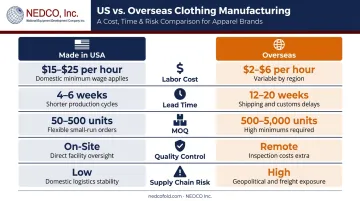
The wage gap is the most striking line item. BLS occupational data puts the US sewing machine operator median at $16.56/hour — while Bangladesh's entire sector minimum wage sits at roughly $113 per month after a 56% increase in 2023. That gap looks decisive on paper. Factor in ocean freight, import duties, third-party inspections, and markdown exposure from longer lead times, and the true cost comparison becomes considerably tighter.
US Clothing Manufacturing: Costs, Strengths, and Operational Realities
US clothing manufacturing covers cut-and-sew operations, private label production, and finishing work performed domestically. For brands using a "Made in USA" label, the FTC's "all or virtually all" standard applies — final assembly and all significant processing must occur in the US, with foreign content that is absent or negligible. That requirement directly affects compliance planning and brand positioning.
The True Cost Structure
Labor is the most visible cost, but not the only one:
- Sewing operators: $12.19–$21.81/hour (median $16.56; mean $16.83 in cut-and-sew apparel)
- Cutting room technicians: $13.83–$26.13/hour (median $17.81)
- Overhead: Real estate, utilities, regulatory compliance, and benefits add meaningfully to the per-unit cost above the base wage
McKinsey's landed cost model pegs a US-made pair of jeans at $14.05 versus $10.68 from Bangladesh and $12.04 from China — a gap that narrows considerably once freight and import duties are factored into the offshore number.
Where US Manufacturing Wins
That cost gap doesn't tell the whole story. Domestic production is the right choice in specific operational circumstances:
- Small-batch and prototype runs where overseas MOQ requirements are prohibitive
- Time-sensitive orders tied to launch windows within 8 weeks
- Styles still in active development requiring rapid iterative sampling — domestic revision cycles run significantly faster than overseas equivalents
- In-person factory access and same-business-day issue resolution eliminate the cost and delay of third-party inspection agencies — an advantage that compounds across a production run
There's also a measurable brand premium at stake. A 2023 study of 727 US shoppers found willingness to pay $13 more — a 31% premium — for US-manufactured denim jeans. That premium is product-specific, not universal, but for the right brand and category it can offset a meaningful portion of the domestic cost gap.
Facilities investing in automated finishing equipment can close that gap further. NEDCO's E-Z Fold folding and packaging systems, built in Covington, Georgia since 1989, increase throughput and cut finishing labor per unit — making domestic production more cost-competitive without adding headcount.
Overseas Clothing Manufacturing: Costs, Strengths, and Operational Realities
Overseas apparel manufacturing is still the dominant model for US brands. The primary hubs each serve a distinct function in the global supply chain:
- Bangladesh — cost-efficiency on basics and high-volume commodity garments
- Vietnam — technical garments, growing capacity, competitive labor costs
- China — scale, vertical integration, and capability across complex constructions
- India — diverse fabric ecosystem, strong in wovens and natural fiber categories
The Real Cost Advantage (After Landed Cost)
The headline labor cost gap is significant, but the net savings after full landed cost calculation is more modest. Using McKinsey's modeled jeans data as a reference point:
| Origin | Landed Cost (US Destination) |
|---|---|
| US (onshore) | $14.05 |
| Mexico (nearshore) | $10.57 |
| Bangladesh (offshore) | $10.68 |
| China (offshore) | $12.04 |
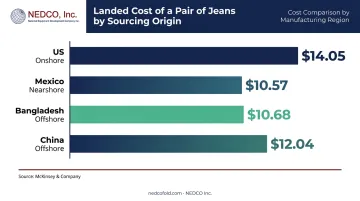
The actual cost advantage of offshore production, after accounting for materials, freight, duties, and inspection, runs closer to 15–30% on landed cost — not the 50%+ gap that raw labor rates might suggest.
Where Overseas Manufacturing Wins
Overseas production makes sense under specific operational conditions:
- High-volume orders on proven, specification-locked styles where per-unit economics are the primary constraint
- Programs with planning horizons of 4–6 months that can absorb the freight and customs cycle
- Retail pricing targets that domestic production cannot meet given margin requirements
Key Operational Challenges
Production managers relying on overseas manufacturing deal with recurring friction points:
- Communication gaps across time zones requiring airtight tech packs and written specifications
- Mandatory pre-shipment inspection (inspection agencies quote rates by man-day; costs vary by country and scope — get quotes before budgeting)
- Supply chain vulnerability: port congestion, geopolitical disruption, and seasonal freight delays can add weeks to delivery cycles
- AlixPartners research found 22% of respondents cited late deliveries as a major assortment-planning challenge in 2021 — a figure that translates directly into markdown risk when stock arrives after peak selling windows
The reshoring pressure is also building. Kearney reports that 96% of CEOs were evaluating reshoring, had decided to reshore, or had already reshored — up from 78% in 2022. That figure spans broad US manufacturing, but for apparel brands specifically, it signals that supply chain resilience is becoming a line-item decision — not just a contingency conversation.
US vs Overseas: Which Manufacturing Model Fits Your Business?
Choose US Manufacturing When:
- Brand positioning is premium or luxury, justifying higher unit costs
- Styles are new or experimental and still being fit-tested
- Launch dates fall within 8 weeks
- Ethical sourcing and supply chain transparency are retail partner requirements
- Inventory restock agility is business-critical
Choose Overseas Manufacturing When:
- Core styles have locked specifications and proven, predictable reorder demand
- Order volumes exceed 1,000 units and per-unit savings are meaningful at scale
- Planning horizons allow for 4–6 months from production to delivery
- Retail pricing targets require cost structures domestic production cannot deliver
The Hybrid Model in Practice
The strongest apparel businesses route each style to the model that fits the job. Domestic production validates new styles and fulfills time-sensitive drops. Overseas production handles proven high-volume programs once specifications are confirmed and demand is established.
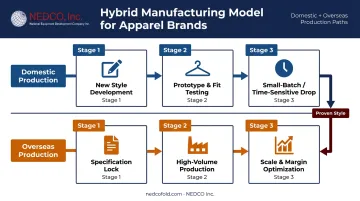
Reformation is the most documented example. The brand built a Los Angeles factory to support biweekly limited-edition releases at small batch sizes, while routing wovens, denim, and other programs to overseas partners in China, India, and Turkey. By 2020, outsourced production had grown from 20% of manufacturing to nearly half — a deliberate evolution as the brand scaled, not an abandonment of domestic production.
Domestic capacity serves speed and control; overseas capacity serves volume and margin.
For US-based facilities running a hybrid model, the economics of the domestic leg improve with automated finishing equipment. NEDCO's modular E-Z Fold systems — folding, labeling, bagging, and conveyor — integrate into a complete finishing line that reduces labor per unit as throughput scales. Screen printers, apparel manufacturers, and fulfillment operations can start with a single folding unit and expand the line as volume grows.
Conclusion
Neither model wins universally. US manufacturing delivers speed, control, flexibility, and brand story. Overseas manufacturing delivers volume economics and scale. The most competitive operations learn to use both — validating domestically, scaling overseas, and treating the two as complementary.
Where garments are made matters — but so does what happens after they leave the production floor. Facilities that pair a well-chosen manufacturing location with optimized finishing operations — automated folding, labeling, bagging, and conveyor systems running as an integrated line — consistently outperform those that focus on sourcing while leaving finishing labor untouched.
Sourcing strategy sets the ceiling. Finishing efficiency determines how close you get to it.
Frequently Asked Questions
How much does it cost to manufacture clothes in the US?
McKinsey's landed cost model benchmarks a pair of US-made jeans at approximately $14.05, compared to $10.68 from Bangladesh. Per-unit costs vary by garment complexity, material, and order size — small-batch runs typically carry a higher per-unit cost than larger production runs due to setup and overhead distribution.
Are clothes cheaper to manufacture in the US or Europe?
Both are significantly more expensive than Asian production hubs. McKinsey's model puts German onshore production at $30.36 per pair of jeans versus $14.05 in the US — making US manufacturing generally more cost-competitive than Western Europe while both serve premium and ethically positioned brands.
What are the biggest hidden costs in overseas clothing manufacturing?
Freight and import duties, pre-shipment inspection fees, extended sampling revision cycles, and markdown losses from late deliveries are the most commonly underestimated. Brands focused only on unit price often find total landed cost runs 20–30% higher than initial quotes.
What is the typical lead time difference between US and overseas production?
US domestic production typically runs 4–6 weeks from approved samples to delivery. Overseas production, including sea freight (approximately 30 days from Asia) and customs clearance, typically runs 12–20 weeks — with the gap widening during peak shipping seasons or periods of port congestion.
Is a hybrid manufacturing model viable for apparel brands?
Yes, and it's widely used. Domestic production handles new styles, small drops, and time-sensitive orders; overseas handles proven high-volume programs. The key is setting clear minimums and lead time expectations for each channel so neither disrupts the other.
How is automation changing the cost competitiveness of US clothing manufacturing?
Automated cutting, computerized production monitoring, and finishing equipment (folding, labeling, bagging) are reducing labor hours per garment in US facilities. The result is a narrowing per-unit cost gap with overseas production, making reshoring increasingly viable for volume apparel programs.