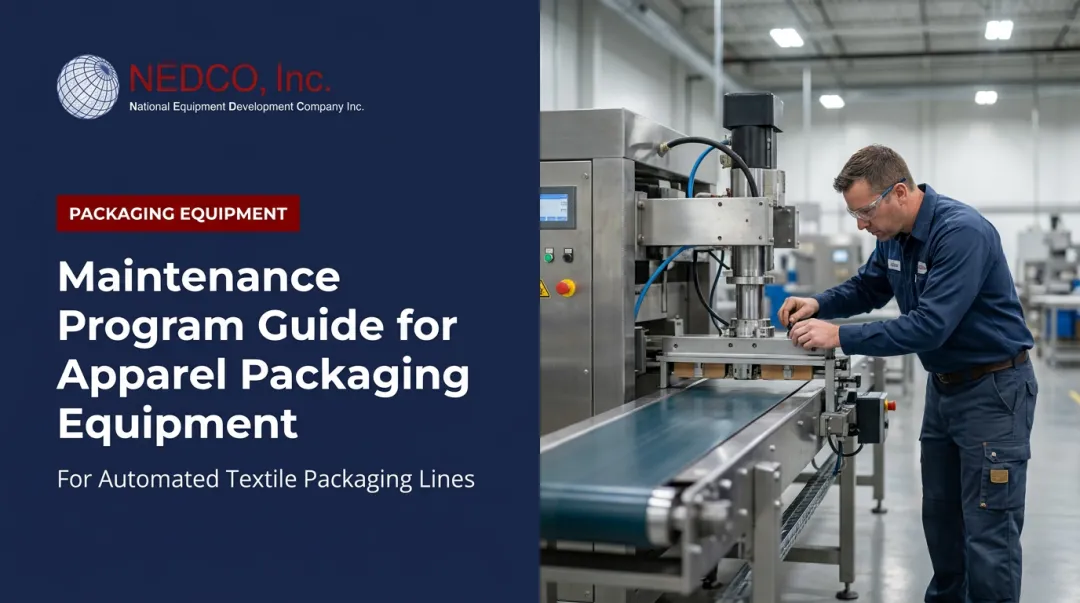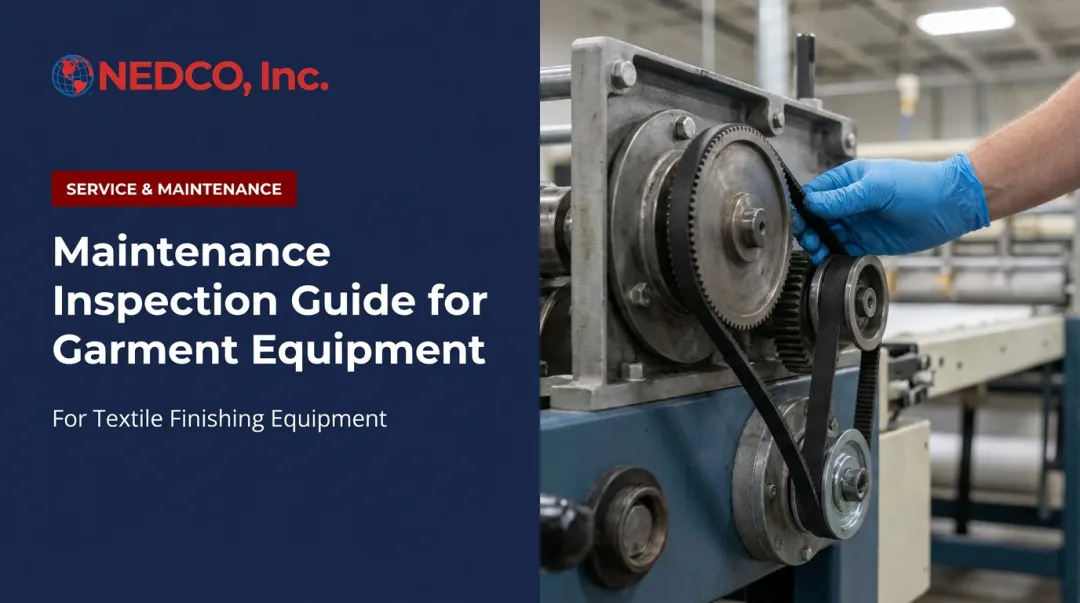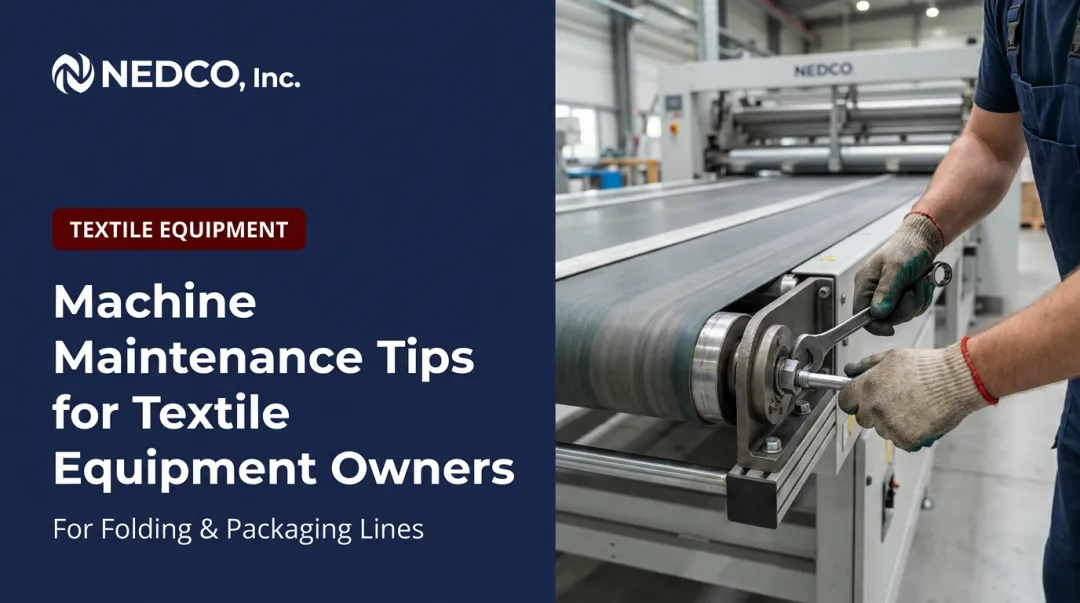
The consequences of neglecting maintenance in this environment are concrete: unplanned downtime that halts production, inconsistent fold quality that drives up reject rates, shortened equipment lifespan, and real safety risks for floor operators. According to NIST, preventable maintenance failures across US manufacturing accounted for an estimated $119.1 billion in losses in 2016, including $18.1 billion in direct downtime costs.
This guide covers what a structured maintenance program looks like for textile equipment, the four main maintenance types, how to spot warning signs before a breakdown, a practical scheduling framework, and answers to common questions.
Key Takeaways
- Preventive and predictive maintenance programs reduce unplanned downtime compared to reactive-only approaches
- Four maintenance types apply to textile equipment: preventive, corrective/reactive, predictive, and overhaul — effective programs layer all four
- Output quality changes (fold inconsistency, jams, reject rate increases) are often the first sign maintenance is overdue
- Maintenance frequency should scale with usage intensity — three-shift operations need more aggressive schedules than single-shift facilities
- OEM parts and service guidance reduce repair costs and downtime — and are often overlooked
Why a Maintenance Program Matters for Textile Equipment
The Financial Case
Treating maintenance as an optional expense is a costly mistake. Equipment running high-cycle production shifts degrades faster than low-volume machinery, and deferred maintenance compounds that degradation with every skipped inspection cycle.
A 2021 NIST survey found that manufacturers running preventive and predictive maintenance programs had 52.7% less unplanned downtime and 78.5% fewer defects than reactive operations.
Siemens' 2024 analysis put the broader cost in sharper focus: $1.4 trillion in annual unplanned downtime losses across Fortune Global 500 manufacturers — roughly 11% of revenue.
For a textile production facility running volume apparel orders, even a few hours of unplanned downtime translates directly to missed shipments and strained customer relationships.
Output Quality and Safety
Poorly maintained textile equipment rarely fails all at once. Worn fold plates and misaligned guide rails produce inconsistent folds long before a machine stops entirely. Rising reject rates and increased manual corrections are typically the first sign that equipment is approaching a maintenance threshold.
Safety is equally at stake. Worn belts, overheating motors, and misaligned components create real hazards for operators working on or near moving machinery. A structured maintenance program enforces inspection routines that catch these conditions before they cause incidents.
Preventive vs. Reactive Costs
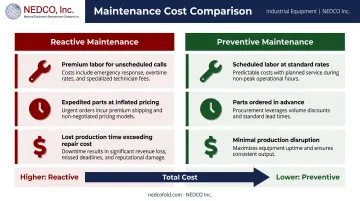
The cost gap between planned maintenance and emergency repair isn't linear. Emergency repairs carry:
- Premium labor rates for unscheduled technician calls
- Expedited parts costs that far exceed standard pricing
- Lost production time that often dwarfs the repair cost itself
Facilities operating predominantly in reactive mode consistently report higher total maintenance spend than those running proactive programs — and production losses compound the gap further.
Types of Maintenance for Textile Equipment
No single strategy works for every machine or every production environment. Effective programs layer multiple approaches based on equipment criticality, usage intensity, and budget.
Preventive Maintenance
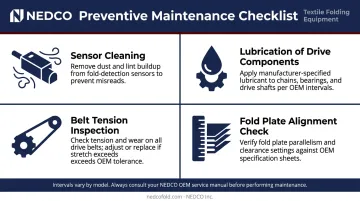
Preventive maintenance (PM) covers scheduled tasks performed at defined intervals — time-based or cycle-based — regardless of whether equipment shows visible signs of wear. For textile folding and packaging equipment, this includes:
- Cleaning lint and fiber buildup from sensors, mechanisms, and guide rails
- Lubricating conveyor and drive components at manufacturer-specified intervals
- Inspecting belts for tension loss and surface wear
- Checking fold plate alignment against baseline settings
PM is most effective when OEM service intervals anchor the schedule. Most textile folding and packaging machines ship with manufacturer recommendations — those intervals exist for a reason and should not be extended without documented justification.
Corrective / Reactive Maintenance
Corrective maintenance is repair work triggered after a failure: a jammed folding mechanism, a snapped belt, a sensor that stops detecting garments. Some reactive work is unavoidable — the real risk is over-reliance on it as a default strategy.
A single machine failure on a busy production line doesn't just stop that machine — it backs up every downstream operation. The practical mitigation: keep OEM-supplied replacement parts on hand. Waiting for parts to ship after a failure extends downtime significantly, while a well-stocked parts inventory can reduce repair windows from days to hours.
Predictive / Condition-Based Maintenance
Predictive maintenance monitors specific performance indicators — motor temperature, vibration levels, cycle counts, fold accuracy rates — to anticipate failure before it happens. Work gets scheduled during planned downtime rather than triggered by a breakdown.
Formal predictive programs with sensors and monitoring software are common in large textile manufacturing operations. Smaller facilities can apply the same principle through consistent operator observation and logged performance trends.
Tracking fold quality scores, error code frequency, and cycle-to-cycle consistency over time creates a usable baseline. Deviations from that baseline are where predictive value lives.
Deloitte analysis cites potential outcomes of 10–40% lower maintenance costs and 30–50% less downtime from predictive approaches, though these figures reflect large industrial organizations and should be treated as directional rather than guaranteed.
Overhaul Maintenance
Overhaul maintenance is a comprehensive deep-service event: full belt replacement, drive system overhaul, complete cleaning and realignment of fold plates and guide rails, motor mount inspection. It goes beyond routine service and restores equipment to a defined baseline condition.
Overhaul is appropriate when:
- A defined number of operating hours has been reached
- A major failure event has occurred
- Cumulative wear across multiple components is identified during routine inspection
OEM guidance from the equipment manufacturer is the most reliable source for overhaul intervals. Generic schedules don't account for design-specific wear rates.
How to Check If Textile Equipment Needs Maintenance
Catching issues early reduces both repair costs and production disruption. These are the primary signals to watch for across textile folding and packaging equipment.
Performance or Output Changes
Output quality degradation is often the first indicator — and the easiest to miss if operators aren't trained to track it:
- Inconsistent fold quality or garment alignment that wasn't present previously
- Increase in rejected units or manual corrections per shift
- Measurable drop in throughput or slower cycle times
- More frequent operator intervention to correct folds mid-run
Any of these, sustained across multiple shifts, indicates that folding mechanisms, alignment guides, or conveyor tension need inspection.
Unusual Behavior or Operation
Abnormal sounds are early mechanical warning signs that shouldn't be normalized:
- Grinding or squealing — often bearing wear or belt slippage
- Irregular clicking — may indicate debris in moving parts or timing issues
- Unexpected stops or erratic cycling — sensor faults, electrical issues, or timing problems that warrant investigation, not just a reset
Repeated resets without investigation allow minor faults to develop into full failures.
Visible Wear and Error Indicators
Operator walkthroughs should look for:
- Frayed or cracked belts
- Lint and fiber accumulation around sensors and drive components
- Worn or scored fold plates
- Visible misalignment in guides or rollers
Active error messages and indicator lights on the control panel should never be dismissed. They surface issues before full mechanical failure — treating them as nuisances is one of the fastest ways to turn a minor repair into a major one.
Increased Resource Consumption and Recurring Issues
Motors drawing more power or running hotter than normal indicate mechanical resistance: worn components, inadequate lubrication, or debris in the drive system. If operators are regularly compensating for machine inconsistencies with manual adjustments, that compensation is masking an underlying maintenance need.
Recurring minor issues are particularly telling. A garment that jams in the same location every few hundred cycles, a sensor that repeatedly triggers false stops, a fold that consistently requires correction — these are systematic maintenance signals, not random events. Tracking downtime frequency and duration over time makes these patterns visible and easier to prioritize.
Textile Equipment Maintenance Schedule
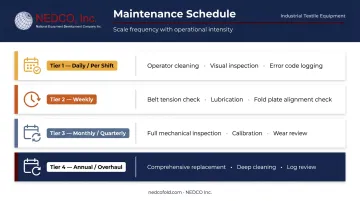
The right maintenance frequency depends on how equipment is actually used. A folding machine running three production shifts per day needs more aggressive attention than one used for intermittent seasonal runs. OEM-recommended intervals should serve as the baseline — adjusted upward based on actual operating conditions, never downward without justification.
| Frequency | Tasks |
|---|---|
| Daily / Per Shift | Operator cleaning of lint and debris from sensors, mechanisms, and guide rails; visual inspection for wear, misalignment, or unusual sounds; log all error codes rather than resetting without documentation |
| Weekly | Belt tension check; lubrication of conveyor and drive components per OEM specs; review of logged error codes and anomalies; visual check of fold plate alignment |
| Monthly / Quarterly | Full mechanical inspection of rollers, fold plates, drive belts, and motor mounts; calibration of fold alignment against baseline; parts wear review against OEM thresholds; identify components approaching replacement intervals |
| Annual / Overhaul | Comprehensive component inspection and replacement as needed; deep cleaning of all internal mechanisms; full maintenance log review and update; assessment of cumulative wear patterns across the line |
Adjusting for operational context:
- High-volume continuous operations (bulk apparel manufacturing, three-shift production): Increase frequency at every tier. Daily tasks become per-shift tasks; weekly checks may need to move to twice weekly during peak periods.
- Single-shift or seasonal operations: Some intervals can stretch slightly, but no tier should be eliminated entirely. A machine that sits idle still accumulates wear when it runs — resuming after low-activity periods warrants a thorough inspection before ramping back up.
For E-Z Fold textile folding and packaging equipment, NEDCO's service team provides OEM-specific guidance on service intervals and genuine replacement parts for every maintenance tier. Their annual service plan covers scheduled preventive maintenance and inspections throughout the year. Contact Don Cranshaw at Don@nedcofold.com or reach the support team at (770) 484-9969 for details.
Conclusion
A maintenance program for textile equipment isn't optional overhead — it's a direct investment in production uptime, output quality, and operator safety. Facilities that treat maintenance as something done only after a breakdown pay more over time: in repair costs, in lost production, and in shortened equipment service life.
The right program combines three core elements:
- Preventive routines that catch wear before it becomes failure
- Condition-based monitoring that turns operator observation into actionable data
- OEM support access when parts or service guidance are needed
NEDCO Inc. — makers of the E-Z Fold line, based in Covington, Georgia since 1989 — provides replacement parts, annual service plans, and on-demand technical support to help textile and apparel facilities reduce unplanned downtime and extend the service life of their equipment.
Frequently Asked Questions
What are the three types of maintenance program?
The three core types are preventive (scheduled, interval-based tasks performed before failure), corrective/reactive (repairs triggered after a fault or breakdown), and predictive (condition-based monitoring that anticipates failure from observed performance data). Most effective programs use all three, weighted heavily toward the proactive end.
What is the 80/20 rule in maintenance?
The 80/20 rule targets roughly 80% proactive maintenance (preventive and predictive) and 20% corrective/reactive work. No formal body mandates this ratio, but facilities running closer to 50/50 — or heavier on the reactive side — consistently face higher costs and more unplanned downtime.
How often should textile folding and packaging equipment be serviced?
Service frequency depends on usage intensity. High-volume facilities running continuous shifts should perform daily operator cleaning, weekly mechanical checks, and monthly or quarterly full inspections. Lower-volume operations may extend some intervals, but no maintenance tier should be skipped entirely. Always use OEM recommendations as your starting baseline.
What causes textile equipment to break down most often?
The most common causes are lint and fiber accumulation in sensors and mechanical components, belt wear and tension loss from high-cycle operation, inadequate lubrication of moving parts, and delayed response to early warning signs that allow minor issues to escalate into full failures.
How can I reduce unplanned downtime in my textile production facility?
Shift from reactive to preventive practices, keep critical spare parts on hand, train operators to recognize early warning signs, and document your maintenance schedule so tasks don't slip. When failures do occur, having OEM components in stock is one of the highest-leverage changes a facility can make — it directly controls how fast you recover.
Is SAP a CMMS or an ERP?
SAP is primarily an ERP — a broad platform covering financials, supply chain, and operations — though it includes Plant Maintenance modules that handle maintenance workflows. A dedicated CMMS is purpose-built for work orders, PM schedules, and technician tracking, making it the more practical choice for facilities focused specifically on equipment maintenance.