The question isn't whether your equipment will need maintenance. It's whether you'll be ready when it does.
This guide covers what a preventative maintenance agreement (PMA) actually is, how the main types work, what a solid contract should include, and how to set one up for your industrial equipment — before something breaks.
Key Takeaways
- Prevents failures — not just responds to them — by scheduling routine inspections and proactive repairs
- Covers three agreement types: time-based, usage-based, and condition-based
- The U.S. Department of Energy estimates preventive maintenance saves 12%–18% over reactive-only maintenance costs
- Choose an Annual Maintenance Contract (AMC) for newer equipment; a Comprehensive Maintenance Contract (CMC) when parts replacement is frequent and budget certainty matters
- Lock in parts and service contacts before equipment goes down — not after
What Is a Preventative Maintenance Agreement for Equipment?
A preventative maintenance agreement is a formal service contract between an equipment owner and a service provider that schedules routine inspections, cleaning, lubrication, calibration, and proactive part replacement to prevent unplanned failures.
The key distinction from reactive maintenance is timing. Reactive maintenance addresses breakdowns after they occur — often under pressure, with emergency labor rates and expedited parts costs. A PMA shifts your operation from emergency response to controlled upkeep, built around scheduled intervals and documented equipment history.
What a PMA Typically Covers
In an industrial or production context, agreements generally address:
- Belts, bearings, motors, and drive systems (mechanical components)
- Electrical connections, sensors, and control systems
- Firmware updates and sensor calibration for automated folding and labeling systems
- Wear parts replaced on a schedule, before failure forces a stoppage
PMAs are customizable. The scope, visit frequency, and services included are negotiated based on the equipment type, usage intensity, and operational demands of your facility. A packaging line running two shifts daily needs a different plan than machinery running four hours per week.
Main Types of Preventative Maintenance
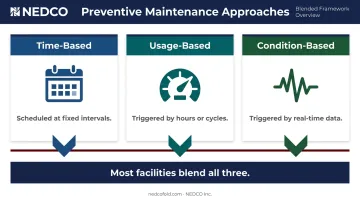
Time-Based (Calendar-Driven) Maintenance
Time-based PM schedules service at regular calendar intervals — weekly, monthly, quarterly, or annually — regardless of actual equipment usage. This approach works well for equipment with predictable wear cycles or clear manufacturer-recommended service schedules. It's simple to plan around and easy to document.
Usage-Based Maintenance
Usage-based PM ties service intervals to measurable outputs: operating hours, production cycles, or units processed. Rather than servicing a machine on March 1st regardless of what it's done since the last visit, you service it after 500 operating hours or 200,000 cycles. This approach suits high-throughput environments where calendar-based intervals would either over-service low-use periods or under-serve peak production runs.
Condition-Based Maintenance
Condition-based maintenance (CBM) triggers service only when equipment shows measurable signs of degradation, using real-time monitoring data such as:
- Vibration sensor readings
- Temperature thresholds
- Motor load metrics
According to Plant Engineering's 2018 industrial maintenance survey, 51% of respondents reported using predictive/condition-based maintenance with analytics. CBM reduces unnecessary service visits but requires more monitoring infrastructure upfront.
Most production facilities blend all three approaches. Time-based schedules provide the foundation, while usage-based and condition-based triggers fill in the gaps — a structure most preventative maintenance agreements are built to accommodate.
What Should a Preventative Maintenance Agreement Include?
A PMA is only as useful as what's written into it. Vague language creates gaps, and gaps become disputes when something breaks.
Equipment List and Task Checklist
Every machine covered should be itemized by make, model, serial number, and installation date. The contract must also define exactly which tasks are performed at each visit. "General inspection" is not sufficient. Spell out each task by name:
- Lubrication points and intervals
- Belt tension and wear checks
- Fastener torque verification
- Calibration steps
- Cleaning of mechanical components
Service Visit Frequency and Timing
Specify the number of annual visits and, where possible, when they occur. Scheduling a visit before your peak production season is worth more than one scheduled during it. If your apparel finishing line runs hardest in Q4, your pre-fall service window matters.
Parts and Labor Terms
This section requires the most attention. Clarify:
- Whether replacement parts (belts, bearings, filters, wear components) are included in the flat contract price or billed separately
- Labor rates for work performed outside scheduled visits
- Whether OEM-genuine parts are used or aftermarket substitutes
Parts sourcing is where manufacturer relationships make a measurable difference. NEDCO Inc., for example, supplies genuine OEM replacement parts for its E-Z Fold finishing and packaging equipment — components built to the original spec, not aftermarket approximations. Don Cranshaw (Don@nedcofold.com / 770-484-9969) handles parts ordering and service requests for NEDCO equipment nationwide.
Documentation and Emergency Response Terms
Require written service reports after each visit: findings, actions taken, parts replaced, and flagged concerns. Over time, these reports build an equipment health record that helps predict failures before they happen and gives both parties a clear reference if disputes arise.
Emergency response terms deserve equal attention. Define:
- Committed response time for failures between scheduled visits
- Whether emergency calls are covered under the contract or billed separately
- Any geographic limitations on on-site response
Key Benefits of a Preventative Maintenance Agreement for Production Equipment
Reduced Unplanned Downtime
A 2021 NIST manufacturing study found that manufacturers relying more on preventive and predictive maintenance experienced 52.7% less unplanned downtime and 78.5% fewer defects than those leaning heavily on reactive approaches. Scheduled inspections catch worn components before they fail — keeping production lines running through peak periods rather than grinding to a halt during them.
Extended Equipment Lifespan
The U.S. Department of Energy states directly that failing to perform maintenance activities intended by the equipment's designer shortens operating life. Consistent lubrication, cleaning, and proactive part replacement reduce cumulative mechanical stress over time. NEDCO's Annual Service Plans are specifically designed to extend the operational lifespan of E-Z Fold equipment, with lifespan extension as a defined goal of every service agreement.
Lower Total Maintenance Costs
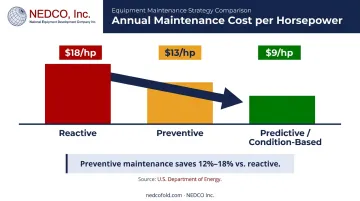
The DOE's comparison of maintenance approaches shows the annual cost difference clearly:
| Maintenance Approach | Annual Cost (per hp) |
|---|---|
| Reactive | $18 |
| Preventive | $13 |
| Predictive/Condition-Based | $9 |
The DOE estimates preventive maintenance saves an average of 12%–18% over reactive maintenance. Emergency labor rates, expedited shipping on parts, and collateral damage from cascading failures all push reactive costs higher. A PM agreement eliminates most of these exposure points before they occur.
Predictable Budget Planning
A PMA converts irregular, surprise repair costs into a fixed line-item expense. Production managers and finance teams can forecast equipment maintenance costs reliably rather than absorbing unpredictable emergency invoices. For facilities managing tight margins, that predictability matters.
Safety and Compliance
Well-maintained equipment is less likely to experience sudden mechanical failures that expose operators to hazards. OSHA 29 CFR 1910.147 (lockout/tagout) and 29 CFR 1910.212 (machine guarding) establish obligations around safe equipment condition — and OSHA estimates that proper hazardous-energy control prevents 120 fatalities and 50,000 injuries annually. Regular servicing keeps equipment operating within design parameters and supports the conditions those standards require.
AMC vs. CMC: Which Type of PM Agreement Is Right for You?
These two contract structures represent the most common formats for industrial maintenance agreements, and choosing between them comes down to equipment age, usage intensity, and your budget priorities.
Annual Maintenance Contract (AMC)
An AMC covers labor and scheduled service tasks only. Parts and components are an additional cost, billed as needed. This structure suits newer equipment in good condition where part replacement is infrequent — you're paying primarily for consistent inspections and technician expertise, not parts inventory.
Comprehensive Maintenance Contract (CMC)
A CMC bundles labor, scheduled visits, and parts/component replacements into one flat-rate agreement. You pay more upfront, but you also avoid unexpected parts costs throughout the year. This structure suits older or high-usage equipment where some part replacement is expected and budget certainty outweighs the savings of a lower base rate.
Use this as a quick guide when comparing your options:
- If equipment is newer with minimal part wear, an AMC keeps costs low while maintaining consistent inspection schedules
- If equipment is aging or runs at high intensity, a CMC delivers the budget predictability that a lower base rate can't offset
Keep in mind: AMC and CMC are widely used terms, but coverage scope varies significantly between vendors. Always review the specific task lists and exclusions before signing — what's included matters far more than what the contract is called.
How to Set Up a Preventative Maintenance Agreement for Your Equipment
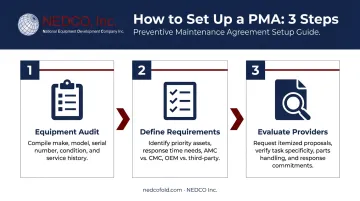
Step 1 — Conduct an Equipment Audit
Before contacting any service provider, compile a complete inventory of all equipment to be covered: make, model, serial number, installation date, current condition, usage hours, and any existing service history. This baseline determines what level of coverage is appropriate and gives providers what they need to quote accurately.
Step 2 — Define Your Service Requirements
Identify which machines carry the highest downtime risk — those are your highest-priority assets. Then determine:
- Acceptable emergency response time if equipment fails between visits
- Whether you want parts bundled (CMC) or billed separately (AMC)
- Whether you need OEM-level support or if third-party service is acceptable for your equipment
Step 3 — Evaluate Providers and Request Itemized Proposals
Get written proposals from at least two or three service providers. When comparing them, go beyond price:
- Task specificity: "General inspection" means nothing — look for itemized task checklists
- Parts handling: Confirm whether parts are bundled or billed separately
- OEM vs. third-party: Verify whether the provider is authorized to service your specific equipment
- Response time commitments: Get emergency response windows in writing
Working directly with the equipment's original manufacturer is almost always the better choice. For E-Z Fold folding and packaging equipment, NEDCO Inc.'s service team handles service requests and parts ordering nationwide. Contact Don Cranshaw at Don@nedcofold.com or 770-484-9969 to set up an annual service plan — he'll walk you through coverage options based on your machines and production volume.
Frequently Asked Questions
What is a preventative maintenance agreement?
A preventative maintenance agreement is a service contract that schedules routine inspections, cleaning, lubrication, and proactive repairs at defined intervals. The goal is to catch problems before they become failures, keeping equipment running and avoiding costly emergency repairs.
Which is better, an AMC or a CMC preventative maintenance agreement?
It depends on equipment age and usage intensity. AMCs work well for newer machines where part replacement is infrequent and labor-only coverage suffices. CMCs are better suited for older or heavily used equipment where bundling parts and labor into one rate provides more budget certainty.
What are the main types of preventative maintenance?
The three main types are time-based (scheduled at calendar intervals), usage-based (triggered by operating hours or production cycles), and condition-based (triggered by real-time performance data). Most production facilities use a combination of all three.
Are preventative maintenance agreements worth the money?
Yes, consistently. The DOE estimates 12%–18% average cost savings versus reactive maintenance, and NIST research found 52.7% less unplanned downtime among manufacturers using preventive strategies.
How do I get started with a service plan for E-Z Fold equipment?
Contact Don Cranshaw at NEDCO Inc. directly — Don@nedcofold.com or 770-484-9969. NEDCO offers Annual Service Plans for its full equipment lineup, including E-Z Fold folding machines, pillow compression machines, labeling systems, bagger/sealer systems, and conveyor systems.