Introduction
Machine guarding violations ranked as OSHA's 10th most frequently cited standard in FY2025, while lockout/tagout failures came in 4th — two citations that almost always appear together on conveyor-related inspection reports. When those violations escalate to willful or repeated status, penalties can reach $165,514 per violation, with an additional $16,550 per day for failure to abate.
Dollar figures only tell part of the story. A 2019 OSHA inspection of U.S. Cotton LLC documented what happens when interlocks are defeated: a maintenance worker used a magnet to bypass a guard interlock, worked on an unisolated machine, and lost a finger. That single incident — preventable, documented, and cited — is the clearest argument for why interlock systems demand serious attention.
This guide covers what conveyor belt interlock systems are, how each type works, and the safety practices that protect workers and equipment. For garment and textile finishing facilities — where fiber debris, repetitive motion, and multi-stage conveyor sequences create compounding hazards — understanding these systems is the foundation of a defensible safety program.
Key Takeaways
- Conveyor belt interlock systems prevent operation any time a required safety condition — open guard, offline downstream conveyor, or unsafe load — isn't met.
- Safety interlocks protect personnel; process interlocks protect equipment and production flow. Most industrial conveyors rely on both.
- Bypassing interlocks, even temporarily, is the leading cause of conveyor-related injuries and OSHA citations.
- Dust, moisture, and vibration degrade switch reliability over time — environmental match to IP ratings matters.
- Interlock checks belong in daily operations, not just periodic compliance audits.
Safety Guidelines for Conveyor Belt Interlock Systems
What an Interlock System Actually Does
A conveyor belt interlock system is a safety or control mechanism that prevents a conveyor from starting — or continuing to run — when required conditions aren't met.
OSHA's textile standard (29 CFR 1910.262) defines an interlock precisely: a device that prevents machine operation while a cover or door is open or unlocked, and holds that cover closed and locked while the machine is in motion.
ISO 14119:2024 expands this to cover mechanical, electrical, and other interlocking devices associated with guards and the prevention of hazardous machine functions. Both definitions point to the same outcome — the machine cannot expose a worker to hazardous motion if the interlock is functioning correctly.
One important terminology note: interlocking belts (also called modular belts) refer to a belt construction method where plastic modules link together. That's a belt design feature — entirely separate from the safety interlock function discussed here.
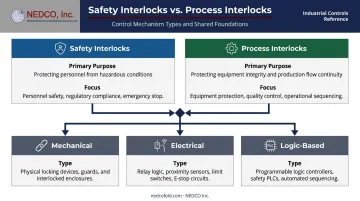
Two Categories of Interlocks
Most industrial conveyor systems use a combination of two interlock types:
- Safety interlocks — designed to protect personnel. These trigger a machine stop when a guard is opened, an operator enters a restricted zone, or an unsafe condition is detected.
- Process (non-safety) interlocks — designed to protect equipment and process flow. Examples include preventing an upstream conveyor from running when a downstream conveyor isn't active.
Within these categories, control mechanisms range from mechanical (physical device connections), to electrical (relay- or sensor-based switching), to logic-based (PLC-driven software conditions). Most modern conveyor systems combine all three.
Setting Realistic Expectations
Safe interlock operation isn't a one-time setup task. It requires scheduled audits, trained personnel, and a workplace culture where bypassing an interlock — for any reason — is treated as a serious safety failure rather than a productivity shortcut.
General Safety Precautions
PPE Requirements
OSHA 1910.132 requires a documented hazard assessment before determining appropriate PPE. For work near conveyor interlock systems, that assessment typically identifies:
- Wear close-fitting clothing — loose garments, drawstrings, and dangling items create entanglement risk near moving belts
- Wear safety footwear to protect against pinch points and falling components during inspection or changeover
- Wear eye protection when inspecting electrical components or cleaning switch housings
- Use gloves for most tasks, but avoid them during fine-adjustment work near pinch points where they could catch
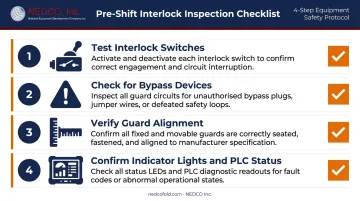
Pre-Shift Inspection Checklist
Before every production shift, a designated person should verify:
- All interlock switches respond correctly when guards are opened and closed
- No bypass devices — jumper wires, taped switches, magnetic actuators — have been left from prior maintenance
- Guard mounting hardware is secure and aligned so switches actuate as intended
- Interlock indicator lights or PLC status signals show expected states at startup
In textile and garment finishing environments, like facilities running NEDCO's automatic conveyor and packaging lines, fiber debris accumulates quickly on switch contacts and actuator mechanisms. Pre-shift checks catch small deviations before they become failures.
Authorized Personnel Only
Only trained and authorized personnel should interact with interlock systems. Operators need to understand what an interlock does and why defeating it creates risk for themselves and every co-worker downstream. Refresher training is required whenever equipment is modified, personnel change, or an incident — including near-misses — occurs.
Safety During Installation and Operation
Installation: Start with LOTO
29 CFR 1910.147 governs the control of hazardous energy. Before any interlock switch is mounted, wired, or adjusted, the conveyor must be fully de-energized using proper lockout/tagout procedures. This isn't optional — and OSHA is explicit that interlock switches themselves are not energy-isolating devices. A machine stopped by an interlock signal can still be energized. LOTO is the only compliant method for safe installation.
Actuator Alignment Risks
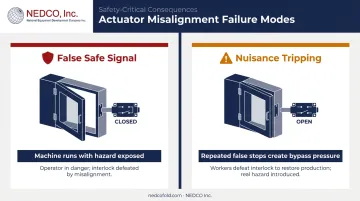
Interlock switch actuators must be precisely aligned to the guard's motion path. Misalignment creates two failure modes, both dangerous:
- False "safe" signal — the switch reads as closed even when the guard is open; the machine runs with a hazard exposed
- Nuisance tripping — the switch reads as open during normal operation; repeated false stops frustrate operators and create pressure to bypass
When guard mounting points are damaged, when wiring runs cross high-voltage lines without shielding, or when the switch housing isn't rated for the installation environment, installation should stop until those conditions are corrected.
Operating Limits Operators Must Respect
Interlocks signal a stop condition — they don't confirm a safe state. An operator must never re-enter a guarded area based solely on an interlock signal. The conveyor must reach a complete, verified stop before any access.
These warning signs require immediate investigation, not a reset-and-continue response:
- Repeated nuisance trips with no apparent cause
- Delayed response when a guard is opened
- Indicator lights that don't match the expected interlock state
- PLC error codes related to safety relay inputs
The Bypass Problem
The U.S. Cotton 2019 case cited in OSHA's records is the clearest field example of what bypass behavior produces: a magnet used to defeat a guard interlock, no energy isolation, and an amputation. That sequence (defeat the interlock, skip LOTO, proceed) is documented in OSHA's accident investigation database precisely because it keeps happening.
Bypassing an interlock "just for a few minutes" to speed a belt change or clear a jam is the most commonly cited contributor to conveyor-related incidents. One injury event carries costs that dwarf the seconds saved: investigation time, lost production, regulatory penalties, workers' compensation, and potential litigation.
Cascading Conveyor Sequences
Safe operation extends beyond individual guards. In multi-stage conveyor systems, startup sequence is just as critical. Upstream conveyors should not run unless downstream conveyors are already operating. Violating this sequence causes material jams and belt damage — and workers clearing those jams under live equipment face the same entanglement hazards the interlocks exist to prevent. The startup sequence logic should be documented, tested, and enforced through the control system rather than left to operator judgment.
Environmental and System Safety Considerations
Dust and Debris Accumulation
Textile and garment finishing environments generate fiber debris that accumulates on switch contacts and actuator mechanisms. Enough buildup can prevent a switch from tripping — meaning the guard opens and the machine keeps running. This failure mode is especially dangerous because the interlock appears functional until it isn't.
Cleaning frequency should be based on actual production conditions. For high-fiber environments, that typically means:
- Inspect and clean switch contacts weekly at minimum
- Document every cleaning in the same maintenance log as guard inspections
- Treat a missed cleaning as a missed safety check — not a skipped housekeeping task
Moisture, Vibration, and Corrosion
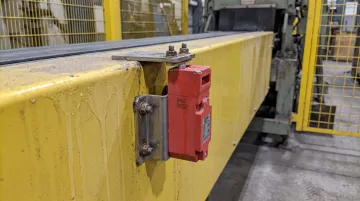
Fiber debris isn't the only environmental threat. Omron's safety switch guidance warns that continuous vibration or shock can cause contact failure and reduced service life through abrasive wear. Moisture corrodes switch contacts; temperature cycling weakens spring mechanisms; vibration loosens mounting hardware over time.
IP ratings under IEC 60529 indicate a switch's resistance to these conditions:
| Rating | Protection Level |
|---|---|
| IP67 | Dust-tight; protected against temporary immersion |
| IP69 / IP69K | Dust-tight; protected against high-pressure, high-temperature washdown |
If installed switches aren't rated for the actual operating environment — a standard switch in a washdown area, for example — the safety system can fail silently. Match the switch rating to the environment before installation, not after a failure.
Common Safety Mistakes to Avoid
1. Bypassing Interlocks for "Quick Fixes"
Even temporary bypasses during maintenance, belt changes, or troubleshooting require formal LOTO procedures — not a jumper wire or a piece of tape over a switch. There is no version of "just for a few minutes" that is compliant or safe. Facilities that normalize temporary bypasses create the exact conditions that produce recordable injuries and OSHA willful citations.
2. Skipping Functional Tests After Maintenance
Any time a guard, cover, or interlock switch is disturbed during maintenance or cleaning, the interlock function must be tested before the machine returns to service. Assuming the interlock still works without verification is a shortcut that has caused serious injuries. Test it. Document it.
3. Ignoring Early Warning Signs
Intermittent failures are more dangerous than complete failures. A switch that occasionally fails to trip creates false confidence — operators assume the interlock is working because it usually does. An interlock that restarts faster than expected after a guard opens, or that occasionally misses a trip, is a failing interlock. Treat it accordingly.
4. Treating the Interlock as the Only Safeguard
Interlocks are one layer of a layered safety system. Relying on them as the sole protection — without enforcing LOTO during maintenance, maintaining physical guards in good condition, and providing adequate operator training — creates gaps that a single component failure can expose.
OSHA's machine guarding standard (29 CFR 1910.212) is a performance-based requirement. Compliance means demonstrating that the complete guarding system protects workers — not just that one component is present.
Conclusion
Conveyor belt interlock safety comes down to three things working together: properly selected and installed hardware, an operating environment that doesn't degrade that hardware faster than it's maintained, and operator discipline that never treats bypassing a safety device as acceptable under any circumstance. None of these substitutes for the others.
Facilities that treat interlock checks as a daily operational routine — not a box checked during an annual compliance audit — are the ones that avoid the incidents, penalties, and production disruptions that follow a guarding failure.
NEDCO Inc. builds its finishing and packaging conveyor systems with operator safety built into the design — not added as an afterthought. If you have equipment-specific safety questions or need support with your conveyor system, reach out to Don Cranshaw, NEDCO's service contact, at Don@nedcofold.com or (770) 484-9969.
Frequently Asked Questions
What is a conveyor interlock?
A conveyor interlock is a safety or control mechanism that prevents a conveyor from operating unless specific required conditions are met — such as all guards being closed, downstream equipment running, or a safe load state being confirmed. When those conditions aren't met, the interlock either prevents startup or triggers a stop.
What are the three types of interlocks?
The industry generally groups control interlocks into three types: mechanical (physical device-to-device control), electrical (relay- or sensor-based switching), and logic-based (PLC-driven software conditions). Safety interlocks, designed specifically to protect personnel, may use any of these mechanisms.
What are interlocking belts?
Interlocking belts, or modular belts, refer to a conveyor belt construction method where plastic modules link together to form the belt surface. This is a belt design feature — not a safety interlock system — though the similar terminology sometimes causes confusion.
How do safety interlock switches work on conveyor systems?
Safety interlock switches use an actuator key mounted on a removable guard or cover. When the guard is in place, the key engages the switch and allows the machine circuit to run. When the guard is removed, the key withdraws, the circuit breaks, and the machine stops.
Do OSHA regulations require conveyor belt interlocks?
OSHA's general machine guarding standard (29 CFR 1910.212) requires protection from hazardous moving parts but doesn't mandate interlocks for every conveyor guard. The textile-specific standard (29 CFR 1910.262) does explicitly require them for specified equipment. ASME B20.1-2024 is the current consensus design standard — confirm which applies with your safety officer.
How often should conveyor belt interlocks be inspected?
OSHA requires power-transmission equipment to be inspected at intervals no longer than 60 days under 1910.219. In high-use environments, best practice is a functional test before each shift and a documented inspection after any maintenance that disturbs guards, covers, or switch mounts.