](https://file-host.link/website/nedcofold-3pu5an/assets/blog-images/271a9c86-d8dc-4fea-9091-8f9cbd61a3c2/1784140155527746_4518717b3b524a928fdd889fb13c1f3c/360.webp)
Choosing the wrong film means reprints, compliance failures, and labels that look unprofessional on finished garments. Choosing the right one — matched to your printing method, laundering conditions, and compliance requirements — is one of the most consequential materials decisions a converter or apparel manufacturer makes.
This guide covers the top global manufacturers of garment label films, what distinguishes each one, and the criteria buyers should use to evaluate them before committing to a supplier.
Key Takeaways
- Garment label films include pressure-sensitive vinyl, heat-transfer films (PU/TPU), PET, and BOPP — each suited to different applications and printing methods.
- Top manufacturers specialize by film type; no single supplier is best across all categories.
- Prioritize wash durability, print compatibility, and safety certifications over brand recognition alone.
- Always request standardized test data and pilot samples before scaling with any supplier.
- Sustainable options are growing, with recycled-content BOPP and PVC-free TPU films now widely available from major suppliers.
What Are Garment Label Films?
Garment label films are the engineered substrate materials — not the finished label — that converters and apparel brands use to produce care labels, size labels, brand labels, and hang tags. They're distinct from woven fabric labels, which are manufactured on looms using yarn. Film-based labels are printed, adhesive-applied, or heat-transferred, giving them different durability profiles, texture characteristics, and printing requirements.
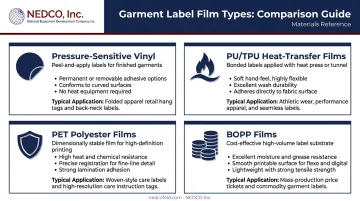
The Four Main Film Categories
| Material | Key Characteristics | Typical Applications |
|---|---|---|
| Pressure-sensitive vinyl | Self-adhesive, repositionable or permanent | Washable name labels, stick-on brand labels |
| PU/TPU heat-transfer films | Soft hand, stretch-compatible | Activewear, performance fabrics, athletic branding |
| PET (polyester) films | Dimensional stability, heat resistance | Care labels, heat-transfer label facestocks |
| BOPP films | Cost-effective, wide format | High-volume pressure-sensitive label facestocks |
The broader label market illustrates the scale of this market: Grand View Research reports global pressure-sensitive labels revenue reached $21.95 billion in 2024, forecast to grow to $29.36 billion by 2030 — reflecting the substantial commercial ecosystem that supports label film supply.
Top Global Manufacturers of Garment Label Films
These manufacturers were selected based on film performance, wash durability credentials, safety compliance, print compatibility, global reach, and apparel industry track record. Each leads in a specific film type category — use those strengths to match the right supplier to your application.
Great K2 Industry Co., Ltd.
Founded in 2009 and headquartered in Shanghai, China, Great K2 is a specialized manufacturer and exporter of self-adhesive pressure-sensitive clothing label films — vinyl facestocks engineered for washable, no-iron garment name labels and brand identification, serving 50+ countries.
Their flagship TK01 is an eco-solvent, UV, and latex-printable self-adhesive vinyl designed for clothing labels that require no ironing or sewing. That single-application focus is a genuine advantage: Great K2's entire R&D, coating, and slitting capability is built around making washable clothing label films work reliably across diverse print processes.
Great K2 reports 40+ quality control items per production run and claims 30+ machine-wash cycle durability for TK01. These figures are manufacturer-reported; no public AATCC or ISO test report was located to independently verify them. Buyers should request batch-level test documentation directly.
| Attribute | Details |
|---|---|
| Film Types | Self-adhesive vinyl label films; printable PS facestocks (eco-solvent, UV, latex); no-iron name-label materials in rolls, sheets, and pre-cuts |
| Certifications / Compliance | REACH, RoHS, CPC (children's products), California Prop 65 — reported by manufacturer |
| Best Suited For | Apparel brands, converters, schools, and healthcare providers needing washable, child-safe, self-adhesive clothing label films |
The CPC and Prop 65 compliance positioning makes Great K2 particularly relevant for children's wear programs, school uniform labeling, and healthcare garment identification — sectors where chemical safety documentation is non-negotiable.
Avery Dennison
Headquartered in Mentor, Ohio, Avery Dennison is a global materials science company offering an enterprise-grade portfolio of apparel labeling solutions — including heat-transfer films under the Embelex™ brand, pressure-sensitive label facestocks, woven and printed label materials, and RFID-integrated label products.
For large apparel brands managing multi-country sourcing programs, Avery Dennison's primary advantage is consolidation. Brands can source heat-transfer embellishment, care label facestocks, and compliance documentation through a single partner — with technical support teams present in the same regions where their suppliers operate.
Avery's apparel solutions reference GRS (Global Recycled Standard) and OEKO-TEX Standard 100 certifications for certain care-label offerings. These apply to specific product grades, not the entire portfolio — buyers should confirm which grades carry which certifications for their program.
| Attribute | Details |
|---|---|
| Film Types | Embelex™ heat-transfer embellishment films, PS label facestocks, woven/printed label materials, RFID-integrated label films |
| Certifications / Compliance | GRS and OEKO-TEX Standard 100 for select grades; regional certifications vary by product line |
| Best Suited For | Large global apparel brands and enterprises needing a unified, scalable label film and branding materials supplier across multiple sourcing regions |
Taghleef Industries (Ti)
Headquartered in Dubai, UAE, Taghleef Industries is a global specialist in biaxially oriented polypropylene (BOPP) films. Their 2024 Sustainability Report identifies 11 manufacturing plants across six continents — a production footprint that enables consistent supply for high-volume converters regardless of geography.
Ti's label film portfolio covers pressure-sensitive, wrap-around roll-fed, cut-and-stack, shrink-sleeve, and in-mold applications. No apparel-specific BOPP garment label application was found in their official literature — Ti is best understood as a converter-facing facestock supplier rather than a direct garment labeling specialist. Converters working at high volume who need cost-competitive BOPP facestock with documented sustainability credentials are the natural fit.
Their reLIFE™ recycled polypropylene range includes certified post-consumer recycled (PCR) grades and ISCC PLUS mass-balance options — though specific recycled content percentages vary by grade and are not stated as a single portfolio-wide figure.
| Attribute | Details |
|---|---|
| Film Types | BOPP label facestocks for pressure-sensitive, roll-fed, shrink, and in-mold label applications; specialty and sustainable film grades |
| Certifications / Compliance | ISCC PLUS mass-balance certification for reLIFE™ PCR grades; sustainability documented in annual report |
| Best Suited For | Converters and brands seeking cost-effective, high-volume BOPP label facestocks with sustainable mono-polyolefin options |
Stahls'
Based in St. Clair Shores, Michigan, Stahls' is a well-established name in heat-transfer vinyl (HTV) and specialty heat-applied film materials — including PU/TPU films engineered specifically for performance fabrics like nylon, polyester, Lycra/Spandex, and mesh used in activewear and technical garments.
Their CAD-CUT® series is the most relevant product line for apparel manufacturers. Key grades include:
- Premium Plus — targets cotton, polyester blends, and performance fabrics
- Thermo-GRIP — designed specifically for nylon mesh and Dazzle fabrics
Stahls' comparison data lists washability of 50 cycles for multiple CAD-CUT products. This is a manufacturer specification without a named AATCC or ISO method attached — request the underlying test protocol before committing to a program.
Stahls' safety certificate library is publicly accessible, though product and validity scope varies by grade.
| Attribute | Details |
|---|---|
| Film Types | Heat-transfer vinyl (HTV), PU/TPU heat-applied films for performance and technical apparel |
| Certifications / Compliance | Safety certificate library available; scope varies by product grade — verify per SKU |
| Best Suited For | Sportswear, activewear, outerwear, and swimwear brands needing durable, waterproof branding on technical performance fabrics |
Mylar Specialty Films
Mylar Specialty Films — formerly DuPont Teijin Films, rebranded in February 2024 under the same Celanese-Teijin joint venture ownership — is a global supplier of PET (polyester) films marketed under the Mylar and Melinex brands.
PET's thermal stability and dimensional control are what distinguish it from BOPP in demanding label applications. Where BOPP can deform under heat-press processes, properly specified PET maintains dimensional consistency — a critical property for heat-transfer label production and durable care label facestocks. Top-coated variants improve ink adhesion for print-critical programs.
Mylar Specialty Films' official label portfolio documents performance in UL 969 durability testing. However, no official garment-care-label or apparel-specific heat-transfer label application was found in their public literature — their positioning is as a facestock and overlamination supplier to converters, not directly to apparel brands.
| Attribute | Details |
|---|---|
| Film Types | PET (polyester) films and top-coated Melinex/Mylar PET facestocks for durable labels, heat-transfer labels, and overlamination |
| Certifications / Compliance | UL 969 durability testing reported; request current product-specific compliance documentation directly |
| Best Suited For | Converters requiring PET film properties — thermal stability, dimensional control, and superior print performance — for heat-transfer or durable care labels |
How to Choose the Right Garment Label Film Manufacturer
Not all garment label film suppliers are interchangeable, and price should not be the primary selection criterion. Here's the evaluation framework that matters.
What to Assess
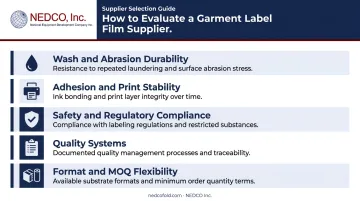
- Wash and abrasion durability — Request the actual test method (AATCC or ISO wash standard), not just the cycle count. A cycle count without an attached protocol is unverifiable.
- Adhesion and print stability — AATCC 135 measures fabric dimensional change — not label adhesion. Require a separate adhesion and appearance acceptance protocol alongside any wash conditioning method.
- Safety and regulatory compliance — Understand the actual scope of each framework:
- REACH: EU chemical registration requirements for substances in articles placed on the EU market
- RoHS: Covers electrical/electronic equipment — not a universal garment-film standard
- CPC/CPSIA: Applies to specific US children's products; not a general material approval
- California Prop 65: An exposure warning regime, not a product certification
- Quality systems — Confirm whether QC data is batch-level or per-product-grade, and whether it's internally or third-party verified.
- Format and MOQ flexibility — Commodity BOPP and PET suppliers typically require large roll quantities suited to converters. Specialized suppliers may offer rolls, sheets, and pre-cuts with lower minimum order quantities — useful if you're qualifying a material before committing at volume.
Before You Commit at Scale
- Request current Safety Data Sheets (SDS) for every material under consideration.
- Obtain standardized wash and peel test reports — specify which AATCC or ISO method applies to your laundering conditions.
- Run pilot samples on your actual printer and actual garment substrate before approving a supplier.
The most common mistake buyers make: approving a supplier based on a spec sheet alone, then discovering adhesion failures or print incompatibility during production runs.
Frequently Asked Questions
Is it legal to put your own label on clothing?
Yes — adding your own brand label to garments you manufacture or source for resale is generally legal. However, US regulations under 16 CFR Part 423 require permanent care instructions, while the FTC's Textile and Wool Acts mandate fiber content, country of origin, and manufacturer identity. Replacing required labels doesn't remove these obligations; all disclosures must remain accurate and present.
What is the difference between garment label films and woven labels?
Garment label films are engineered substrates — vinyl, PET, BOPP, or heat-transfer films — used to produce printed, adhesive, or heat-applied labels. Woven labels are fabric-based, made by weaving yarn on looms. The two differ in texture, durability, and cost — film labels offer more print flexibility, while woven labels deliver a premium tactile finish.
What film material is best for heat-transfer garment labels?
PET films and PU/TPU films are the two primary choices. PET offers superior dimensional stability and heat resistance, making it preferred for care labels produced via heat-transfer processes. PU/TPU films deliver a soft hand and stretch compatibility, making them the go-to for branding applications on activewear, swimwear, and other performance fabrics.
How do I verify a garment label film supplier's safety compliance?
Request current third-party test reports for REACH (EU chemical safety), CPC/CPSIA (US children's products), and California Prop 65 where applicable. Ask for Safety Data Sheets and batch-level QC documentation. Verify that each standard applies to your product category — RoHS, for example, covers electrical equipment, not apparel films.
Are sustainable or eco-friendly garment label film options available?
Yes. Taghleef Industries offers recycled-PP films under its reLIFE™ range (ISCC PLUS certified), and Avery Dennison has documented a 30% post-industrial recycled PP facestock. PU/TPU films provide a PVC-free heat-transfer option — though confirm PVC-free status for a specific named grade. Ask suppliers for recycled content percentage, recyclability, and eco-certifications per SKU.