Many operations teams still treat preventive maintenance as a compliance checkbox, something to log and forget. But its real value shows up in daily throughput: fewer surprise stoppages, fewer missed ship dates, and a production floor that behaves the way you planned it to.
This article breaks down seven measurable benefits a consistent preventive maintenance program delivers, backed by data and grounded in how folding, bagging, and sealing equipment actually runs day to day.
Key Takeaways
- Preventive maintenance protects uptime, costs, safety, and order fulfillment—not only equipment longevity
- Well-maintained folding and packaging equipment keeps finishing lines at full capacity during peak periods
- Gains compound over time: less firefighting, lower long-term costs, and more predictable output
- Skipping preventive maintenance raises the risk of breakdowns, safety incidents, and missed shipment deadlines
What Is Preventive Maintenance (Brief Context)
Preventive maintenance is scheduled inspection, cleaning, lubrication, and part replacement performed on a set interval, before equipment fails rather than after.
In textile and apparel operations, this applies directly to the machines that prepare garments for shipment:
- Automatic folding machines
- Baggers and sealers
- Labeling systems
- Conveyor lines
- Pillow compression equipment
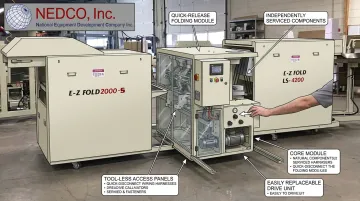
Modular equipment is built with this in mind. E-Z Fold's automatic folding systems, for instance, use a modular core design so individual components can be serviced or swapped without tearing down the entire machine. That matters because preventive maintenance exists to deliver an outcome: dependable lines that hit order deadlines, shift after shift.
7 Key Benefits of Preventive Maintenance for Operations
The benefits below focus on measurable operational impact, not abstract advantages. Each one ties to KPIs operations managers already track: downtime hours, cost per unit, order fulfillment rate, and safety incidents.
Benefit 1: Reduced Unplanned Downtime
Scheduled inspections catch worn belts, failing motors, or misaligned folding mechanisms before they seize up mid-run. A five-minute part swap on a Tuesday morning beats a four-hour emergency repair during a rush shipment.
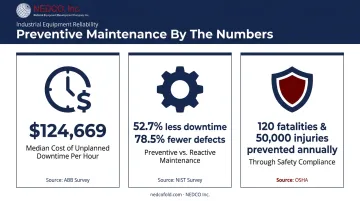
ABB's 2023 survey of 3,215 plant-maintenance leaders found a median unplanned downtime cost of $124,669 per hour across industrial businesses. Even a fraction of that exposure changes the math on skipping an inspection.
KPIs impacted:
- Uptime percentage
- Downtime hours per month
- Missed shipment deadlines
High-volume runs, tight shipping windows, and fixed bulk deadlines feel this first. One breakdown can ripple straight into a missed truck departure.
Benefit 2: Extended Equipment Lifespan
Routine lubrication, calibration, and part checks slow the wear on folding arms, drive motors, and packaging mechanisms. Skipping these steps doesn't just risk breakdowns; it shortens the working life of equipment you've already paid for.
Properly executed preventive maintenance keeps equipment closer to its intended design life; skipping it accelerates wear well before that point. A folder that might run reliably for a decade can need major overhauls within a few years without those cycles.
KPIs impacted:
- Asset lifespan
- Frequency of capital expenditure
- Resale or trade-in value
Multi-shift plants and older machines near end-of-life gain the most. Each maintenance cycle either buys more useful runtime or speeds up replacement.
Benefit 3: Improved Productivity & Throughput
Well-maintained machines process garments faster with fewer jams, which means more finished units per shift without adding headcount. A folder that stutters every twenty minutes doesn't just lose those minutes; it breaks the operator's rhythm and slows the whole line.
NIST's 2021 manufacturer survey found that manufacturers relying more heavily on preventive and predictive maintenance saw 52.7% less unplanned downtime and 78.5% fewer defects than those leaning on reactive repairs.
KPIs impacted:
- Units processed per hour
- Order fulfillment rate
- Labor cost per unit
Peak season, high order volume, and contract work with strict turnarounds put the premium on throughput. Capacity there maps directly to revenue.
Benefit 4: Lower Operating Costs
Scheduled repairs and planned part replacement almost always cost less than emergency fixes, rush parts shipping, or overtime labor triggered by a surprise breakdown. Reactive maintenance carries hidden costs: expedited freight, idle labor, and rushed technician callouts that inflate the final bill.
KPIs impacted:
- Maintenance cost per machine
- Total cost of ownership
- Budget variance against annual maintenance plans
Tight margins and fixed annual maintenance budgets leave little room for surprises. One unplanned repair can wipe out months of allocated spend in a single incident.
Benefit 5: Enhanced Workplace Safety & Reduced Operator Fatigue
Preventive maintenance keeps moving parts, guards, and controls functioning as designed, lowering injury risk. It also has a quieter benefit: smoother-running machines mean less manual troubleshooting and less repetitive strain on operators who'd otherwise be fighting the equipment all shift.
OSHA estimates that compliance with lockout/tagout procedures (a core part of maintaining hazardous machinery safely) prevents 120 fatalities and 50,000 injuries annually. Separately, BLS data shows machinery involved in 58% of work-related amputation cases, with a median 31 days away from work.
KPIs impacted:
- Safety incident rate
- Compliance standing
- Operator turnover
Multi-shift lines and any floor where operators work close to moving equipment see the clearest safety and fatigue payoff.
Benefit 6: Consistent Product Quality & Customer Satisfaction
Calibrated, well-maintained folding and packaging equipment produces uniform folds, seals, and packaging on every run. Inconsistent equipment, by contrast, produces the kind of damaged goods and packaging errors that reach the customer, and once that happens, trust with a retail buyer gets harder to rebuild.
Consistent output isn't just an internal metric. Retail and wholesale partners with strict packaging specifications will flag defects fast, and repeat orders often hinge on whether the last shipment arrived clean and correctly sealed.
KPIs impacted:
- Defect and rework rate
- Customer complaints
- On-time delivery accuracy
Brands shipping to retail partners with tight quality or packaging specs have the least margin for error. A single bad batch can put the account at risk.
Benefit 7: Competitive Advantage & Scalability
Reliable equipment gives operations the confidence to take on larger or rush orders without fearing a breakdown-driven delay. That operational headroom is often what separates a manufacturer that can bid on growth opportunities from one stuck protecting its current capacity.
KPIs impacted:
- Order capacity
- Customer retention
- Bid win rate
Growing shops and contract manufacturers that win on turnaround speed feel downtime as lost bids, not only repair invoices. Reliable uptime is what lets them scale without protecting every hour of current capacity.
What Happens When Preventive Maintenance Is Missing or Ignored
Skipping preventive maintenance doesn't create an immediate crisis. It shifts operations into a reactive cycle where consequences build quietly, then all at once.
- Unpredictable fold and seal quality from run to run
- Higher defect rates that reach customers instead of getting caught internally
- Production schedules disrupted by unplanned repairs
- Repair and replacement costs that climb as neglected wear compounds
- Harder scaling and delegation when equipment reliability is already uncertain
Each of these feeds the next. A missed inspection becomes a jammed sealer, which becomes a missed shipment, which becomes a lost account.
How to Get the Most Value from Preventive Maintenance
Preventive maintenance pays off most when it's consistent, not sporadic. A once-a-year inspection squeezed in during a slow week won't deliver the same results as a maintenance rhythm tied to actual usage.
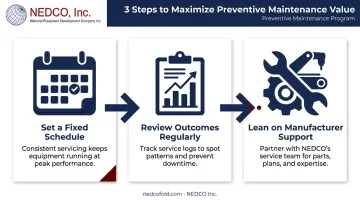
- Set a fixed schedule based on manufacturer guidance and machine-run hours, not convenience.
- Review outcomes regularly — downtime logs and part replacement history show where your schedule needs adjusting.
- Lean on manufacturer support for genuine replacement parts and direct access to a service team that keeps downtime short.
NEDCO's service contact, Don Cranshaw, handles service requests and parts ordering for E-Z Fold equipment nationwide. Many components ship as ready-to-install assemblies, and wear items like Teflon sealing sheets can be ordered by the roll, so routine upkeep doesn't turn into a multi-day parts wait.
Conclusion
Preventive maintenance comes down to keeping daily operations predictable and under control. The seven benefits above reinforce each other: less downtime lowers costs, safer conditions protect your team, and steadier equipment output protects quality.
Treat preventive maintenance as an ongoing operational practice, not a one-time task. For any facility relying on finishing and packaging equipment to hit shipment deadlines, that consistency is what keeps the whole operation dependable.
Frequently Asked Questions
What are the benefits of planned preventive maintenance?
Planned preventive maintenance reduces unplanned downtime, extends equipment life, lowers operating costs, improves workplace safety, and produces more consistent output. These benefits compound over time as reactive firefighting decreases.
How often should preventive maintenance be performed on textile finishing equipment?
Frequency depends on usage hours, production volume, and manufacturer guidelines. Rather than a fixed calendar rule, follow the equipment-specific schedule provided by your machine's manufacturer.
What's the difference between preventive and reactive maintenance?
Preventive maintenance is scheduled, proactive upkeep performed on a set interval before failure occurs. Reactive maintenance happens only after a breakdown, typically costing more and causing unplanned downtime.
Can preventive maintenance really reduce operator fatigue?
Yes. Smoother-running, well-calibrated equipment requires less manual troubleshooting and adjustment, which cuts down on the repetitive strain and stress that build up when operators are constantly fighting balky machines.
How do I get started with a preventive maintenance schedule for my equipment?
Start by identifying your most critical machines, then follow manufacturer-recommended intervals for inspection and part replacement. Log every service visit so you can refine the schedule based on actual equipment performance.
Does preventive maintenance require specialized technicians?
Basic tasks like cleaning and visual inspection can often be handled in-house. More complex repairs, calibration, or parts sourcing typically benefit from manufacturer service teams like NEDCO's.