This scenario plays out across textile and apparel facilities more often than most operators admit. Unplanned downtime isn't just an inconvenience — it's a direct hit to revenue, and the numbers back that up. A 2023 ABB survey of 3,215 plant-maintenance decision-makers reported a median unplanned-downtime cost of $125,000 per hour across industrial businesses.
Spare parts are the quiet backbone of any maintenance strategy, especially for the folding, bagging, and packaging equipment that keeps garment finishing lines moving. This article breaks down what spare parts actually are, where they show up on the plant floor, the challenges that trip up inventory managers, and the practices that keep breakdowns from becoming full-blown production emergencies.
Key Takeaways
- Unplanned downtime costs a median of $125,000 per hour, making spare parts planning a financial priority.
- Spare parts fall into three categories: capital, consumables, and inspection/operational spares, each with its own stocking strategy.
- Non-OEM substitutes carry documented failure risk; one pump failed within hours of installation.
- Predictive maintenance programs typically cut downtime by 30% to 50%, according to McKinsey research.
- A single trusted OEM parts relationship simplifies sourcing and reduces quality-control headaches.
What Are Industrial Spare Parts?
An industrial spare part is any interchangeable component kept in inventory specifically to repair or maintain machinery. It's the physical link between a breakdown and a return to production. In logistics and supply chain terms, spares exist to shrink the gap between "machine down" and "machine running."
Three Types of Spare Parts
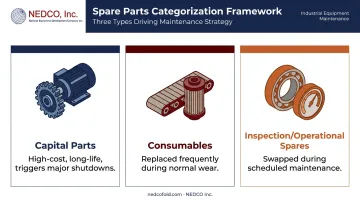
Not every spare carries the same weight. Reliability engineering typically sorts them into three buckets:
- Capital parts: High-cost, long-life components that trigger major shutdowns if unavailable. Think drive motors and gearboxes on a folding machine.
- Consumables: Items replaced frequently as part of normal wear, such as folding belts, filters, and lubricants.
- Inspection/operational spares: Bearings, seals, and gauges swapped during scheduled maintenance rather than after failure.
OEM, Aftermarket, or Used: The Commercial Divide
Beyond function, parts also split by where they come from:
- OEM parts: Manufactured by the original equipment maker and engineered to exact original tolerances.
- Aftermarket parts: Third-party alternatives that are often cheaper or faster to source, though fit and quality can vary.
- Used or refurbished parts: Reclaimed components — generally the least predictable option for critical equipment.
There's also a practical distinction between repairable parts (worth fixing economically, like a resealed gearbox) and consumable parts, which simply get scrapped and replaced once worn. For equipment like automatic folding machines, sticking with genuine OEM parts protects fit, performance, and warranty coverage in ways generic substitutes rarely match.
The Role of Spare Parts in Textile & Apparel Equipment Operations
A dependable spare parts supply is what keeps finishing and packaging lines running without gaps, and that directly protects order fulfillment timelines. Miss a shipping deadline because a $40 sensor wasn't in stock, and the math stops making sense fast.
The financial stakes are real. That $125,000-per-hour median downtime figure from ABB isn't textile-specific, but it illustrates just how quickly small parts gaps translate into large losses across industrial sectors.
Safety and Equipment Longevity
Worn or improvised parts don't just slow production; they create hazards on the line. Common issues include:
- Stretched belts that snap unexpectedly during operation
- Jury-rigged guards that no longer meet OSHA machine-guarding standards
- Delayed replacements that force operators to work around exposed moving parts
Proper replacement procedures address these risks directly, mattering as much as repair speed.
Consistent parts access also extends the usable life of capital equipment. Folding and packaging machines represent a significant upfront investment; keeping them serviced with correct parts protects that investment's long-term return.
This is where equipment design matters. NEDCO's modular equipment philosophy, built into the E-Z Fold line and its related packaging systems, makes individual components easier to identify, access, and swap. For E-Z Fold customers, that translates into shorter repair windows and less guesswork during a breakdown.
Applications of Spare Parts Across Industrial Equipment
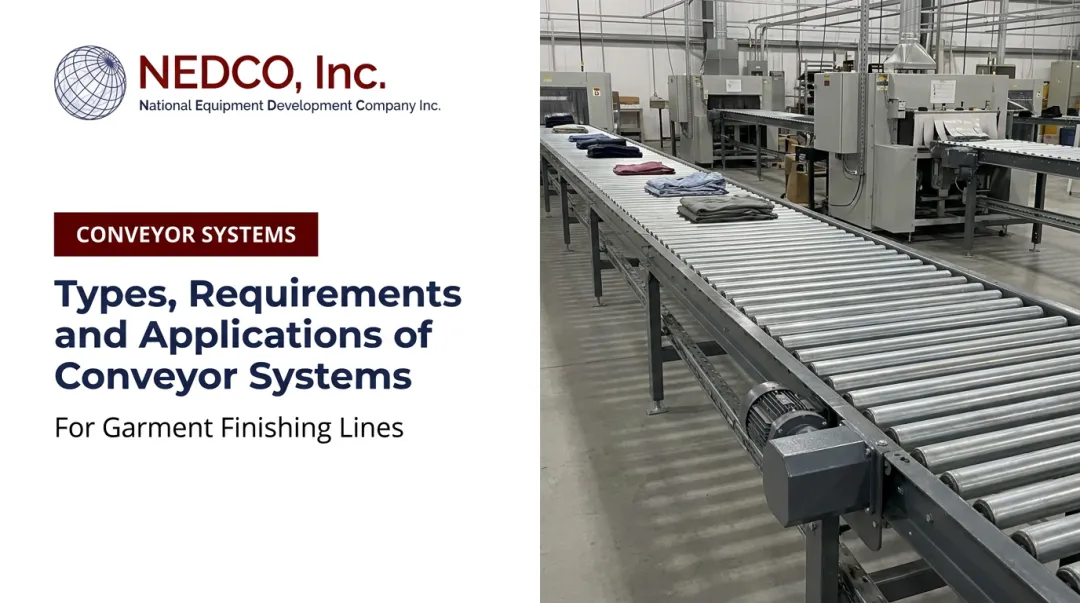
Spare parts are highly application-specific. A folding machine's belts and rollers have almost nothing in common with a conveyor's drag chains or a fan's bearings, even when all three sit in the same facility.
Operating environment also shapes wear rates:
- Heat and humidity accelerate belt and seal degradation.
- Dust and lint buildup common in textile facilities wear down bearings faster.
- High cycle speeds on folding or labeling lines shorten component lifespans compared to lower-throughput equipment.
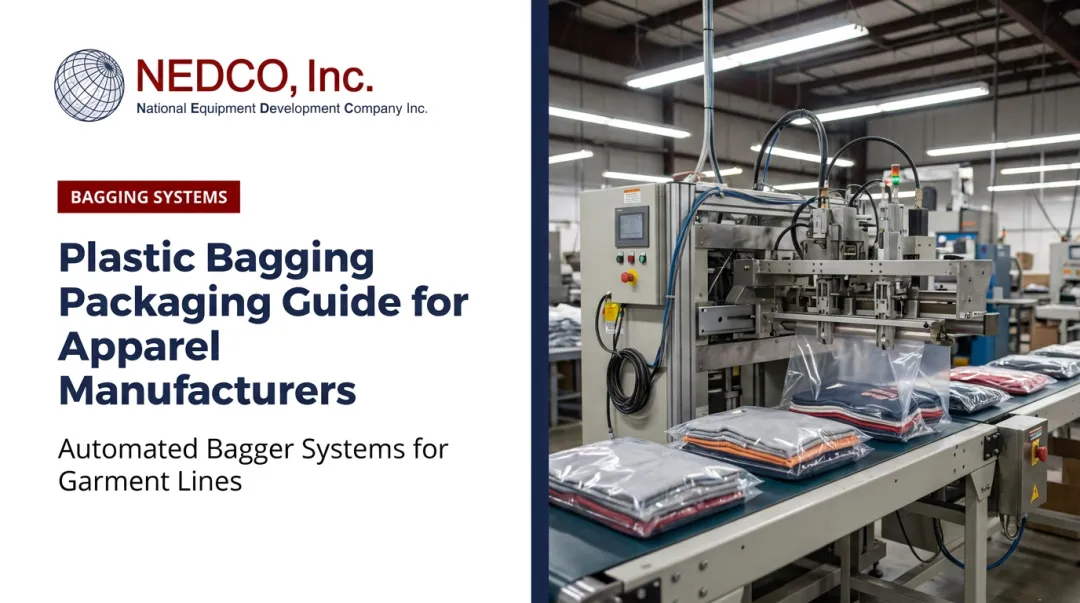
Wear patterns aren't the only factor — deciding what to stock matters just as much. Not every part deserves shelf space. Some components, like folding belts or heat seal elements on a bagger/sealer, are critical enough to keep on hand, since a failure here halts the entire line.
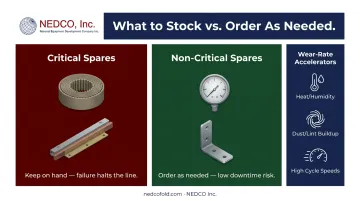
Others, like less-frequently-used gauges or brackets, can reasonably be ordered as needed without risking major downtime. NEDCO's parts team can help identify which items need to stay in stock for your specific equipment.
Common Challenges in Spare Parts Inventory Management
Spare parts management comes with real tradeoffs, and most facilities run into the same three friction points.
The storage-versus-capital tension. Keep too many parts on hand and you tie up warehouse space and working capital in inventory that may sit unused for months. Keep too few and you're gambling on lead times during a breakdown.
The cheap-parts trap. Sourcing lower-cost aftermarket or overseas parts can look attractive on a purchase order, but the risk shows up later. In one documented case, a facility installed lower-priced, non-OEM pump parts against its own maintenance team's recommendation.
The pump failed within hours, and inspection found an undersized bore and misaligned studs. The inferior parts also added roughly $7,600 per year in extra energy cost from reduced efficiency.
The multi-supplier headache. Juggling several vendors for different components across folding, bagging, and conveyor equipment multiplies the chances of mismatched quality, inconsistent lead times, and finger-pointing when something fails. A single trusted OEM relationship removes most of that complexity — one point of contact, a single parts catalog, and consistent quality standards across every order.
Best Practices for Effective Spare Parts Management
Good spare parts management comes down to three things: knowing what to stock, when to act, and who to call.
- Adopt predictive maintenance. Rather than waiting for failure, condition monitoring flags wear before it becomes a shutdown. According to McKinsey research, predictive maintenance reduces machine downtime by 30% to 50% and extends machine life by 20% to 40%.
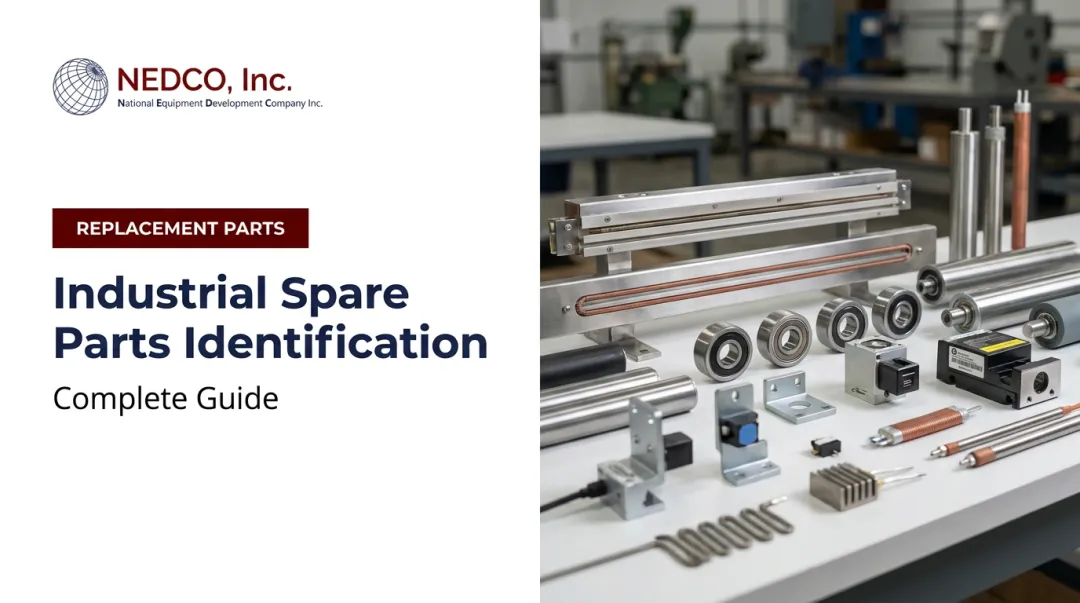
- Identify your critical spares. Map out which components, such as drive motors, heat seal bars, key sensors, or pneumatic valves, would stop the whole line if they failed, and make sure those never run out.
- Use digital tracking tools. Automated reordering systems and inventory software signal low stock before it becomes a shortage, instead of relying on someone noticing an empty bin.
- Build a direct OEM relationship. Having one person who knows your equipment inside and out beats sorting through catalogs. NEDCO customers work directly with Don Cranshaw, who handles service requests and parts ordering nationwide, giving them a single point of contact instead of a supplier hunt.
- Schedule regular inspections. Catching wear patterns early lets you plan a replacement on your timeline, not the machine's.
Why NEDCO Is a Trusted Partner for Genuine Spare Parts
As the original manufacturer of the E-Z Fold T-Shirt Folder and its related finishing and packaging equipment, NEDCO supplies genuine replacement parts engineered for a precise fit and long-term reliability. These parts avoid the fit issues and premature wear common with generic substitutes.
That support means direct access to the person who handles it. Don Cranshaw manages service and parts requests for customers nationwide, giving textile and apparel facilities fast attention whenever a machine needs a fix.
NEDCO has backed this approach for 37 years as a family-owned, made-in-the-USA manufacturer. That track record spans founder Jack Dodson Jr.'s original E-Z Fold design through second-generation leadership under Jason Dodson today. It's why operators return to NEDCO for both new equipment and the parts that keep it running.
Frequently Asked Questions
What are industrial spare parts?
Industrial spare parts are replacement components kept in inventory to repair or maintain machinery. They exist to prevent unplanned production downtime when equipment wears out or fails.
What are the three types of spares?
Spares generally fall into capital parts (motors, gearboxes), consumables (belts, filters, lubricants), and inspection/operational spares (bearings, seals, gauges). Each requires a different stocking approach based on cost and failure impact.
What are mechanical critical spares?
Mechanical critical spares are components essential to a machine's core operation — parts whose failure would cause significant downtime. These are the priority items to always have in stock, not order on demand.
What's the difference between OEM and aftermarket spare parts?
OEM parts come from the original manufacturer and are built to exact original specifications, ensuring proper fit and performance. Aftermarket parts are third-party alternatives that may cost less but vary in quality and reliability.
How often should industrial spare parts be replaced?
Replacement frequency depends on the part type, usage intensity, and manufacturer guidance. Consumables need frequent swaps, while capital parts last years with proper inspection schedules catching wear early.
How can better spare parts management reduce equipment downtime?
Predictive maintenance, accurate inventory tracking, and a dependable OEM parts relationship all shrink the gap between failure and fix. NEDCO Inc.'s replacement parts and annual service plans, for instance, turn reactive scrambling into planned, low-disruption maintenance.