Manual bottlenecks are the real problem here. When products sit waiting for someone to carry them to the next station, order fulfillment slows and labor costs climb. That's why understanding where this market and its technology are heading matters right now, not next year.
This article breaks down current market size and growth projections through 2026, the trends actually reshaping packaging conveyors, what's fueling them, and what operators should expect next.
Key Takeaways
- Packaging automation will grow from $86.64B in 2026 to $122.51B by 2031, a 7.17% CAGR
- IoT-enabled sensors and predictive maintenance are shifting from optional upgrades to standard specifications
- Modular, reconfigurable conveyor systems now let manufacturers change layouts in hours, not days
- Energy-efficient drives and regenerative motors now top the purchase criteria for new lines
- Early adopters of modular automation are outpacing competitors still running rigid, manual lines
Packaging Conveyors Market Size & Growth Snapshot
Market research firms don't agree on exact conveyor market size, mostly because they define product and application boundaries differently.
| Research Firm | Near-Term Estimate | Long-Term Projection | CAGR |
|---|---|---|---|
| Grand View Research | $9.7B (2025) → $10.2B (2026) | $15.9B by 2033 | — |
| MarketsandMarkets | $10.27B (2026) | $14.64B by 2033 | 5.2% |
| Fact.MR | $5.1B (2026) | $7.5B by 2036 | — |
These figures shouldn't be blended together. Each reflects a different scope.
Packaging and warehouse distribution stands out as one of the fastest-growing end-use segments, with a reported 6.4% CAGR — outpacing many other conveyor applications.
In North America, the U.S. conveyor systems market is estimated at $1.55 billion in 2025, growing to roughly $2.2 billion by 2035 at a 3.54% CAGR. The U.S. represents the dominant share of regional revenue.
Belt vs. Roller: Where the Demand Sits
Product-type breakdowns consistently favor belt systems for packaging applications:
- Belt conveyors hold roughly 34.9% of the global product segment in 2026 and led warehouse conveying with 24.2% of 2023 revenue
- Belt systems handle light unit goods, polybags, parcels, and irregular loads well, which explains their dominance in apparel and packaging lines
- Roller conveyors remain the go-to for moving carton boxes and heavier, uniform loads through distribution centers
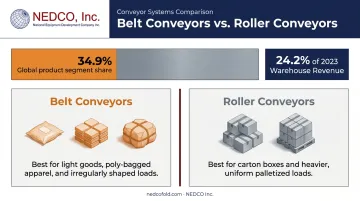
For textile and apparel finishing lines, this split matters in practice: production runs mixing folded garments, polybags, and cartons often need belt and roller sections working together on the same production line, not one or the other.
The Bigger Automation Picture
Conveyors don't grow in isolation. They're hardware inside a much larger automation wave. Packaging automation is projected to reach $86.64 billion in 2026 and $122.51 billion by 2031, a 7.17% CAGR according to Mordor Intelligence. U.S. packaging-machinery shipments also climbed 5.8% to $10.9 billion in 2023, signaling adjacent demand for finishing and conveying equipment.
Textile, apparel, and bulk-goods packagers are a meaningful piece of this growth. As production volumes increase and SKU counts multiply, these operations need conveying and finishing equipment that keeps pace without constant redesign.
Top Trends Shaping the Packaging Conveyors Market by 2026
Five forces are reshaping how packaging conveyors get built, sold, and used. Each one addresses a specific operational pain point.
Smart, IoT-Enabled Conveyors and Predictive Maintenance
Sensors and edge analytics now track motor temperature, belt tension, and bearing wear in real time. Instead of waiting for a breakdown, maintenance teams get alerts before a failure happens.
MHI documents current and voltage sensors feeding data straight into computerized maintenance-management systems for predictive analysis. One vendor-reported case from Dorner describes an automotive-parts manufacturer that cut unplanned conveyor stops from eight per month to fewer than two after adding sensor-based monitoring.
Unplanned downtime is expensive, full stop. Predictive systems pay for themselves fast, whether you're running a single line or a dozen.
E-Commerce-Driven Demand for High-Speed Sortation and Secondary Packaging
U.S. e-commerce sales hit $326.7 billion in Q1 2026, up 9.8% year over year, representing 16.9% of total retail sales. That growth is pushing fulfillment centers toward compact, high-throughput conveyors that keep pace with same-day and next-day promises.
Parcel sortation specifically is forecast to grow at 5.97% annually through 2031, reaching $4.19 billion. Some deployed systems process anywhere from 12,500 to over 20,000 items per hour, though these rates are system-specific rather than universal benchmarks.
Rising online shopping volumes make fast, automated secondary packaging a competitive necessity, not a nice-to-have.
Modular and Flexible Conveyor Systems for Adaptable Packaging Lines
Bolt-together, field-reconfigurable conveyor modules are replacing welded, fixed-position lines. Operators can now change a layout without shutting down for days.
One contract packager, Oak State Products, switched to flexible-chain conveyors and cut reconfiguration time from days down to one or two hours. That's the kind of change that lets a facility pivot between SKUs or seasonal demand without a full equipment overhaul.
This same shift shows up in E-Z Fold's own CV-100 and CV-500 Automatic Conveyor Systems. The CV-500 uses modular sections built for custom line layouts, and it syncs speed automatically with connected folding, labeling, and bagging equipment. A smaller operation can start with the compact CV-100 and scale up as volume grows, without replacing the entire line.
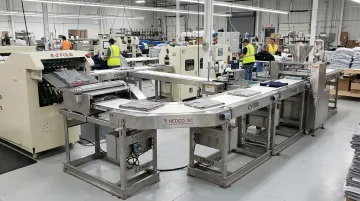
Manufacturers facing changing SKUs, seasonal demand, or new product lines need equipment that scales rather than gets replaced.
Sustainability and Energy-Efficient Drive Systems
Motors driving conveyors and other material-handling equipment account for about 54% of U.S. manufacturing electricity consumption, according to the Department of Energy. That's a big enough number to push regenerative drives and energy-efficiency guarantees into standard spec sheets.
Patagonia's Reno distribution center reported 20% greater system efficiency and power consumption up to 30% below traditional roller conveyors after switching to run-on-demand modular conveyors. Some utilities are backing the shift financially — PG&E's California rebate program, for instance, offered $75 per horsepower for motor variable-frequency drive retrofits in 2025.
That's why rising energy costs and regulatory pressure are pushing operators to weigh lifecycle efficiency, not just upfront price.
Robotics and AMR Integration with Fixed Conveyors
Autonomous mobile robots are increasingly paired with fixed conveyor lines rather than replacing them outright. Honeywell's UK facility combined three AMRs with conveyor-top modules, redeployed six employees to other tasks, and hit full ROI within two years.
Modern Materials Handling frames the division simply: fixed conveyors and sorters handle sustained, high-volume flow, while AMRs add flexible, localized transport where layouts change frequently.
Combining fixed-line speed with robotic flexibility helps operations absorb variable order volumes without over-building infrastructure.
What's Driving These Trends
Several forces are converging to accelerate change across the packaging conveyor space.
- Technology advances: AI, IoT, and Industry 4.0 platforms are spreading through material handling equipment.
- Automation impact: MHI and Deloitte found 39% of supply-chain leaders rated automation's impact as significant or greater in 2026, up 16 percentage points from prior years.
- Market demand: Rising e-commerce penetration keeps raising the bar for fast, error-free order fulfillment.
- Cost pressures: The median wage for U.S. hand laborers and material movers reached $37,680 in May 2024, according to the U.S. Bureau of Labor Statistics, pushing operators toward labor-saving automation.
- Regulatory influences: Safety codes like OSHA 1910.212 and design standards such as ASME B20.1-2024 are shaping new equipment specifications, alongside decarbonization incentives at the state level.
How These Trends Are Impacting the Packaging Industry
These shifts are producing real operational, business, and workforce changes across packaging operations, not just theoretical improvements.
Packaging teams feel the impact in three concrete ways:
- Operational: Faster changeovers and less downtime result from tighter conveyor-to-equipment integration, such as E-Z Fold's plug-and-play design, which eliminates manual handoffs between stations entirely.
- Business: Capital investment priorities are shifting toward modularity, service backing, and energy efficiency, since lifecycle cost increasingly outweighs upfront price.
- Workforce: Operators need reskilling for sensor dashboards and automated controls, while reduced manual handling improves workplace safety and cuts operator fatigue on the line.
Future Outlook & Conclusion
Several trends will define the next few years for packaging conveyors:
- Deeper AI and digital-twin integration into conveyor control systems
- Continued convergence between robotics and fixed conveyor infrastructure
- Steady market growth alongside expanding modular equipment adoption
- Consolidation among smaller suppliers unable to keep pace with these shifts
These shifts are turning packaging conveyors into far more than steel frames and belts moving boxes from point A to point B. Smarter, more flexible, and more energy-conscious systems are reshaping how packaging operations compete.
Businesses that adapt early — choosing modular, service-backed equipment over rigid legacy systems — position themselves ahead of competitors still running yesterday's infrastructure. NEDCO Inc., the manufacturer behind E-Z Fold equipment, has spent over three decades building made-in-USA finishing and packaging equipment for the textile and apparel industries. That experience is available to any manufacturer navigating this transition now.
Frequently Asked Questions
What are the trends in the conveyor industry?
Smart, IoT-enabled monitoring, e-commerce-driven sortation demand, modular reconfigurable systems, energy-efficient drives, and AMR-conveyor integration are the five dominant trends heading into 2026 and beyond.
Is the packaging industry growing?
Yes. Packaging automation is projected to grow from $86.64 billion in 2026 to $122.51 billion by 2031, a 7.17% CAGR, driven largely by e-commerce fulfillment demand and rising automation adoption.
How big is the packaging conveyors market expected to be by 2026?
Global conveyor system estimates for 2026 range from roughly $5.1 billion to $10.27 billion depending on the research firm's scope, with the packaging and warehouse distribution segment growing at an estimated 6.4% CAGR.
What type of conveyor is most in demand for packaging applications?
Belt conveyors lead the packaging segment, holding about 34.9% of the global product mix in 2026 due to their versatility with light goods and irregular loads. Roller conveyors still dominate heavier carton handling.
How can automation improve packaging conveyor efficiency?
IoT sensors and predictive maintenance catch mechanical issues before they cause breakdowns, cutting unplanned downtime in real-world deployments. This keeps lines running longer between service interventions.
What should businesses consider when choosing a packaging conveyor system?
Focus on modularity so the system adapts to future layout changes, and confirm its throughput matches your volume needs. Also verify the manufacturer offers ongoing service and parts support — scalability matters more than upfront cost alone.